Quick and Dirty Introduction to Mott Insulators Introduction



- Slides: 18
Quick and Dirty Introduction to Mott Insulators Introduction to Solid State Physics http: //www. physics. udel. edu/~bnikolic/teaching/phys 624. html 1
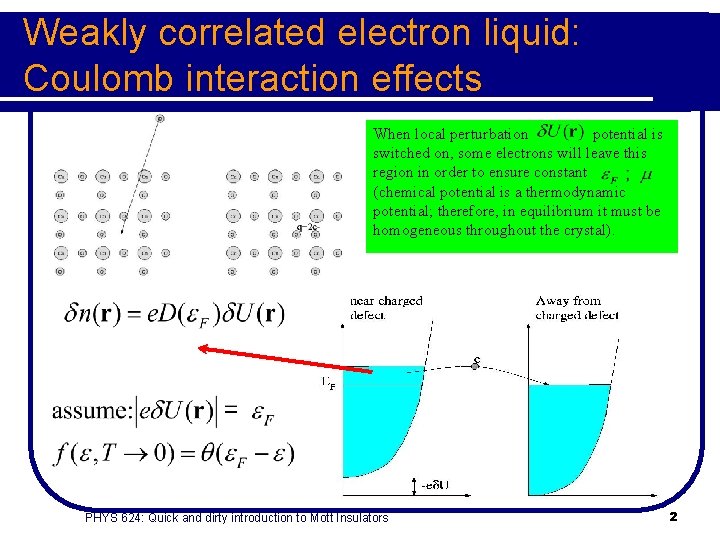
Weakly correlated electron liquid: Coulomb interaction effects When local perturbation potential is switched on, some electrons will leave this region in order to ensure constant (chemical potential is a thermodynamic potential; therefore, in equilibrium it must be homogeneous throughout the crystal). PHYS 624: Quick and dirty introduction to Mott Insulators 2
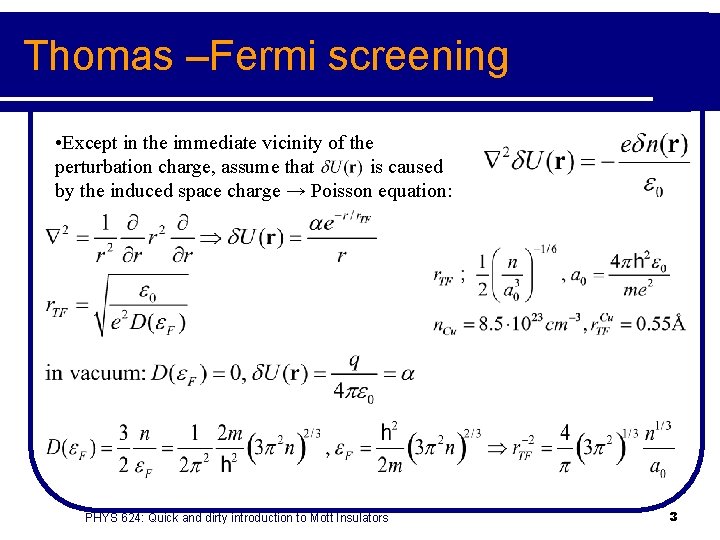
Thomas –Fermi screening • Except in the immediate vicinity of the perturbation charge, assume that is caused by the induced space charge → Poisson equation: PHYS 624: Quick and dirty introduction to Mott Insulators 3
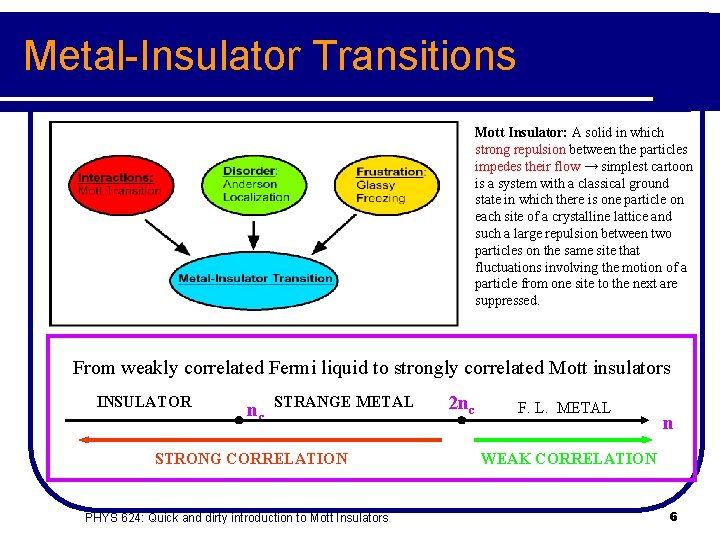
Mott Metal-Insulator transition • Below critical electron concentration, the potential well of the screened field extends far enough for a bound state to be formed → screening length increases so that free electrons become localized → Mott Insulators (e. g. , transition metal oxides, glasses, amorphous semiconductors)! PHYS 624: Quick and dirty introduction to Mott Insulators 4
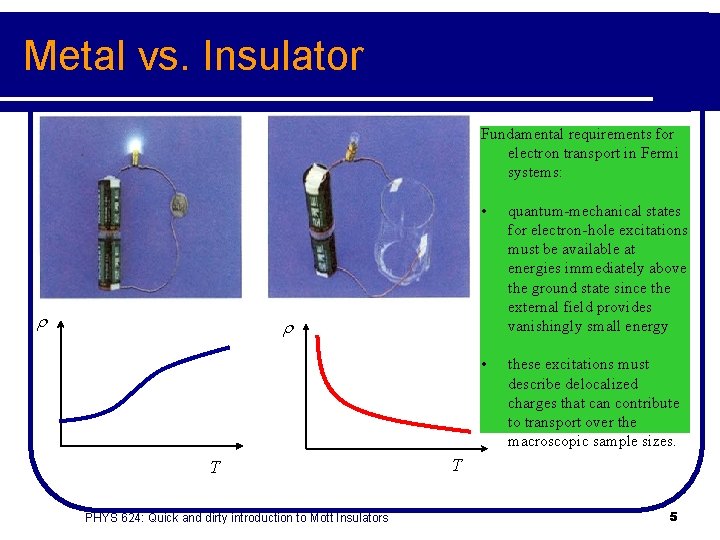
Metal vs. Insulator Fundamental requirements for electron transport in Fermi systems: • quantum-mechanical states for electron-hole excitations must be available at energies immediately above the ground state since the external field provides vanishingly small energy • these excitations must describe delocalized charges that can contribute to transport over the macroscopic sample sizes. T PHYS 624: Quick and dirty introduction to Mott Insulators T 5
Metal-Insulator Transitions Mott Insulator: A solid in which strong repulsion between the particles impedes their flow → simplest cartoon is a system with a classical ground state in which there is one particle on each site of a crystalline lattice and such a large repulsion between two particles on the same site that fluctuations involving the motion of a particle from one site to the next are suppressed. From weakly correlated Fermi liquid to strongly correlated Mott insulators INSULATOR nc STRANGE METAL STRONG CORRELATION PHYS 624: Quick and dirty introduction to Mott Insulators 2 nc F. L. METAL n WEAK CORRELATION 6
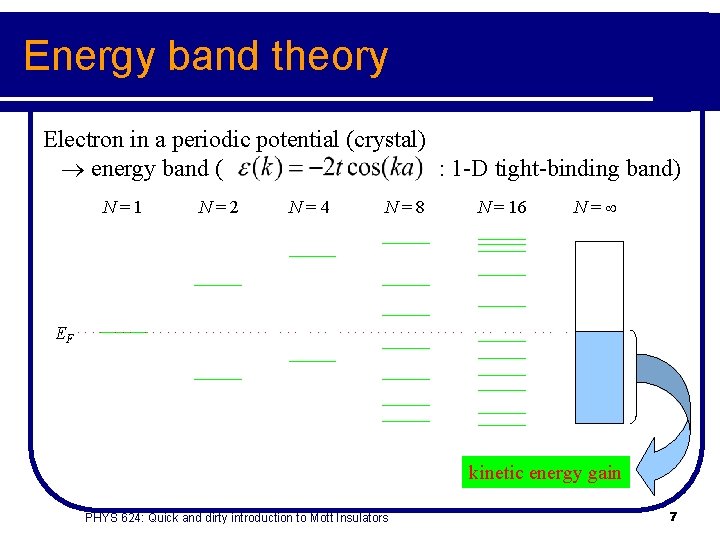
Energy band theory Electron in a periodic potential (crystal) energy band ( : 1 -D tight-binding band) N=1 N=2 N=4 N=8 N = 16 N= EF kinetic energy gain PHYS 624: Quick and dirty introduction to Mott Insulators 7
Band (Bloch-Wilson) insulator Wilson’s rule 1931: partially filled energy band metal otherwise insulator metal insulator semimetal Counter example: transition-metal oxides, halides, chalcogenides Fe: metal with 3 d 6(4 sp)2 Fe. O: insulator with 3 d 6 PHYS 624: Quick and dirty introduction to Mott Insulators 8
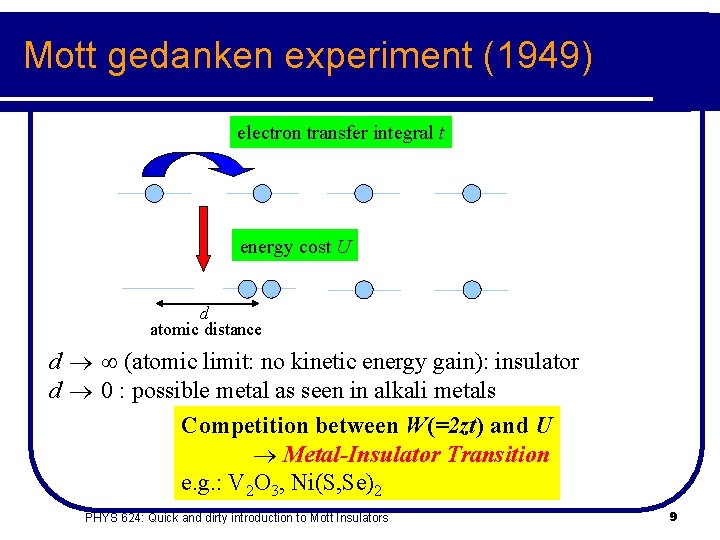
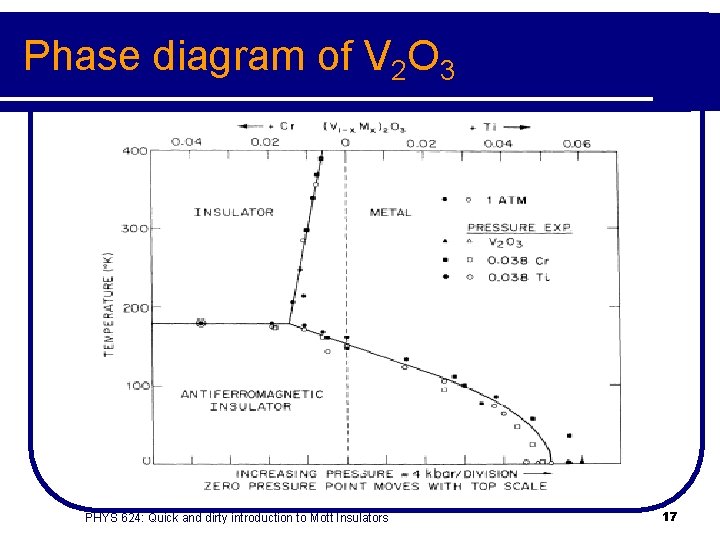
Mott gedanken experiment (1949) electron transfer integral t energy cost U d atomic distance d (atomic limit: no kinetic energy gain): insulator d 0 : possible metal as seen in alkali metals Competition between W(=2 zt) and U Metal-Insulator Transition e. g. : V 2 O 3, Ni(S, Se)2 PHYS 624: Quick and dirty introduction to Mott Insulators 9
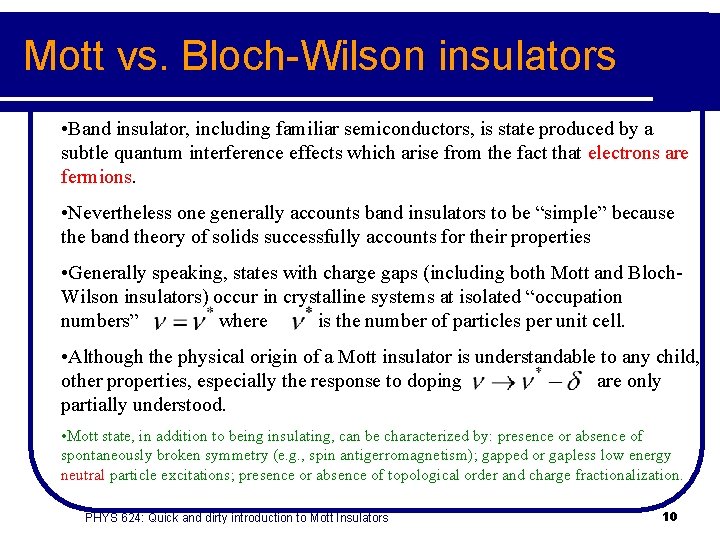
Mott vs. Bloch-Wilson insulators • Band insulator, including familiar semiconductors, is state produced by a subtle quantum interference effects which arise from the fact that electrons are fermions. • Nevertheless one generally accounts band insulators to be “simple” because the band theory of solids successfully accounts for their properties • Generally speaking, states with charge gaps (including both Mott and Bloch. Wilson insulators) occur in crystalline systems at isolated “occupation numbers” where is the number of particles per unit cell. • Although the physical origin of a Mott insulator is understandable to any child, other properties, especially the response to doping are only partially understood. • Mott state, in addition to being insulating, can be characterized by: presence or absence of spontaneously broken symmetry (e. g. , spin antigerromagnetism); gapped or gapless low energy neutral particle excitations; presence or absence of topological order and charge fractionalization. PHYS 624: Quick and dirty introduction to Mott Insulators 10
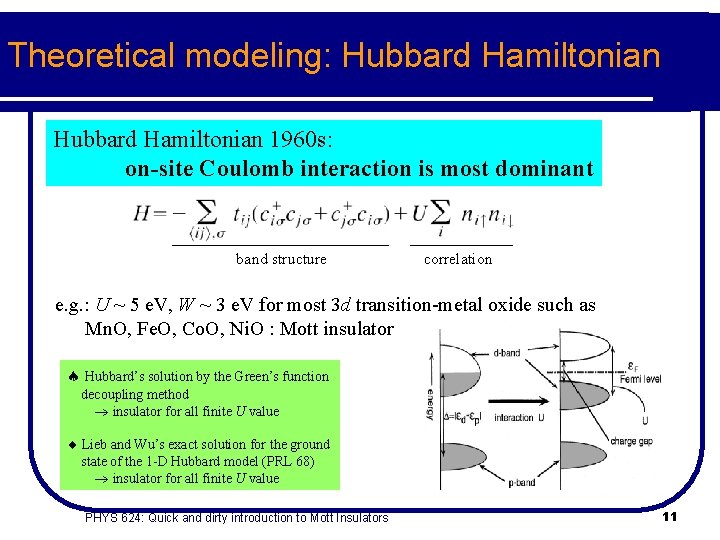
Theoretical modeling: Hubbard Hamiltonian 1960 s: on-site Coulomb interaction is most dominant band structure correlation e. g. : U ~ 5 e. V, W ~ 3 e. V for most 3 d transition-metal oxide such as Mn. O, Fe. O, Co. O, Ni. O : Mott insulator Hubbard’s solution by the Green’s function decoupling method insulator for all finite U value ¨ Lieb and Wu’s exact solution for the ground state of the 1 -D Hubbard model (PRL 68) insulator for all finite U value PHYS 624: Quick and dirty introduction to Mott Insulators 11
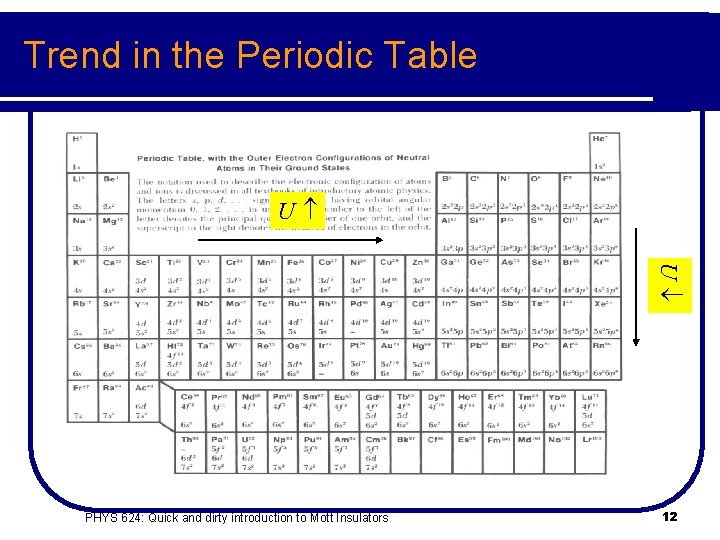
Trend in the Periodic Table U U PHYS 624: Quick and dirty introduction to Mott Insulators 12
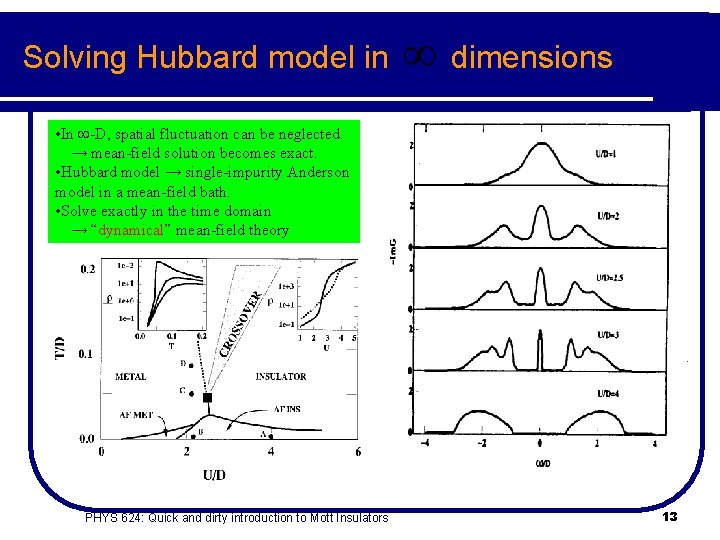
Solving Hubbard model in dimensions • In -D, spatial fluctuation can be neglected. → mean-field solution becomes exact. • Hubbard model → single-impurity Anderson model in a mean-field bath. • Solve exactly in the time domain → “dynamical” mean-field theory PHYS 624: Quick and dirty introduction to Mott Insulators 13
From non-Fermi liquid metal to Mott insulator NOTE: DOS defined even though there are no fermionic quasiparticles. Model: Mobile spin-up electrons interact with frozen spin-down electrons. PHYS 624: Quick and dirty introduction to Mott Insulators 14
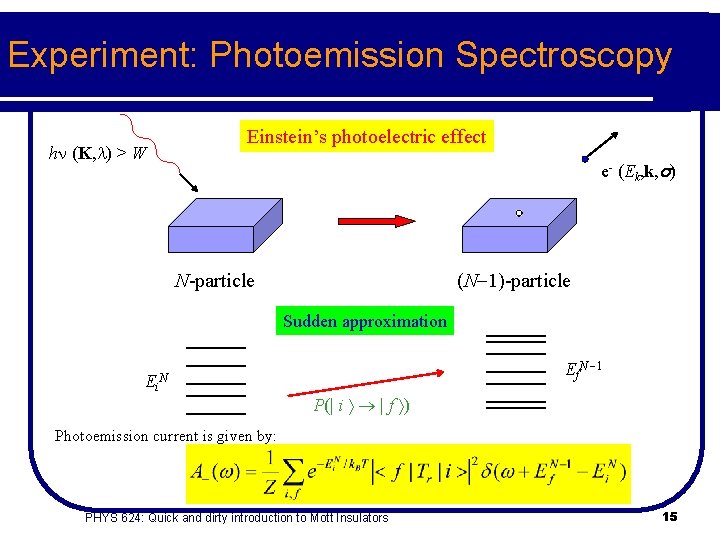
Experiment: Photoemission Spectroscopy h (K, ) > W Einstein’s photoelectric effect e- (Ek, k, ) N-particle (N 1)-particle Sudden approximation Ei. N Ef. N 1 P(| i | f ) Photoemission current is given by: PHYS 624: Quick and dirty introduction to Mott Insulators 15
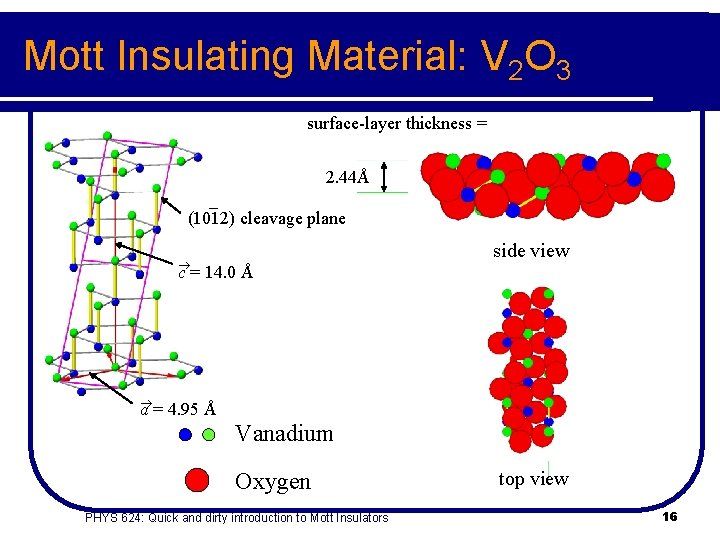
Mott Insulating Material: V 2 O 3 surface-layer thickness = 2. 44Å – (1012) cleavage plane side view c = 14. 0 Å a = 4. 95 Å Vanadium Oxygen PHYS 624: Quick and dirty introduction to Mott Insulators top view 16
Phase diagram of V 2 O 3 PHYS 624: Quick and dirty introduction to Mott Insulators 17
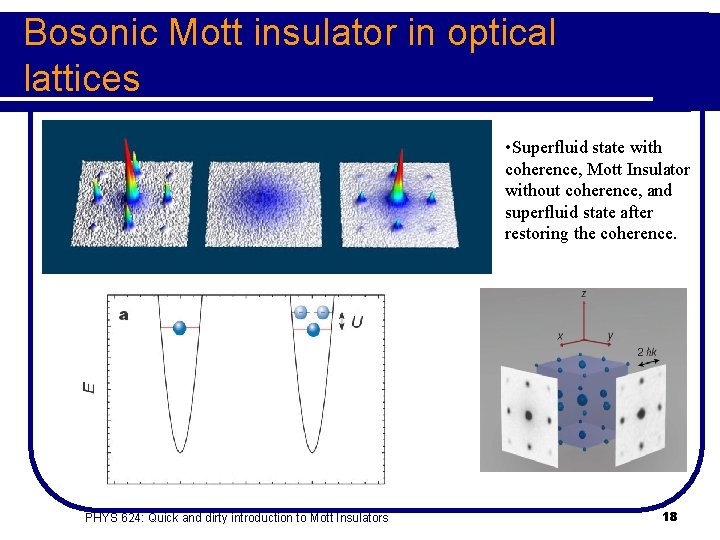
Bosonic Mott insulator in optical lattices • Superfluid state with coherence, Mott Insulator without coherence, and superfluid state after restoring the coherence. PHYS 624: Quick and dirty introduction to Mott Insulators 18