Qualitative Research Methods and Data Collection Research and



- Slides: 22
Qualitative Research Methods and Data Collection Research and Development in Medical Education: Educational Skills Workshop Arianne Teherani, Ph. D Bridget O’Brien, Ph. D
Creative Commons License Attribution-Non. Commercial-Share Alike 3. 0 Unported You are free: • to Share — to copy, distribute and transmit the work • to Remix — to adapt the work Under the following conditions: • Attribution. You must give the original authors credit (but not in any way that suggests that they endorse you or your use of the work). • Noncommercial. You may not use this work for commercial purposes. • Share Alike. If you alter, transform, or build upon this work, you may distribute the resulting work only under a license identical to this one. See http: //creativecommons. org/licenses/by-nc-sa/3. 0/ for full license.
Overview of Workshop § Evaluation of qualitative research § Definition of qualitative methods § Types of qualitative data § Design of qualitative data collection methods
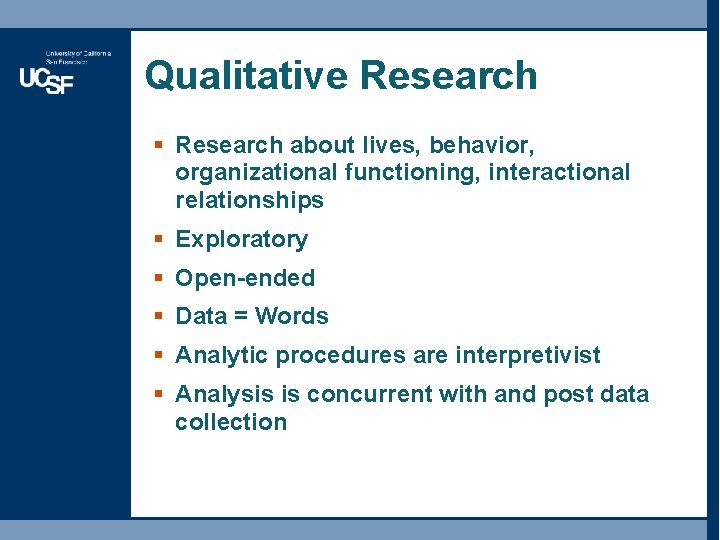
Qualitative Research § Research about lives, behavior, organizational functioning, interactional relationships § Exploratory § Open-ended § Data = Words § Analytic procedures are interpretivist § Analysis is concurrent with and post data collection
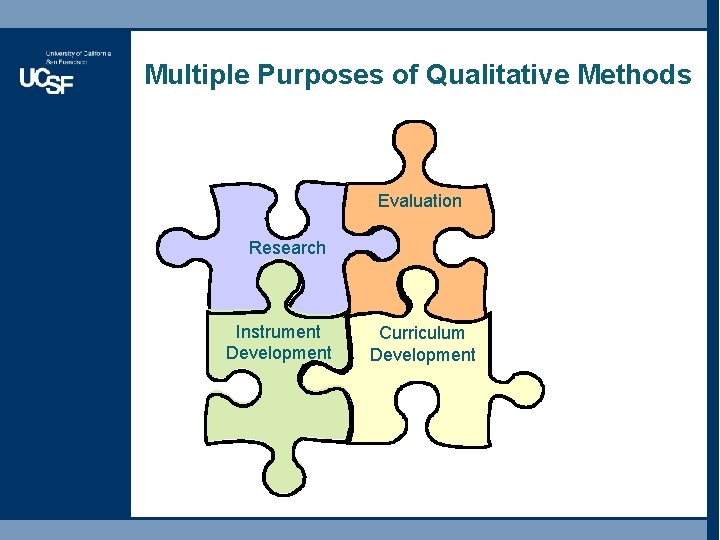
Multiple Purposes of Qualitative Methods Evaluation Research Instrument Development Curriculum Development
Qualitative Research Questions • What are the qualities of an ideal mentor? • How are attending physicians prepared and trained to perform the tasks and duties after transitioning to their new positions? • How do clerkship students characterize the struggles they face when transitioning to the clerkships? How do clinical teachers characterize students’ struggles? • How do residents describe the contributions of their fourth year experiences to their professional development.
Qualitative Paradigms Sets of beliefs that guide action Qualitative research takes place within a vast spectrum of paradigms: –Positivism –Post-positivism –Interpretivism / Constructivism –Critical Theory See: Bunniss & Kelly. Research paradigms in medical education. Medical Education, 2010, 44: 358 -366.
Qualitative Approaches Explore social processes through interpretation of data Four Most Common in Medical Education: • General Inductive Approach • Ethnography • Grounded theory • Case study • Phenomenology / Phenomenography • Hermeneutics • Narrative research • Action research
Sampling “Participants are not recruited on a representative basis, but rather because of their expert knowledge of the phenomenon under inquiry” (Green & Thorogood, 2005) • Purposeful – Seeking the best sources of information about the phenomenon of interest • Theoretical – Seeking the best sources of information to confirm / disconfirm your developing explanatory model
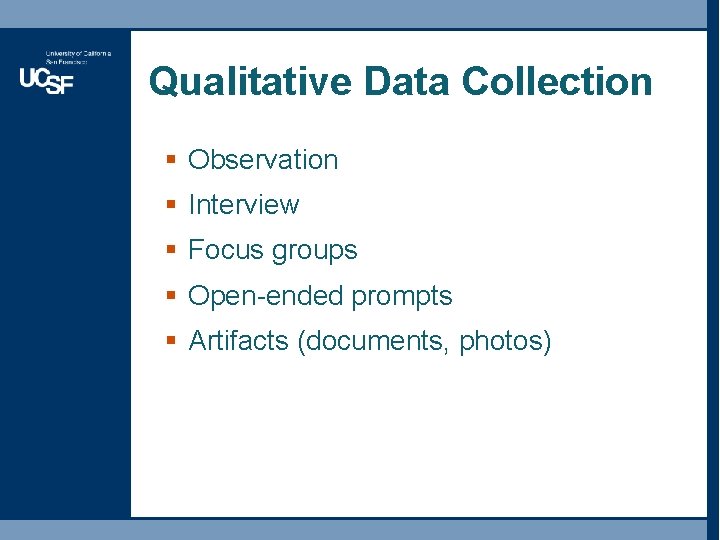
Qualitative Data Collection § Observation § Interview § Focus groups § Open-ended prompts § Artifacts (documents, photos)
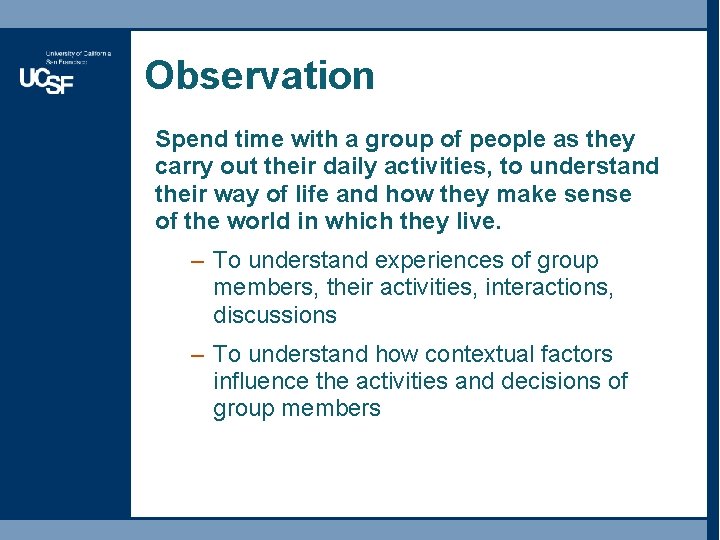
Observation Spend time with a group of people as they carry out their daily activities, to understand their way of life and how they make sense of the world in which they live. – To understand experiences of group members, their activities, interactions, discussions – To understand how contextual factors influence the activities and decisions of group members
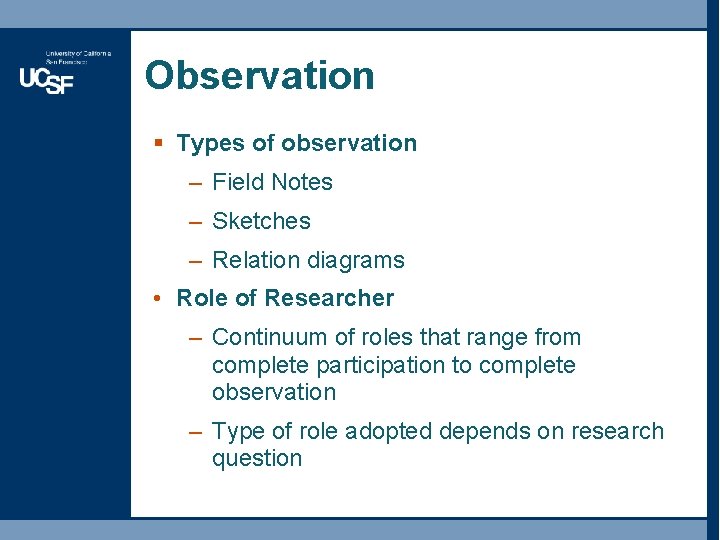
Observation § Types of observation – Field Notes – Sketches – Relation diagrams • Role of Researcher – Continuum of roles that range from complete participation to complete observation – Type of role adopted depends on research question
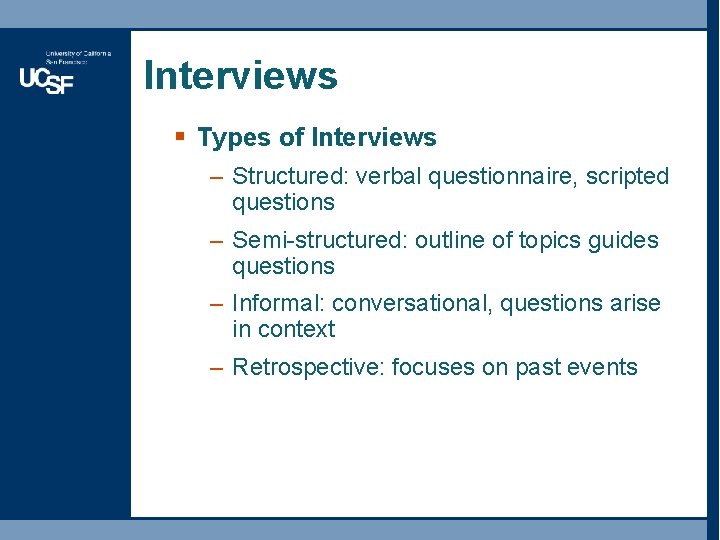
Interviews § Types of Interviews – Structured: verbal questionnaire, scripted questions – Semi-structured: outline of topics guides questions – Informal: conversational, questions arise in context – Retrospective: focuses on past events
Focus Groups • Small groups with a moderator • Concentrated data on topic of interest in short time span • Group interview with insight into interactions on topic (compared to interviews) • Important that topic of interest would be easy for participants to discuss in a group
Exercise 1: Designing Instruments Each group will be charged with developing a qualitative instrument to answer the following research question: How do students’ roles in patient care change over the course of the clerkship year? Group 1: Observation tool Group 2: Interview protocol Group 3: Focus group protocol
Exercise 2: Interviewing Skills We will role play 2 interviews between a qualitative researcher and participant. After each interview, discuss: • How you feel the interview went • Thoughts about the questions asked and the responses elicited • What you think was done particularly well and/or what could be improved
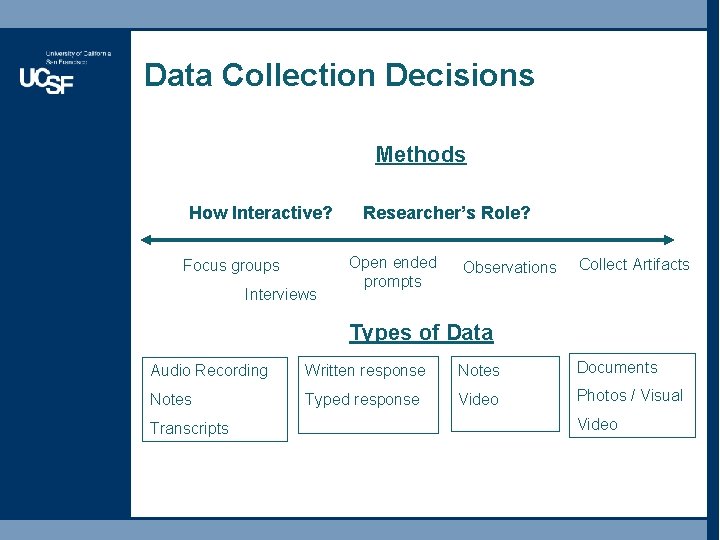
Data Collection Decisions Methods How Interactive? Focus groups Interviews Researcher’s Role? Open ended prompts Observations Collect Artifacts Types of Data Audio Recording Written response Notes Documents Notes Typed response Video Photos / Visual Transcripts Video
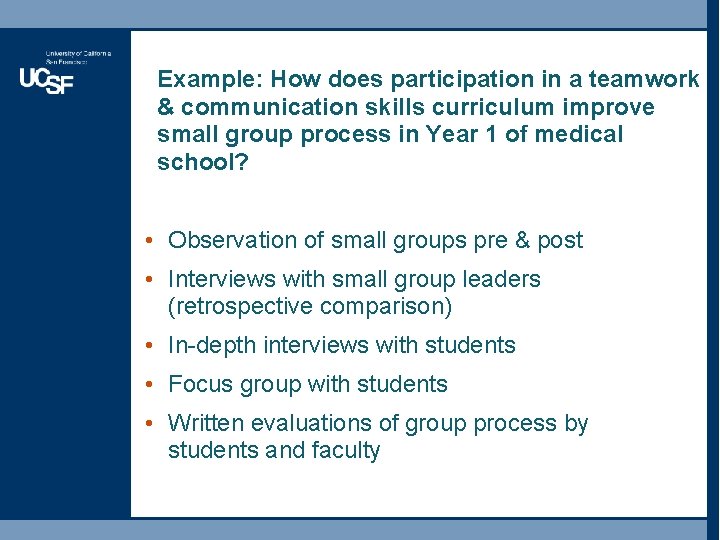
Example: How does participation in a teamwork & communication skills curriculum improve small group process in Year 1 of medical school? • Observation of small groups pre & post • Interviews with small group leaders (retrospective comparison) • In-depth interviews with students • Focus group with students • Written evaluations of group process by students and faculty
Other topics / questions • Recording (audio, video) • Transcription • Software for qualitative analysis
Convincing a Colleague “You are about to present the results of a survey evaluating your program to colleagues in your department. The results include both quantitative results (descriptive statistics for responses to structured questions) and an analysis of responses to openended questions. One of your colleagues says: “Let’s just look at the numbers, the hard data, not the anecdotes. ” You would say (or do). . .
Teaching Material References § § § § Lofland & Lofland. Analyzing social settings. Rubin, H. J. & Rubin, I. S. (1995). Qualitative interviewing: The art of hearing data. Thousand Oaks, CA: Sage Publications Strauss, A. & Corbin, J. (1990). Basics of qualitative research: Grounded theory procedures and techniques. Newbury Park: Sage Publications Cote, L. , & Turgeon, J. (2005). Appraising qualitative research articles in medicine and medical education. Medical Teacher, 27(1), 71 -75. Green J, Thorogood N. Qualitative methods for health research. London: Sage; 2005. Thomas D. A general inductive approach for analyzing qualitative evaluation data. Am J of Eval. 2006; 27: 237 -246. Expanded bibliography distributed via handout
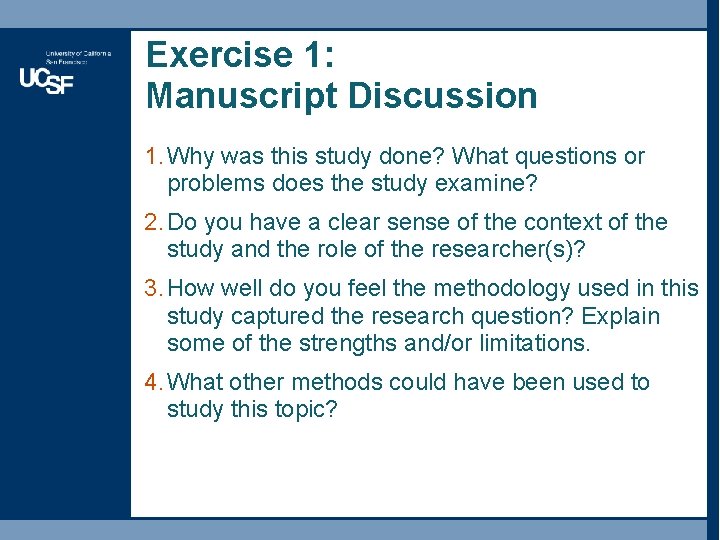
Exercise 1: Manuscript Discussion 1. Why was this study done? What questions or problems does the study examine? 2. Do you have a clear sense of the context of the study and the role of the researcher(s)? 3. How well do you feel the methodology used in this study captured the research question? Explain some of the strengths and/or limitations. 4. What other methods could have been used to study this topic?