Quad Rat Vitals Monitor Jack Ho Joseph Yuen

- Slides: 1
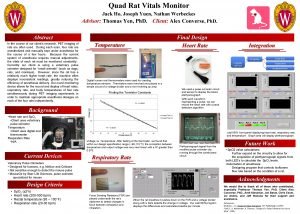
Quad Rat Vitals Monitor Jack Ho, Joseph Yuen, Nathan Werbeckes Advisor: Thomas Yen, Ph. D. Client: Alex Converse, Ph. D. Abstract Background • Heart rate and Sp. O 2 • Client uses veterinary pulse oximeter Temperature • Client uses digital oral thermometer Respiration Rate • N/A Current Devices Temperature Computer Lab. View Digital human oral thermometers were used for creating temperature sensors. Thermistors were removed and placed in a simple circuit of a voltage divider and a non-inverting op amp. Temperature Finding the Termistor Constants We used a pulse oximeter circuit and sensor to display the blood plethysmograph. With each waveform representing a pulse, we can record the heart rate with a peak detection algorithm. 3. 8 R 2 = 0. 9983 3. 3 Linear(Trial 1) Linear(Trial 2) 2. 8 R 2 = 0. 9938 2. 3 28 30 32 34 36 38 40 42 Lab. VIEW front panel displaying heart rate, respiratory rate, and temperature. Graph area will display plethysmograph. 44 Temperature (C) Voltage vs. Temperature. After testing of thermistor, we found that within our design specification range (~90 -110 °F) the correlation between temperature and output voltage was very near linear with a R 2 greater than 0. 975. Respiratory Rate Plethysmograph signal from the modified pulse oximeter clip running through the constructed circuit. Future Work • Sp. O 2 value calculations Further expand on the circuitry to allow for the acquisition of plethysmograph signals from both LED’s to calculate the Sp. O 2 levels. • Automation of anesthesia Designing program that controls Isoflurane flow rate based on the condition of a rat. Acknowledgments Design Criteria Sp. O 2 (± 2%) Heart rate (200 -500 bpm) Rectal temperature (93 – 100°F) Respiration rate (20 -30 bpm) Heart Rate Respiratory Rate Veterinary Pulse Oximeters • Designed for humans, e. g. Nellcor and Criticare • Not sensitive enough to detect the mouse pulse • Mouse. Ox by Starr Life Sciences, pulse oximeter specialized for mouse • • Integration DAq Box Voltage (V) In the course of our client’s research, PET imaging of rats are often used. During each scan, four rats are anesthetized and manually kept under anesthesia for the course of a few hours. Because the current system of anesthesia requires manual adjustments, the vitals of each rat must be monitored constantly. Currently our client is using a veterinary pulse oximeter designed for “small animals” (such as dogs, cats, and monkeys). However, since the rat has a relatively much higher heart rate, the machine often displays inconsistent readings, greatly reducing the efficiency of anesthesia delivery. Our novel monitoring device allows for the record and display of heart rates, respiratory rate, and body temperatures of four rats simultaneously during PET imaging experiments in order to maintain appropriate anesthesia dosages on each of the four rats independently. Final Design Heart Rate Force Sensing Resistors (FSR) are placed underneath the rat’s abdomen to detect changes in force between exhalation and inhalation. When the rat breathes it pushes down on the FSR and a voltage divider along with a Da. Q detects the change in voltage. Our Lab. VIEW program displays the differences and calculates breaths per minute. We would like to thank all of those who contributed, especially Professor Thomas Yen, Ph. D, Client Alex Converse, Ph. D. , Amit Nimunkar, Jon Baran, Chris Esser, Liz Ahlers, and Jeff Moirano for their support and assistance. References: Webster, J. G. , Design of Pulse Oximeters. IOP Publishing Ltd 1997. Ford D. , D. Nachreiner, R. Thomas, “Design of a Pulse Oximeter for Use in Mice”. 2005.