Producing ICT indicators in developing countries challenges and

- Slides: 12
Producing ICT indicators in developing countries: challenges and initiatives Dr. Susan TELTSCHER, ITU José CERVERA-FERRI, Dev. Stat
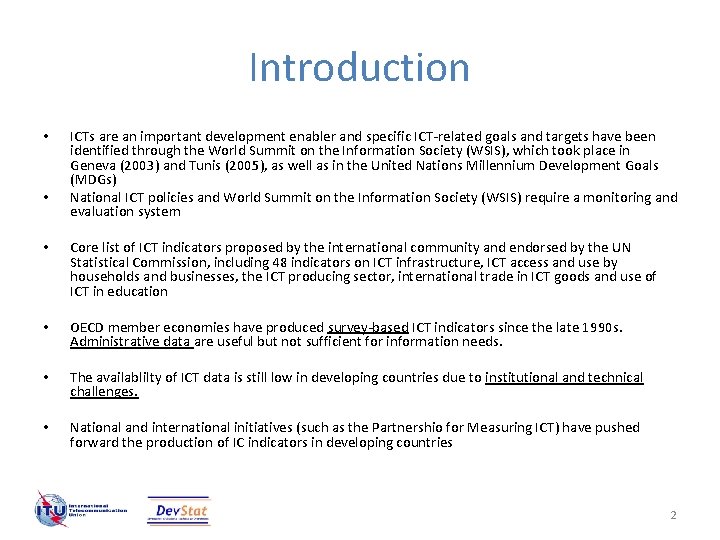
Introduction • • ICTs are an important development enabler and specific ICT-related goals and targets have been identified through the World Summit on the Information Society (WSIS), which took place in Geneva (2003) and Tunis (2005), as well as in the United Nations Millennium Development Goals (MDGs) National ICT policies and World Summit on the Information Society (WSIS) require a monitoring and evaluation system • Core list of ICT indicators proposed by the international community and endorsed by the UN Statistical Commission, including 48 indicators on ICT infrastructure, ICT access and use by households and businesses, the ICT producing sector, international trade in ICT goods and use of ICT in education • OECD member economies have produced survey-based ICT indicators since the late 1990 s. Administrative data are useful but not sufficient for information needs. • The availablilty of ICT data is still low in developing countries due to institutional and technical challenges. • National and international initiatives (such as the Partnershio for Measuring ICT) have pushed forward the production of IC indicators in developing countries 2
Contents 1. Institutional and technical challenges related to the production of ICT household and business statistics 2. National and international efforts 3. Recommendations on how to further advance information society measurements in developing countries 3
Challenges in the production of ICT indicators in developing countries • Institutional challenges: – Weak coordination mechanisms between NSOs, Ministries for ICT and the private sector (decentralised competencies and activities) – National legal framework for statistics (statistical strategy, annual programme, working groups) outdated, not accomodating ICT statistics, or giving priority to other, more basic statistics – Multi-annual statistical programme not ensuring a sustainable implementation of ICT surveys (survey frequency, funding) 4
Challenges in the production of ICT indicators in developing countries (cont. ) • Technical challenges (general): – Need of a technological background (rapid developments in connectivity and access to networks, mobile devices and applications for e-business processes; technological convergence), – For respondents and interviewers, concepts such as type of ICT access and use, may be difficult to understand. – Poor data dissemination, insufficient knowledge of ICT policy-making data needs which should be addressed in the dissemination of results 5
Challenges in the production of ICT indicators in developing countries (cont. ) • Technical challenges (Household ICT Indicators): – Lack of reliable or updated household sample frames – Restrictred coverage of surveys (urban/rural) – Difficulties for collecting ICT information from individuals – Insufficient technical skills for ICT household data analysis in NSOs (estimation of complex ratios and proportions, statistical modelling for the analysis of micro-data, etc. ) 6
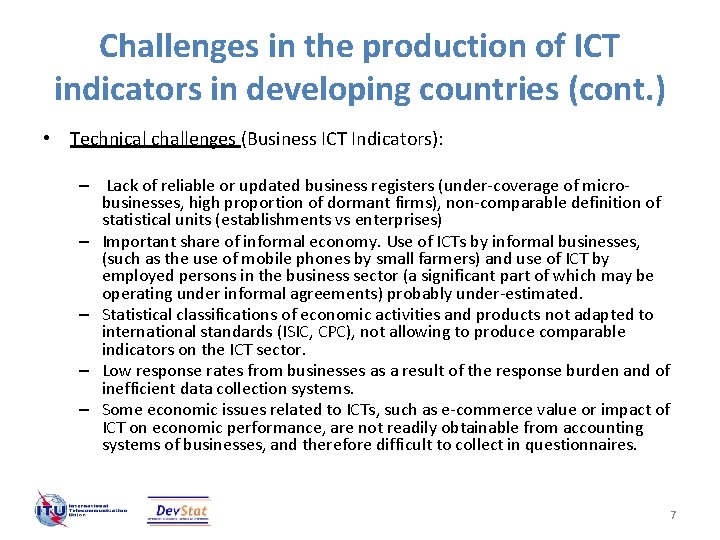
Challenges in the production of ICT indicators in developing countries (cont. ) • Technical challenges (Business ICT Indicators): – Lack of reliable or updated business registers (under-coverage of microbusinesses, high proportion of dormant firms), non-comparable definition of statistical units (establishments vs enterprises) – Important share of informal economy. Use of ICTs by informal businesses, (such as the use of mobile phones by small farmers) and use of ICT by employed persons in the business sector (a significant part of which may be operating under informal agreements) probably under-estimated. – Statistical classifications of economic activities and products not adapted to international standards (ISIC, CPC), not allowing to produce comparable indicators on the ICT sector. – Low response rates from businesses as a result of the response burden and of inefficient data collection systems. – Some economic issues related to ICTs, such as e-commerce value or impact of ICT on economic performance, are not readily obtainable from accounting systems of businesses, and therefore difficult to collect in questionnaires. 7
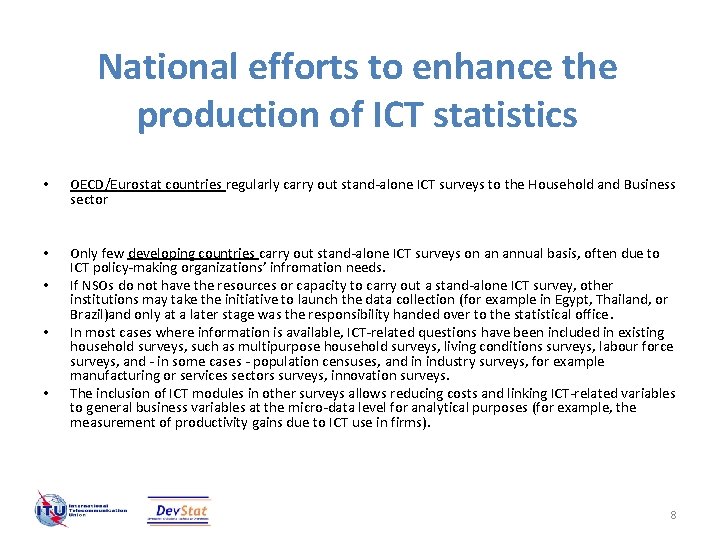
National efforts to enhance the production of ICT statistics • OECD/Eurostat countries regularly carry out stand-alone ICT surveys to the Household and Business sector • Only few developing countries carry out stand-alone ICT surveys on an annual basis, often due to ICT policy-making organizations’ infromation needs. If NSOs do not have the resources or capacity to carry out a stand-alone ICT survey, other institutions may take the initiative to launch the data collection (for example in Egypt, Thailand, or Brazil)and only at a later stage was the responsibility handed over to the statistical office. In most cases where information is available, ICT-related questions have been included in existing household surveys, such as multipurpose household surveys, living conditions surveys, labour force surveys, and - in some cases - population censuses, and in industry surveys, for example manufacturing or services sectors surveys, innovation surveys. The inclusion of ICT modules in other surveys allows reducing costs and linking ICT-related variables to general business variables at the micro-data level for analytical purposes (for example, the measurement of productivity gains due to ICT use in firms). • • • 8
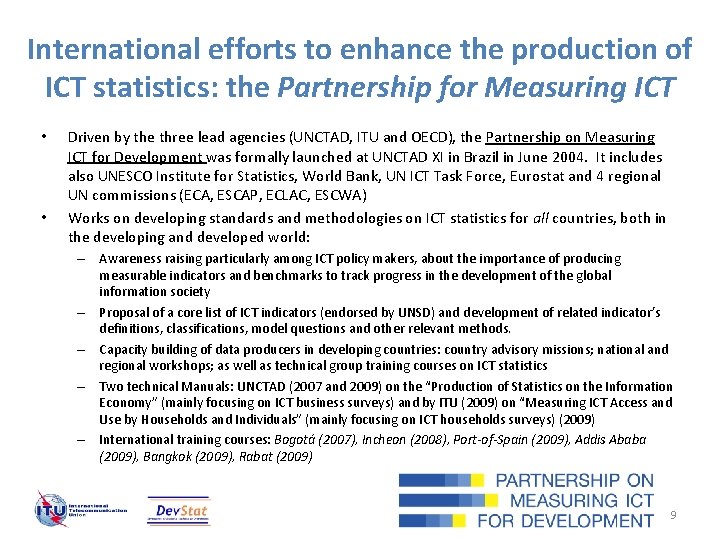
International efforts to enhance the production of ICT statistics: the Partnership for Measuring ICT • • Driven by the three lead agencies (UNCTAD, ITU and OECD), the Partnership on Measuring ICT for Development was formally launched at UNCTAD XI in Brazil in June 2004. It includes also UNESCO Institute for Statistics, World Bank, UN ICT Task Force, Eurostat and 4 regional UN commissions (ECA, ESCAP, ECLAC, ESCWA) Works on developing standards and methodologies on ICT statistics for all countries, both in the developing and developed world: – Awareness raising particularly among ICT policy makers, about the importance of producing measurable indicators and benchmarks to track progress in the development of the global information society – Proposal of a core list of ICT indicators (endorsed by UNSD) and development of related indicator’s definitions, classifications, model questions and other relevant methods. – Capacity building of data producers in developing countries: country advisory missions; national and regional workshops; as well as technical group training courses on ICT statistics – Two technical Manuals: UNCTAD (2007 and 2009) on the “Production of Statistics on the Information Economy” (mainly focusing on ICT business surveys) and by ITU (2009) on “Measuring ICT Access and Use by Households and Individuals” (mainly focusing on ICT households surveys) (2009) – International training courses: Bogotá (2007), Incheon (2008), Port-of-Spain (2009), Addis Ababa (2009), Bangkok (2009), Rabat (2009) 9
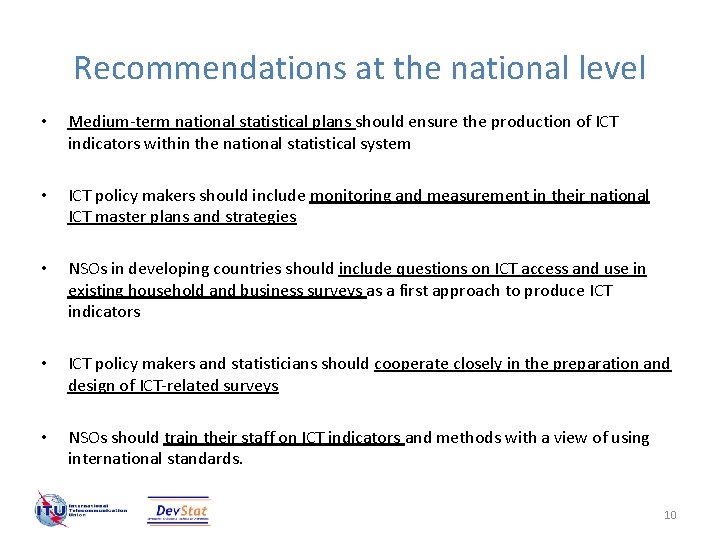
Recommendations at the national level • Medium-term national statistical plans should ensure the production of ICT indicators within the national statistical system • ICT policy makers should include monitoring and measurement in their national ICT master plans and strategies • NSOs in developing countries should include questions on ICT access and use in existing household and business surveys as a first approach to produce ICT indicators • ICT policy makers and statisticians should cooperate closely in the preparation and design of ICT-related surveys • NSOs should train their staff on ICT indicators and methods with a view of using international standards. 10
Recommendations at the international level • ICT measurement should continue to receive major international attention in the post-WSIS process in view of the 2015 target date • UNSC members should give the appropriate attention to ICT statistics, in view of the emerging information society and the role of ICTs as key development enablers • The international donor community should consider funding the production of measurable indicators on information society progress in developing countries, in coordination with national statistical strategies • OECD members and other countries experienced in ICT measurement should share their expertise and provide assistance to countries/NSOs • The Partnership on Measuring ICT for Development and its members should continue the work on coordinating and promoting ICT measurement at the global and regional levels through awareness creation, capacity building, and developing standards and methods. 11
Thank you