Pricing Products and Services Appendix A Mc GrawHillIrwin
- Slides: 18
Pricing Products and Services Appendix A Mc. Graw-Hill/Irwin Copyright © 2010 by The Mc. Graw-Hill Companies, Inc. All rights reserved.
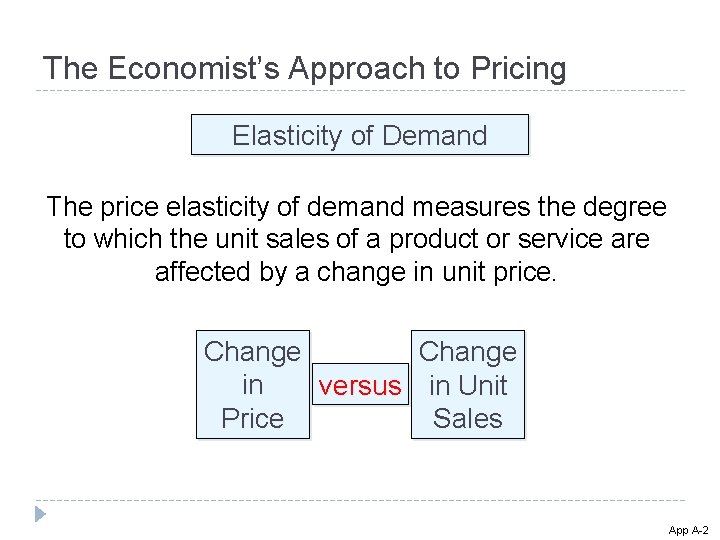
The Economist’s Approach to Pricing Elasticity of Demand The price elasticity of demand measures the degree to which the unit sales of a product or service are affected by a change in unit price. Change in versus in Unit Price Sales App A-2
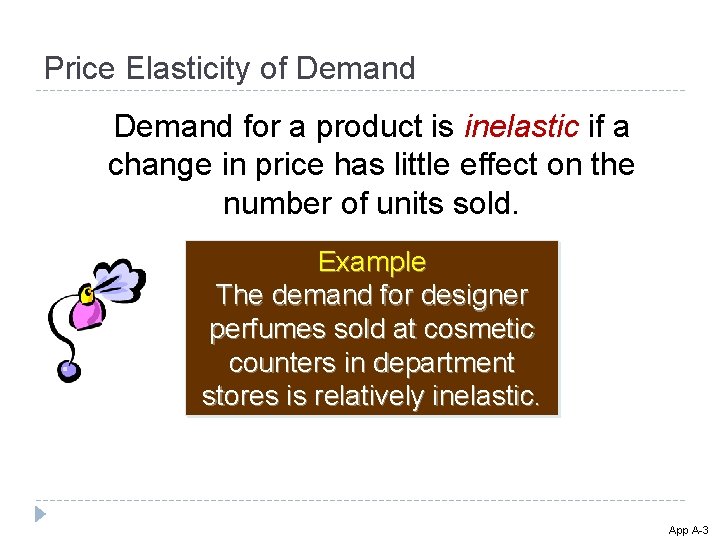
Price Elasticity of Demand for a product is inelastic if a change in price has little effect on the number of units sold. Example The demand for designer perfumes sold at cosmetic counters in department stores is relatively inelastic. App A-3
Price Elasticity of Demand for a product is elastic if a change in price has a substantial effect on the number of units sold. Example The demand for gasoline is relatively elastic because if a gas station raises its price, unit sales will drop as customers seek lower prices elsewhere. App A-4
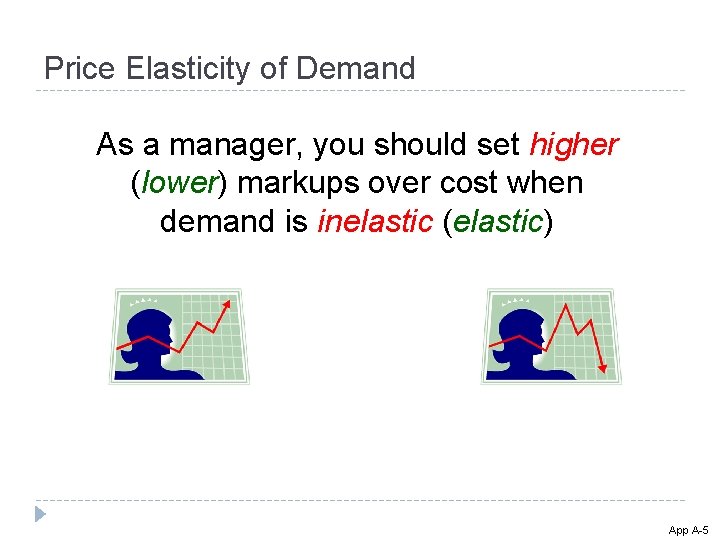
Price Elasticity of Demand As a manager, you should set higher (lower) markups over cost when demand is inelastic (elastic) App A-5
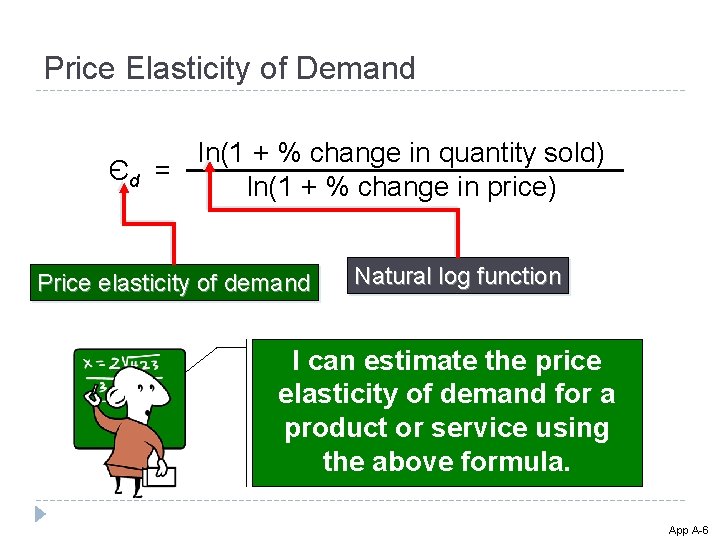
Price Elasticity of Demand ln(1 + % change in quantity sold) Єd = ln(1 + % change in price) Price elasticity of demand Natural log function I can estimate the price elasticity of demand for a product or service using the above formula. App A-6
Price Elasticity of Demand The price elasticity of demand for the strawberry glycerin soap is larger, in absolute value, than the apple-almond shampoo. This indicates that the demand for strawberry glycerin soap is more elastic than the demand for apple-almond shampoo. App A-7
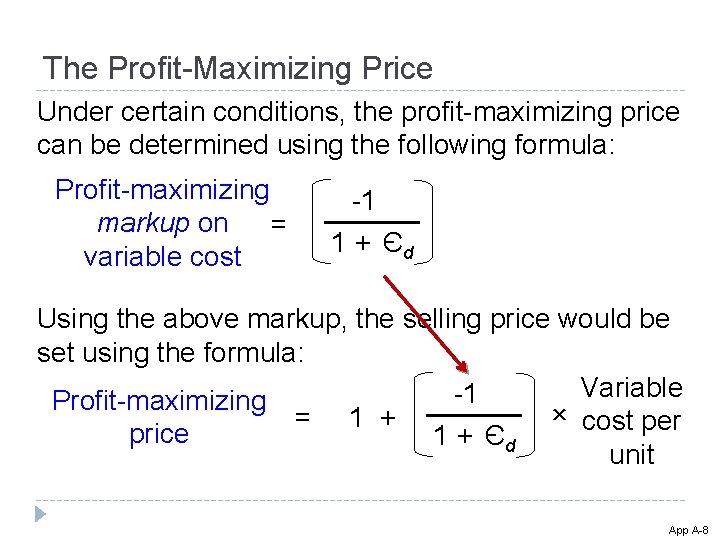
The Profit-Maximizing Price Under certain conditions, the profit-maximizing price can be determined using the following formula: Profit-maximizing markup on = variable cost -1 1 + Єd Using the above markup, the selling price would be set using the formula: Variable -1 Profit-maximizing × cost per = 1 + price 1 + Єd unit App A-8
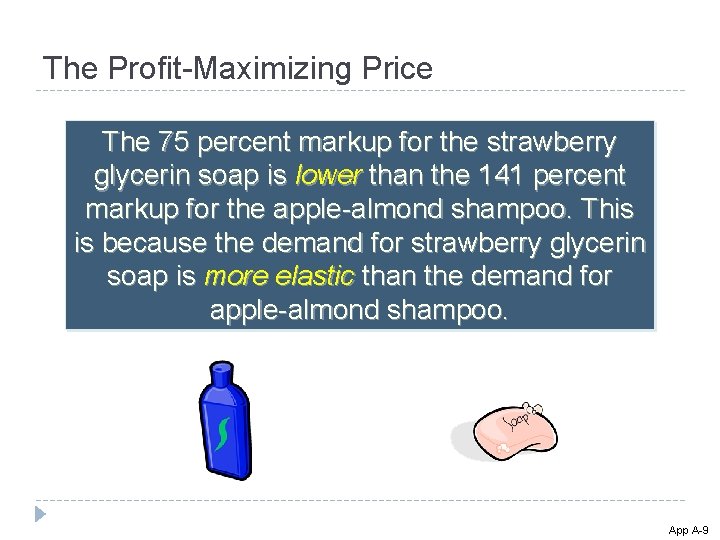
The Profit-Maximizing Price The 75 percent markup for the strawberry glycerin soap is lower than the 141 percent markup for the apple-almond shampoo. This is because the demand for strawberry glycerin soap is more elastic than the demand for apple-almond shampoo. App A-9
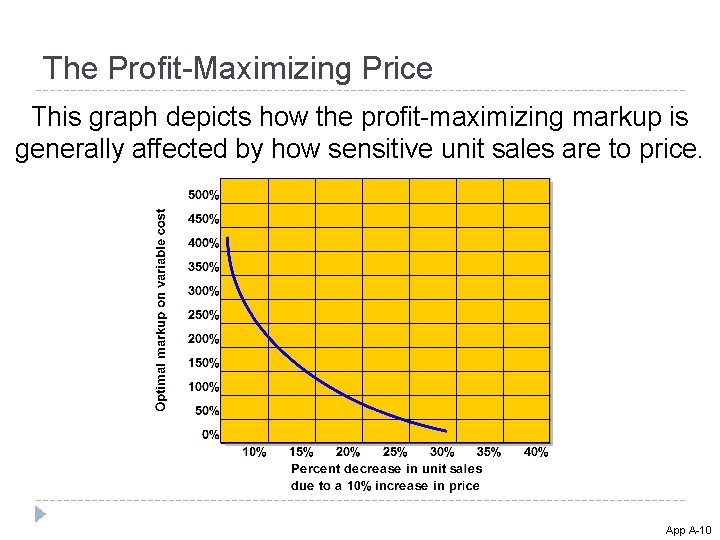
The Profit-Maximizing Price This graph depicts how the profit-maximizing markup is generally affected by how sensitive unit sales are to price. App A-10
The Profit-Maximizing Price Nature’s Garden is currently selling 200, 000 bars of strawberry glycerin soap per year at the price of $0. 60 a bar. If the change in price has no effect on the company’s fixed costs or on other products, let’s determine the effect on contribution margin of increasing the price by 10 percent. App A-11
The Cost Base Under the absorption approach to cost-plus pricing, the cost base is the absorption costing unit product cost rather than the variable cost. The cost base includes direct materials, direct labor, and variable and fixed manufacturing overhead. App A-12
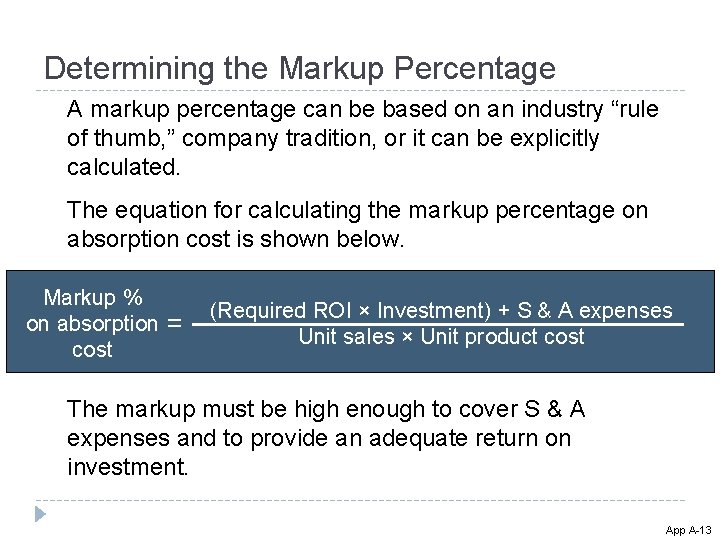
Determining the Markup Percentage A markup percentage can be based on an industry “rule of thumb, ” company tradition, or it can be explicitly calculated. The equation for calculating the markup percentage on absorption cost is shown below. Markup % on absorption cost = (Required ROI × Investment) + S & A expenses Unit sales × Unit product cost The markup must be high enough to cover S & A expenses and to provide an adequate return on investment. App A-13
Determining the Markup Percentage Let’s assume that Ritter must invest $100, 000 in the product and market 10, 000 units of product each year. The company requires a 20% ROI on all investments. Let’s determine Ritter’s markup percentage on absorption cost. App A-14
Problems with the Absorption Costing Approach The absorption costing approach essentially assumes that customers need the forecasted unit sales and will pay whatever price the company decides to charge. This is flawed logic simply because customers have a choice. App A-15
Target Costing Target costing is the process of determining the maximum allowable cost for a new product and then developing a prototype that can be made for that maximum target cost figure. The equation for determining a target price is shown below: Target cost = Anticipated selling price – Desired profit Once the target cost is determined, the product development team is given the responsibility of designing the product so that it can be made for no more than the target cost. App A-16
Reasons for Using Target Costing Two characteristics of prices and product costs include: 1. The market (i. e. , supply and demand) determines price. 2. Most of the cost of a product is determined in the design stage. App A-17
End of Appendix A App A-18