PISA for Development Out of School Technical Meeting

- Slides: 7
PISA for Development Out of School Technical Meeting
PISA for Development How we arrived at this point – the journey • So far, PISA has covered 74 countries, 28 of which are developing countries (ODA recipients) • Our experience so far: • Relevance of the PISA approach and assessment • Adherence to technical standards • Quality of technical implementation matches that of OECD countries • Full compliance with confidentiality requirements • Some open issues • Match between student ability distribution and item difficulties • Relevance of context questionnaires • Out-of-school populations • How far can we go with expanding PISA as we know it?
The challenge of PISA for Development • Can we develop a framework that embraces the diversity of contexts in which students learn, teachers teach and school systems operate? – As comparable as possible to facilitate peer-learning – As country-specific as necessary to be meaningful and interpretable in national contexts • Can we improve the relevance, quality and reliability of performance measurement? – Establishing measures that work in a wider range of countries • Can we extend measurement to children not enrolled in formal education? – Establishing policy-incentives for inclusiveness
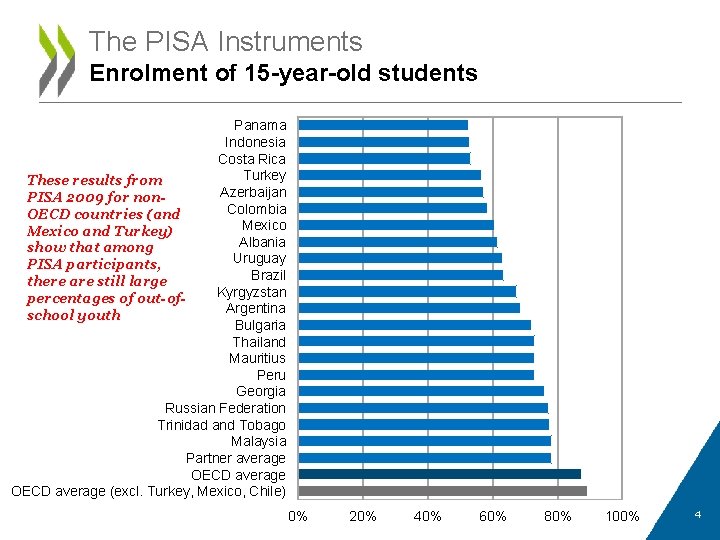
The PISA Instruments Enrolment of 15 -year-old students Panama Indonesia Costa Rica Turkey These results from Azerbaijan PISA 2009 for non. Colombia OECD countries (and Mexico and Turkey) Albania show that among Uruguay PISA participants, Brazil there are still large Kyrgyzstan percentages of out-of. Argentina school youth Bulgaria Thailand Mauritius Peru Georgia Russian Federation Trinidad and Tobago Malaysia Partner average OECD average (excl. Turkey, Mexico, Chile) 0% 20% 40% 60% 80% 100% 4
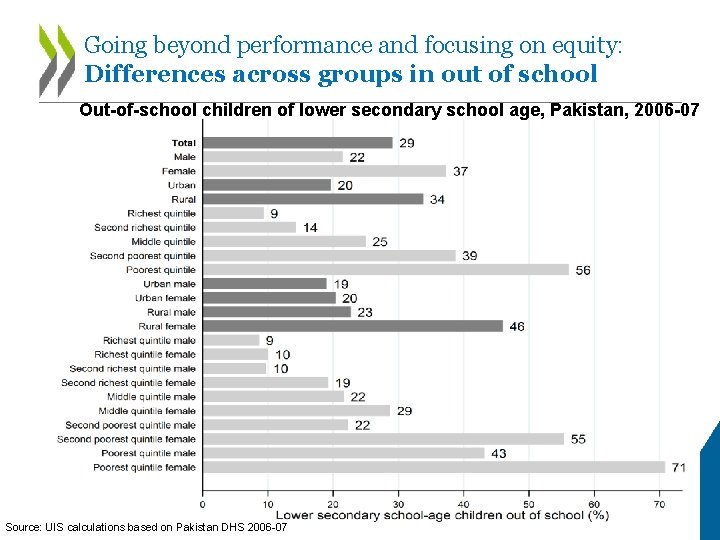
Going beyond performance and focusing on equity: Differences across groups in out of school Out-of-school children of lower secondary school age, Pakistan, 2006 -07 Source: UIS calculations based on Pakistan DHS 2006 -07
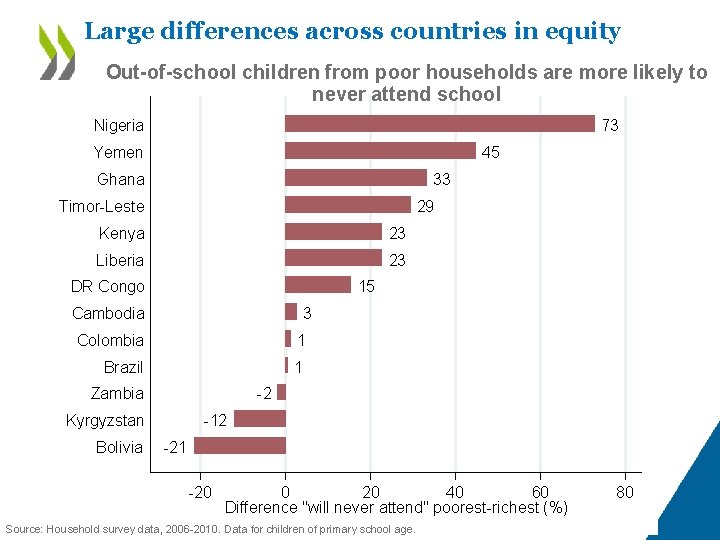
Large differences across countries in equity Out-of-school children from poor households are more likely to never attend school Nigeria 73 Yemen 45 33 Ghana Timor-Leste 29 Kenya 23 Liberia 23 15 DR Congo 3 Cambodia Colombia 1 Brazil 1 Zambia -2 Kyrgyzstan Bolivia -12 -21 -20 0 20 40 60 Difference "will never attend" poorest-richest (%) Source: Household survey data, 2006 -2010. Data for children of primary school age. 80
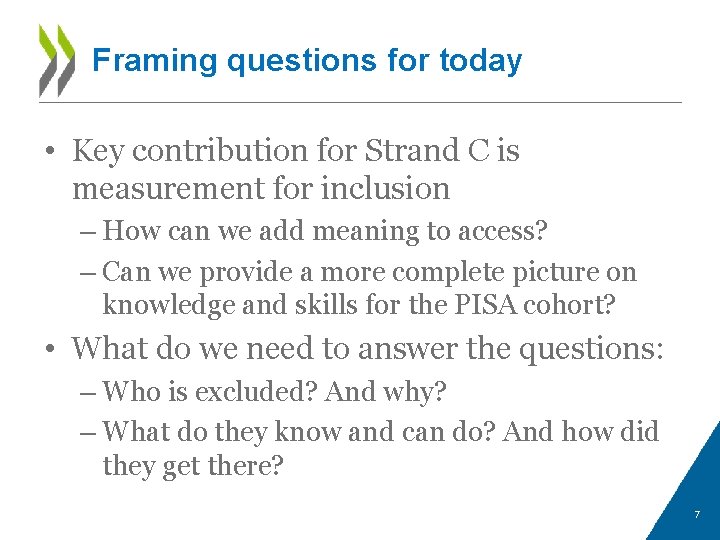
Framing questions for today • Key contribution for Strand C is measurement for inclusion – How can we add meaning to access? – Can we provide a more complete picture on knowledge and skills for the PISA cohort? • What do we need to answer the questions: – Who is excluded? And why? – What do they know and can do? And how did they get there? 7