Pilot actions linked to smart specialisation Industrial Transition
- Slides: 8
Pilot actions linked to smart specialisation Industrial Transition Interregional Innovation Projects G 1 - Smart & Sustainable Growth DG Regional and Urban Policy European Commission
Pilot Action on Industrial Transition
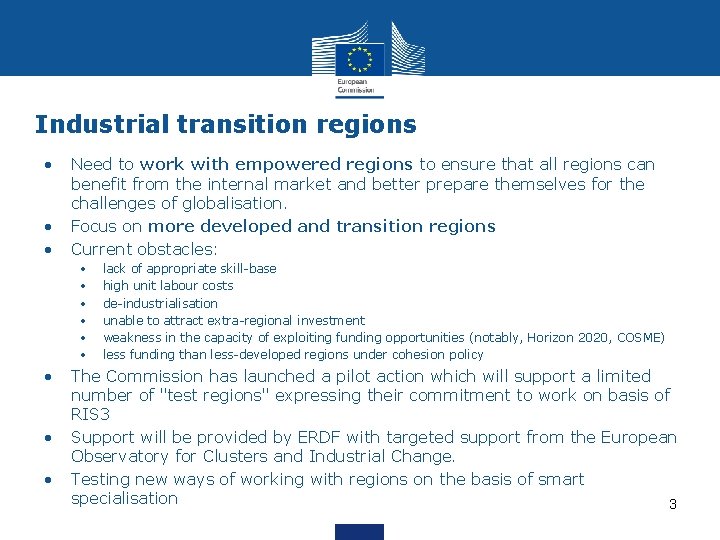
Industrial transition regions • • • Need to work with empowered regions to ensure that all regions can benefit from the internal market and better prepare themselves for the challenges of globalisation. Focus on more developed and transition regions Current obstacles: • • • lack of appropriate skill-base high unit labour costs de-industrialisation unable to attract extra-regional investment weakness in the capacity of exploiting funding opportunities (notably, Horizon 2020, COSME) less funding than less-developed regions under cohesion policy The Commission has launched a pilot action which will support a limited number of "test regions" expressing their commitment to work on basis of RIS 3 Support will be provided by ERDF with targeted support from the European Observatory for Clusters and Industrial Change. Testing new ways of working with regions on the basis of smart specialisation 3
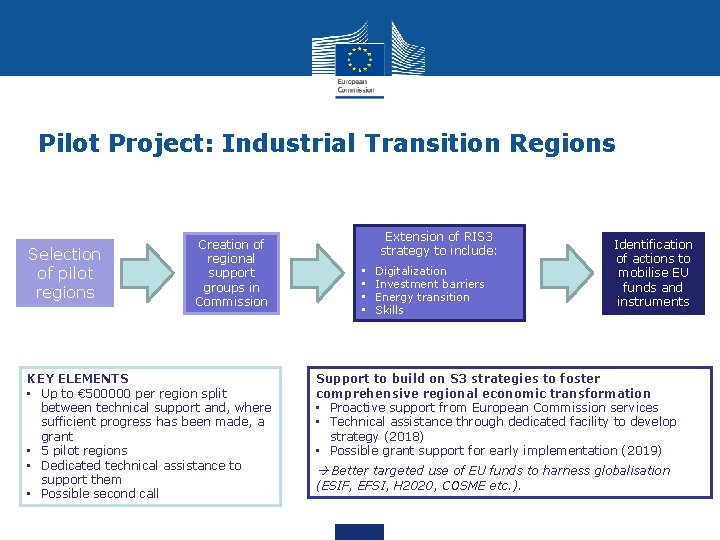
Pilot Project: Industrial Transition Regions Selection of pilot regions Creation of regional support groups in Commission KEY ELEMENTS • Up to € 500000 per region split between technical support and, where sufficient progress has been made, a grant • 5 pilot regions • Dedicated technical assistance to support them • Possible second call Extension of RIS 3 strategy to include: • • Digitalization Investment barriers Energy transition Skills Identification of actions to mobilise EU funds and instruments Support to build on S 3 strategies to foster comprehensive regional economic transformation • Proactive support from European Commission services • Technical assistance through dedicated facility to develop strategy (2018) • Possible grant support for early implementation (2019) Better targeted use of EU funds to harness globalisation (ESIF, EFSI, H 2020, COSME etc. ).
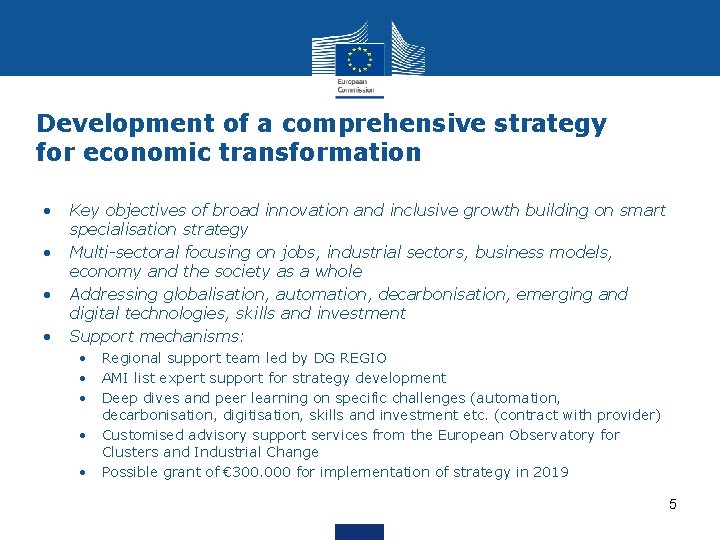
Development of a comprehensive strategy for economic transformation • • Key objectives of broad innovation and inclusive growth building on smart specialisation strategy Multi-sectoral focusing on jobs, industrial sectors, business models, economy and the society as a whole Addressing globalisation, automation, decarbonisation, emerging and digital technologies, skills and investment Support mechanisms: • • • Regional support team led by DG REGIO AMI list expert support for strategy development Deep dives and peer learning on specific challenges (automation, decarbonisation, digitisation, skills and investment etc. (contract with provider) Customised advisory support services from the European Observatory for Clusters and Industrial Change Possible grant of € 300. 000 for implementation of strategy in 2019 5
Pilot Action on Interregional Innovation Projects
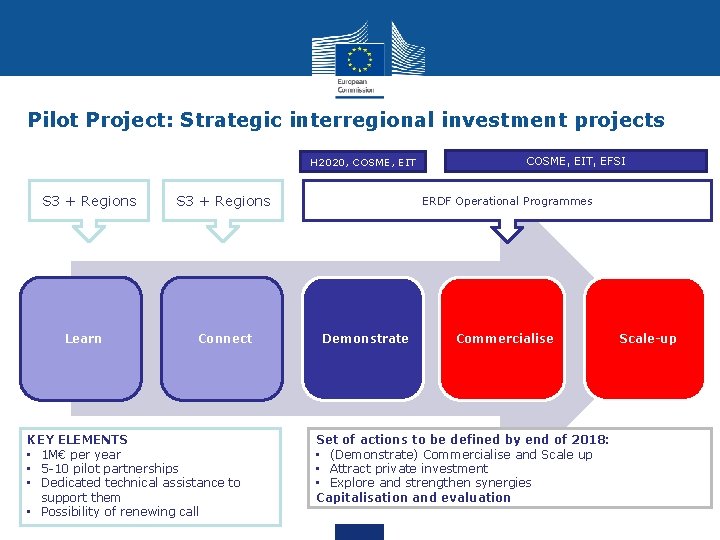
Pilot Project: Strategic interregional investment projects H 2020, COSME, EIT S 3 + Regions Learn S 3 + Regions Connect KEY ELEMENTS • 1 M€ per year • 5 -10 pilot partnerships • Dedicated technical assistance to support them • Possibility of renewing call COSME, EIT, EFSI ERDF Operational Programmes Demonstrate Commercialise Set of actions to be defined by end of 2018: • (Demonstrate) Commercialise and Scale up • Attract private investment • Explore and strengthen synergies Capitalisation and evaluation Scale-up
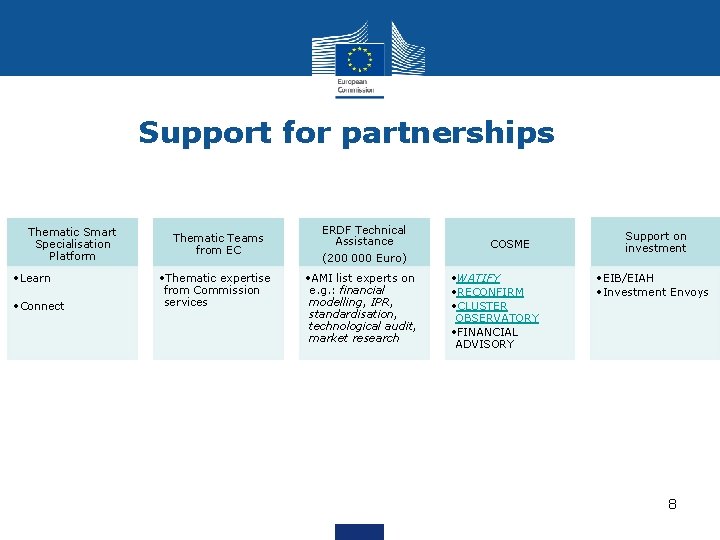
Support for partnerships Thematic Smart Specialisation Platform • Learn • Connect Thematic Teams from EC • Thematic expertise from Commission services ERDF Technical Assistance COSME (200 000 Euro) • AMI list experts on e. g. : financial modelling, IPR, standardisation, technological audit, market research • WATIFY • RECONFIRM • CLUSTER OBSERVATORY • FINANCIAL ADVISORY Support on investment • EIB/EIAH • Investment Envoys 8