Phy 101 Fundamentals of Physics I Chapter 7
- Slides: 11
Phy 101: Fundamentals of Physics I Chapter 7 Lecture Notes
James Prescott Joule (1818 -1889) • Inventor & scientist • Interested in efficiency of electric motors • Described the heat dissipated across a resistor (now known as Joules’ Law) • Showed that heat is produced by motion • Credited with establishing the mechanical energy equivalent of heat • Participated in establishing the “Law of Energy Conservation”
Work • Effort times output • To calculate work: Work = (Force Applied)*(Distance Traveled) or W = F. d • Only force that is applied in the direction of distance traveled can do work • Work is a scalar quantity • Units (SI) are Joules (J)
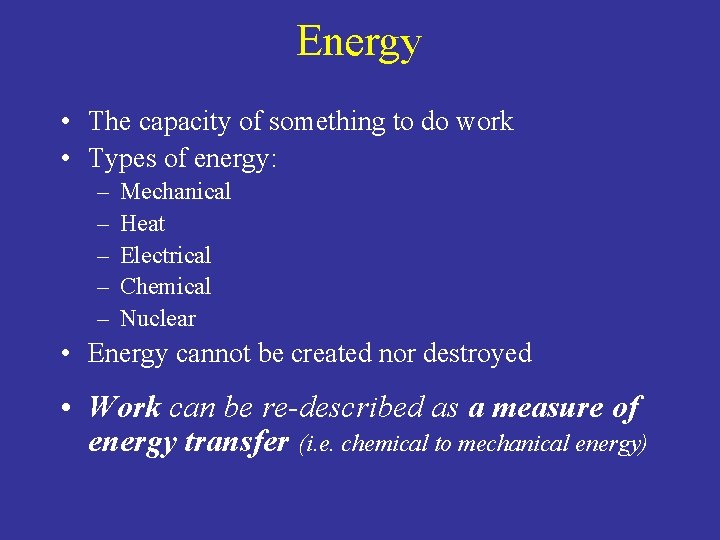
Energy • The capacity of something to do work • Types of energy: – – – Mechanical Heat Electrical Chemical Nuclear • Energy cannot be created nor destroyed • Work can be re-described as a measure of energy transfer (i. e. chemical to mechanical energy)
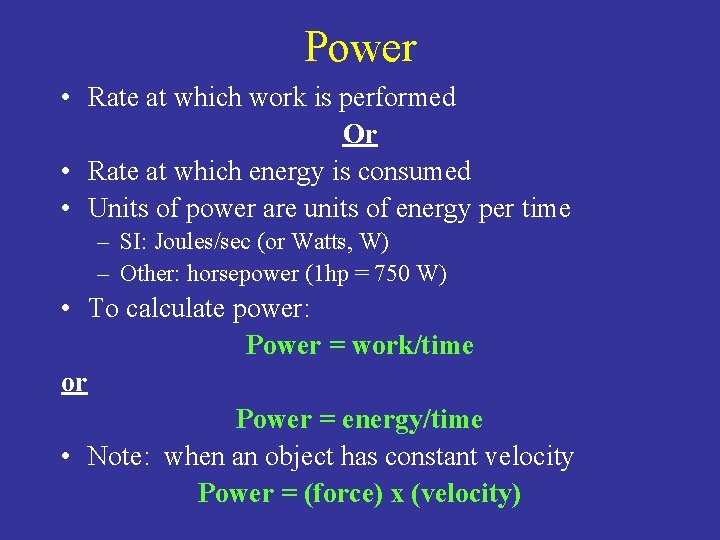
Power • Rate at which work is performed Or • Rate at which energy is consumed • Units of power are units of energy per time – SI: Joules/sec (or Watts, W) – Other: horsepower (1 hp = 750 W) • To calculate power: Power = work/time or Power = energy/time • Note: when an object has constant velocity Power = (force) x (velocity)
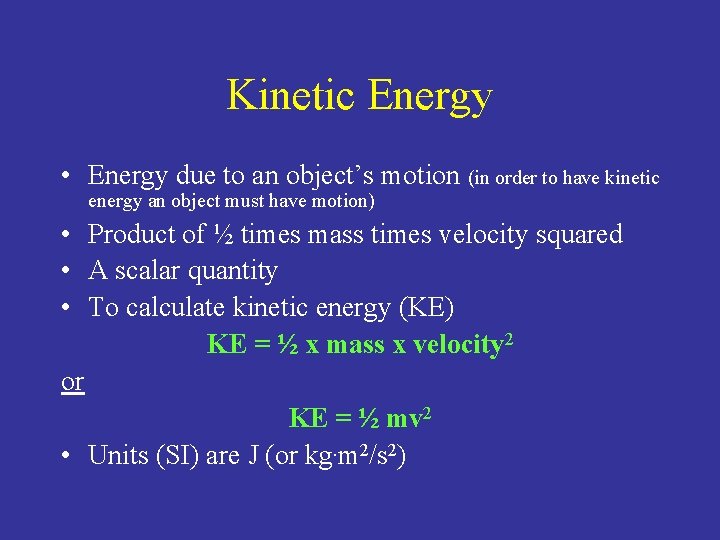
Kinetic Energy • Energy due to an object’s motion (in order to have kinetic energy an object must have motion) • Product of ½ times mass times velocity squared • A scalar quantity • To calculate kinetic energy (KE) KE = ½ x mass x velocity 2 or KE = ½ mv 2 • Units (SI) are J (or kg. m 2/s 2)
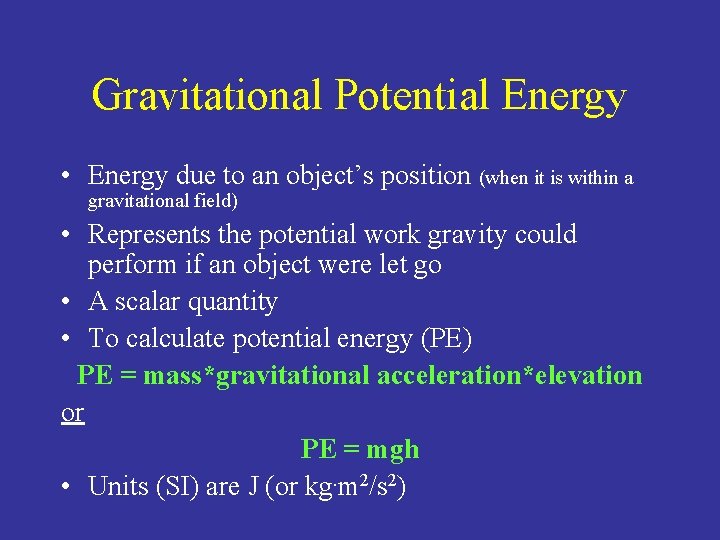
Gravitational Potential Energy • Energy due to an object’s position (when it is within a gravitational field) • Represents the potential work gravity could perform if an object were let go • A scalar quantity • To calculate potential energy (PE) PE = mass*gravitational acceleration*elevation or PE = mgh • Units (SI) are J (or kg. m 2/s 2)
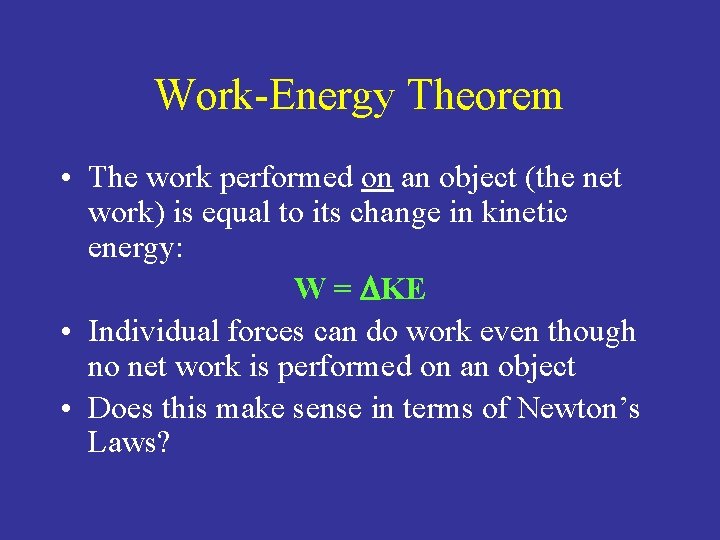
Work-Energy Theorem • The work performed on an object (the net work) is equal to its change in kinetic energy: W = DKE • Individual forces can do work even though no net work is performed on an object • Does this make sense in terms of Newton’s Laws?
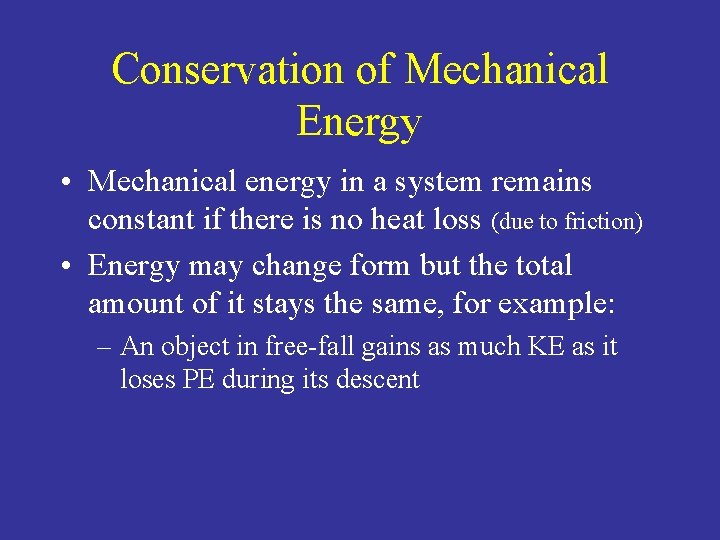
Conservation of Mechanical Energy • Mechanical energy in a system remains constant if there is no heat loss (due to friction) • Energy may change form but the total amount of it stays the same, for example: – An object in free-fall gains as much KE as it loses PE during its descent
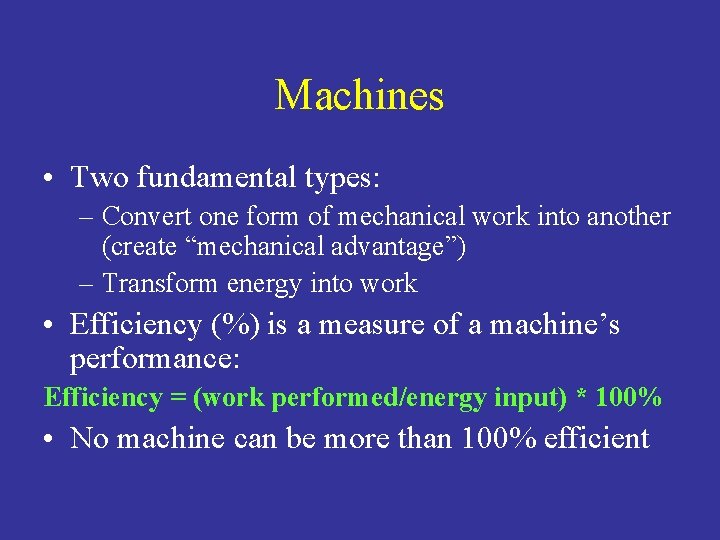
Machines • Two fundamental types: – Convert one form of mechanical work into another (create “mechanical advantage”) – Transform energy into work • Efficiency (%) is a measure of a machine’s performance: Efficiency = (work performed/energy input) * 100% • No machine can be more than 100% efficient
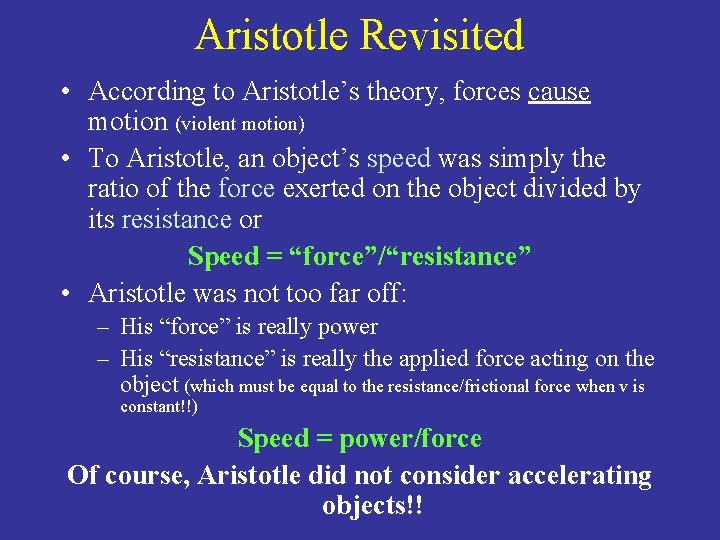
Aristotle Revisited • According to Aristotle’s theory, forces cause motion (violent motion) • To Aristotle, an object’s speed was simply the ratio of the force exerted on the object divided by its resistance or Speed = “force”/“resistance” • Aristotle was not too far off: – His “force” is really power – His “resistance” is really the applied force acting on the object (which must be equal to the resistance/frictional force when v is constant!!) Speed = power/force Of course, Aristotle did not consider accelerating objects!!