Pest management in storage Joe Rickman and Martin

- Slides: 17
Pest management in storage Joe Rickman and Martin Gummert, Agricultural Engineering, International Rice Research Institute, Philippines
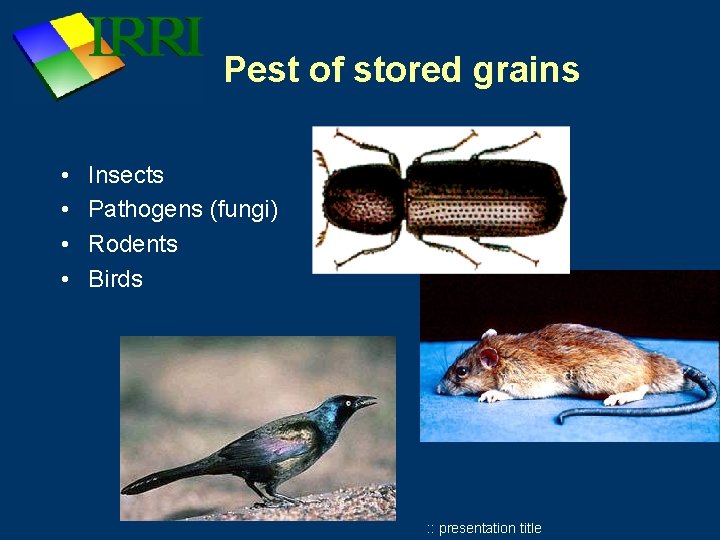
Pest of stored grains • • Insects Pathogens (fungi) Rodents Birds : : presentation title
Ideal Conditions for pest Environment Conditions • Temperature 20 - 40 o. C • Relative humidity 60 -70% Mixing grain lots • old and new Time • Longer storage >no insects : : presentation title
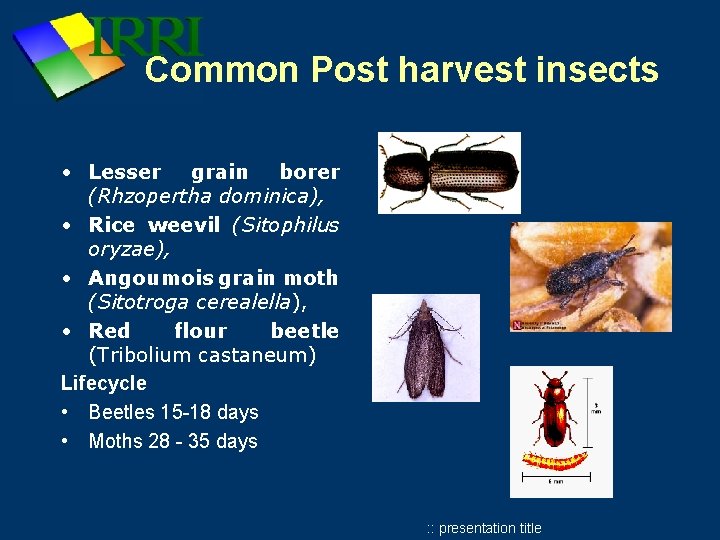
Common Post harvest insects • Lesser grain borer (Rhzopertha dominica), • Rice weevil (Sitophilus oryzae), • Angoumois grain moth (Sitotroga cerealella), • Red flour beetle (Tribolium castaneum) Lifecycle • Beetles 15 -18 days • Moths 28 - 35 days : : presentation title
Management of insect pests : : presentation title
Harvesting and drying • Grain moisture content (12 -14%) • Minimize cracked and broken grain during processing • Don’t mix old and new grain : : presentation title
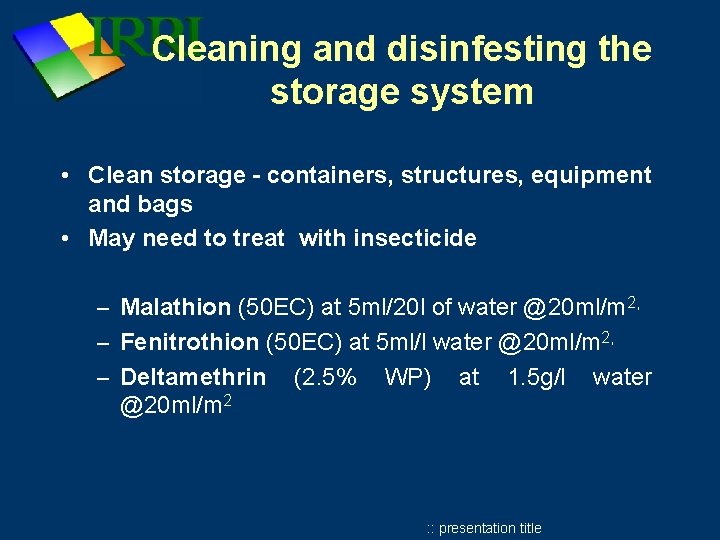
Cleaning and disinfesting the storage system • Clean storage - containers, structures, equipment and bags • May need to treat with insecticide – Malathion (50 EC) at 5 ml/20 l of water @20 ml/m 2, – Fenitrothion (50 EC) at 5 ml/l water @20 ml/m 2, – Deltamethrin (2. 5% WP) at 1. 5 g/l @20 ml/m 2 : : presentation title water
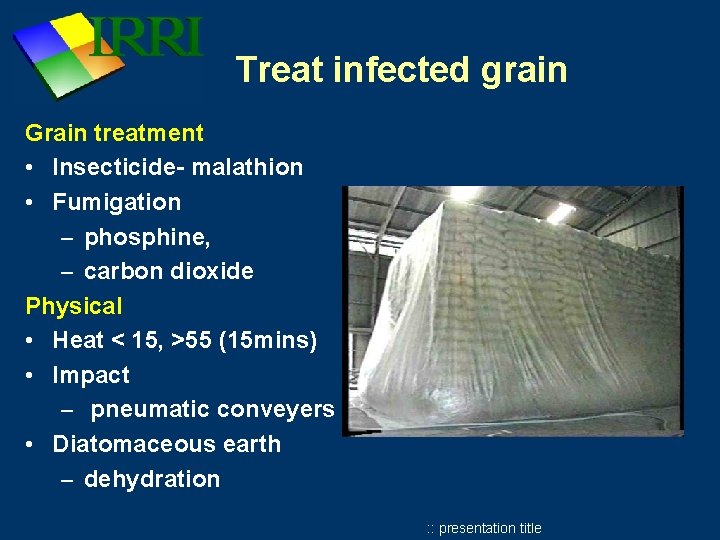
Treat infected grain Grain treatment • Insecticide- malathion • Fumigation – phosphine, – carbon dioxide Physical • Heat < 15, >55 (15 mins) • Impact – pneumatic conveyers • Diatomaceous earth – dehydration : : presentation title
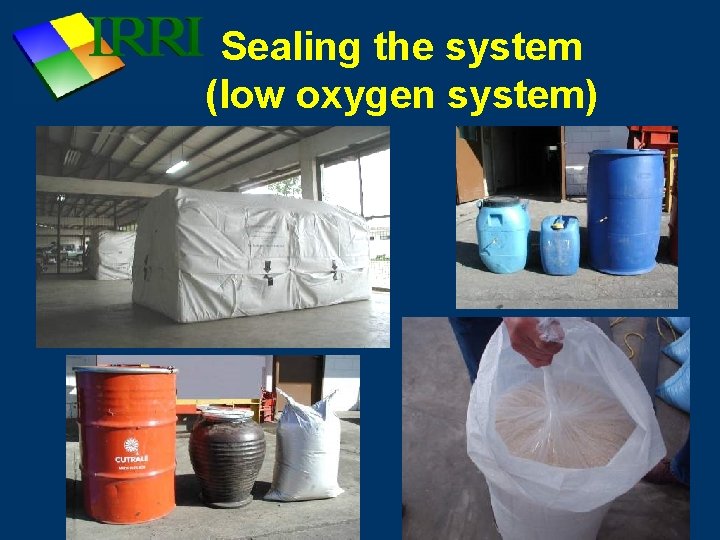
Sealing the system (low oxygen system) : : presentation title
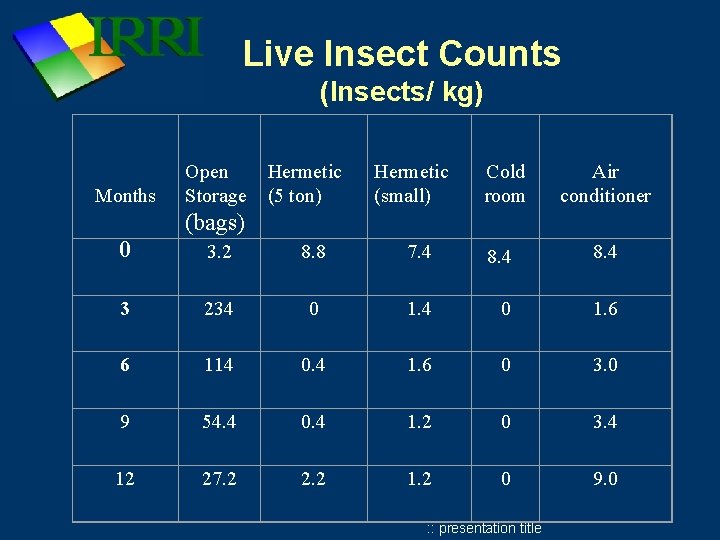
Live Insect Counts (Insects/ kg) Months Open Storage Hermetic (5 ton) Hermetic (small) Cold room Air conditioner (bags) 0 3. 2 8. 8 7. 4 8. 4 3 234 0 1. 6 6 114 0. 4 1. 6 0 3. 0 9 54. 4 0. 4 1. 2 0 3. 4 12 27. 2 2. 2 1. 2 0 9. 0 : : presentation title
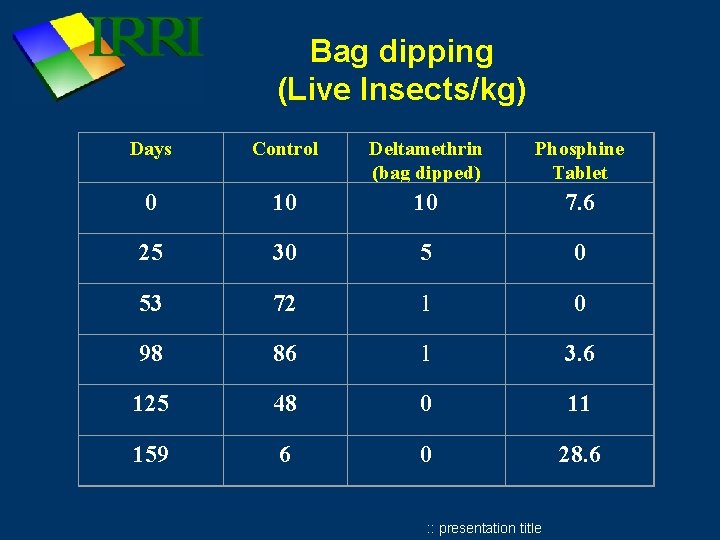
Bag dipping (Live Insects/kg) Days Control Deltamethrin (bag dipped) Phosphine Tablet 0 10 10 7. 6 25 30 5 0 53 72 1 0 98 86 1 3. 6 125 48 0 11 159 6 0 28. 6 : : presentation title
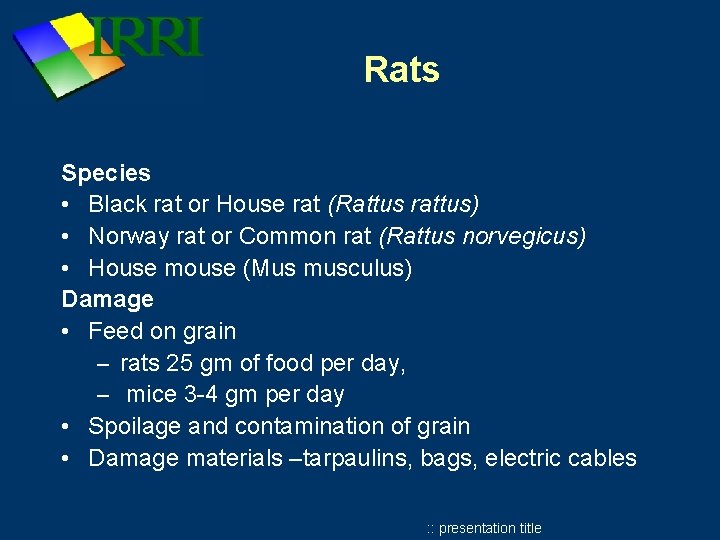
Rats Species • Black rat or House rat (Rattus rattus) • Norway rat or Common rat (Rattus norvegicus) • House mouse (Mus musculus) Damage • Feed on grain – rats 25 gm of food per day, – mice 3 -4 gm per day • Spoilage and contamination of grain • Damage materials –tarpaulins, bags, electric cables : : presentation title
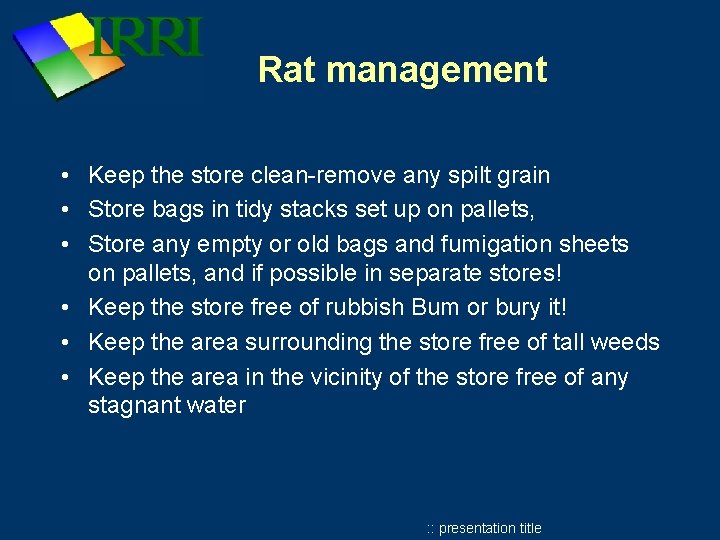
Rat management • Keep the store clean-remove any spilt grain • Store bags in tidy stacks set up on pallets, • Store any empty or old bags and fumigation sheets on pallets, and if possible in separate stores! • Keep the store free of rubbish Bum or bury it! • Keep the area surrounding the store free of tall weeds • Keep the area in the vicinity of the store free of any stagnant water : : presentation title
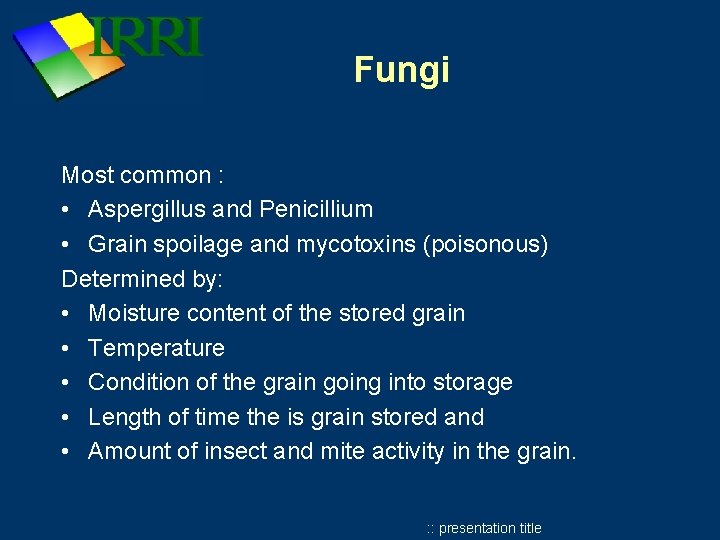
Fungi Most common : • Aspergillus and Penicillium • Grain spoilage and mycotoxins (poisonous) Determined by: • Moisture content of the stored grain • Temperature • Condition of the grain going into storage • Length of time the is grain stored and • Amount of insect and mite activity in the grain. : : presentation title
Fungi Control • Moisture content (12 -14%) • Heat – dry heat at 65 o. C for 6 days – hot water treatment at 52 -55 o. C • Fungicides – Dithane M-45 and Benlate at 3 grams kg-1. : : presentation title
Storage Hygiene • Keep storage areas clean. • Clean storage rooms after they are emptied • Placing rat-traps and barriers in drying and storage areas. Cats deter and help control rats and mice • Inspect storage room regularly to keep it vermin proof. • Inspect the stored seeds once a week for signs of insect infestation. : : presentation title
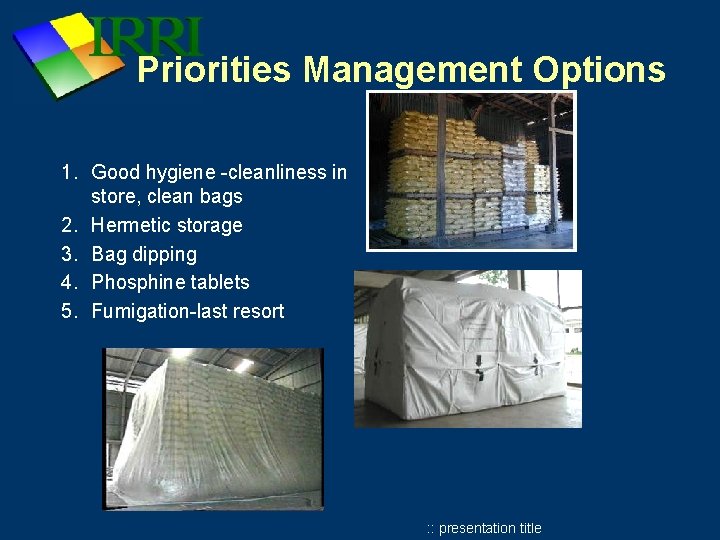
Priorities Management Options 1. Good hygiene -cleanliness in store, clean bags 2. Hermetic storage 3. Bag dipping 4. Phosphine tablets 5. Fumigation-last resort : : presentation title