Personality and Crime General Personality Traits Psychopaths and
- Slides: 22
Personality and Crime General Personality Traits Psychopaths and other nasty people
What is a “Personality? ” n n Webster’s dictionary: “The totality of distinct traits of a particular person. ” Eysenck (1991) Traits = consistent characteristics of people that are relevant to wide variety of behavioral domains. 1. Stable over time 2. Stable over different situations/domains
Measuring Personality n General Standardized Tests – MMPI (Minnesota Muliphasic Personality Inventory) • Pd – CPI (California Personality Inventory) • So – MPQ (Multidimensional Personality Questionnaire
Personality and Crime n Pd (psychopathic deviance) of the MMPI and the So (socialization) scale of the CPI are related to criminal offending, but… – Pd and So include questions about delinquency, probation and parole violations… – These scales were designed to differentiate criminals from non-criminals
Multidimensional Personality Questionnaire (Tellegen) n MPQ is a paper and pencil test that yields 3 “super factors” – Constraint – Negative Emotionality – Positive Emotionality
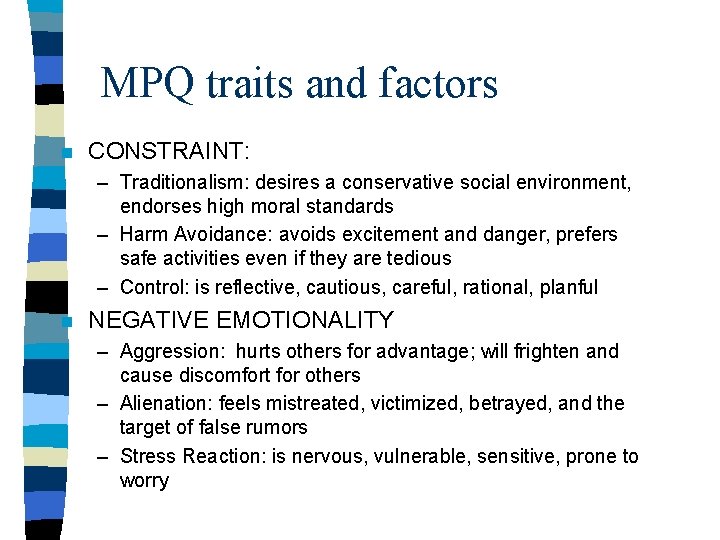
MPQ traits and factors n CONSTRAINT: – Traditionalism: desires a conservative social environment, endorses high moral standards – Harm Avoidance: avoids excitement and danger, prefers safe activities even if they are tedious – Control: is reflective, cautious, careful, rational, planful n NEGATIVE EMOTIONALITY – Aggression: hurts others for advantage; will frighten and cause discomfort for others – Alienation: feels mistreated, victimized, betrayed, and the target of false rumors – Stress Reaction: is nervous, vulnerable, sensitive, prone to worry
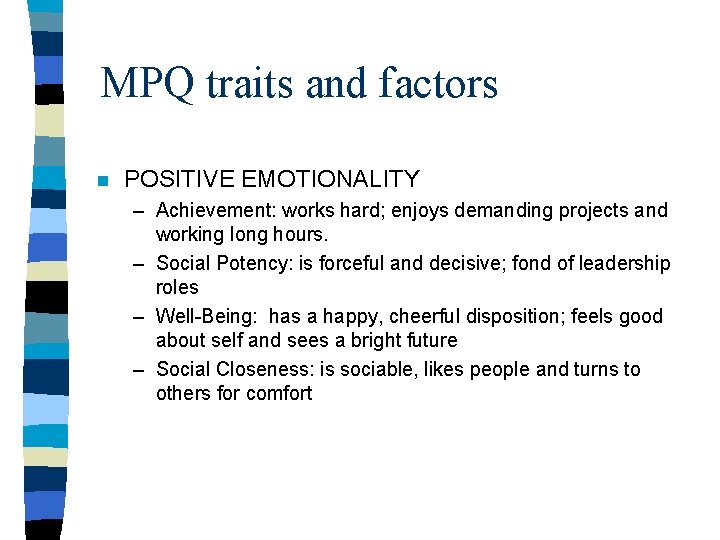
MPQ traits and factors n POSITIVE EMOTIONALITY – Achievement: works hard; enjoys demanding projects and working long hours. – Social Potency: is forceful and decisive; fond of leadership roles – Well-Being: has a happy, cheerful disposition; feels good about self and sees a bright future – Social Closeness: is sociable, likes people and turns to others for comfort
MPQ and Crime n Caspi et al. (1994) – Kids from Pittsburgh, PA, and adolescents from Dunedin, New Zealand – Research Question: Do MPQ personality constructs relate to crime and delinquency • Self-reported • Official • Parent/Teacher reports
Findings n Negative Emotionality and Constraint – Related to crime • • n Across both samples Across race Across different measures of delinquency Delinquents = high negative emotionality and low constraint Why?
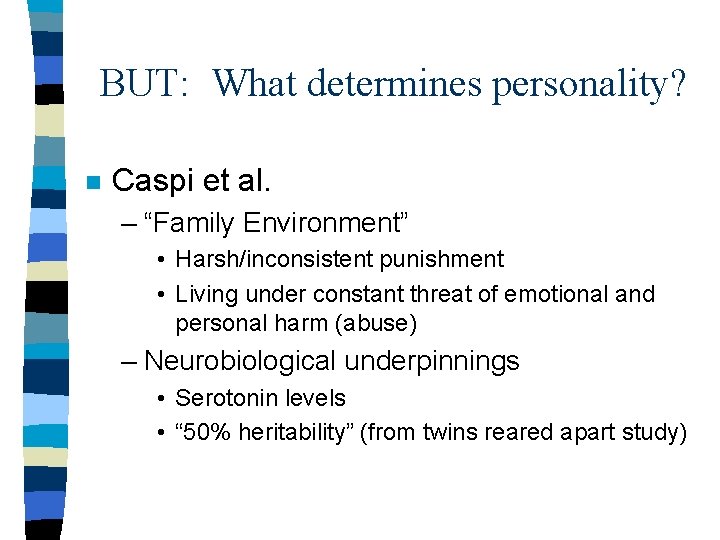
BUT: What determines personality? n Caspi et al. – “Family Environment” • Harsh/inconsistent punishment • Living under constant threat of emotional and personal harm (abuse) – Neurobiological underpinnings • Serotonin levels • “ 50% heritability” (from twins reared apart study)
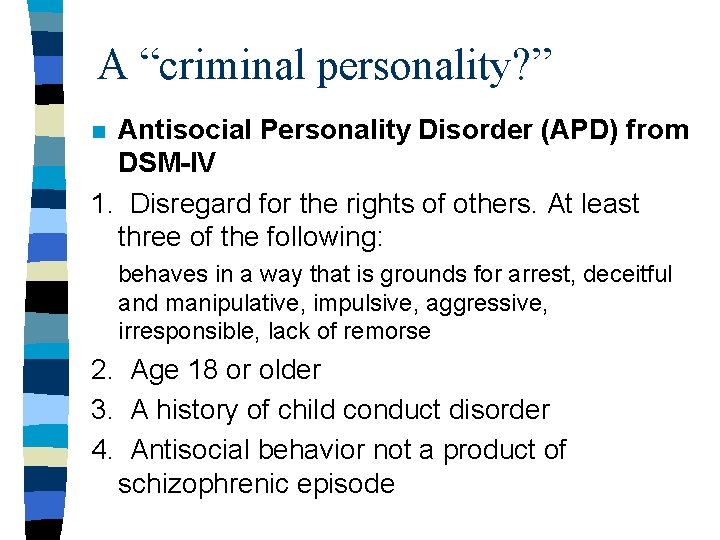
A “criminal personality? ” Antisocial Personality Disorder (APD) from DSM-IV 1. Disregard for the rights of others. At least three of the following: n behaves in a way that is grounds for arrest, deceitful and manipulative, impulsive, aggressive, irresponsible, lack of remorse 2. Age 18 or older 3. A history of child conduct disorder 4. Antisocial behavior not a product of schizophrenic episode
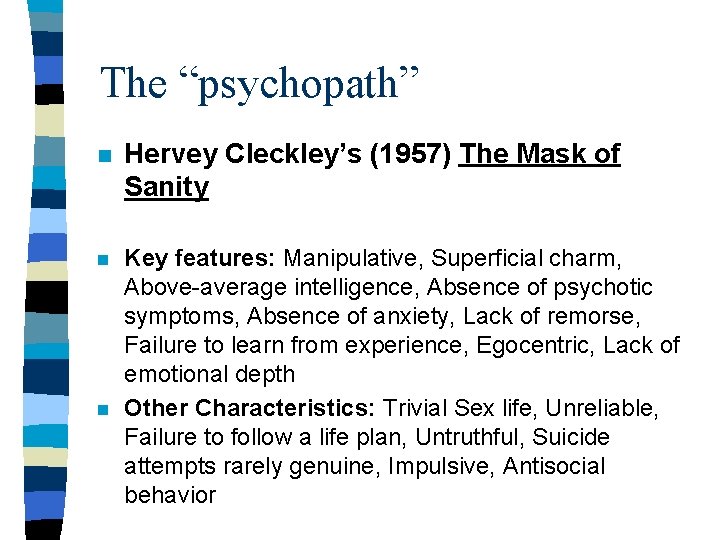
The “psychopath” n Hervey Cleckley’s (1957) The Mask of Sanity n Key features: Manipulative, Superficial charm, Above-average intelligence, Absence of psychotic symptoms, Absence of anxiety, Lack of remorse, Failure to learn from experience, Egocentric, Lack of emotional depth Other Characteristics: Trivial Sex life, Unreliable, Failure to follow a life plan, Untruthful, Suicide attempts rarely genuine, Impulsive, Antisocial behavior n
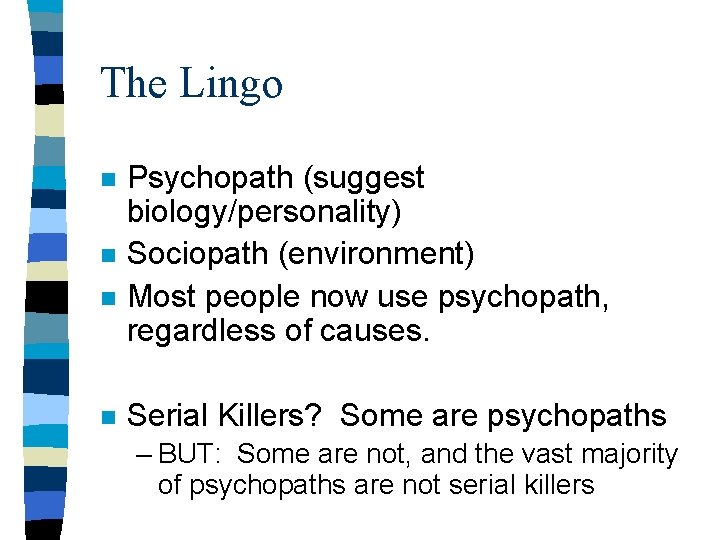
The Lingo n n Psychopath (suggest biology/personality) Sociopath (environment) Most people now use psychopath, regardless of causes. Serial Killers? Some are psychopaths – BUT: Some are not, and the vast majority of psychopaths are not serial killers
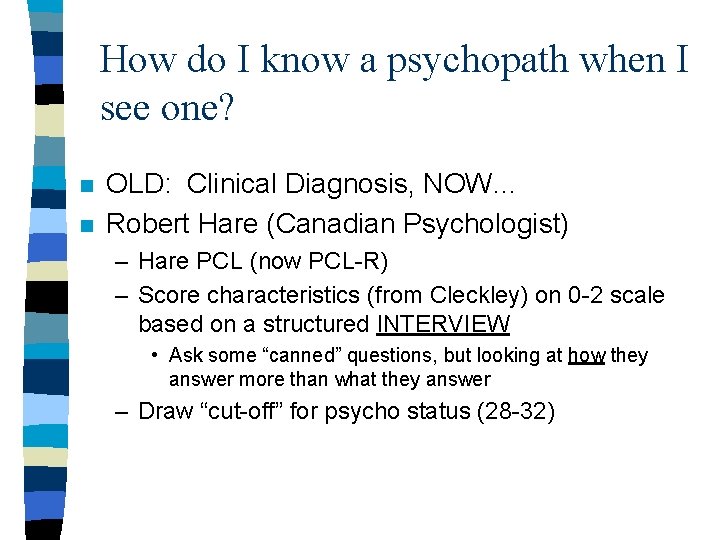
How do I know a psychopath when I see one? n n OLD: Clinical Diagnosis, NOW… Robert Hare (Canadian Psychologist) – Hare PCL (now PCL-R) – Score characteristics (from Cleckley) on 0 -2 scale based on a structured INTERVIEW • Ask some “canned” questions, but looking at how they answer more than what they answer – Draw “cut-off” for psycho status (28 -32)
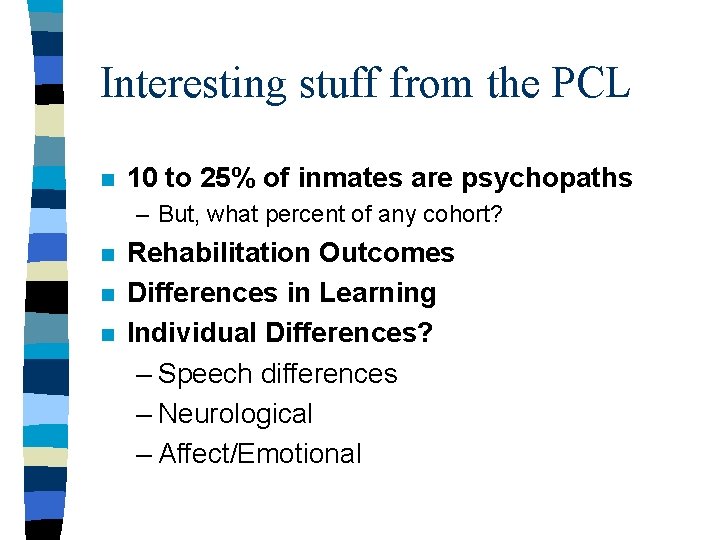
Interesting stuff from the PCL n 10 to 25% of inmates are psychopaths – But, what percent of any cohort? n n n Rehabilitation Outcomes Differences in Learning Individual Differences? – Speech differences – Neurological – Affect/Emotional
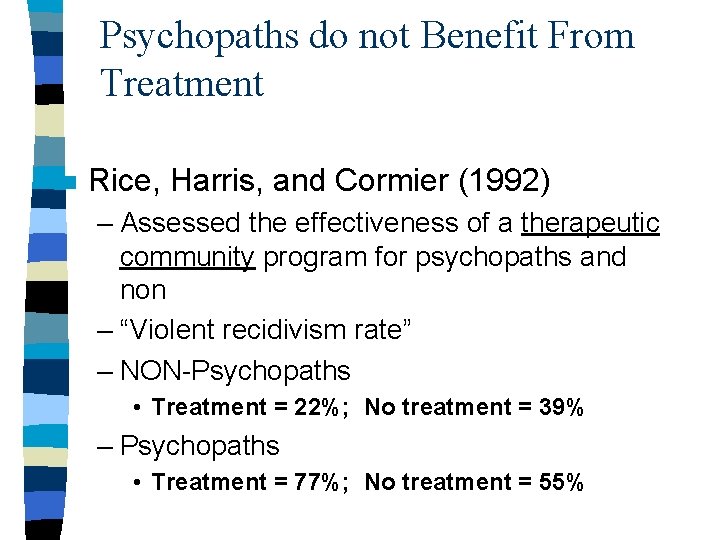
Psychopaths do not Benefit From Treatment n Rice, Harris, and Cormier (1992) – Assessed the effectiveness of a therapeutic community program for psychopaths and non – “Violent recidivism rate” – NON-Psychopaths • Treatment = 22%; No treatment = 39% – Psychopaths • Treatment = 77%; No treatment = 55%
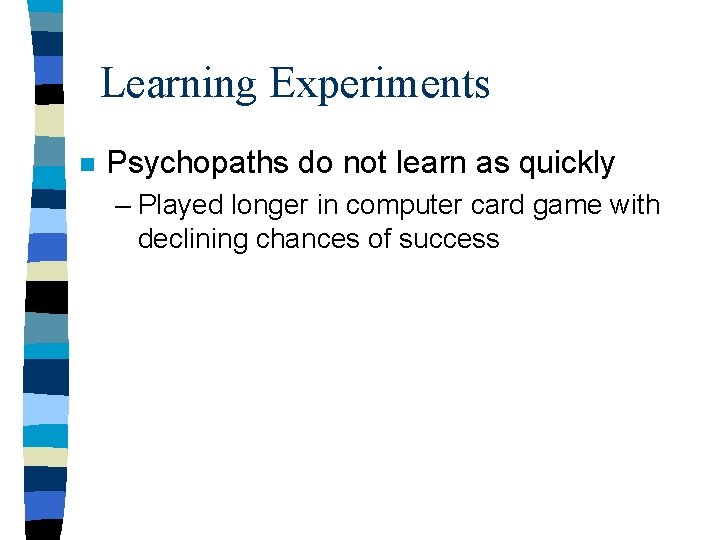
Learning Experiments n Psychopaths do not learn as quickly – Played longer in computer card game with declining chances of success
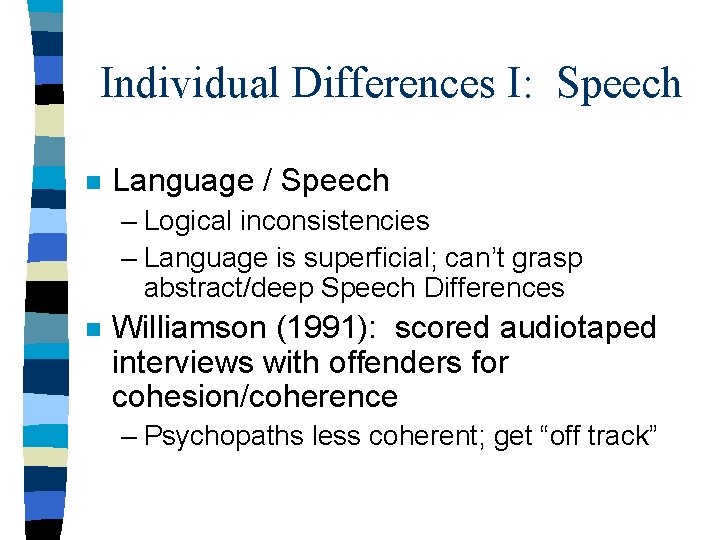
Individual Differences I: Speech n Language / Speech – Logical inconsistencies – Language is superficial; can’t grasp abstract/deep Speech Differences n Williamson (1991): scored audiotaped interviews with offenders for cohesion/coherence – Psychopaths less coherent; get “off track”
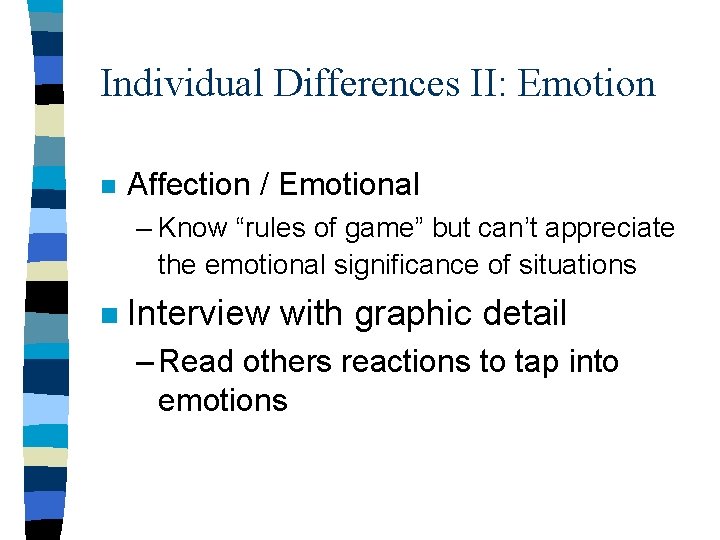
Individual Differences II: Emotion n Affection / Emotional – Know “rules of game” but can’t appreciate the emotional significance of situations n Interview with graphic detail – Read others reactions to tap into emotions
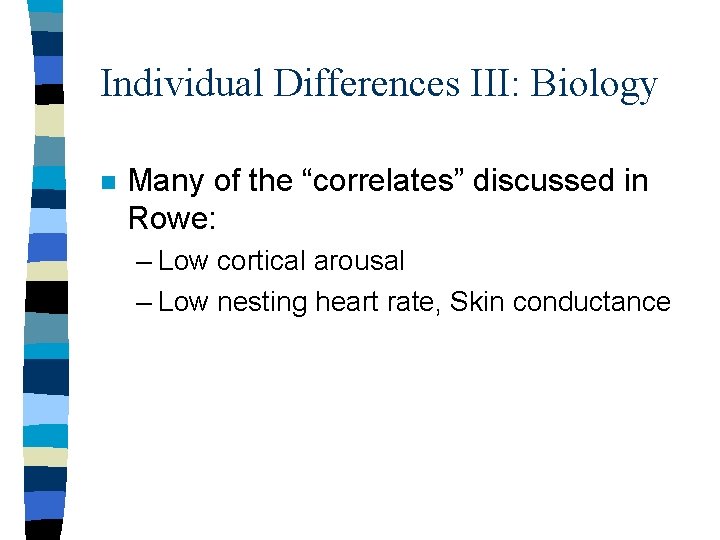
Individual Differences III: Biology n Many of the “correlates” discussed in Rowe: – Low cortical arousal – Low nesting heart rate, Skin conductance
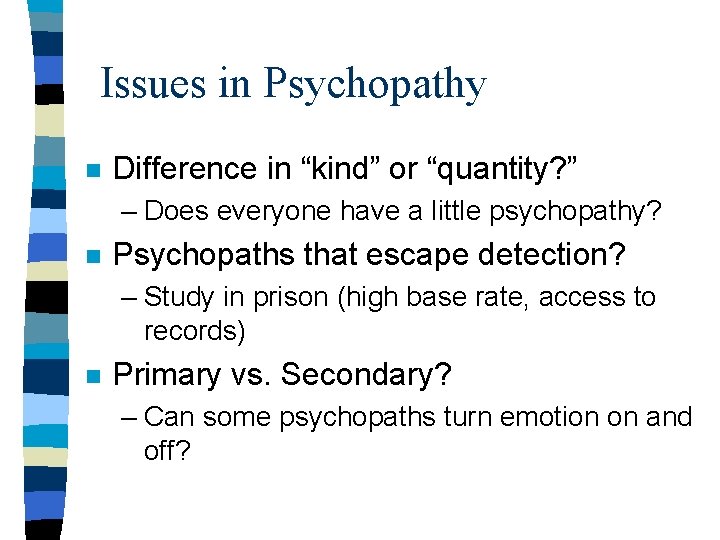
Issues in Psychopathy n Difference in “kind” or “quantity? ” – Does everyone have a little psychopathy? n Psychopaths that escape detection? – Study in prison (high base rate, access to records) n Primary vs. Secondary? – Can some psychopaths turn emotion on and off?
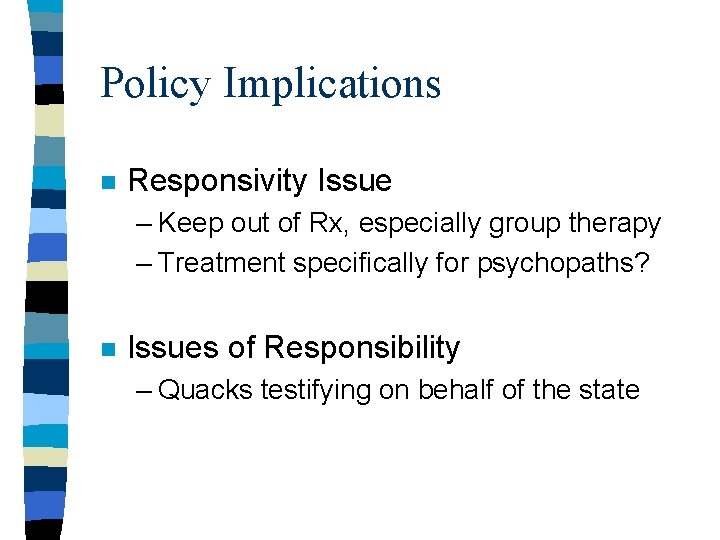
Policy Implications n Responsivity Issue – Keep out of Rx, especially group therapy – Treatment specifically for psychopaths? n Issues of Responsibility – Quacks testifying on behalf of the state