Patient Safety Competencies in Rural ASN Students An
- Slides: 1
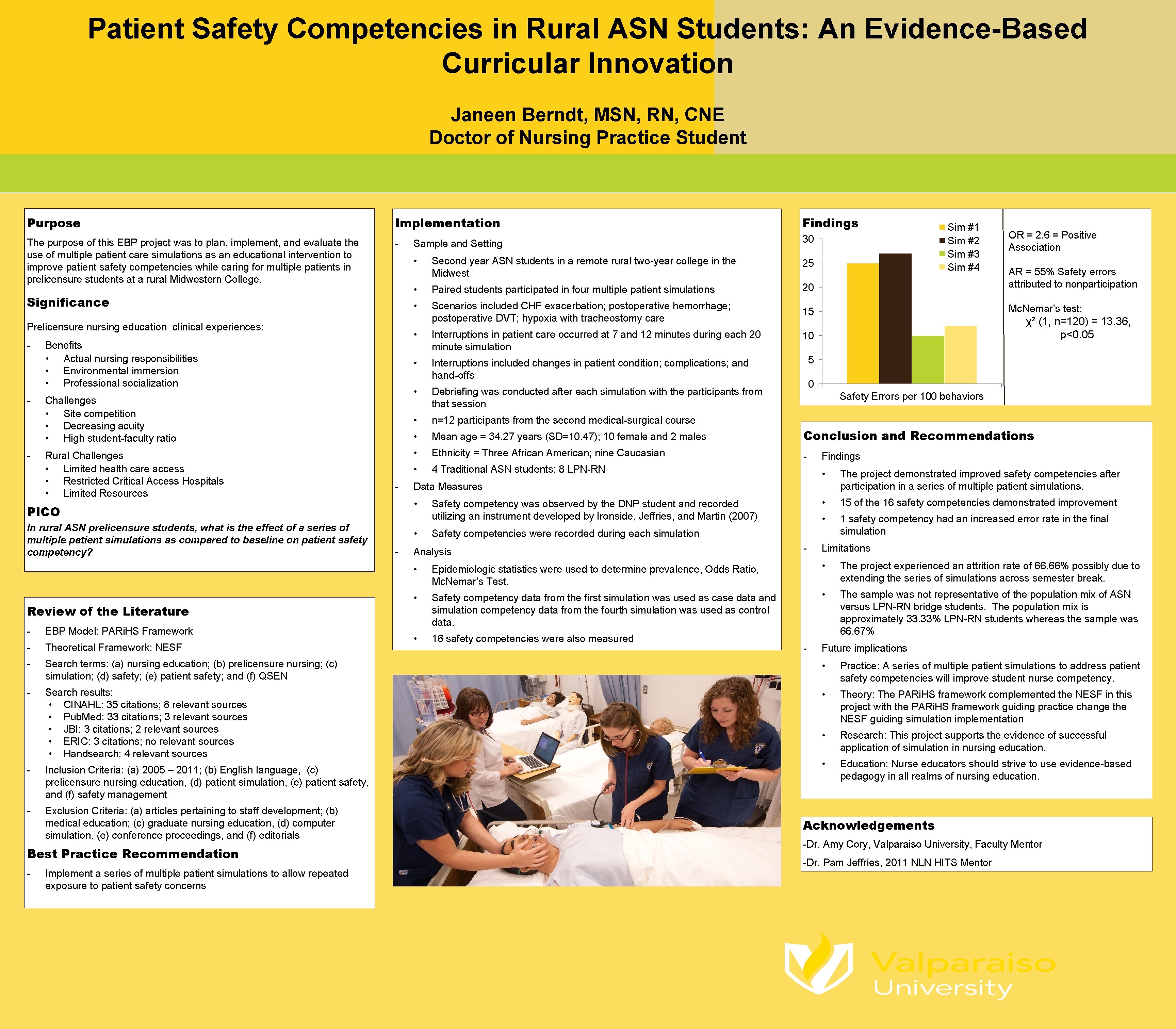
Patient Safety Competencies in Rural ASN Students: An Evidence-Based Curricular Innovation Janeen Berndt, MSN, RN, CNE Doctor of Nursing Practice Student Purpose The purpose of this EBP project was to plan, implement, and evaluate the use of multiple patient care simulations as an educational intervention to improve patient safety competencies while caring for multiple patients in prelicensure students at a rural Midwestern College. Implementation Findings - Sample and Setting 30 • Second year ASN students in a remote rural two-year college in the Midwest 25 • Paired students participated in four multiple patient simulations 20 AR = 55% Safety errors attributed to nonparticipation • Scenarios included CHF exacerbation; postoperative hemorrhage; postoperative DVT; hypoxia with tracheostomy care 15 Mc. Nemar’s test: • Interruptions in patient care occurred at 7 and 12 minutes during each 20 minute simulation 10 • Interruptions included changes in patient condition; complications; and hand-offs Significance Prelicensure nursing education clinical experiences: - - - Benefits • Actual nursing responsibilities • Environmental immersion • Professional socialization Challenges • Site competition • Decreasing acuity • High student-faculty ratio Rural Challenges • Limited health care access • Restricted Critical Access Hospitals • Limited Resources - In rural ASN prelicensure students, what is the effect of a series of multiple patient simulations as compared to baseline on patient safety competency? Review of the Literature χ² (1, n=120) = 13. 36, p<0. 05 5 0 Debriefing was conducted after each simulation with the participants from that session • n=12 participants from the second medical-surgical course • Mean age = 34. 27 years (SD=10. 47); 10 female and 2 males Conclusion and Recommendations • Ethnicity = Three African American; nine Caucasian - • 4 Traditional ASN students; 8 LPN-RN Safety Errors per 100 behaviors Findings • The project demonstrated improved safety competencies after participation in a series of multiple patient simulations. • 15 of the 16 safety competencies demonstrated improvement • 1 safety competency had an increased error rate in the final simulation Data Measures • - OR = 2. 6 = Positive Association • • PICO Sim #1 Sim #2 Sim #3 Sim #4 Safety competency was observed by the DNP student and recorded utilizing an instrument developed by Ironside, Jeffries, and Martin (2007) Safety competencies were recorded during each simulation Analysis - Limitations • Epidemiologic statistics were used to determine prevalence, Odds Ratio, Mc. Nemar’s Test. • The project experienced an attrition rate of 66. 66% possibly due to extending the series of simulations across semester break. • Safety competency data from the first simulation was used as case data and simulation competency data from the fourth simulation was used as control data. • • 16 safety competencies were also measured The sample was not representative of the population mix of ASN versus LPN-RN bridge students. The population mix is approximately 33. 33% LPN-RN students whereas the sample was 66. 67% - EBP Model: PARi. HS Framework - Theoretical Framework: NESF - Search terms: (a) nursing education; (b) prelicensure nursing; (c) simulation; (d) safety; (e) patient safety; and (f) QSEN • Practice: A series of multiple patient simulations to address patient safety competencies will improve student nurse competency. - Search results: • CINAHL: 35 citations; 8 relevant sources • Pub. Med: 33 citations; 3 relevant sources • JBI: 3 citations; 2 relevant sources • ERIC: 3 citations; no relevant sources • Handsearch: 4 relevant sources • Theory: The PARi. HS framework complemented the NESF in this project with the PARi. HS framework guiding practice change the NESF guiding simulation implementation • Research: This project supports the evidence of successful application of simulation in nursing education. • Education: Nurse educators should strive to use evidence-based pedagogy in all realms of nursing education. - Inclusion Criteria: (a) 2005 – 2011; (b) English language, (c) prelicensure nursing education, (d) patient simulation, (e) patient safety, and (f) safety management - Exclusion Criteria: (a) articles pertaining to staff development; (b) medical education; (c) graduate nursing education, (d) computer simulation, (e) conference proceedings, and (f) editorials Best Practice Recommendation - Implement a series of multiple patient simulations to allow repeated exposure to patient safety concerns - Future implications Acknowledgements -Dr. Amy Cory, Valparaiso University, Faculty Mentor -Dr. Pam Jeffries, 2011 NLN HITS Mentor