Part I Entrepreneurship in the TwentyFirst Century Chapter
- Slides: 18
Part I – Entrepreneurship in the Twenty-First Century Chapter 1 - The Entrepreneurial Revolution Chapter 2 - Entrepreneurship: An Evolving Concept Chapter 3 - Intrapreneurship: Developing Corporate Entrepreneurship Copyright (c) 2004 by South-Western, a division of Thomson Learning. All rights reserved.
Chapter 2 – Entrepreneurship: An Evolving Concept
The Evolution of Entrepreneurship • Entrepreneur is derived from the French entreprendre, meaning “to undertake”. • Although no single definition of entrepreneur exists and no one profile can represent today’s entrepreneur, research is providing an increasingly sharper focus on the subject.
Robert C. Ronstadt put together a summary description: • Entrepreneurship is the dynamic process of creating incremental wealth. This wealth is created by individuals who assume the major risks in terms of equity, time, and/or career commitment of providing value for some product or service. The product or service itself may or may not be new or unique but value must somehow be infused by the entrepreneur by securing and allocating the necessary skills and resources.
An Integrated Definition • Entrepreneurship is a dynamic process of vision, change, and creation. It requires an application of energy and passion towards the creation and implementation of new ideas and creative solutions. Essential ingredients include the willingness to take calculated risks- in terms of time, equity, or career; the ability to formulate an effective venture team; the creative skill to marshall needed resources; the fundamental skills of building a solid business plan; and, finally, the vision to recognize opportunity where others see chaos, contradiction, and confusion.
The Myths of Entrepreneurship • Myth 1: Entrepreneurs Are Doers, Not Thinkers • Myth 2: Entrepreneurs Are Born, Not Made • Myth 3: Entrepreneurs Are Always Inventors • Myth 4: Entrepreneurs Are Academic and Social Misfits • Myth 5: Entrepreneurs Must Fit the “Profile” • Myth 6: All Entrepreneurs Need Is Money
The Myths of Entrepreneurship • Myth 7: All Entrepreneurs Need Is Luck • Myth 8: Ignorance Is Bliss For Entrepreneurs • Myth 9: Entrepreneurs Seek Success But Experience High Failure Rates • Myth 10: Entrepreneurs Are Extreme Risk Takers (Gamblers)
The Corridor Principle States that with every venture launched, new and unintended opportunities often arise.
Approaches to Entrepreneurship • Schools of Thought Approach • Process Approaches
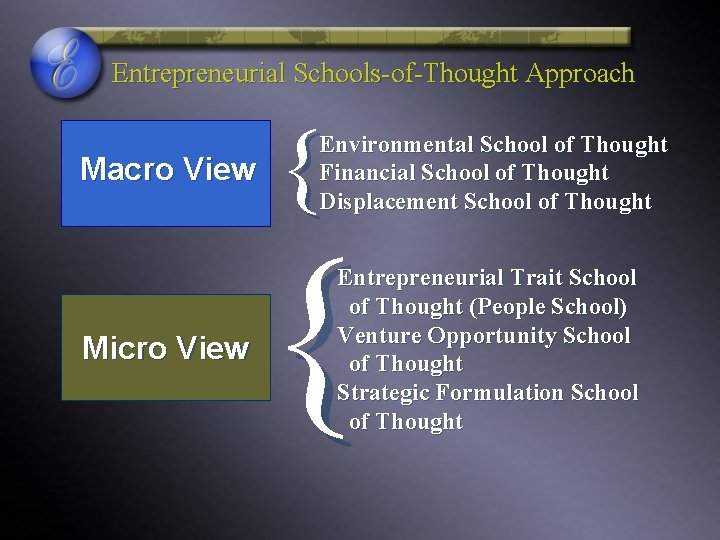
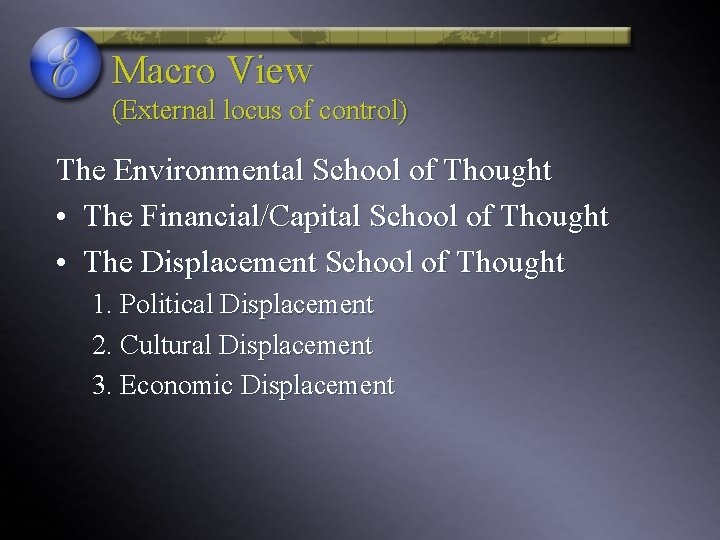
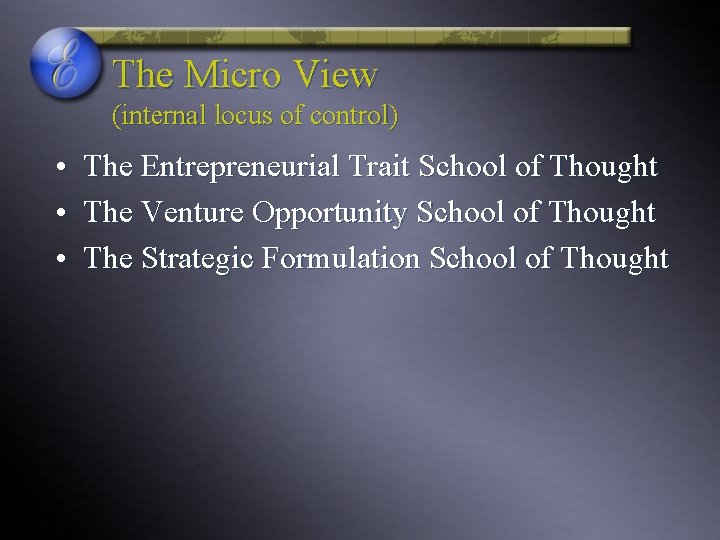
Entrepreneurial Schools-of-Thought Approach Macro View Micro View { Environmental School of Thought Financial School of Thought Displacement School of Thought { Entrepreneurial Trait School of Thought (People School) Venture Opportunity School of Thought Strategic Formulation School of Thought
Macro View (External locus of control) The Environmental School of Thought • The Financial/Capital School of Thought • The Displacement School of Thought 1. Political Displacement 2. Cultural Displacement 3. Economic Displacement
The Micro View (internal locus of control) • • • The Entrepreneurial Trait School of Thought The Venture Opportunity School of Thought The Strategic Formulation School of Thought
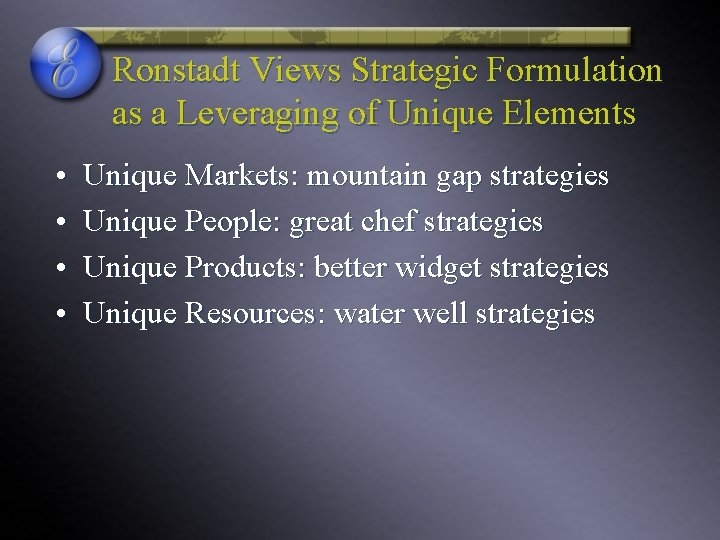
Ronstadt Views Strategic Formulation as a Leveraging of Unique Elements • • Unique Markets: mountain gap strategies Unique People: great chef strategies Unique Products: better widget strategies Unique Resources: water well strategies
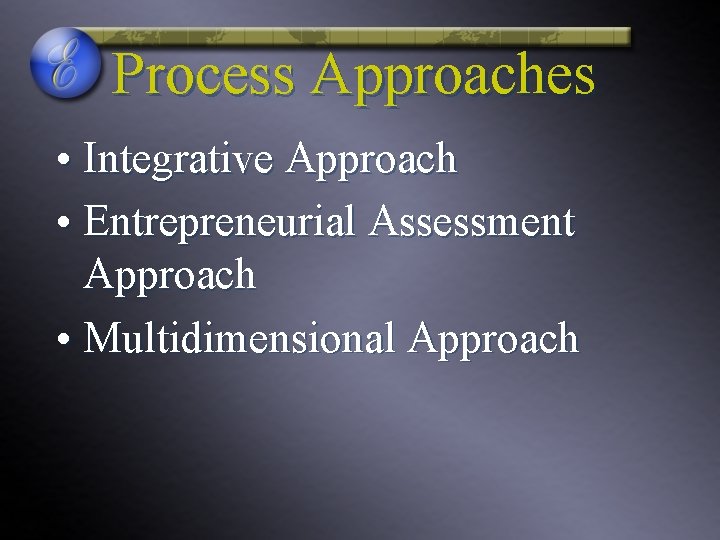
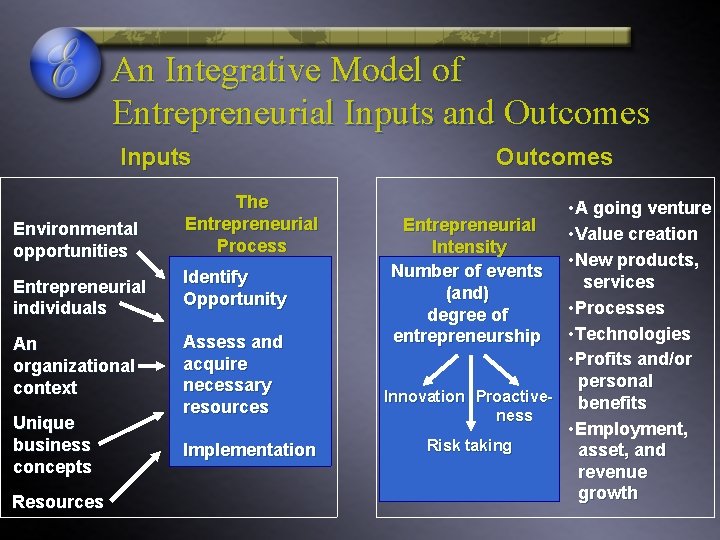
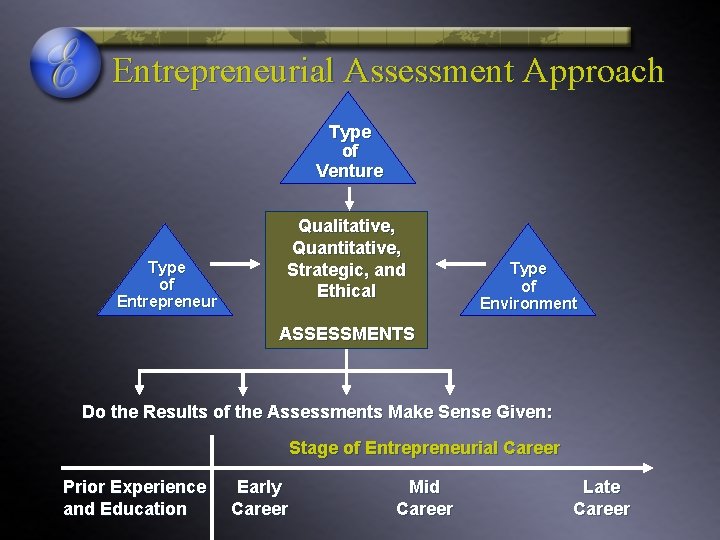
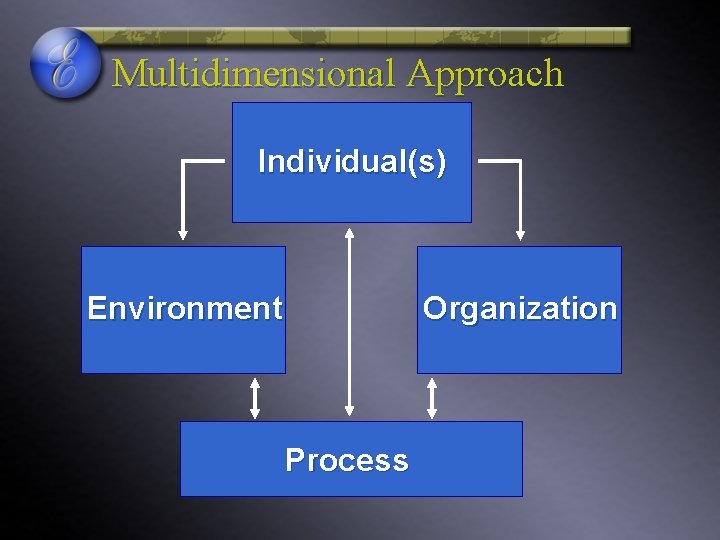
Process Approaches • Integrative Approach • Entrepreneurial Assessment Approach • Multidimensional Approach
An Integrative Model of Entrepreneurial Inputs and Outcomes Inputs Environmental opportunities Entrepreneurial individuals An organizational context Unique business concepts Resources The Entrepreneurial Process Identify Opportunity Assess and acquire necessary resources Implementation Outcomes • A going venture Entrepreneurial • Value creation Intensity • New products, Number of events services (and) • Processes degree of entrepreneurship • Technologies • Profits and/or personal Innovation Proactivebenefits ness • Employment, Risk taking asset, and revenue growth
Entrepreneurial Assessment Approach Type of Venture Type of Entrepreneur Qualitative, Quantitative, Strategic, and Ethical Type of Environment ASSESSMENTS Do the Results of the Assessments Make Sense Given: Stage of Entrepreneurial Career Prior Experience and Education Early Career Mid Career Late Career
Multidimensional Approach Individual(s) Environment Organization Process
Entrepreneurial Management • The underlying theme of this book is the discipline of entrepreneurial management: – Entrepreneurship is based upon the same principles, whether the entrepreneur is an existing large institution or an individual starting his or her new venture singlehanded. It makes little or no difference whether the entrepreneur is a business or a nonbusiness public-service organization, nor even whether the entrepreneur is a governmental or nongovernmental institution. The rules are pretty much the same, the things that work and those that don’t are pretty much the same, and so are the kinds of innovations and where to look for them. In every case there is a discipline we might call Entrepreneurial Management.