
CHAPTER 6 1 CHAPTER 6 Entrepreneurship and Small



- Slides: 41
CHAPTER 6 1 CHAPTER 6 Entrepreneurship and Small Business Management 6 -1 Becoming an Entrepreneur 6 -2 Small Business Basics 6 -3 Starting a Small Business © 2012 Cengage Learning. All Rights Reserved. Principles of Business, 8 e
6 -1 Becoming an Entrepreneur Goal 1 Identify characteristics of successful entrepreneurs. Goal 2 Recognize the importance of entrepreneurship in the economy. Goal 3 Describe opportunities and risks of entrepreneurship. © 2012 Cengage Learning. All Rights Reserved. SLIDE 2
CHAPTER KEY TERMS 6 3 ● entrepreneurship ● venture capital ● innovation ● improvement © 2012 Cengage Learning. All Rights Reserved. Principles of Business, 8 e
CHARACTERISTICS OF ENTREPRENEURS CHAPTER 6 4 ● Desire to be your own boss ● Special skills and abilities © 2012 Cengage Learning. All Rights Reserved. Principles of Business, 8 e
ENTREPRENEURS IN ACTION CHAPTER 6 5 ● Joshua Moore ● Ben Cathers ● Rich Stachowski ● Abbey Fleck © 2012 Cengage Learning. All Rights Reserved. Principles of Business, 8 e
CHAPTER 6 6 WHAT DOES IT TAKE? ● Not all business owners and managers are entrepreneurs. ● Entrepreneurs have unique skills and personal characteristics. © 2012 Cengage Learning. All Rights Reserved. Principles of Business, 8 e
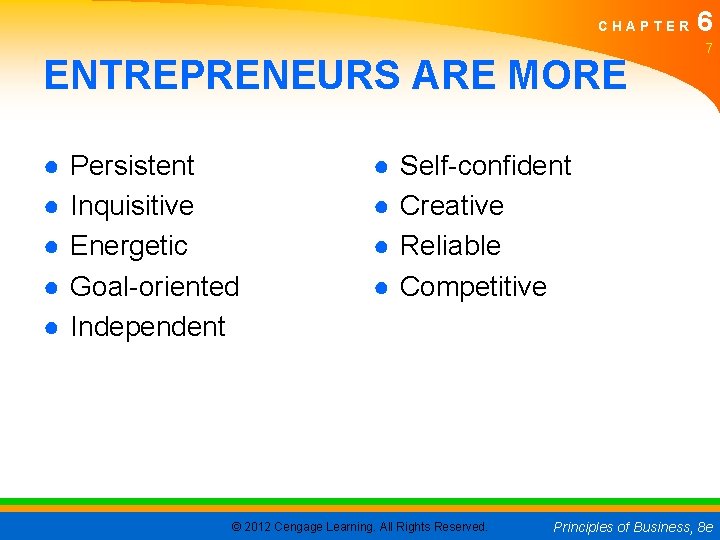
CHAPTER ENTREPRENEURS ARE MORE ● ● ● Persistent Inquisitive Energetic Goal-oriented Independent ● ● 6 7 Self-confident Creative Reliable Competitive © 2012 Cengage Learning. All Rights Reserved. Principles of Business, 8 e
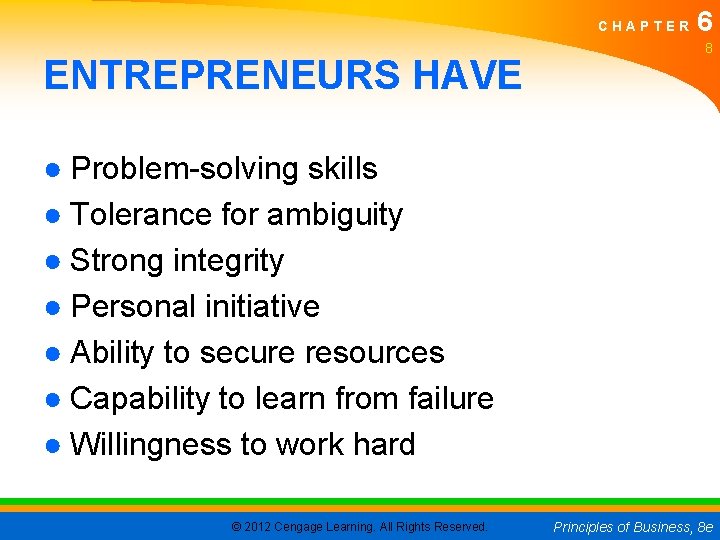
CHAPTER ENTREPRENEURS HAVE 6 8 ● Problem-solving skills ● Tolerance for ambiguity ● Strong integrity ● Personal initiative ● Ability to secure resources ● Capability to learn from failure ● Willingness to work hard © 2012 Cengage Learning. All Rights Reserved. Principles of Business, 8 e
CHAPTER 6 9 Checkpoint ● What personal characteristic are common to most successful entrepreneurs? ● Any characteristics listed in Figure 6 -1 are acceptable, such as persistence, inquisitiveness, self-confidence, creativity, and so forth. © 2012 Cengage Learning. All Rights Reserved. Principles of Business, 8 e
ENTREPRENEURSHIP AND THE ECONOMY CHAPTER 6 10 ● Employment ● Financing ● Productivity © 2012 Cengage Learning. All Rights Reserved. Principles of Business, 8 e
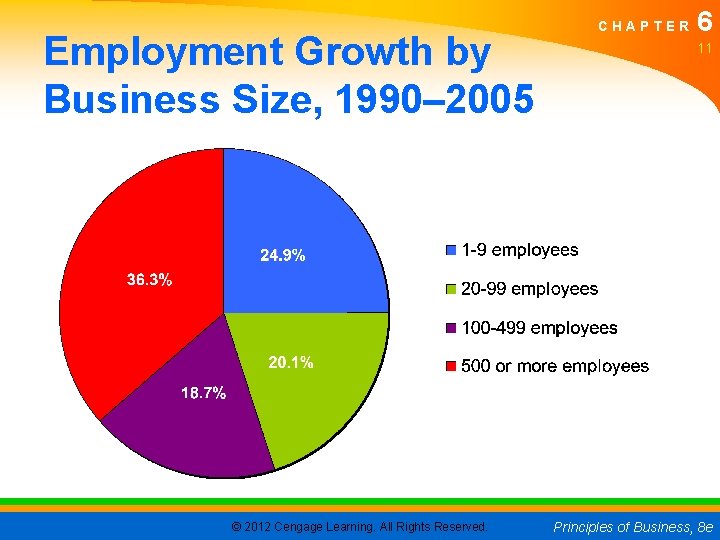
Employment Growth by Business Size, 1990– 2005 © 2012 Cengage Learning. All Rights Reserved. CHAPTER 6 11 Principles of Business, 8 e
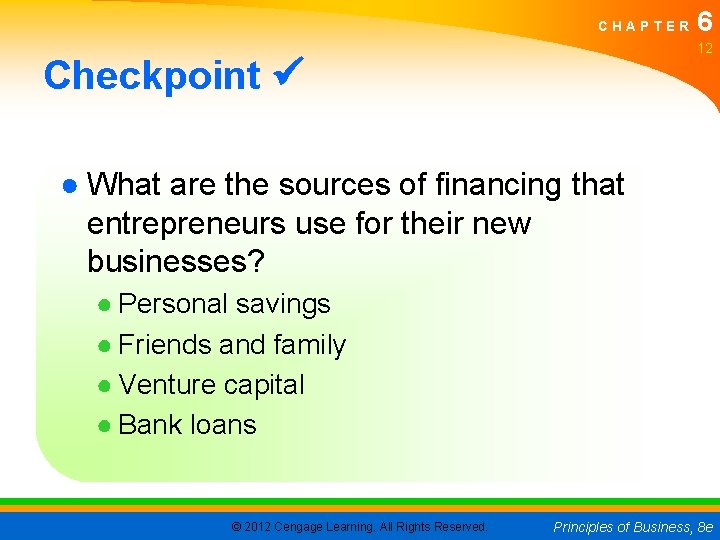
CHAPTER 6 12 Checkpoint ● What are the sources of financing that entrepreneurs use for their new businesses? ● Personal savings ● Friends and family ● Venture capital ● Bank loans © 2012 Cengage Learning. All Rights Reserved. Principles of Business, 8 e
CHAPTER OPPORTUNITIES AND RISKS 6 13 ● Before deciding to start a business, you need to think about the opportunities and risks. © 2012 Cengage Learning. All Rights Reserved. Principles of Business, 8 e
NEW BUSINESS OPPORTUNITIES CHAPTER 6 14 ● Innovation ● Improvement © 2012 Cengage Learning. All Rights Reserved. Principles of Business, 8 e
CHAPTER 6 15 RECOGNIZING RISKS ● Lack of adequate capital ● Low sales ● Higher than expected expenses ● Competitive pressure ● An owner unprepared to manage a growing business ● Operations requiring more time than the owner is willing to commit © 2012 Cengage Learning. All Rights Reserved. Principles of Business, 8 e
CHAPTER 6 16 Checkpoint ● Where do entrepreneurship opportunities begin? ● Opportunities begin with innovations (ideas about new products and services) or improvements (ideas for changes to existing products, services, or processes). © 2012 Cengage Learning. All Rights Reserved. Principles of Business, 8 e
6 -2 Small Business Basics Goal 1 Identify important characteristics of small businesses. Goal 2 Recognize the competitive advantages of small businesses. Goal 3 Identify problems faced by many small businesses. © 2012 Cengage Learning. All Rights Reserved. SLIDE 17
CHAPTER 6 18 KEY TERMS ● small business ● Small Business Administration (SBA) © 2012 Cengage Learning. All Rights Reserved. Principles of Business, 8 e
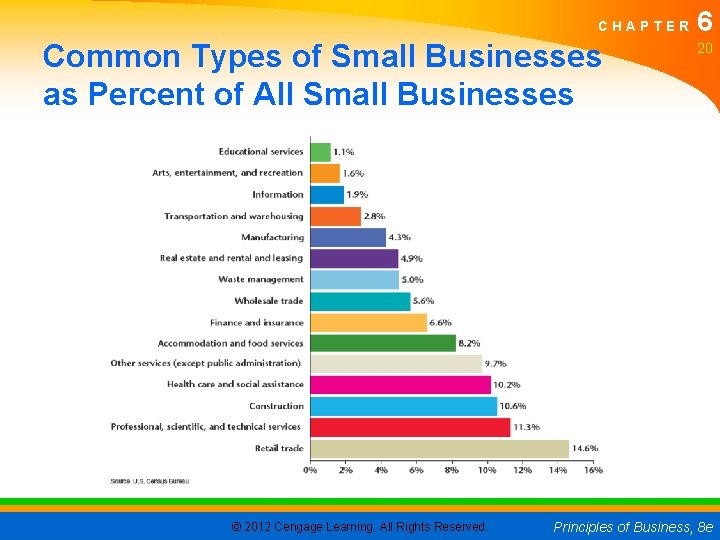
CHAPTER SMALL BUSINESS OWNERSHIP 6 19 ● Description of a small business ● Owner is usually the manager ● Operates in one or very few locations ● Typically serves a small market ● Not dominant in its field ● Small business employment ● Ownership diversity © 2012 Cengage Learning. All Rights Reserved. Principles of Business, 8 e
CHAPTER Common Types of Small Businesses as Percent of All Small Businesses © 2012 Cengage Learning. All Rights Reserved. 6 20 Principles of Business, 8 e
CHAPTER 6 21 Checkpoint ● Beyond the formal definition of a small business, what four points can be used to describe a small business? ● Owner is usually the manager ● Business operates in one or very few locations ● Business typically serves a small market ● Business is not dominant in its field © 2012 Cengage Learning. All Rights Reserved. Principles of Business, 8 e
SMALL BUSINESS ADVANTAGES CHAPTER 6 22 ● Meeting customer needs ● Providing unique services © 2012 Cengage Learning. All Rights Reserved. Principles of Business, 8 e
CHAPTER 6 23 Checkpoint ● How can small businesses compete successfully with larger businesses? ● Smaller businesses are able to provide more personalized products and services to their customers. ● They are able to provide products and services where smaller orders and projects are required and tend to fill unique customer needs, which larger companies do not provide. © 2012 Cengage Learning. All Rights Reserved. Principles of Business, 8 e
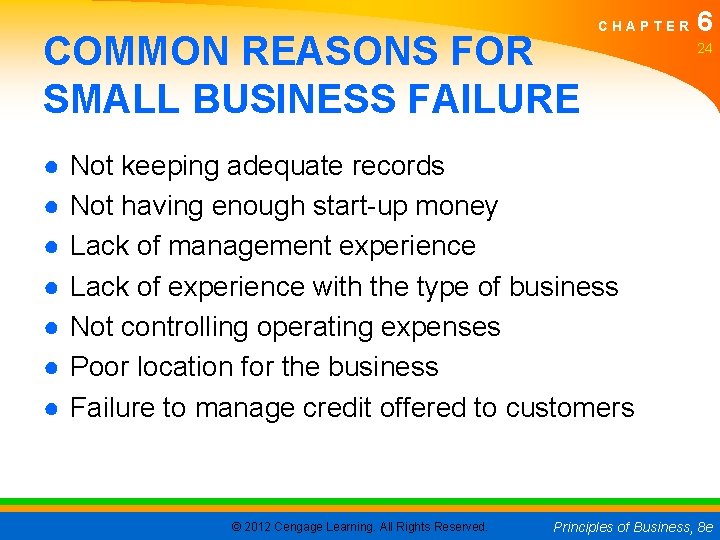
COMMON REASONS FOR SMALL BUSINESS FAILURE ● ● ● ● CHAPTER 6 24 Not keeping adequate records Not having enough start-up money Lack of management experience Lack of experience with the type of business Not controlling operating expenses Poor location for the business Failure to manage credit offered to customers © 2012 Cengage Learning. All Rights Reserved. Principles of Business, 8 e
SMALL BUSINESS ASSISTANCE CHAPTER 6 25 ● University and college faculty members ● Local groups of business people ● Small Business Administration (SBA) © 2012 Cengage Learning. All Rights Reserved. Principles of Business, 8 e
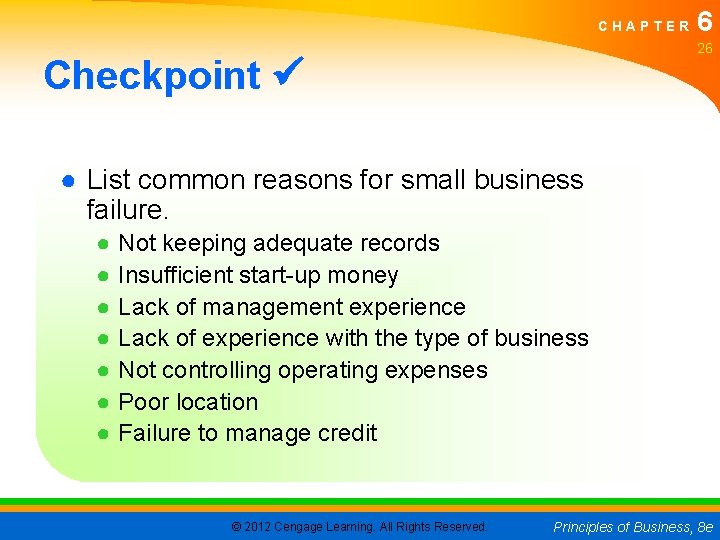
CHAPTER 6 26 Checkpoint ● List common reasons for small business failure. ● ● ● ● Not keeping adequate records Insufficient start-up money Lack of management experience Lack of experience with the type of business Not controlling operating expenses Poor location Failure to manage credit © 2012 Cengage Learning. All Rights Reserved. Principles of Business, 8 e
6 -3 Starting a Small Business Goal 1 Recognize important factors to be considered when starting a business. Goal 2 Describe the elements of a business plan. Goal 3 Identify types and sources of financing for a small business. © 2012 Cengage Learning. All Rights Reserved. SLIDE 27
CHAPTER KEY TERMS 6 28 ● business plan ● start-up financing ● short-term financing ● long-term financing © 2012 Cengage Learning. All Rights Reserved. Principles of Business, 8 e
CHAPTER THE BUSINESS DECISION 6 29 ● An idea plus experience ● Right place and time ● Team approach ● Preparation and research © 2012 Cengage Learning. All Rights Reserved. Principles of Business, 8 e
CHAPTER 6 30 Checkpoint ● Why is it important to use a team approach when starting a new business? ● A team approach allows employees to feel valued and motivated to take personal responsibility for the benefit of the business. ● Owners cannot expect to be able to do everything alone. Building a team will allow the business to increase productivity and, ultimately, profits. © 2012 Cengage Learning. All Rights Reserved. Principles of Business, 8 e
WHAT IS A BUSINESS PLAN? CHAPTER 6 31 ● A business plan is a written description of the business idea and how it will be carried out, including all major business activities. © 2012 Cengage Learning. All Rights Reserved. Principles of Business, 8 e
ELEMENTS OF A BUSINESS PLAN CHAPTER 6 32 ● Description of the Business ● The business idea ● Major products and services ● Ownership structure ● Strengths/weaknesses ● Long- and short-term goals © 2012 Cengage Learning. All Rights Reserved. Principles of Business, 8 e
ELEMENTS OF A BUSINESS PLAN CHAPTER 6 33 (continued) ● Description of Competition ● Characteristics of the industry ● Condition of the economy ● Strengths and weaknesses of major competitors © 2012 Cengage Learning. All Rights Reserved. Principles of Business, 8 e
ELEMENTS OF A BUSINESS PLAN CHAPTER 6 34 (continued) ● Customer Analysis ● Description of customers ● Location, number, and resources of customers ● Sales forecasts © 2012 Cengage Learning. All Rights Reserved. Principles of Business, 8 e
ELEMENTS OF A BUSINESS PLAN CHAPTER 6 35 (continued) ● Operations Plan ● Organization of the company ● Description of major operations ● Analysis of resources needed ● Human resource plans © 2012 Cengage Learning. All Rights Reserved. Principles of Business, 8 e
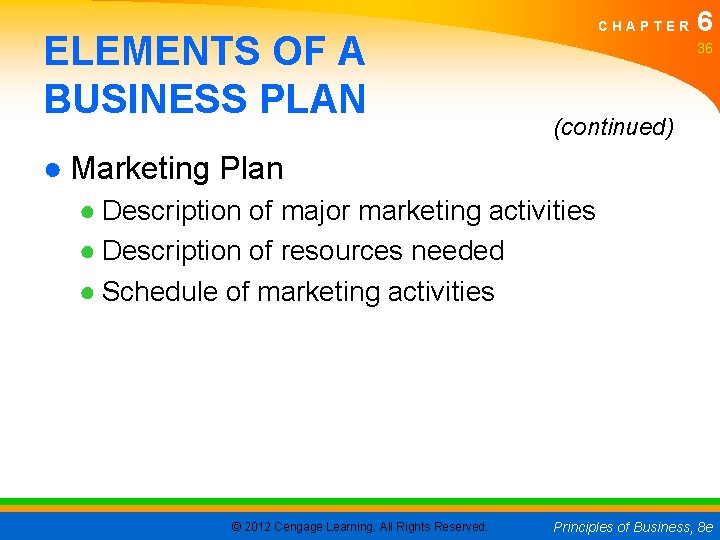
ELEMENTS OF A BUSINESS PLAN CHAPTER 6 36 (continued) ● Marketing Plan ● Description of major marketing activities ● Description of resources needed ● Schedule of marketing activities © 2012 Cengage Learning. All Rights Reserved. Principles of Business, 8 e
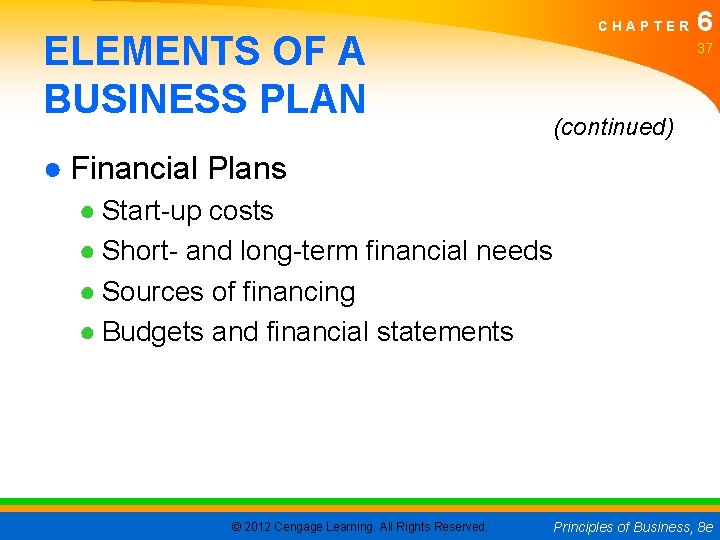
CHAPTER ELEMENTS OF A BUSINESS PLAN 6 37 (continued) ● Financial Plans ● Start-up costs ● Short- and long-term financial needs ● Sources of financing ● Budgets and financial statements © 2012 Cengage Learning. All Rights Reserved. Principles of Business, 8 e
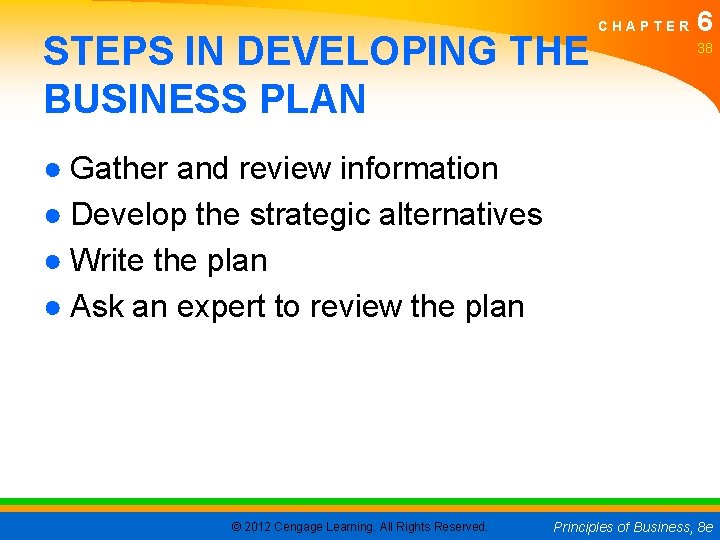
STEPS IN DEVELOPING THE BUSINESS PLAN CHAPTER 6 38 ● Gather and review information ● Develop the strategic alternatives ● Write the plan ● Ask an expert to review the plan © 2012 Cengage Learning. All Rights Reserved. Principles of Business, 8 e
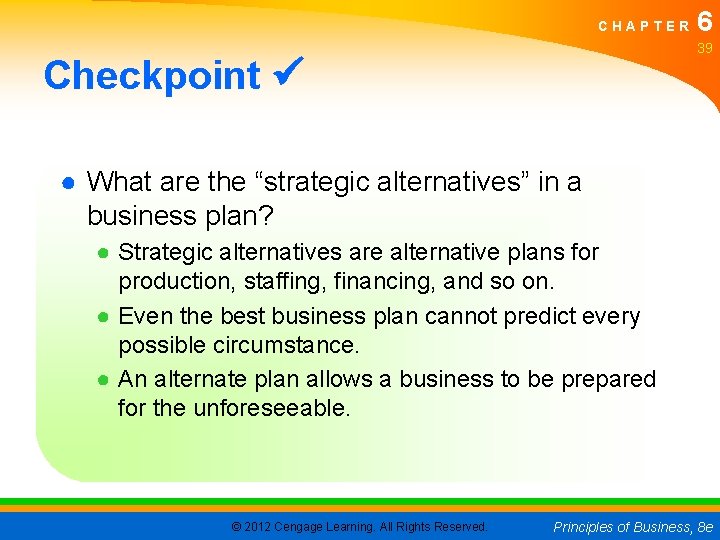
CHAPTER 6 39 Checkpoint ● What are the “strategic alternatives” in a business plan? ● Strategic alternatives are alternative plans for production, staffing, financing, and so on. ● Even the best business plan cannot predict every possible circumstance. ● An alternate plan allows a business to be prepared for the unforeseeable. © 2012 Cengage Learning. All Rights Reserved. Principles of Business, 8 e
FINANCING THE SMALL BUSINESS CHAPTER 6 40 ● Types of financing ● Start-up financing ● Short-term financing ● Long-term financing ● Sources of financing ● Owner-supplied funds ● Borrowed funds © 2012 Cengage Learning. All Rights Reserved. Principles of Business, 8 e
CHAPTER 6 41 Checkpoint ● In addition to owner-supplied capital, what are several other sources of financing for a small business? ● Borrowed money may come from banks, finance companies, or other individuals, such as friends and family. ● Some suppliers may also be willing to extend credit. © 2012 Cengage Learning. All Rights Reserved. Principles of Business, 8 e