P 780 02 Spring 2003 L 12 Richard
- Slides: 6
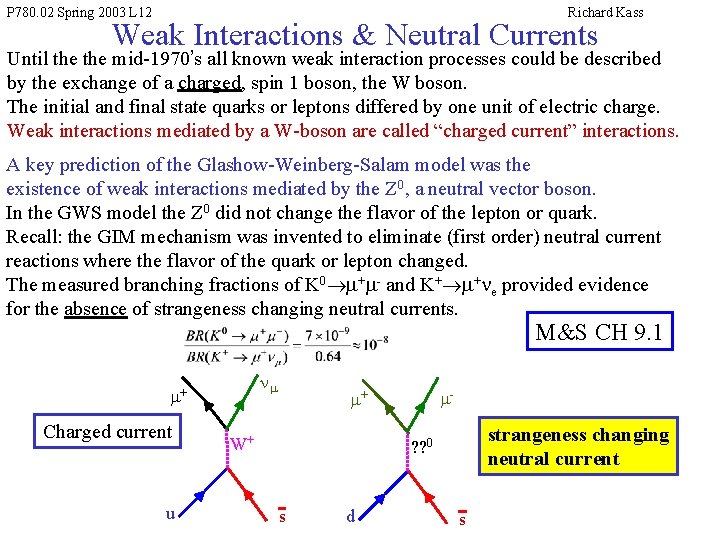
P 780. 02 Spring 2003 L 12 Richard Kass Weak Interactions & Neutral Currents Until the mid-1970’s all known weak interaction processes could be described by the exchange of a charged, spin 1 boson, the W boson. The initial and final state quarks or leptons differed by one unit of electric charge. Weak interactions mediated by a W-boson are called “charged current” interactions. A key prediction of the Glashow-Weinberg-Salam model was the existence of weak interactions mediated by the Z 0, a neutral vector boson. In the GWS model the Z 0 did not change the flavor of the lepton or quark. Recall: the GIM mechanism was invented to eliminate (first order) neutral current reactions where the flavor of the quark or lepton changed. The measured branching fractions of K 0®m+m- and K+®m+ne provided evidence for the absence of strangeness changing neutral currents. M&S CH 9. 1 nm m+ Charged current u m- m+ W+ strangeness changing neutral current ? ? 0 s d s
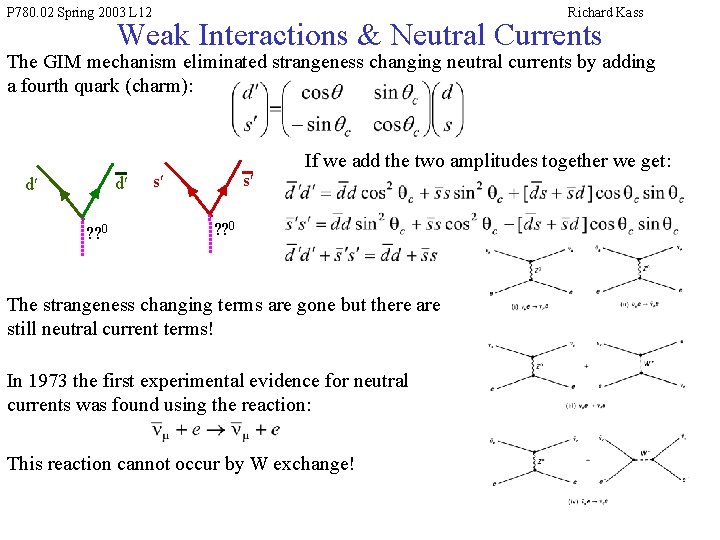
P 780. 02 Spring 2003 L 12 Richard Kass Weak Interactions & Neutral Currents The GIM mechanism eliminated strangeness changing neutral currents by adding a fourth quark (charm): d¢ d¢ ? ? 0 s¢ s¢ If we add the two amplitudes together we get: ? ? 0 The strangeness changing terms are gone but there are still neutral current terms! In 1973 the first experimental evidence for neutral currents was found using the reaction: This reaction cannot occur by W exchange!
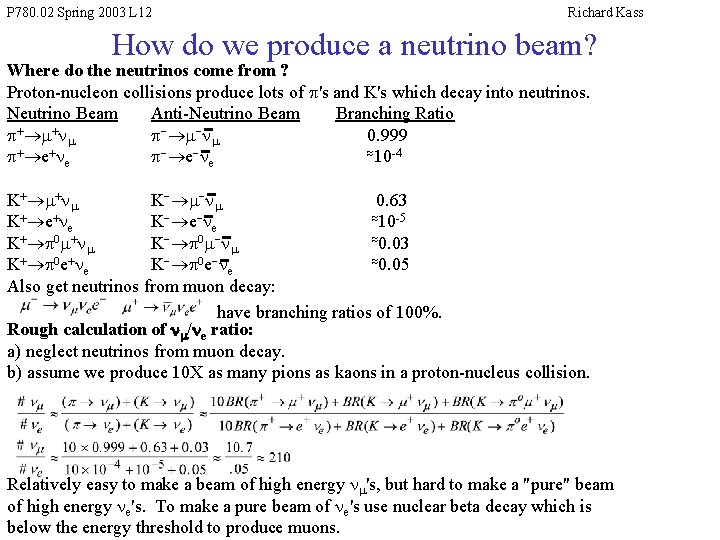
P 780. 02 Spring 2003 L 12 Richard Kass How do we produce a neutrino beam? Where do the neutrinos come from ? Proton-nucleon collisions produce lots of p's and K's which decay into neutrinos. Neutrino Beam Anti-Neutrino Beam Branching Ratio p+®m+nm p-®m-nm 0. 999 » 10 -4 p+®e+ne p-®e-ne K+®m+nm K-®m-nm 0. 63 K+®e+ne K-®e-ne » 10 -5 K+®p 0 m+nm K-®p 0 m-nm » 0. 03 K+®p 0 e+ne K-®p 0 e-ne » 0. 05 Also get neutrinos from muon decay: have branching ratios of 100%. Rough calculation of nm/ne ratio: a) neglect neutrinos from muon decay. b) assume we produce 10 X as many pions as kaons in a proton-nucleus collision. Relatively easy to make a beam of high energy nm's, but hard to make a "pure" beam of high energy ne's. To make a pure beam of ne's use nuclear beta decay which is below the energy threshold to produce muons.
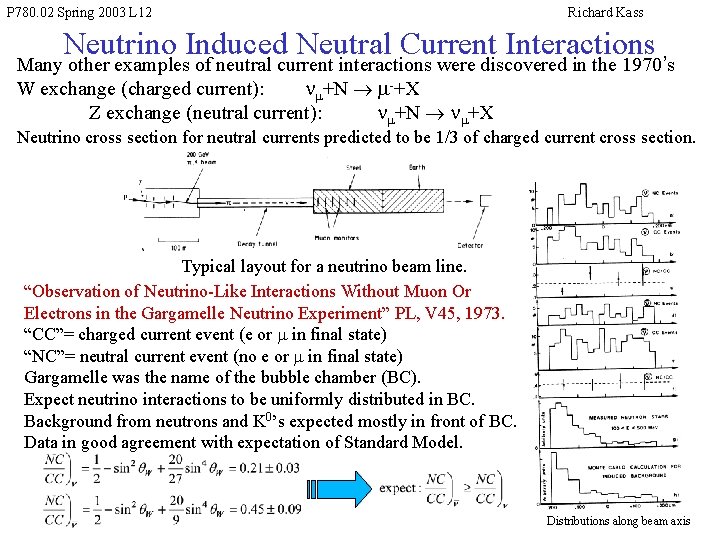
P 780. 02 Spring 2003 L 12 Richard Kass Neutrino Induced Neutral Current Interactions Many other examples of neutral current interactions were discovered in the 1970’s W exchange (charged current): nm+N ® m-+X Z exchange (neutral current): nm+N ® nm+X Neutrino cross section for neutral currents predicted to be 1/3 of charged current cross section. Typical layout for a neutrino beam line. “Observation of Neutrino-Like Interactions Without Muon Or Electrons in the Gargamelle Neutrino Experiment” PL, V 45, 1973. “CC”= charged current event (e or m in final state) “NC”= neutral current event (no e or m in final state) Gargamelle was the name of the bubble chamber (BC). Expect neutrino interactions to be uniformly distributed in BC. Background from neutrons and K 0’s expected mostly in front of BC. Data in good agreement with expectation of Standard Model. Distributions along beam axis
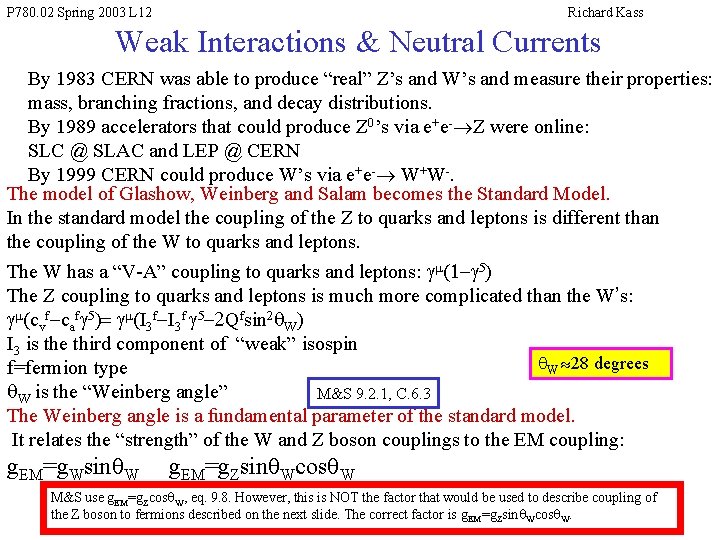
P 780. 02 Spring 2003 L 12 Richard Kass Weak Interactions & Neutral Currents By 1983 CERN was able to produce “real” Z’s and W’s and measure their properties: mass, branching fractions, and decay distributions. By 1989 accelerators that could produce Z 0’s via e+e-®Z were online: SLC @ SLAC and LEP @ CERN By 1999 CERN could produce W’s via e+e-® W+W-. The model of Glashow, Weinberg and Salam becomes the Standard Model. In the standard model the coupling of the Z to quarks and leptons is different than the coupling of the W to quarks and leptons. The W has a “V-A” coupling to quarks and leptons: gm(1 -g 5) The Z coupling to quarks and leptons is much more complicated than the W’s: gm(cvf-cafg 5)= gm(I 3 f-I 3 f g 5 -2 Qfsin 2 q. W) I 3 is the third component of “weak” isospin q. W » 28 degrees f=fermion type q. W is the “Weinberg angle” M&S 9. 2. 1, C. 6. 3 The Weinberg angle is a fundamental parameter of the standard model. It relates the “strength” of the W and Z boson couplings to the EM coupling: g. EM=g. Wsinq. W g. EM=g. Zsinq. Wcosq. W M&S use g. EM=g. Zcosq. W, eq. 9. 8. However, this is NOT the factor that would be used to describe coupling of the Z boson to fermions described on the next slide. The correct factor is g. EM=g. Zsinq. Wcosq. W.
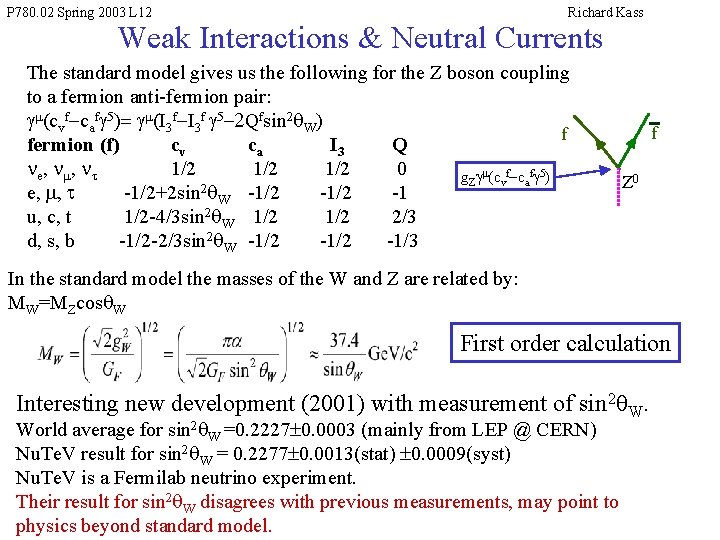
P 780. 02 Spring 2003 L 12 Richard Kass Weak Interactions & Neutral Currents The standard model gives us the following for the Z boson coupling to a fermion anti-fermion pair: gm(cvf-cafg 5)= gm(I 3 f-I 3 f g 5 -2 Qfsin 2 q. W) f fermion (f) cv ca I 3 Q ne, nm, nt 1/2 0 g. Zgm(cvf-cafg 5) e, m, t -1/2+2 sin 2 q. W -1/2 -1 u, c, t 1/2 -4/3 sin 2 q. W 1/2 2/3 d, s, b -1/2 -2/3 sin 2 q. W -1/2 -1/3 f Z 0 In the standard model the masses of the W and Z are related by: MW=MZcosq. W First order calculation Interesting new development (2001) with measurement of sin 2 q. W. World average for sin 2 q. W =0. 2227± 0. 0003 (mainly from LEP @ CERN) Nu. Te. V result for sin 2 q. W = 0. 2277± 0. 0013(stat) ± 0. 0009(syst) Nu. Te. V is a Fermilab neutrino experiment. Their result for sin 2 q. W disagrees with previous measurements, may point to physics beyond standard model.