Overview of Test Procedures etc for Advanced Emergency
- Slides: 8
Overview of Test Procedures, etc. for Advanced Emergency Braking Systems (Braking for Pedestrians)
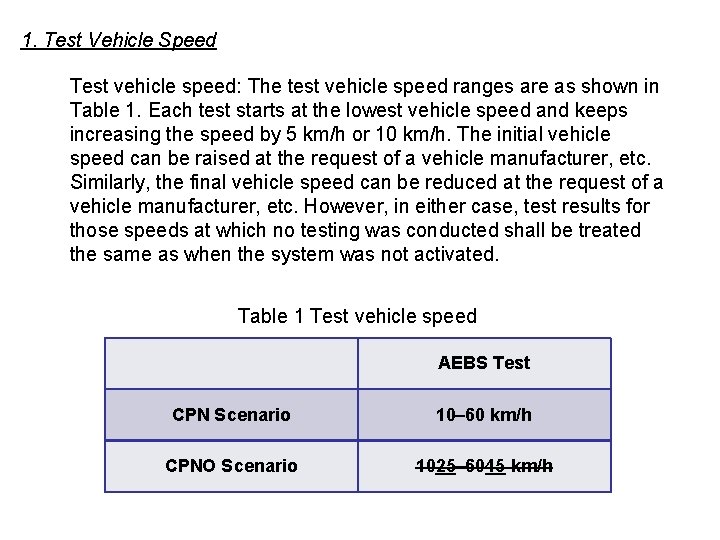
1. Test Vehicle Speed Test vehicle speed: The test vehicle speed ranges are as shown in Table 1. Each test starts at the lowest vehicle speed and keeps increasing the speed by 5 km/h or 10 km/h. The initial vehicle speed can be raised at the request of a vehicle manufacturer, etc. Similarly, the final vehicle speed can be reduced at the request of a vehicle manufacturer, etc. However, in either case, test results for those speeds at which no testing was conducted shall be treated the same as when the system was not activated. Table 1 Test vehicle speed AEBS Test CPN Scenario 10 60 km/h CPNO Scenario 1025 6045 km/h
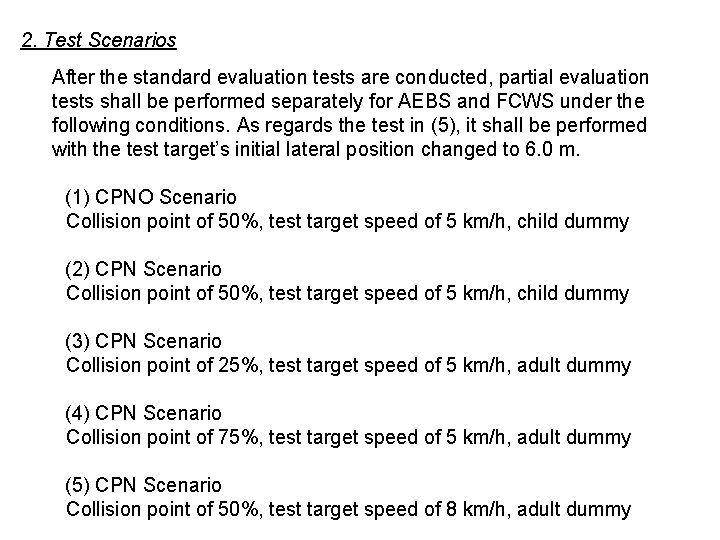
2. Test Scenarios After the standard evaluation tests are conducted, partial evaluation tests shall be performed separately for AEBS and FCWS under the following conditions. As regards the test in (5), it shall be performed with the test target’s initial lateral position changed to 6. 0 m. (1) CPNO Scenario Collision point of 50%, test target speed of 5 km/h, child dummy (2) CPN Scenario Collision point of 50%, test target speed of 5 km/h, child dummy (3) CPN Scenario Collision point of 25%, test target speed of 5 km/h, adult dummy (4) CPN Scenario Collision point of 75%, test target speed of 5 km/h, adult dummy (5) CPN Scenario Collision point of 50%, test target speed of 8 km/h, adult dummy
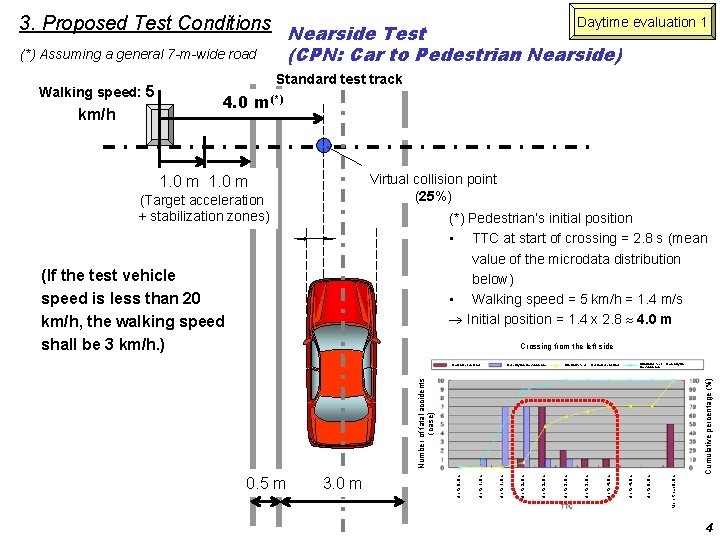
3. Proposed Test Conditions Daytime evaluation 1 Nearside Test (CPN: Car to Pedestrian Nearside) (*) Assuming a general 7 -m-wide road 4. 0 m(*) Virtual collision point (25%) 1. 0 m (Target acceleration + stabilization zones) (*) Pedestrian’s initial position • TTC at start of crossing = 2. 8 s (mean value of the microdata distribution below) • Walking speed = 5 km/h = 1. 4 m/s Initial position = 1. 4 x 2. 8 4. 0 m (If the test vehicle speed is less than 20 km/h, the walking speed shall be 3 km/h. ) Crossing from the left side Cumulative % of TTC at entry into the vehicle lane Cumulative % of TTC at start of crossing More than 5. 0 s Up to 4. 5 s Up to 4. 0 s Up to 3. 5 s Up to 3. 0 s Up to 2. 5 s Up to 2. 0 s 3. 0 m Up to 1. 5 s 0. 5 m Cumulative percentage (%) TTC at entry into the vehicle lane Number of fatal accidents (case) TTC at start of crossing Up to 1. 0 s km/h Standard test track Up to 0. 5 s Walking speed: 5 4
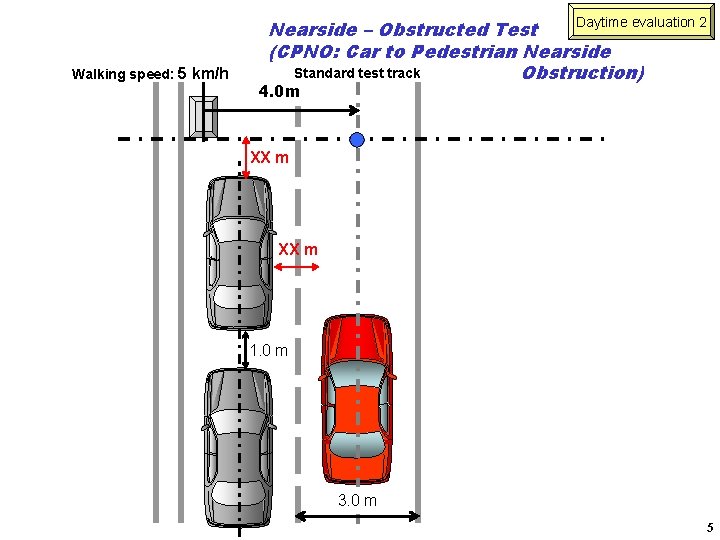
Walking speed: 5 km/h Daytime evaluation 2 Nearside – Obstructed Test (CPNO: Car to Pedestrian Nearside Standard test track Obstruction) 4. 0 m XX m 1. 0 m 3. 0 m 5
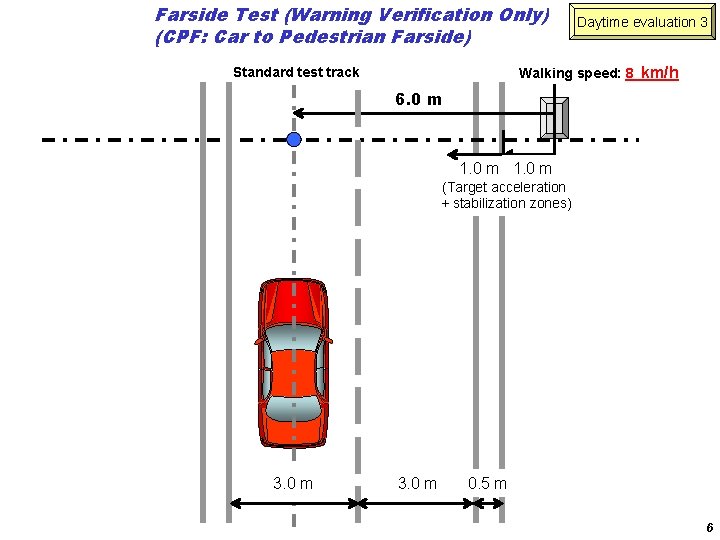
Farside Test (Warning Verification Only) (CPF: Car to Pedestrian Farside) Daytime evaluation 3 Walking speed: 8 km/h Standard test track 6. 0 m 1. 0 m (Target acceleration + stabilization zones) 3. 0 m 0. 5 m 6
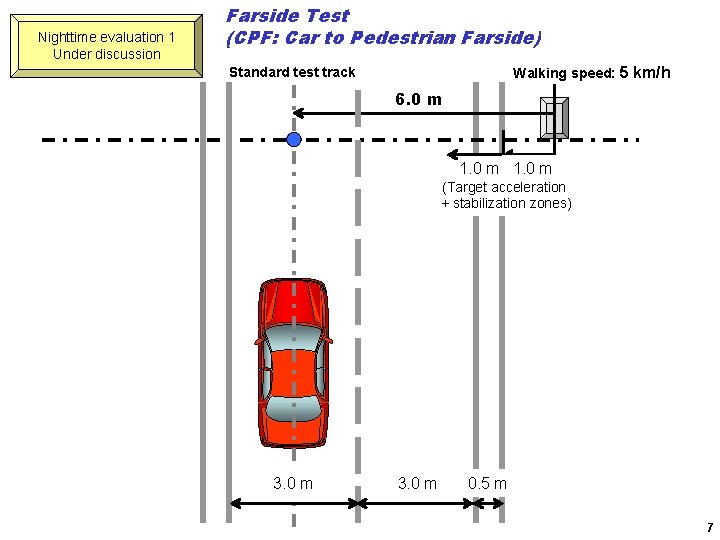
Nighttime evaluation 1 Under discussion Farside Test (CPF: Car to Pedestrian Farside) Walking speed: 5 km/h Standard test track 6. 0 m 1. 0 m (Target acceleration + stabilization zones) 3. 0 m 0. 5 m 7
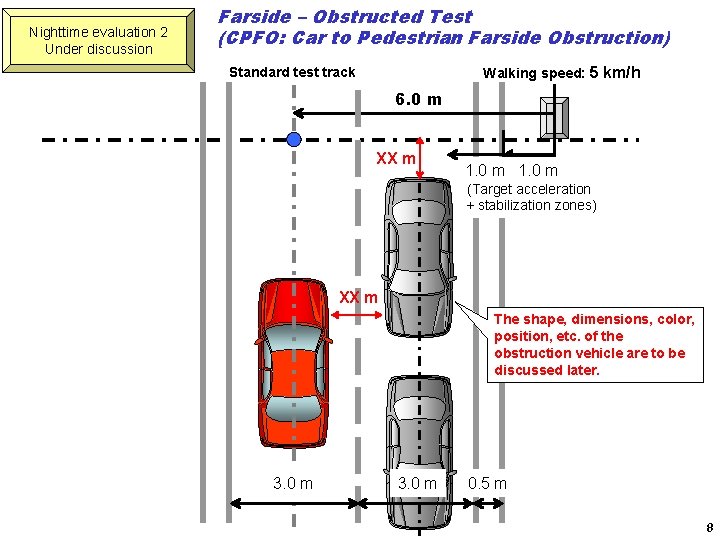
Nighttime evaluation 2 Under discussion Farside – Obstructed Test (CPFO: Car to Pedestrian Farside Obstruction) Walking speed: 5 km/h Standard test track 6. 0 m XX m 1. 0 m (Target acceleration + stabilization zones) XX m The shape, dimensions, color, position, etc. of the obstruction vehicle are to be discussed later. 3. 0 m 0. 5 m 8