Optical Chemical Sensors using Nanocomposites from Porous Silicon
- Slides: 3
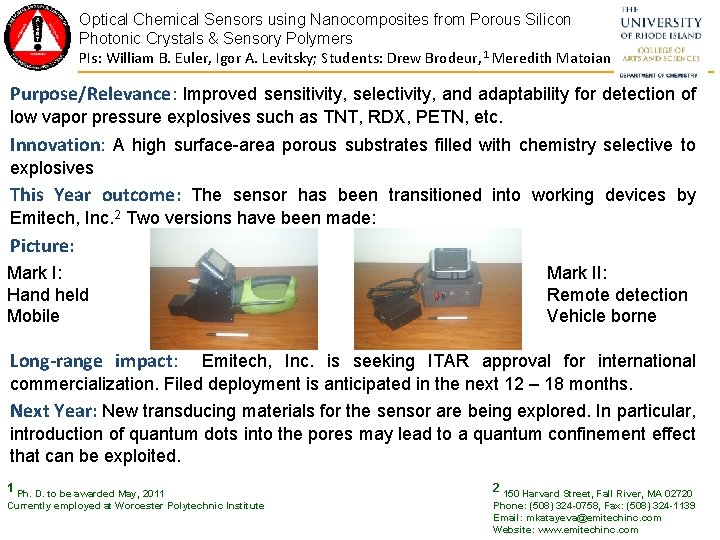
Optical Chemical Sensors using Nanocomposites from Porous Silicon Photonic Crystals & Sensory Polymers PIs: William B. Euler, Igor A. Levitsky; Students: Drew Brodeur, 1 Meredith Matoian Purpose/Relevance: Improved sensitivity, selectivity, and adaptability for detection of low vapor pressure explosives such as TNT, RDX, PETN, etc. Innovation: A high surface-area porous substrates filled with chemistry selective to explosives This Year outcome: The sensor has been transitioned into working devices by Emitech, Inc. 2 Two versions have been made: Picture: Mark I: Hand held Mobile Mark II: Remote detection Vehicle borne Long-range impact: Emitech, Inc. is seeking ITAR approval for international commercialization. Filed deployment is anticipated in the next 12 – 18 months. Next Year: New transducing materials for the sensor are being explored. In particular, introduction of quantum dots into the pores may lead to a quantum confinement effect that can be exploited. 1 Ph. D. to be awarded May, 2011 2 150 Harvard Street, Fall River, MA 02720 Currently employed at Worcester Polytechnic Institute Phone: (508) 324 -0758, Fax: (508) 324 -1139 Email: mkatayeva@emitechinc. com Website: www. emitechinc. com
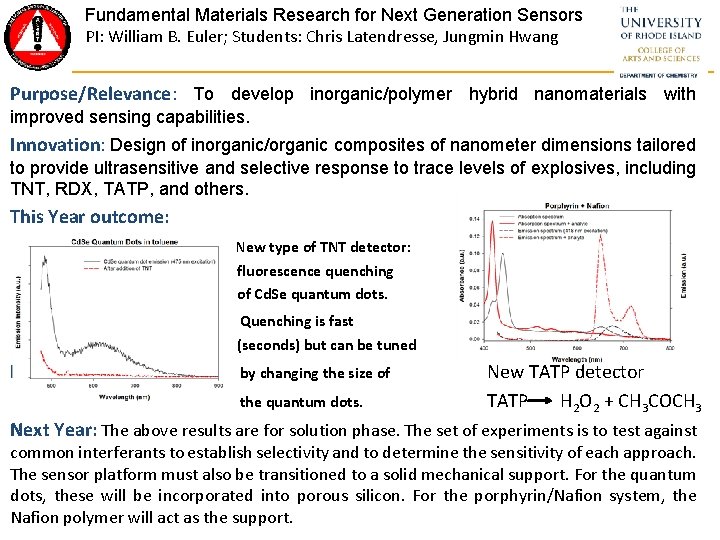
Fundamental Materials Research for Next Generation Sensors PI: William B. Euler; Students: Chris Latendresse, Jungmin Hwang Purpose/Relevance: To develop inorganic/polymer hybrid nanomaterials with improved sensing capabilities. Innovation: Design of inorganic/organic composites of nanometer dimensions tailored to provide ultrasensitive and selective response to trace levels of explosives, including TNT, RDX, TATP, and others. This Year outcome: § New type of TNT detector: § § fluorescence quenching of Cd. Se quantum dots. § Quenching is fast (seconds) but can be tuned Long-range impact: by changing the size of the quantum dots. New TATP detector TATP H 2 O 2 + CH 3 COCH 3 Next Year: The above results are for solution phase. The set of experiments is to test against common interferants to establish selectivity and to determine the sensitivity of each approach. The sensor platform must also be transitioned to a solid mechanical support. For the quantum dots, these will be incorporated into porous silicon. For the porphyrin/Nafion system, the Nafion polymer will act as the support.
“Optical Chemical Sensors using Nanocomposites from Porous Silicon Photonic Crystals & Sensory Polymers” “Fundamental Materials Research for Next Generation Sensors” PI: William B. Euler § Education Students Present & Graduate: § § § Graduate students: § Drew Brodeur (Ph. D. , May 2011, employed as a Lecturer at WPI) § Christopher Latendresse § Meredith Matoian Undergraduate students § Eunhae Hwang (B. S. , May, 2010, dental school , Boston University) § Sarah Decato (B. S. May, 2010, graduate school, UW – Madison) § Justin Gharavi (B. S. May, 2011) § Hyun Yang § Jungmin Hwang § Syrena Fernandes High School teacher § Mark Bartley § Papers/Patents/Presentations: “Optical Humidity Sensing and Ultrasound Effect for Mesoporous Silicon One-Dimensional Photonic Crystals, ” I. G. Kolobov, W. B. Euler, I. A. Levitsky, Appl. Optics, 2010, 49, 137. “Gas Phase Sensors for Bases Using Rhodamine B in Nafion Films, ” E. Hwang, I. A. Levitsky, W. B. Euler, J. Appl. Polym. Sci. , 2010, 116, 2425. § Transition to Industry or Collaboration with Industry: § Emitech, Inc.