Name Hour ASL 1 Working with a Deaf
- Slides: 2
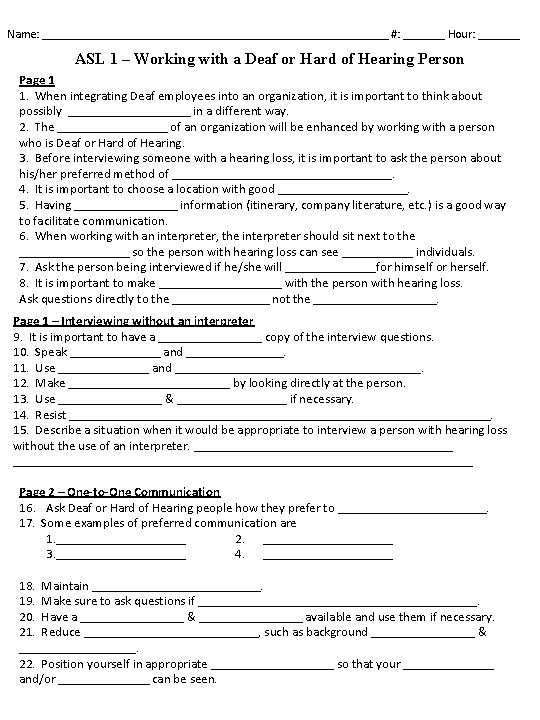
Name: _____________________________ #: _______ Hour: _______ ASL 1 – Working with a Deaf or Hard of Hearing Person Page 1 1. When integrating Deaf employees into an organization, it is important to think about possibly __________ in a different way. 2. The _________ of an organization will be enhanced by working with a person who is Deaf or Hard of Hearing. 3. Before interviewing someone with a hearing loss, it is important to ask the person about his/her preferred method of _________________. 4. It is important to choose a location with good __________. 5. Having ________ information (itinerary, company literature, etc. ) is a good way to facilitate communication. 6. When working with an interpreter, the interpreter should sit next to the _________ so the person with hearing loss can see ______ individuals. 7. Ask the person being interviewed if he/she will _______for himself or herself. 8. It is important to make __________ with the person with hearing loss. Ask questions directly to the ________ not the __________. Page 1 – Interviewing without an interpreter 9. It is important to have a ________ copy of the interview questions. 10. Speak _______ and ________. 11. Use _______ and ___________________. 12. Make _____________ by looking directly at the person. 13. Use ________ & _________ if necessary. 14. Resist _________________________________. 15. Describe a situation when it would be appropriate to interview a person with hearing loss without the use of an interpreter. ________________________________________________________ Page 2 – One-to-One Communication 16. Ask Deaf or Hard of Hearing people how they prefer to ____________. 17. Some examples of preferred communication are 1. __________ 2. __________ 3. __________ 4. __________ 18. Maintain _____________. 19. Make sure to ask questions if ______________________. 20. Have a ________ & ________ available and use them if necessary. 21. Reduce ______________, such as background ________ & _________. 22. Position yourself in appropriate __________ so that your _______ and/or _______ can be seen.
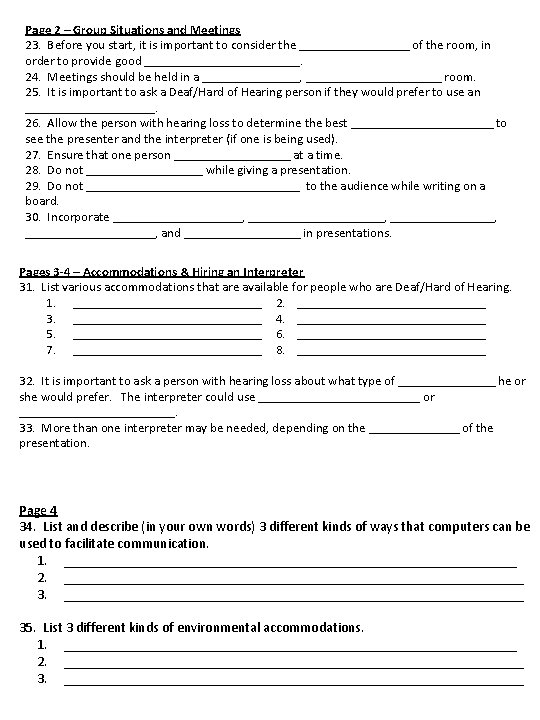
Page 2 – Group Situations and Meetings 23. Before you start, it is important to consider the _________ of the room, in order to provide good ____________. 24. Meetings should be held in a ________, ___________ room. 25. It is important to ask a Deaf/Hard of Hearing person if they would prefer to use an __________. 26. Allow the person with hearing loss to determine the best ___________ to see the presenter and the interpreter (if one is being used). 27. Ensure that one person _________ at a time. 28. Do not _________ while giving a presentation. 29. Do not _________________ to the audience while writing on a board. 30. Incorporate ____________________, __________, and _________ in presentations. Pages 3 -4 – Accommodations & Hiring an Interpreter 31. List various accommodations that are available for people who are Deaf/Hard of Hearing. 1. _______________ 2. _______________ 3. _______________ 4. _______________ 5. _______________ 6. _______________ 7. _______________ 8. _______________ 32. It is important to ask a person with hearing loss about what type of ________ he or she would prefer. The interpreter could use _____________ or ____________. 33. More than one interpreter may be needed, depending on the _______ of the presentation. Page 4 34. List and describe (in your own words) 3 different kinds of ways that computers can be used to facilitate communication. 1. _________________________________ 2. __________________________________________________________________ 35. List 3 different kinds of environmental accommodations. 1. _________________________________ 2. _________________________________ 3. _________________________________