Myth Rain comes from holes in clouds Jazmin

- Slides: 12
Myth: Rain comes from holes in clouds Jazmin Vogler Hr. 2 Web design
Statistics What causes precipitation (rain and snow)? Precipitation forms when cloud droplets (or ice particles) in clouds grow and combine to become so large that their fall speed exceeds the updraft speed in the cloud, and they then fall out of the cloud. If these large water drops or ice particles do not re-evaporate as they fall farther below the cloud, they reach the ground as precipitation. Precipitation that does re-evaporate before reaching the ground is called "virga. "
Facts a cloud must be formed in the atmosphere by warmer air at the surface rising in to cooler air aloft. The water vapor in the air is condensed onto tiny pieces of dust and collected together to create the cloud. Inside the cloud, swirling winds blow water droplets around. When the water droplets bump into each other, they join together.
More facts… the droplets become heavy enough and start to fall. As they fall to the surface, the droplets gather more moisture to form even larger raindrops. Small raindrops are almost spherical or round in shape. Larger drops are flattened at the bottom, resembling a hamburger roll.
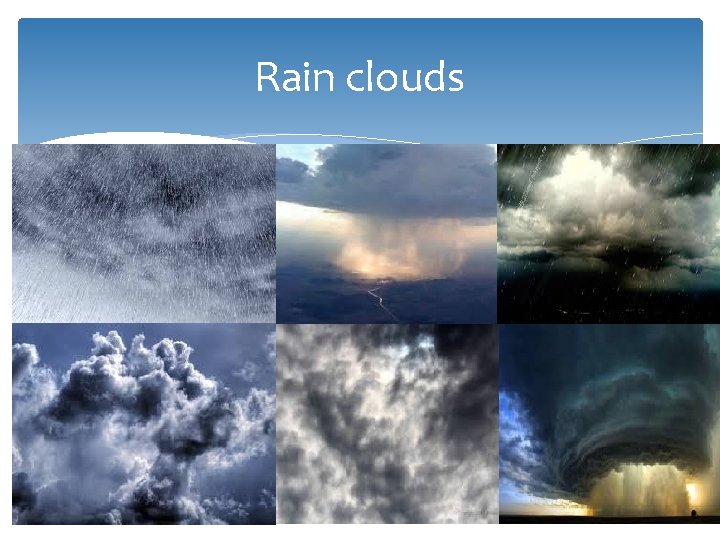
Rain clouds
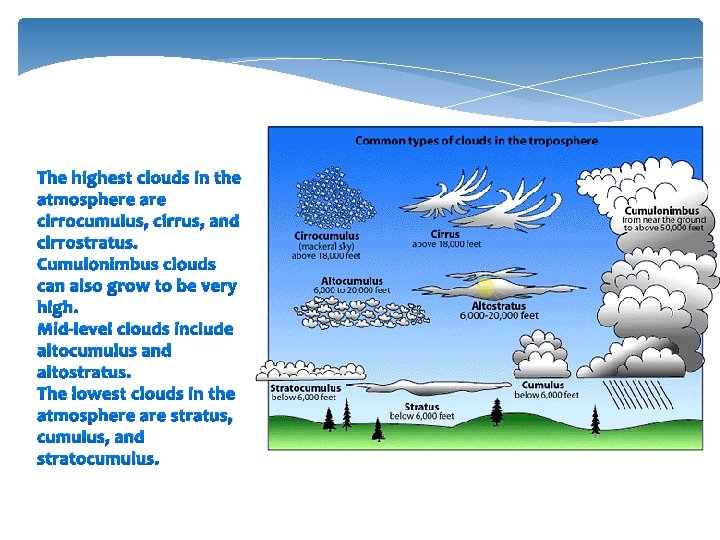
The highest clouds in the atmosphere are cirrocumulus, cirrus, and cirrostratus. Cumulonimbus clouds can also grow to be very high. Mid-level clouds include altocumulus and altostratus. The lowest clouds in the atmosphere are stratus, cumulus, and stratocumulus.
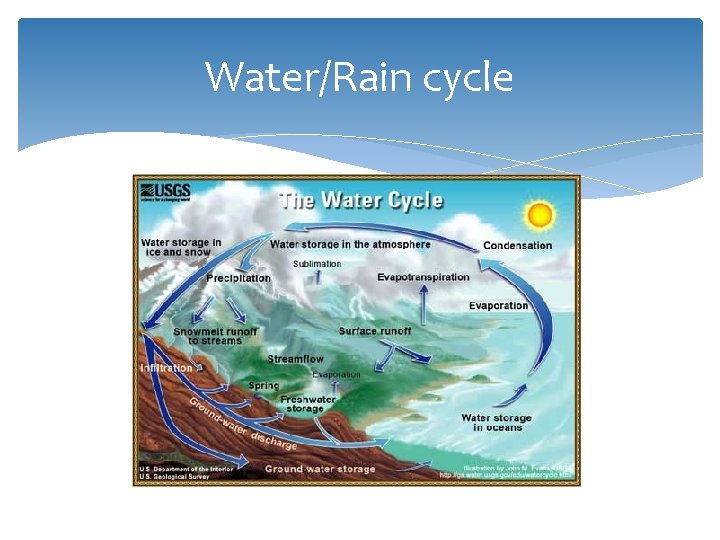
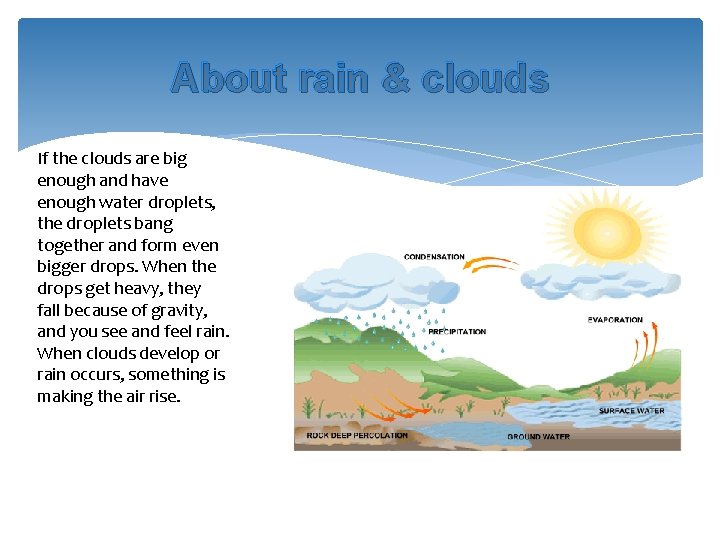
Water/Rain cycle
About rain & clouds If the clouds are big enough and have enough water droplets, the droplets bang together and form even bigger drops. When the drops get heavy, they fall because of gravity, and you see and feel rain. When clouds develop or rain occurs, something is making the air rise.
Clouds contain huge numbers of tiny droplets of moisture. Raindrops are formed when these tiny droplets are enlarged, first by moisture from the surrounding air Clouds are made up of many millions of condensing on them and then by coalescing miniscule water droplets which are formed with other droplets during their descent. when moist warm air rises up into the sky and is then cooled down. If the cloud is very cold it means that it is made up of ice crystals. It takes somewhere between a few minutes and 1 hour for a cloud to be created. Clouds look fluffy and light but the truth is the amount of water that makes up one cloud can weigh more then an airplane!
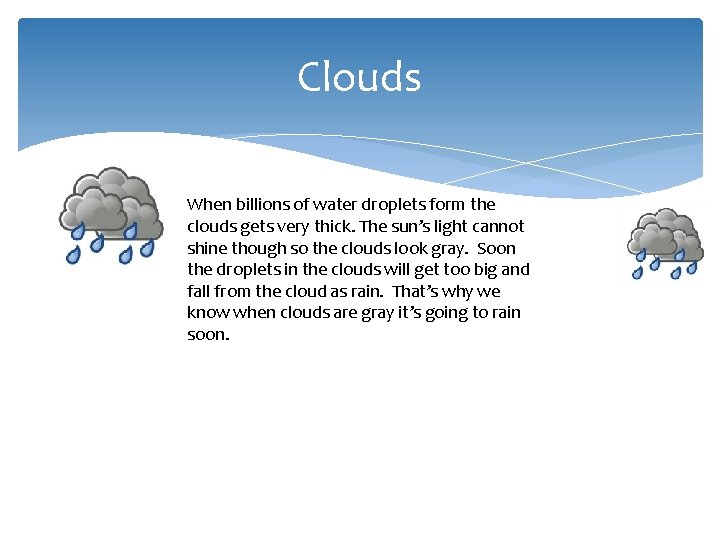
Clouds When billions of water droplets form the clouds gets very thick. The sun’s light cannot shine though so the clouds look gray. Soon the droplets in the clouds will get too big and fall from the cloud as rain. That’s why we know when clouds are gray it’s going to rain soon.
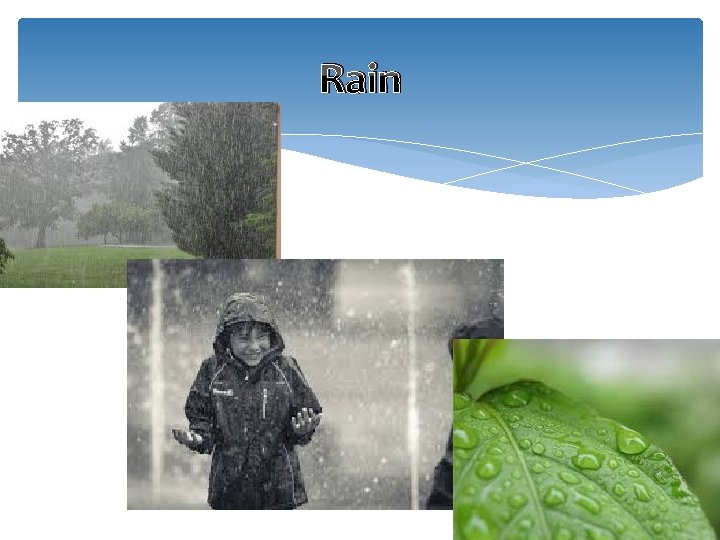
Rain
More about rain The smaller the drops in a cloud the brighter the tops appear (and the darker the bases). Smaller droplets scatter more sunlight, while large drops allow more sunlight to pass through. This explains why the heavily raining part of a shower cloud or thunderstorm is usually brighter than just the cloudy part. The cloud droplets have combined into large raindrops, which allow more sunlight to pass through them.