MUL and DIV How to use the x

- Slides: 7
MUL and DIV How to use the x 86 CPU’s multiplication and division instructions
A comment about addition • When two register-values are added add %al, %bl their total can sometimes be “too large” to fit in the destination register: Example: 150 + 160 = 310 • Both numbers 150 and 160 can be expressed as 8 -bit binary values: 150 as 10010110 (base 2) 160 as 10100000 (base 2) • But not their sum: 310 is 100110110 (base 2)
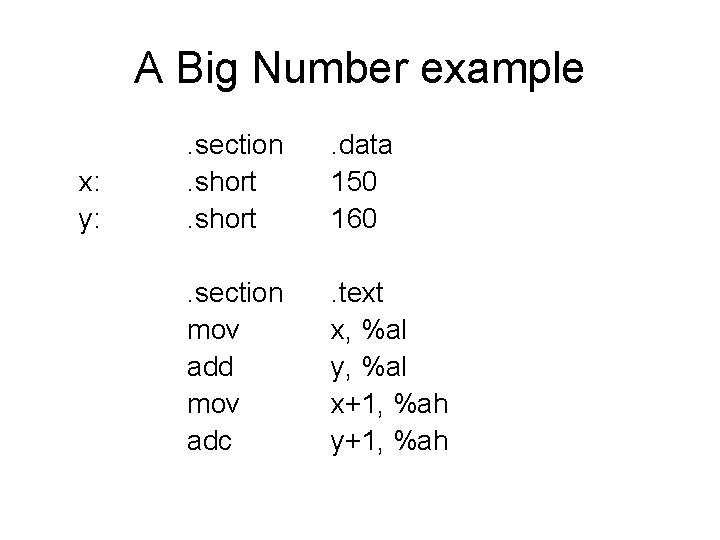
The Carry-Flag • The “extra” bit becomes the CF-bit (i. e. , the ‘Carry’ Flag) in the RFLAGS register • Programs can “branch” if a carry occurs: jc toobig • Or branch elsewhere if no-carry occurs: jnc sumok • Special instruction exists to handle adding of large numbers: ADC (Add-with-Carry)
A Big Number example x: y: . section. short . data 150 160 . section mov add mov adc . text x, %al y, %al x+1, %ah y+1, %ah
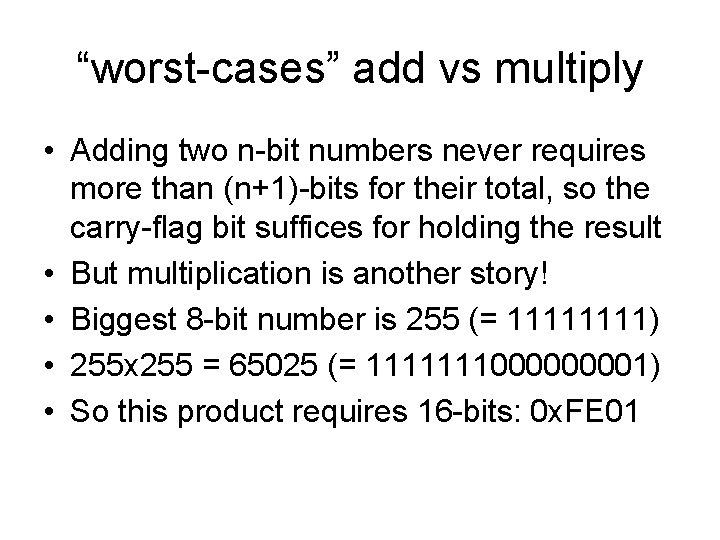
“worst-cases” add vs multiply • Adding two n-bit numbers never requires more than (n+1)-bits for their total, so the carry-flag bit suffices for holding the result • But multiplication is another story! • Biggest 8 -bit number is 255 (= 1111) • 255 x 255 = 65025 (= 111111100001) • So this product requires 16 -bits: 0 x. FE 01
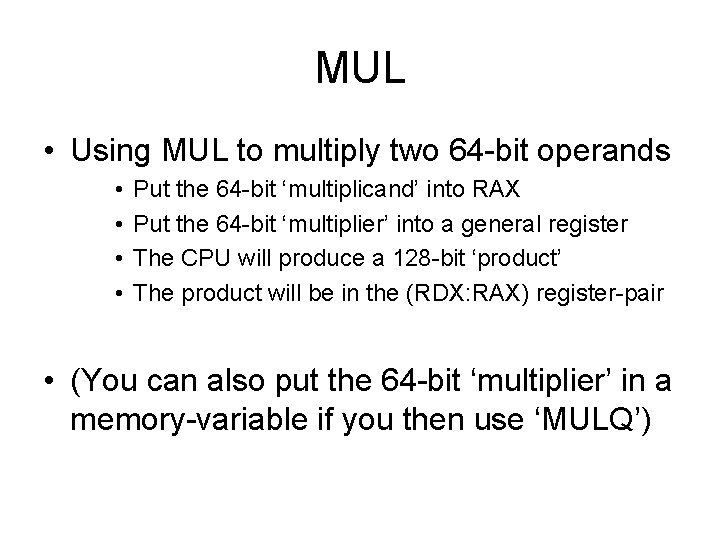
MUL • Using MUL to multiply two 64 -bit operands • • Put the 64 -bit ‘multiplicand’ into RAX Put the 64 -bit ‘multiplier’ into a general register The CPU will produce a 128 -bit ‘product’ The product will be in the (RDX: RAX) register-pair • (You can also put the 64 -bit ‘multiplier’ in a memory-variable if you then use ‘MULQ’)
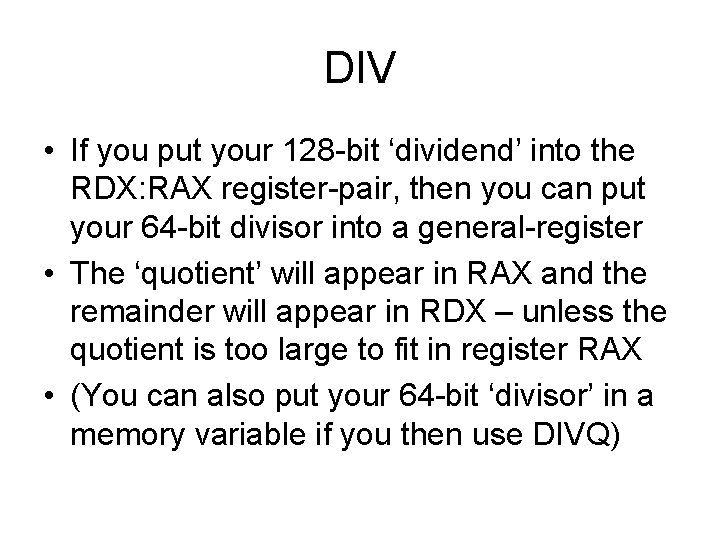
DIV • If you put your 128 -bit ‘dividend’ into the RDX: RAX register-pair, then you can put your 64 -bit divisor into a general-register • The ‘quotient’ will appear in RAX and the remainder will appear in RDX – unless the quotient is too large to fit in register RAX • (You can also put your 64 -bit ‘divisor’ in a memory variable if you then use DIVQ)