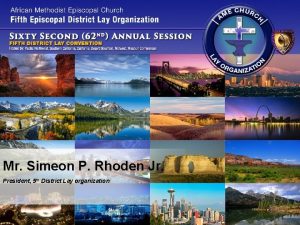
Mr Simeon P Rhoden Jr President 5 th
- Slides: 6
Mr. Simeon P. Rhoden Jr. President, 5 th District Lay organization
TO: Bishop Clement W. Fugh, Presiding Prelate; Supervisor Alexia Fugh; General Officers, Members of the Judicial Council Connectional Leadership, President Valerie G. Bell, Director of Lay Activities Ametta Reeves, Director of Lay Activities Marilyn Lovelace-Grant, Fifth Episcopal District Elected Officers, Advisory Team, Conference Presidents, Delegates, Clergy, and Visitors among us! As President of the Fifth Episcopal District Lay Organization, allow me to remind you of who WE are. We are God’s Chosen People - Globally Connected – Dedicated and Strong Members of the African Methodist Episcopal Church. With a presence in over 15 states, We are steadfast in our duties and responsibilities to be mission driven Lay Women and Men - teaching, training, and empowering members for lay ministry, global leadership, and services following the tenets of Jesus Christ. Throughout this Conference Year, the six conferences have embraced the mission through creating and establishing strategies to accomplishing the following goals: Training & Development Community Outreach Scholarship Collaborating and Sustaining positive relationships with our Clergy Leaders Your keeping to the mission undergirded the 5 th District in accomplishing the following: 1) Awarding over 25 scholarships to graduating seniors & returning students 2) Adding two new scholarships (Community Service & Church Leadership) 3) Bringing Awareness: Real ID Act – Brought awareness to Clergy/Laity about travel/security 4) Support: Awarded $1 K to Fountain Chapel AME Church in Vancouver, Canada 5) Support/Community: Awarded $10 K in LAOS funds to deserving non-profit/social service organizations 6) Support/Community: 2017 – 2018, delivered over 5 thousand pairs of socks to homeless and deserving shelters 7) Sustained scholarships/operational accounts in the Black more than 20%. 8) Assisted in financial sponsorship supporting the Women’s Missionary Society (YPD) 9) Assisted in financial sponsorship supporting the Fifth District’s operational expenses Copyright © 2016 Boeing. All rights reserved.
In addition, there are Lay Mission Opportunities, involving inner city community services I believe we’re missing the mark on; and almost every church leader I’ve encountered acknowledges that our culture is shifting. If we don’t get serious about our outreach, and understanding the cultural shift, we would be doing ourselves a huge disservice and will begin to miss out on God’s rich blessings. Don’t get me wrong, WE DON’T NEED TO CHANGE THE MESSAGE. JUST THE METHOD. One is sacred…the other is not. What isn’t as clear however is what the future AME church/Lay Organization will look like, and what kind of characteristics will mark those functions. However, I think a few trends are becoming clear. Not all of these might be correct, but I think the following traits describe the kind of AME churches/Lay Organizations that will have a significant impact a decade from now: v The ability to say no. One of the reasons churches/Lay Organizations don’t change is because we are unwilling to say no to current members who prefer things the way they were. When you learn to say no to the dream killers of some current members, WE then begin to learn to say yes to a community that is ready to be reached. v Outsider focus. Churches/Ly Organizations that become passionate about people outside their walls will be far more effective than those that are passionate about keeping the few people they have inside their walls. Better still, you will have a healthier church/Lay Organization. We call individuals who are fixated on their wants and needs selfish and immature. Selfless and mature churches will have an impact because of their passion for people God cares about. v Quick decision making. If you have a decision making process that’s slow and complicated, you will not be able to keep up with the pace of change needed. Having convoluted processes and ambiguity in policies and procedures blocks innovation. v Flexibility. You don’t need to change your mission (for the most part), but you do need to change your methods. Flexible and adaptable churches/Lay Organizations that can innovate around strategy and different initiatives will have the freedom to make the changes they need to make an impact moving forward. Copyright © 2016 Boeing. All rights reserved.
v A quicker, lighter footprint. I learned this phrase from a good friend of mine…Churches/The Lay Organization need a quicker, lighter footprint to grow. If you’re waiting for the next best thing to build your ministry, you might wait forever. Get innovative and start looking at portable and non-traditional ways of growing the ministry. v An openness to questions. Most unchurched people today come in with questions that seem weird or will sometimes make us uncomfortable… Churches that understand that embracing questions is as important as providing immediate answers will make an impact in the future. I’ve discovered that if I stop trying to answer the questions and just embrace the questions, the answers eventually find their way into people’s lives. The Holy Spirit actually does move in people’s lives. v A high value on experimentation. The more traditional you are, the less you will value experimentation. The more successful you are, the less you will value experimentation. If you start to raise the value of experimentation, you will accelerate change and flexibility. The Churches/Lay Organizations that connect with their community will be the churches willing enough to try a variety of things, and who also have the courage to kill them as soon as they stop producing results (Give Example of the LCAF) v Prioritizing a for you not from you culture. My Pastor at my home church – Mt. Hermon AME, Ft. Lauderdale, FL often talked about what he wanted for people, not just what he wanted from them. Churches/Lay Organizations in decline often think in terms of what they can get from people – money, time, growth etc. Organizations that will make an impact on the future will be passionate about what they want for people – financial balance, generosity, the joy of serving, better families, and of course, Christ at the center of everyone’s life. NOTE: Doesn’t this sound familiar? ? ? Following the Tenets of Jesus Christ v A tailored experience, not a tailored message. You don’t have to tailor the message to unchurched people, but Organizations that have an impact will tailor the experience. For example, I was blessed to put presents under the Christmas tree last year. But I’m not a shopping mall fan. 90% of my gift buying happened online. You see…the content was the same – but the experience changed! Lay Organizations and Churches that decide they will hold the message sacred but tailor the experience to an ever shifting culture will be more effective! Copyright © 2016 Boeing. All rights reserved.
So here’s what I’m offering as my trust to you for the next conference year, that we embrace the cultural shift by truly focusing on the basics: As you listen to this report, I hope that it encourages you to evaluate your values and your intentions for being a member of your Church and the Lay Organization. Are you recognizing and embracing the cultural shifts? How are you contributing towards the greater good? Look, it is our charge as God’s Disciples to bring others to Christ, it’s an extension of our Church motto; and with this in mind, the Connectional Lay Organization has embraced the Quadrennial theme: “Laity Walking Humbly With God to do Justice and to Love Kindness. ” Finally, I think it is fitting to note that We are the sons and daughters of the remnant God has chosen to remain alive during the Twenty-First Century to work towards breaking chains in the lives of God’s people throughout our Zion. We are the sons and daughters of the remnant God is counting on to stand for righteousness’ sake. This is exactly, I believe, what Tasha Cobbs conveys in a most powerful way – To Break Every Chain Copyright © 2016 Boeing. All rights reserved.
Questions