MODULE 17 AGGREGATE DEMAND INTRODUCTION DETERMINANTS Module 17

- Slides: 19
MODULE 17 AGGREGATE DEMAND: INTRODUCTION & DETERMINANTS
Module 17 Essential Questions 1. 2. 3. How does the aggregate demand curve illustrates the relationship between the aggregate price level and the quantity of aggregate output demanded in the economy? How does the wealth effect and interest rate effect explain the aggregate demand curve’s downward slope? What factors can shift the aggregate demand curve?
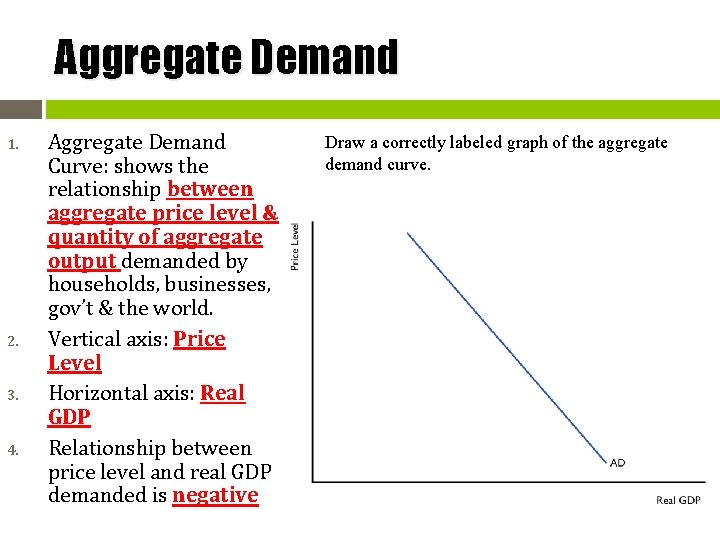
Aggregate Demand 1. 2. 3. 4. Aggregate Demand Curve: shows the relationship between _____________ & ______________ of ______________ demanded by households, businesses, gov’t & the world. Vertical axis: ______ Horizontal axis: _______ Relationship between price level and real GDP demanded is ______ Draw a correctly labeled graph of the aggregate demand curve.
Aggregate Demand 1. 2. 3. 4. Aggregate Demand Curve: shows the relationship between aggregate price level & quantity of aggregate output demanded by households, businesses, gov’t & the world. Vertical axis: Price Level Horizontal axis: Real GDP Relationship between price level and real GDP demanded is negative Draw a correctly labeled graph of the aggregate demand curve.
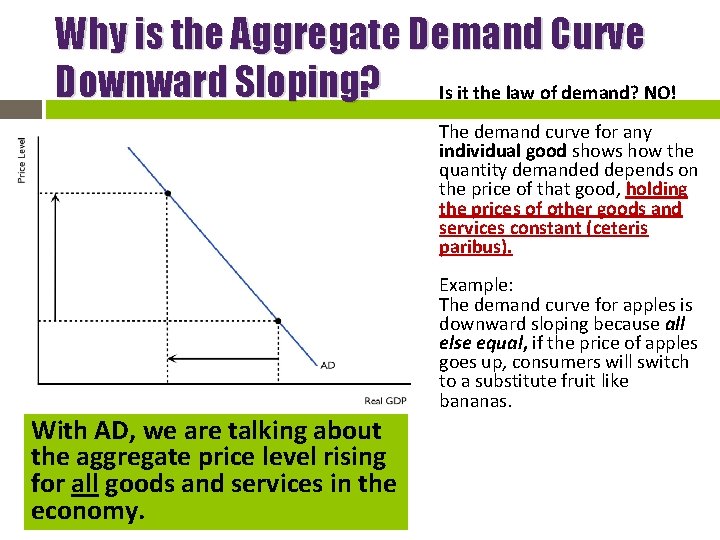
Why is the Aggregate Demand Curve Downward Sloping? Is it the law of demand? NO! With AD, we are talking about the aggregate price level rising for all goods and services in the economy. The demand curve for any individual good shows how the quantity demanded depends on the price of that good, holding the prices of other goods and services constant (ceteris paribus). Example: The demand curve for apples is downward sloping because all else equal, if the price of apples goes up, consumers will switch to a substitute fruit like bananas.
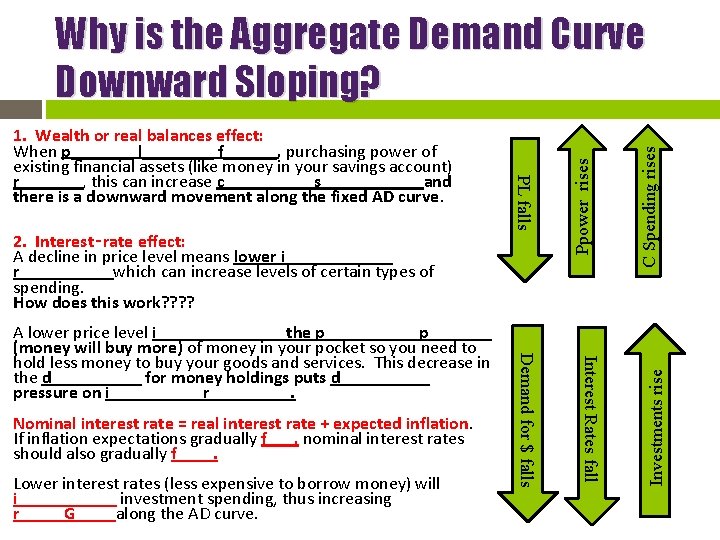
Interest Rates fall Demand for $ falls C Spending rises Investments rise PL falls 1. Wealth or real balances effect: When p_______ l____ f______, purchasing power of existing financial assets (like money in your savings account) r_______, this can increase c_____s______ and there is a downward movement along the fixed AD curve. 2. Interest‑rate effect: A decline in price level means lower i______ r_____ which can increase levels of certain types of spending. How does this work? ? A lower price level i_______ the p_______ (money will buy more) of money in your pocket so you need to hold less money to buy your goods and services. This decrease in the d_____ for money holdings puts d_____ pressure on i_____ r_____. Nominal interest rate = real interest rate + expected inflation. If inflation expectations gradually f___, nominal interest rates should also gradually f____. Lower interest rates (less expensive to borrow money) will i______ investment spending, thus increasing r_____G____ along the AD curve. Ppower rises Why is the Aggregate Demand Curve Downward Sloping?
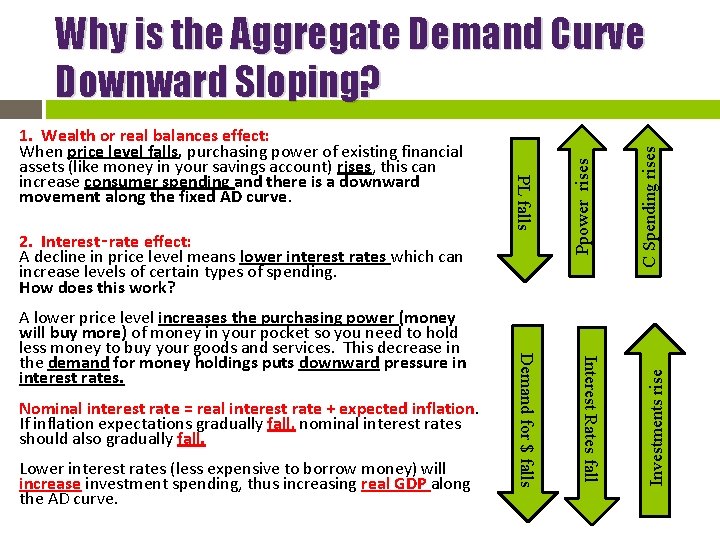
Interest Rates fall Demand for $ falls C Spending rises Investments rise PL falls 1. Wealth or real balances effect: When price level falls, purchasing power of existing financial assets (like money in your savings account) rises, this can increase consumer spending and there is a downward movement along the fixed AD curve. 2. Interest‑rate effect: A decline in price level means lower interest rates which can increase levels of certain types of spending. How does this work? A lower price level increases the purchasing power (money will buy more) of money in your pocket so you need to hold less money to buy your goods and services. This decrease in the demand for money holdings puts downward pressure in interest rates. Nominal interest rate = real interest rate + expected inflation. If inflation expectations gradually fall, nominal interest rates should also gradually fall. Lower interest rates (less expensive to borrow money) will increase investment spending, thus increasing real GDP along the AD curve. Ppower rises Why is the Aggregate Demand Curve Downward Sloping?
Why Does AGG D Slope Down? Wealth & Interest Rate Effect Wealth Effect Interest Rate Effect
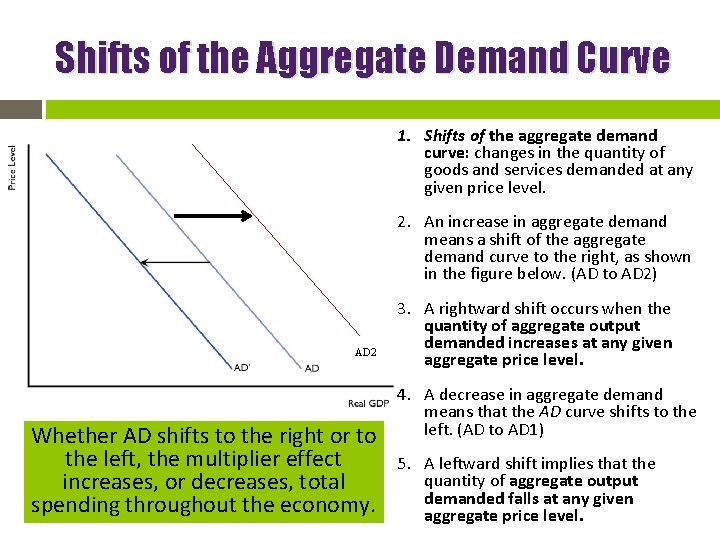
Shifts of the Aggregate Demand Curve 1. Shifts of the aggregate demand curve: changes in the quantity of goods and services demanded at any given price level. 2. An increase in aggregate demand means a shift of the aggregate demand curve to the right, as shown in the figure below. (AD to AD 2) AD 2 Whether AD shifts to the right or to the left, the multiplier effect increases, or decreases, total spending throughout the economy. 3. A rightward shift occurs when the quantity of aggregate output demanded increases at any given aggregate price level. 4. A decrease in aggregate demand means that the AD curve shifts to the left. (AD to AD 1) 5. A leftward shift implies that the quantity of aggregate output demanded falls at any given aggregate price level.
What Shifts of the Aggregate Demand Curve? Changes in Expectations Size of the Existing Stock of Physical Capital Changes in Wealth Government Policies and Aggregate Demand
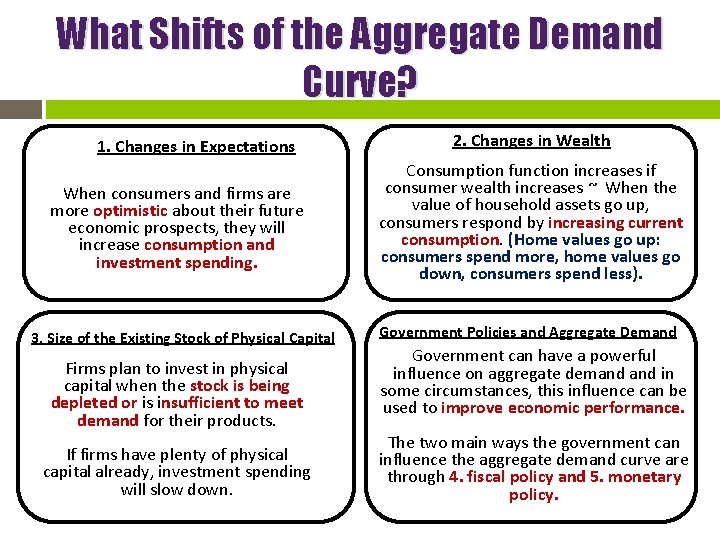
What Shifts of the Aggregate Demand Curve? 1. Changes in Expectations 2. Changes in Wealth When consumers and firms are more optimistic about their future economic prospects, they will increase consumption and investment spending. Consumption function increases if consumer wealth increases ~ When the value of household assets go up, consumers respond by increasing current consumption. (Home values go up: consumers spend more, home values go down, consumers spend less). 3. Size of the Existing Stock of Physical Capital Government Policies and Aggregate Demand Firms plan to invest in physical capital when the stock is being depleted or is insufficient to meet demand for their products. If firms have plenty of physical capital already, investment spending will slow down. Government can have a powerful influence on aggregate demand in some circumstances, this influence can be used to improve economic performance. The two main ways the government can influence the aggregate demand curve are through 4. fiscal policy and 5. monetary policy.
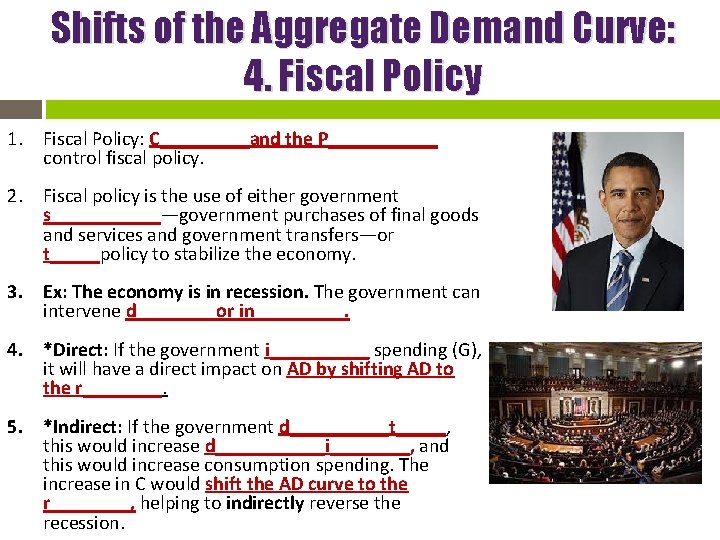
Shifts of the Aggregate Demand Curve: 4. Fiscal Policy 1. Fiscal Policy: C_____and the P______ control fiscal policy. 2. Fiscal policy is the use of either government s______—government purchases of final goods and services and government transfers—or t_____policy to stabilize the economy. 3. Ex: The economy is in recession. The government can intervene d____or in_____. 4. *Direct: If the government i_____ spending (G), it will have a direct impact on AD by shifting AD to the r____. 5. *Indirect: If the government d_____t_____, this would increase d______i____, and this would increase consumption spending. The increase in C would shift the AD curve to the r____, helping to indirectly reverse the recession.
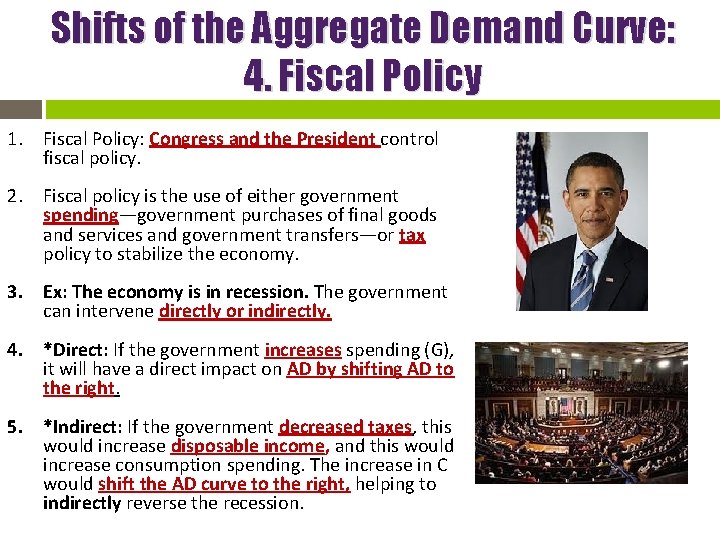
Shifts of the Aggregate Demand Curve: 4. Fiscal Policy 1. Fiscal Policy: Congress and the President control fiscal policy. 2. Fiscal policy is the use of either government spending—government purchases of final goods and services and government transfers—or tax policy to stabilize the economy. 3. Ex: The economy is in recession. The government can intervene directly or indirectly. 4. *Direct: If the government increases spending (G), it will have a direct impact on AD by shifting AD to the right. 5. *Indirect: If the government decreased taxes, this would increase disposable income, and this would increase consumption spending. The increase in C would shift the AD curve to the right, helping to indirectly reverse the recession.
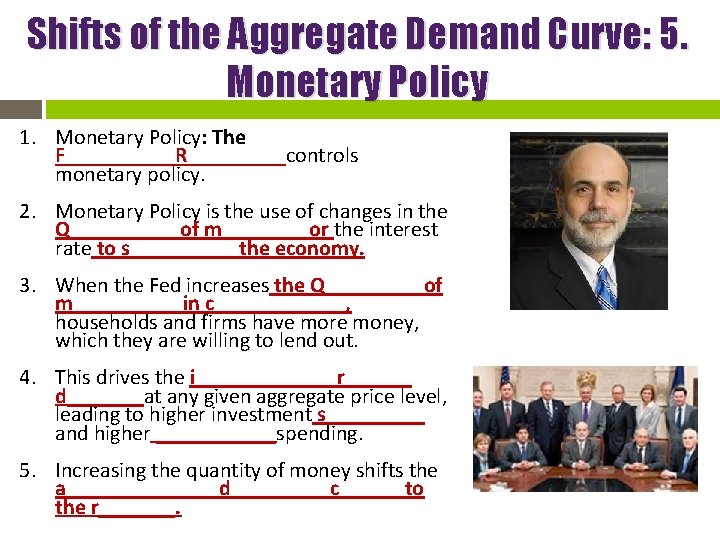
Shifts of the Aggregate Demand Curve: 5. Monetary Policy 1. Monetary Policy: The F_____R_____controls monetary policy. 2. Monetary Policy is the use of changes in the Q_____of m____or the interest rate to s_____the economy. 3. When the Fed increases the Q_____of m_____in c______, households and firms have more money, which they are willing to lend out. 4. This drives the i_______r______ d_______at any given aggregate price level, leading to higher investment s_____ and higher ______spending. 5. Increasing the quantity of money shifts the a_______d_____c______to the r_______.
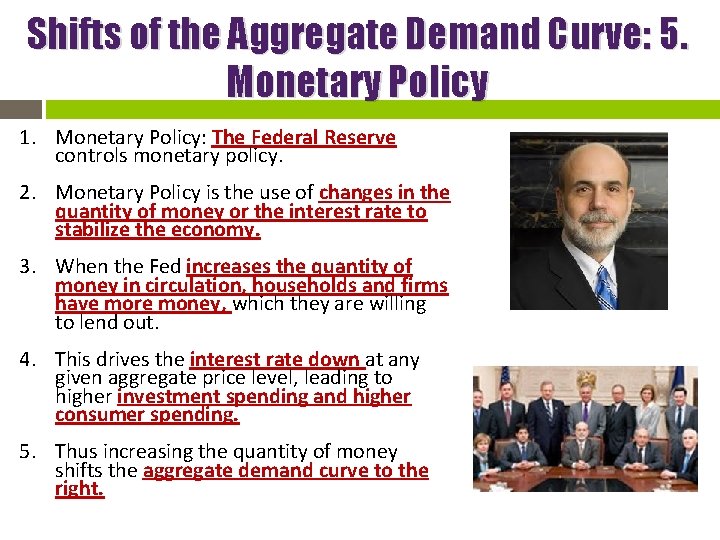
Shifts of the Aggregate Demand Curve: 5. Monetary Policy 1. Monetary Policy: The Federal Reserve controls monetary policy. 2. Monetary Policy is the use of changes in the quantity of money or the interest rate to stabilize the economy. 3. When the Fed increases the quantity of money in circulation, households and firms have more money, which they are willing to lend out. 4. This drives the interest rate down at any given aggregate price level, leading to higher investment spending and higher consumer spending. 5. Thus increasing the quantity of money shifts the aggregate demand curve to the right.
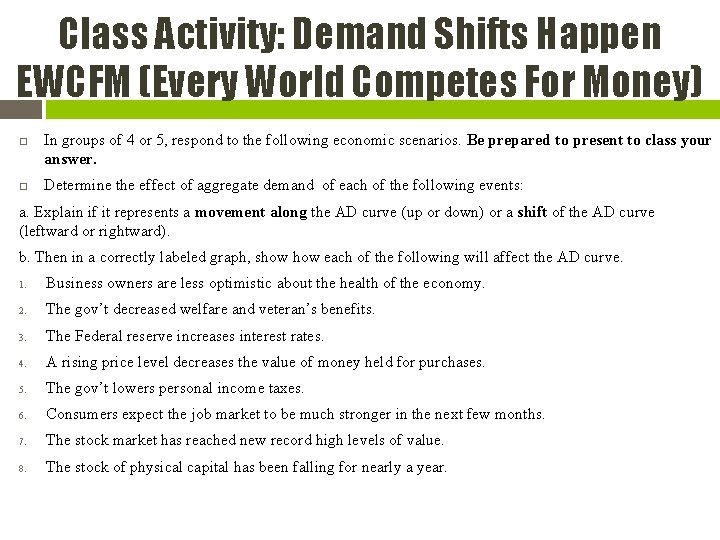
Class Activity: Demand Shifts Happen EWCFM (Every World Competes For Money) In groups of 4 or 5, respond to the following economic scenarios. Be prepared to present to class your answer. Determine the effect of aggregate demand of each of the following events: a. Explain if it represents a movement along the AD curve (up or down) or a shift of the AD curve (leftward or rightward). b. Then in a correctly labeled graph, show each of the following will affect the AD curve. 1. Business owners are less optimistic about the health of the economy. 2. The gov’t decreased welfare and veteran’s benefits. 3. The Federal reserve increases interest rates. 4. A rising price level decreases the value of money held for purchases. 5. The gov’t lowers personal income taxes. 6. Consumers expect the job market to be much stronger in the next few months. 7. The stock market has reached new record high levels of value. 8. The stock of physical capital has been falling for nearly a year.
Which Way Did It Go? QUIZ 1. A decrease in the ________ results in more _____ being demanded because of the wealth effect and the interest rate effect. 2. A lower price level results in more p______ p_____ for financial assets, so more real GDP is demanded. 3. A lower price level also results in a lower ______ ______ which means that more investment in capital (a component of real GDP ) occurs. 4. An increase in the _________results in less _______being demanded because of both the wealth effect and the interest rate effect. 5. A higher price level results in less ___________ for financial assets, so _____ real GDP is demanded. 6. A higher price level also results in a ________ rate which means that less investment in capital (a component of real GDP ) occurs.
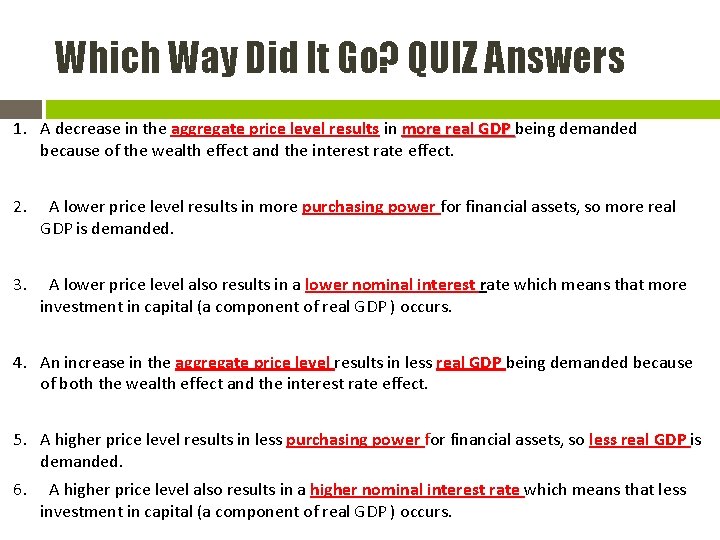
Which Way Did It Go? QUIZ Answers 1. A decrease in the aggregate price level results in more real GDP being demanded because of the wealth effect and the interest rate effect. 2. A lower price level results in more purchasing power for financial assets, so more real GDP is demanded. 3. A lower price level also results in a lower nominal interest rate which means that more investment in capital (a component of real GDP ) occurs. 4. An increase in the aggregate price level results in less real GDP being demanded because of both the wealth effect and the interest rate effect. 5. A higher price level results in less purchasing power for financial assets, so less real GDP is demanded. 6. A higher price level also results in a higher nominal interest rate which means that less investment in capital (a component of real GDP ) occurs.
Module 17 Review p. 177 -178 Read Module 18, Aggregate Supply: Introduction & determinants p. 179 -188