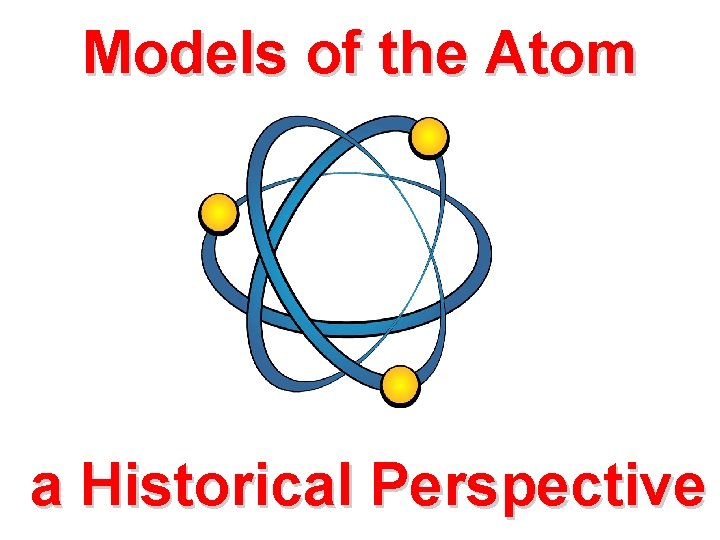
Models of the Atom a Historical Perspective Greek
- Slides: 8
Models of the Atom a Historical Perspective
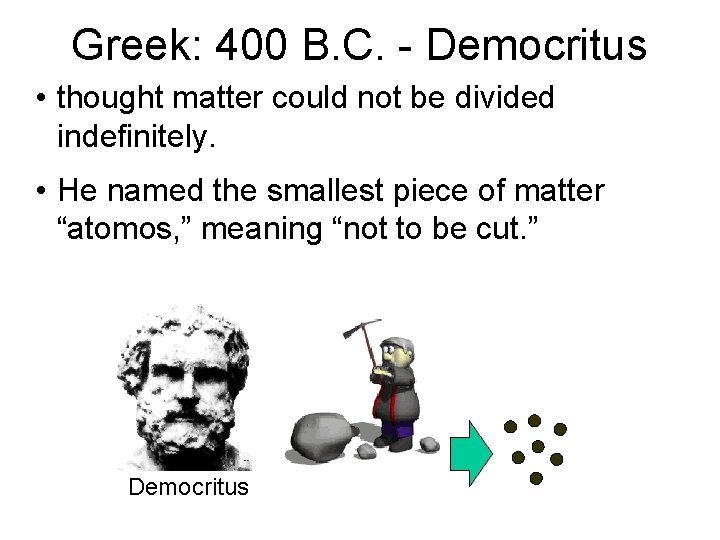
Greek: 400 B. C. - Democritus • thought matter could not be divided indefinitely. • He named the smallest piece of matter “atomos, ” meaning “not to be cut. ” Democritus
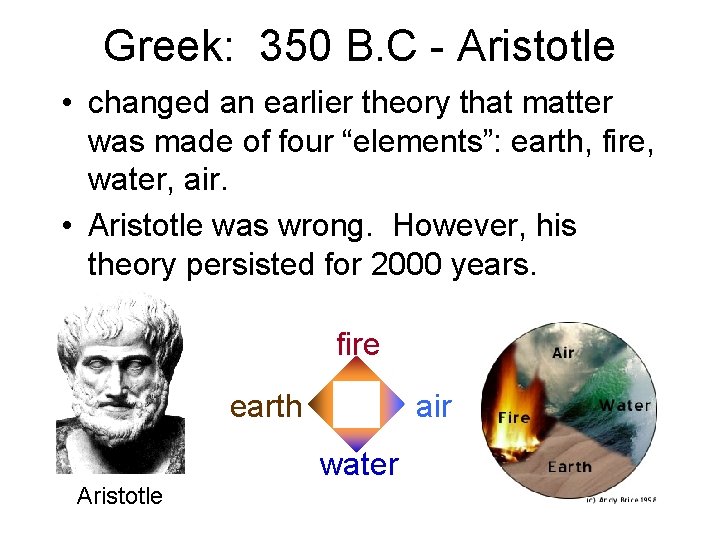
Greek: 350 B. C - Aristotle • changed an earlier theory that matter was made of four “elements”: earth, fire, water, air. • Aristotle was wrong. However, his theory persisted for 2000 years. fire earth air water Aristotle
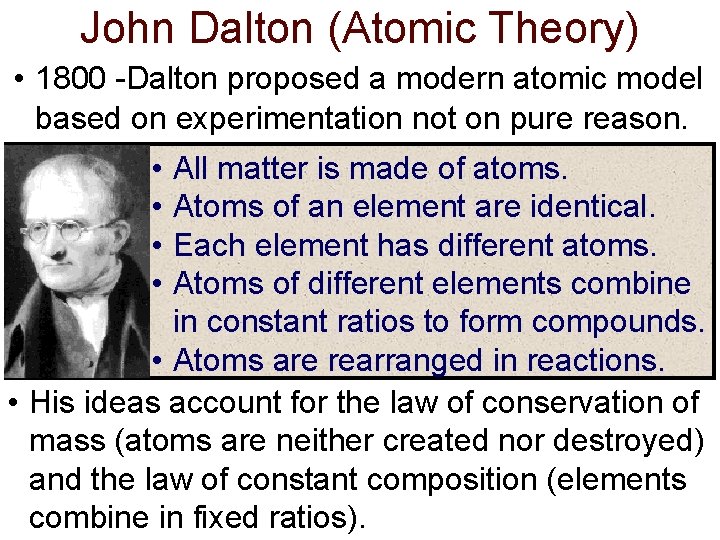
John Dalton (Atomic Theory) • 1800 -Dalton proposed a modern atomic model based on experimentation not on pure reason. • • All matter is made of atoms. Atoms of an element are identical. Each element has different atoms. Atoms of different elements combine in constant ratios to form compounds. • Atoms are rearranged in reactions. • His ideas account for the law of conservation of mass (atoms are neither created nor destroyed) and the law of constant composition (elements combine in fixed ratios).
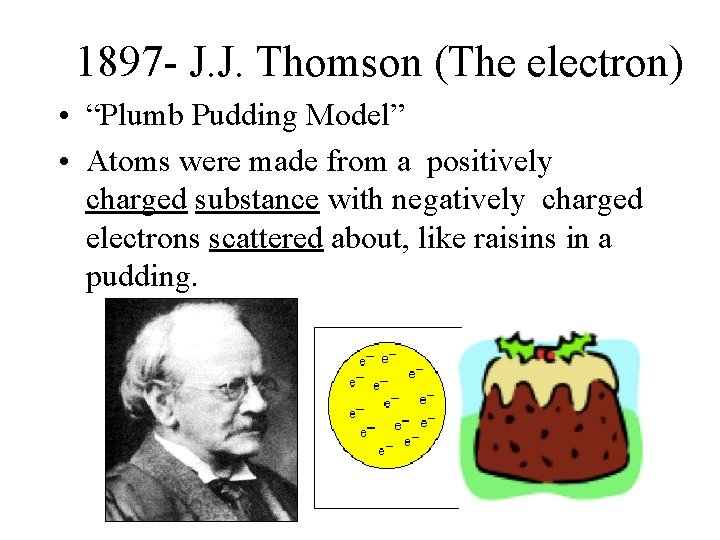
1897 - J. J. Thomson (The electron) • “Plumb Pudding Model” • Atoms were made from a positively charged substance with negatively charged electrons scattered about, like raisins in a pudding.
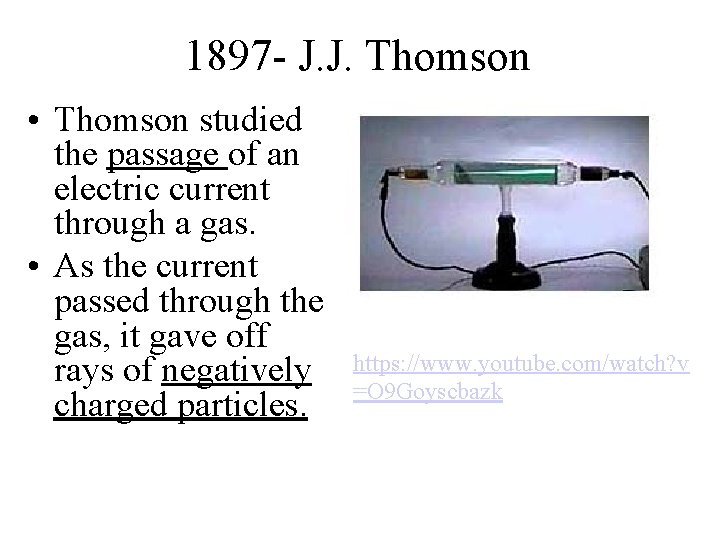
1897 - J. J. Thomson • Thomson studied the passage of an electric current through a gas. • As the current passed through the gas, it gave off rays of negatively charged particles. https: //www. youtube. com/watch? v =O 9 Goyscbazk
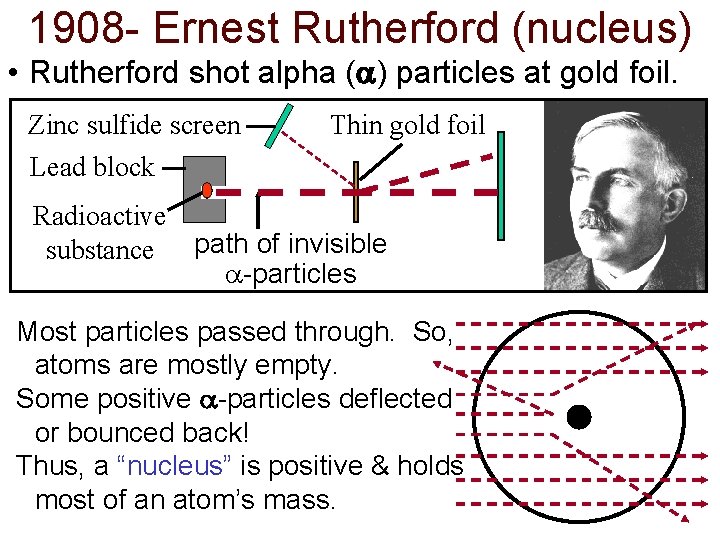
1908 - Ernest Rutherford (nucleus) • Rutherford shot alpha ( ) particles at gold foil. Zinc sulfide screen Lead block Thin gold foil Radioactive substance path of invisible -particles Most particles passed through. So, atoms are mostly empty. Some positive -particles deflected or bounced back! Thus, a “nucleus” is positive & holds most of an atom’s mass.
Rutherford Scatting Experiment https: //www. youtube. com/watch? v=XBq. Hkraf 8 i. E