Measuring gender empowerment and its implications for food

- Slides: 20
Measuring gender empowerment and its implications for food security in northern Vietnam Christian Genova 1, Wendy Umberger 1, Suzie Newman 2, & Mia Urbano 3 1 The University of Adelaide | 2 Plant and Food Research | 3 Department of Foreign Affairs and Trade Seeds of Change Conference | 2 -4 April 2019 | Ann Harding Conference Centre, University of Canberra
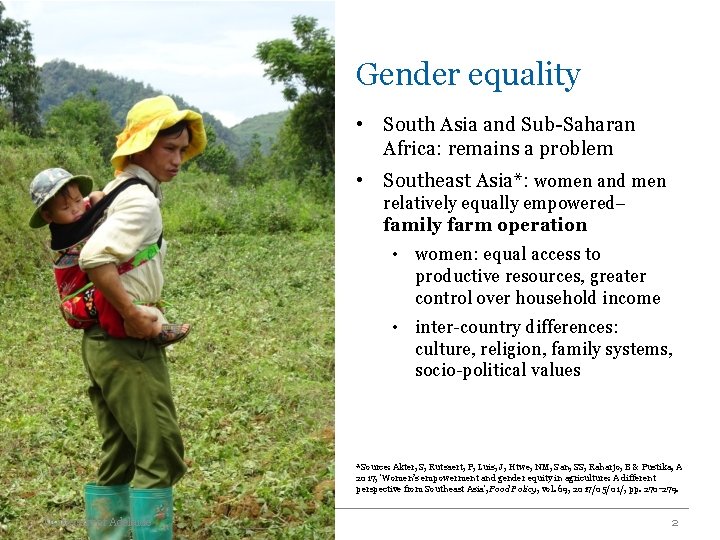
Gender equality • South Asia and Sub-Saharan Africa: remains a problem • Southeast Asia*: women and men relatively equally empowered family farm operation • women: equal access to productive resources, greater control over household income • inter-country differences: culture, religion, family systems, socio-political values *Source: Akter, S, Rutsaert, P, Luis, J, Htwe, NM, San, SS, Raharjo, B & Pustika, A 2017, 'Women’s empowerment and gender equity in agriculture: A different perspective from Southeast Asia', Food Policy, vol. 69, 2017/05/01/, pp. 270 -279. University of Adelaide 2
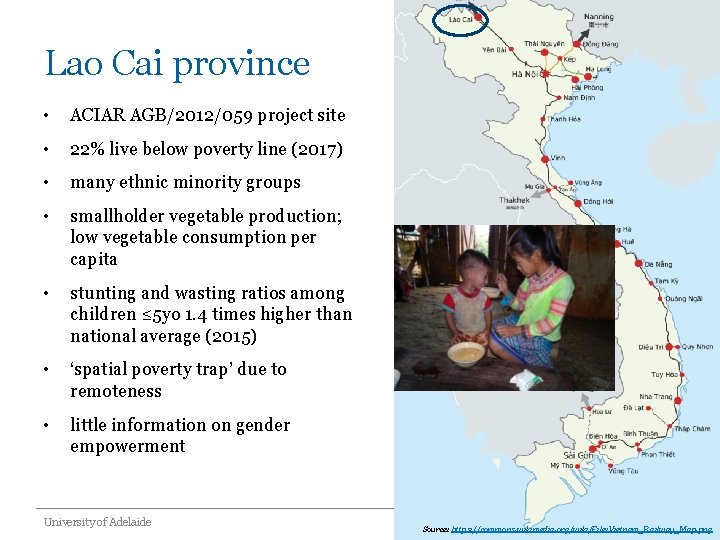
Lao Cai province • ACIAR AGB/2012/059 project site • 22% live below poverty line (2017) • many ethnic minority groups • smallholder vegetable production; low vegetable consumption per capita • stunting and wasting ratios among children ≤ 5 yo 1. 4 times higher than national average (2015) • ‘spatial poverty trap’ due to remoteness • little information on gender empowerment University of Adelaide 3 Source: https: //commons. wikimedia. org/wiki/File: Vietnam_Railway_Map. png
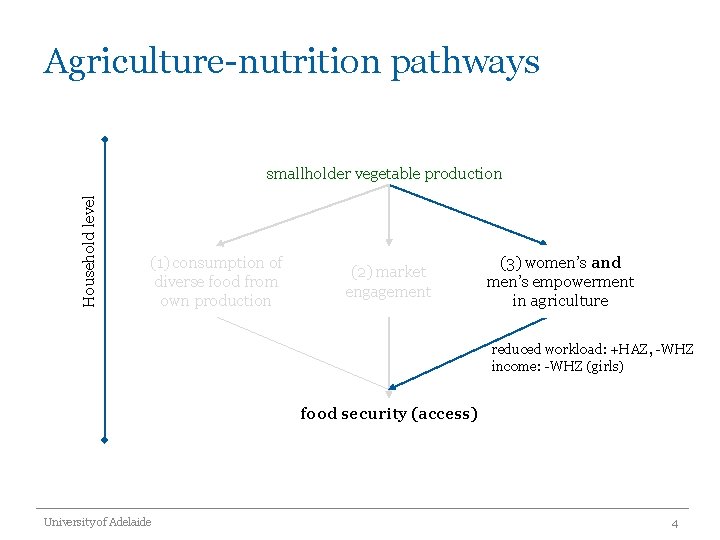
Agriculture-nutrition pathways Household level smallholder vegetable production (1) consumption of diverse food from own production (2) market engagement (3)women’sand empowerment men’s empowerment in agriculture reduced workload: +HAZ, -WHZ income: -WHZ (girls) nutrition foodchild security (access) University of Adelaide 4
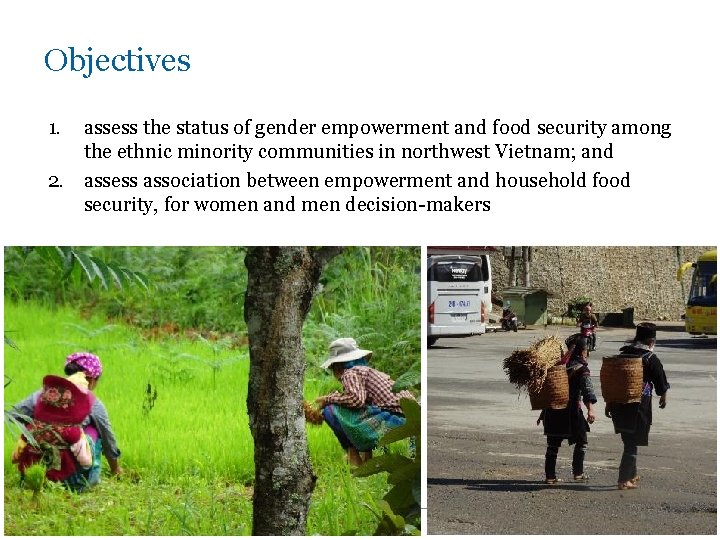
Objectives 1. assess the status of gender empowerment and food security among the ethnic minority communities in northwest Vietnam; and 2. assess association between empowerment and household food security, for women and men decision-makers University of Adelaide 5
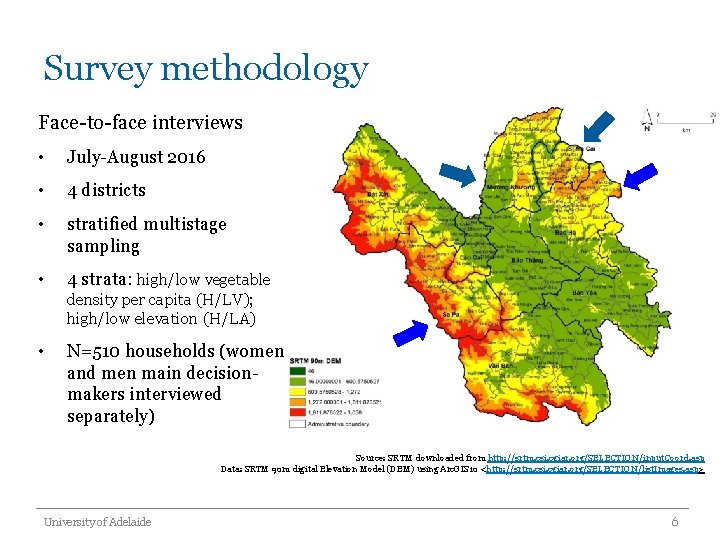
Survey methodology Face-to-face interviews • July-August 2016 • 4 districts • stratified multistage sampling • 4 strata: high/low vegetable density per capita (H/LV); high/low elevation (H/LA) • N=510 households (women and men main decisionmakers interviewed separately) Source: SRTM downloaded from http: //srtm. csi. cgiar. org/SELECTION/input. Coord. asp Data: SRTM 90 m digital Elevation Model (DEM) using Arc. GIS 10 <http: //srtm. csi. cgiar. org/SELECTION/list. Images. asp> University of Adelaide 6
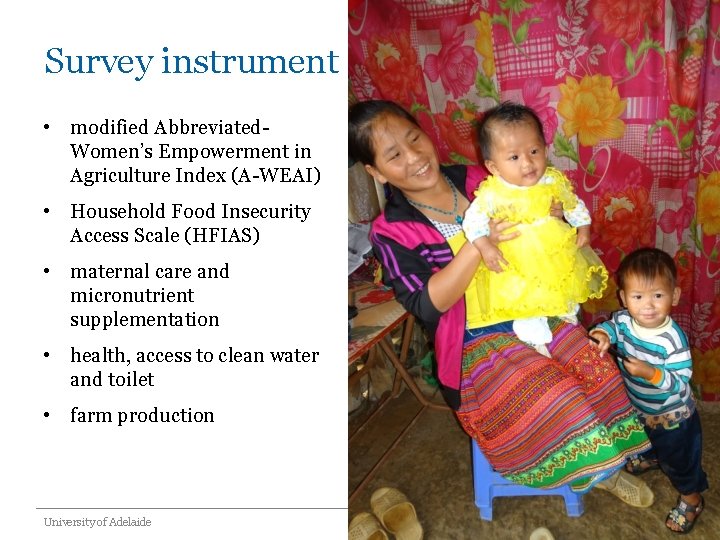
Survey instrument • modified Abbreviated. Women’s Empowerment in Agriculture Index (A-WEAI) • Household Food Insecurity Access Scale (HFIAS) • maternal care and micronutrient supplementation • health, access to clean water and toilet • farm production University of Adelaide 7
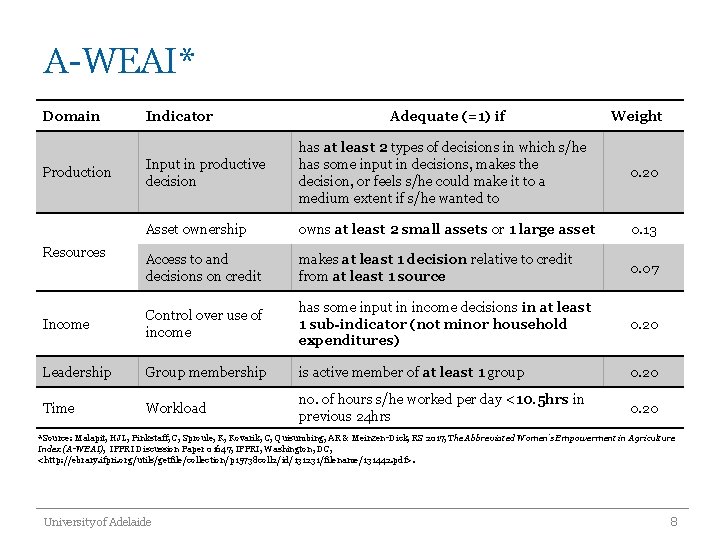
A-WEAI* Domain Indicator Adequate (=1) if Weight Input in productive decision has at least 2 types of decisions in which s/he has some input in decisions, makes the decision, or feels s/he could make it to a medium extent if s/he wanted to 0. 20 Asset ownership owns at least 2 small assets or 1 large asset 0. 13 Access to and decisions on credit makes at least 1 decision relative to credit from at least 1 source 0. 07 Income Control over use of income has some input in income decisions in at least 1 sub-indicator (not minor household expenditures) 0. 20 Leadership Group membership is active member of at least 1 group 0. 20 Time Workload no. of hours s/he worked per day <10. 5 hrs in previous 24 hrs 0. 20 Production Resources *Source: Malapit, HJL, Pinkstaff, C, Sproule, K, Kovarik, C, Quisumbing, AR & Meinzen-Dick, RS 2017, The Abbreviated Women's Empowerment in Agriculture Index (A-WEAI), IFPRI Discussion Paper 01647, IFPRI, Washington, DC, <http: //ebrary. ifpri. org/utils/getfile/collection/p 15738 coll 2/id/131231/filename/131442. pdf>. University of Adelaide 8
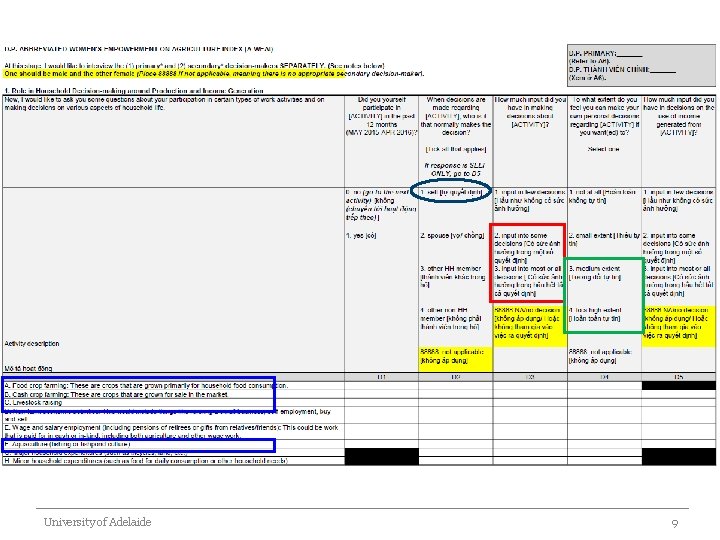
University of Adelaide 9
A-WEAI (cont’d) aggregate index, and 2 subindices: • 5 domains of empowerment (5 DE): degree to which women/men are empowered in 5 domains • Gender Parity Index (GPI): % of women who are equally empowered as men in the household) Source: Malapit, HJL, Kovarik, C, Sproule, K, Meinzen-Dick, RS & Quisumbing, AR 2015, Instructional guide on the Abbreviated-Women's Empowerment in Agriculture Index (A-WEAI), IFPRI, Washington, DC, <https: //www. ifpri. org/sites/default/files/Basic%20 Page/weai_instructionalguide_1. pdf>. University of Adelaide 10
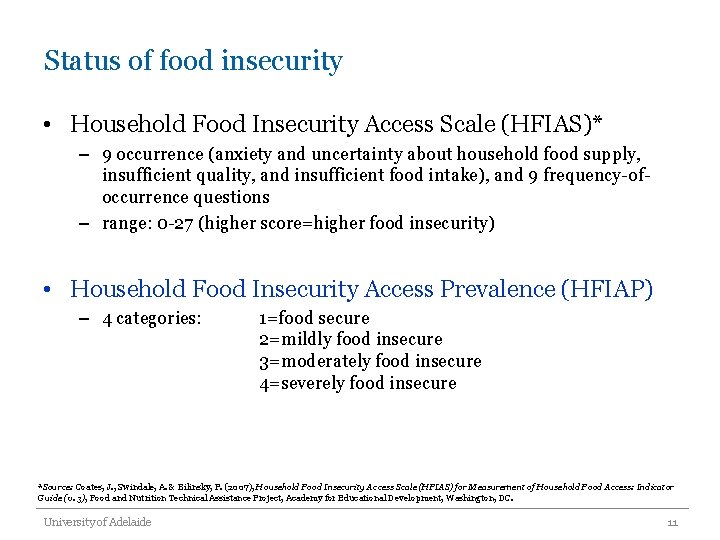
Status of food insecurity • Household Food Insecurity Access Scale (HFIAS)* – 9 occurrence (anxiety and uncertainty about household food supply, insufficient quality, and insufficient food intake), and 9 frequency-ofoccurrence questions – range: 0 -27 (higher score=higher food insecurity) • Household Food Insecurity Access Prevalence (HFIAP) – 4 categories: 1=food secure 2=mildly food insecure 3=moderately food insecure 4=severely food insecure *Source: Coates, J. , Swindale, A. & Bilinsky, P. (2007), Household Food Insecurity Access Scale (HFIAS) for Measurement of Household Food Access: Indicator Guide (v. 3), Food and Nutrition Technical Assistance Project, Academy for Educational Development, Washington, DC. University of Adelaide 11
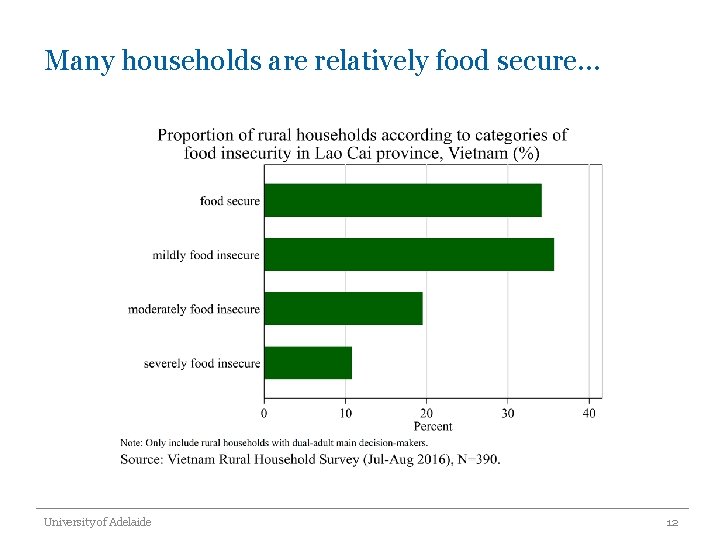
Many households are relatively food secure… University of Adelaide 12
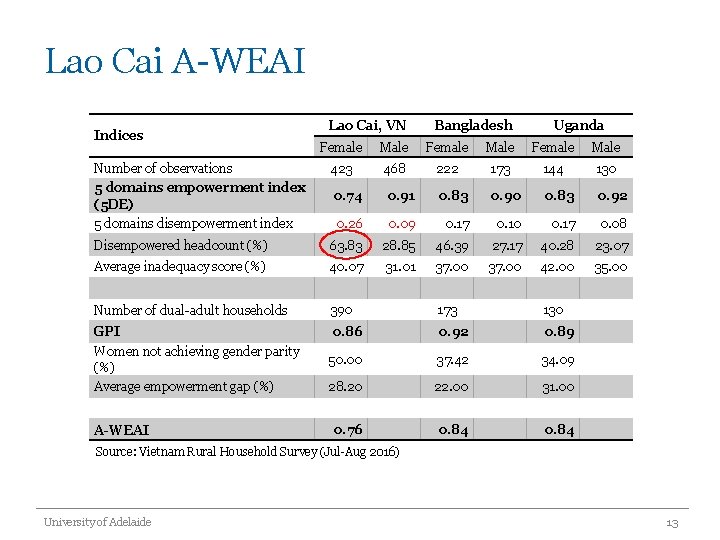
Lao Cai A-WEAI Indices Lao Cai, VN Bangladesh Uganda Female Male Number of observations 5 domains empowerment index (5 DE) 5 domains disempowerment index 423 468 222 173 144 130 0. 74 0. 91 0. 83 0. 90 0. 83 0. 92 0. 26 0. 09 0. 17 0. 10 0. 17 0. 08 Disempowered headcount (%) 63. 83 28. 85 46. 39 27. 17 40. 28 23. 07 Average inadequacy score (%) 40. 07 31. 01 37. 00 42. 00 35. 00 Number of dual-adult households 390 173 130 GPI Women not achieving gender parity (%) Average empowerment gap (%) 0. 86 0. 92 0. 89 50. 00 37. 42 34. 09 28. 20 22. 00 31. 00 0. 76 0. 84 A-WEAI Source: Vietnam Rural Household Survey (Jul-Aug 2016) University of Adelaide 13
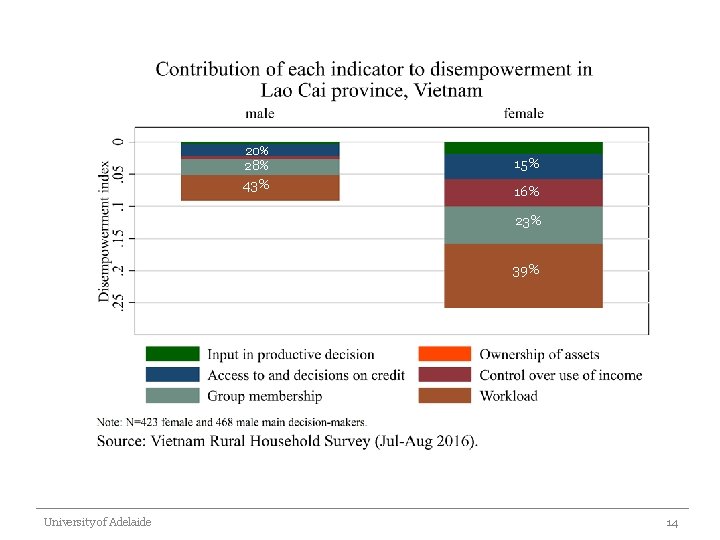
20% 28% 43% 15% 16% 23% 39% University of Adelaide 14
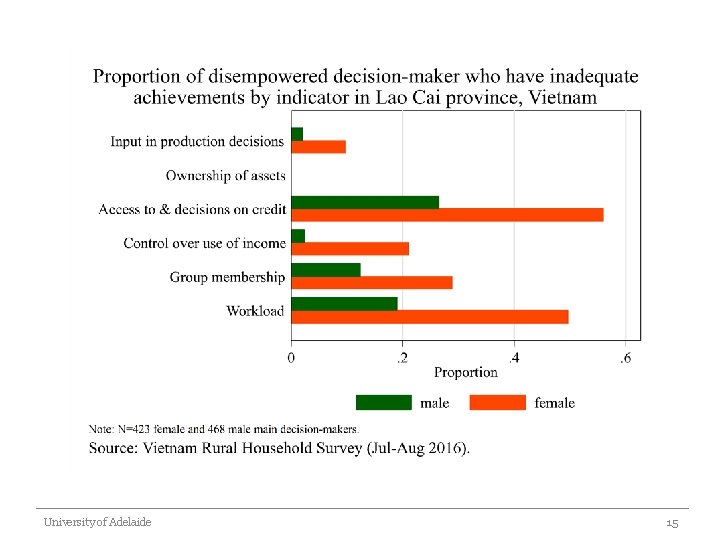
University of Adelaide 15
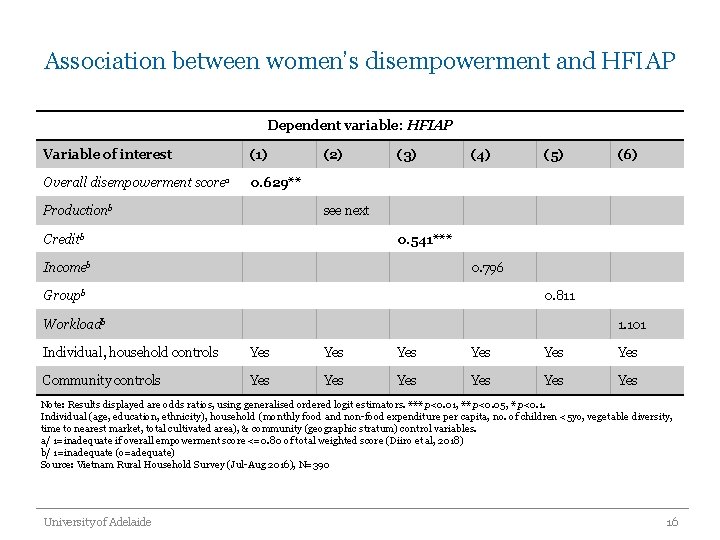
Association between women’s disempowerment and HFIAP Dependent variable: HFIAP Variable of interest (1) Overall disempowerment scorea 0. 629** Productionb (2) (3) (4) (5) (6) see next Creditb 0. 541*** Incomeb 0. 796 Groupb 0. 811 Workloadb 1. 101 Individual, household controls Yes Yes Yes Community controls Yes Yes Yes Note: Results displayed are odds ratios, using generalised ordered logit estimators. *** p<0. 01, ** p<0. 05, * p<0. 1. Individual (age, education, ethnicity), household (monthly food and non-food expenditure per capita, no. of children <5 yo, vegetable diversity, time to nearest market, total cultivated area), & community (geographic stratum) control variables. a/ 1=inadequate if overall empowerment score <=0. 80 of total weighted score (Diiro et al, 2018) b/ 1=inadequate (o=adequate) Source: Vietnam Rural Household Survey (Jul-Aug 2016), N=390 University of Adelaide 16
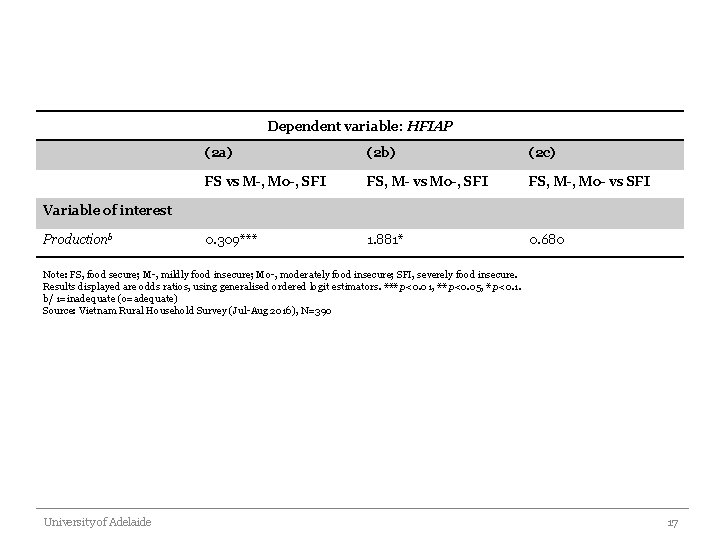
Dependent variable: HFIAP (2 a) (2 b) (2 c) FS vs M-, Mo-, SFI FS, M- vs Mo-, SFI FS, M-, Mo- vs SFI 0. 309*** 1. 881* 0. 680 Variable of interest Productionb Note: FS, food secure; M-, mildly food insecure; Mo-, moderately food insecure; SFI, severely food insecure. Results displayed are odds ratios, using generalised ordered logit estimators. *** p<0. 01, ** p<0. 05, * p<0. 1. b/ 1=inadequate (o=adequate) Source: Vietnam Rural Household Survey (Jul-Aug 2016), N=390 University of Adelaide 17
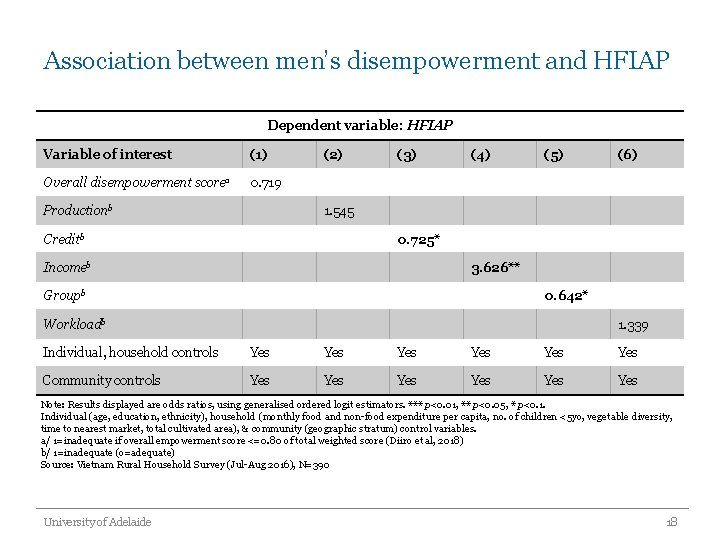
Association between men’s disempowerment and HFIAP Dependent variable: HFIAP Variable of interest (1) Overall disempowerment scorea 0. 719 Productionb (2) (3) (4) (5) (6) 1. 545 Creditb 0. 725* Incomeb 3. 626** Groupb 0. 642* Workloadb 1. 339 Individual, household controls Yes Yes Yes Community controls Yes Yes Yes Note: Results displayed are odds ratios, using generalised ordered logit estimators. *** p<0. 01, ** p<0. 05, * p<0. 1. Individual (age, education, ethnicity), household (monthly food and non-food expenditure per capita, no. of children <5 yo, vegetable diversity, time to nearest market, total cultivated area), & community (geographic stratum) control variables. a/ 1=inadequate if overall empowerment score <=0. 80 of total weighted score (Diiro et al, 2018) b/ 1=inadequate (o=adequate) Source: Vietnam Rural Household Survey (Jul-Aug 2016), N=390 University of Adelaide 18
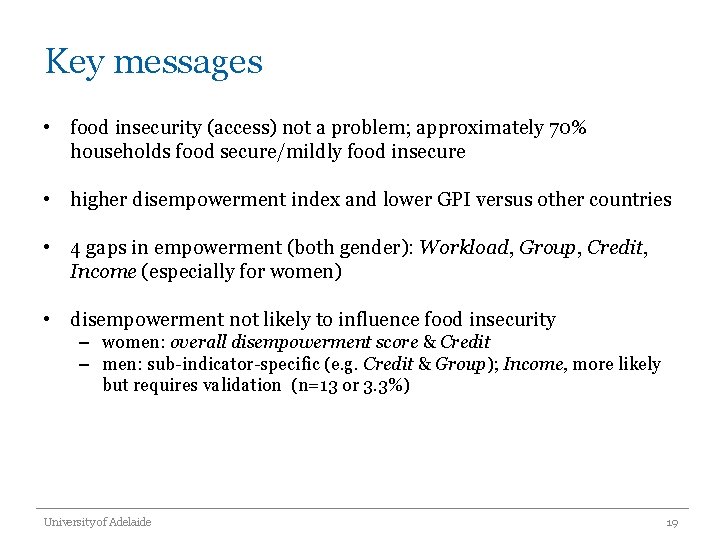
Key messages • food insecurity (access) not a problem; approximately 70% households food secure/mildly food insecure • higher disempowerment index and lower GPI versus other countries • 4 gaps in empowerment (both gender): Workload, Group, Credit, Income (especially for women) • disempowerment not likely to influence food insecurity – women: overall disempowerment score & Credit – men: sub-indicator-specific (e. g. Credit & Group); Income, more likely but requires validation (n=13 or 3. 3%) University of Adelaide 19
Thank you! christianll. genova@adelaide. edu. au wendy. umberger@adelaide. edu. au Acknowledgements: Australian Centre for International Agricultural Research Domestic Scholarship ACIAR for funding through AGB/2012/059 project Vietnam Women’s Union (VWU, especially to Lo Thi Thuy & Pham Thi Thuy Nga) Lao Cai Department of Crop Production and Crop Protection (especially to Nguyen Van Hung & Pham Quoc Cuong) Faculty of Economics and Rural Development, Vietnam National University of Agriculture (VNUA) Mekong Development Research Institute (MDRI, especially to Vuong Anh Vu & Nghiem Hoang Son) Ag. Impact & MAD SRA Team (Stuart Higgins, Amber Gregory, Jack Hetherington, & David Mc. Gill) Pham Thuy Hien & Hien Nguyen (National Coordinators AGB/2012/059), & Tran Minh Tien (SFRI) Alexandra Peralta, Rodd Dyer, Nicholas Minot, James Seale, Christian Culas, Ellen Goddard, & Dale Yi Pham Toan (VNUA), Pham Hung (CIAT), & Do Trong Thang (SFRI) Le Thi Nga (Health. Bridge) Nguyen Anh Duc & Thuy Pham Sonia Asilo (Phil. Rice) Le Nhu Thinh (FAVRI) University of Adelaide 20