Mathematics Rathfern Primary Year 6 COVID19 Home Learning
- Slides: 15
Mathematics Rathfern Primary Year 6 COVID-19 Home Learning
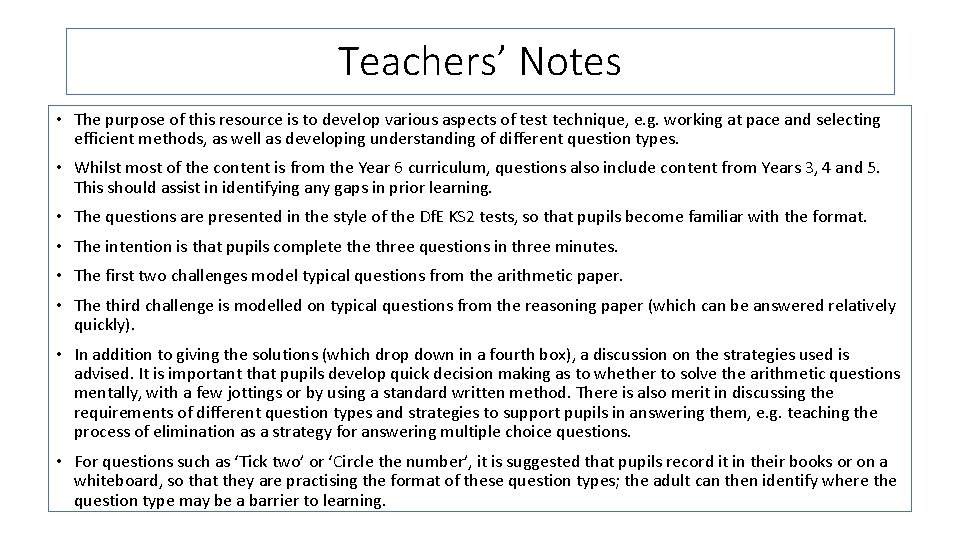
Teachers’ Notes • The purpose of this resource is to develop various aspects of test technique, e. g. working at pace and selecting efficient methods, as well as developing understanding of different question types. • Whilst most of the content is from the Year 6 curriculum, questions also include content from Years 3, 4 and 5. This should assist in identifying any gaps in prior learning. • The questions are presented in the style of the Df. E KS 2 tests, so that pupils become familiar with the format. • The intention is that pupils complete three questions in three minutes. • The first two challenges model typical questions from the arithmetic paper. • The third challenge is modelled on typical questions from the reasoning paper (which can be answered relatively quickly). • In addition to giving the solutions (which drop down in a fourth box), a discussion on the strategies used is advised. It is important that pupils develop quick decision making as to whether to solve the arithmetic questions mentally, with a few jottings or by using a standard written method. There is also merit in discussing the requirements of different question types and strategies to support pupils in answering them, e. g. teaching the process of elimination as a strategy for answering multiple choice questions. • For questions such as ‘Tick two’ or ‘Circle the number’, it is suggested that pupils record it in their books or on a whiteboard, so that they are practising the format of these question types; the adult can then identify where the question type may be a barrier to learning.
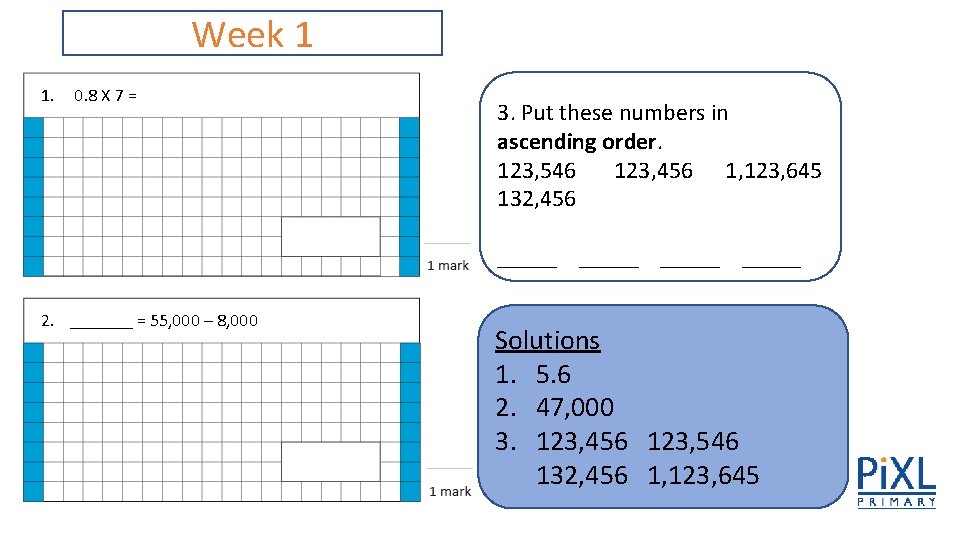
Week 1 1. 0. 8 X 7 = 3. Put these numbers in ascending order. 123, 546 123, 456 1, 123, 645 132, 456 _____ 2. _______ = 55, 000 – 8, 000 Solutions 1. 5. 6 2. 47, 000 3. 123, 456 123, 546 132, 456 1, 123, 645
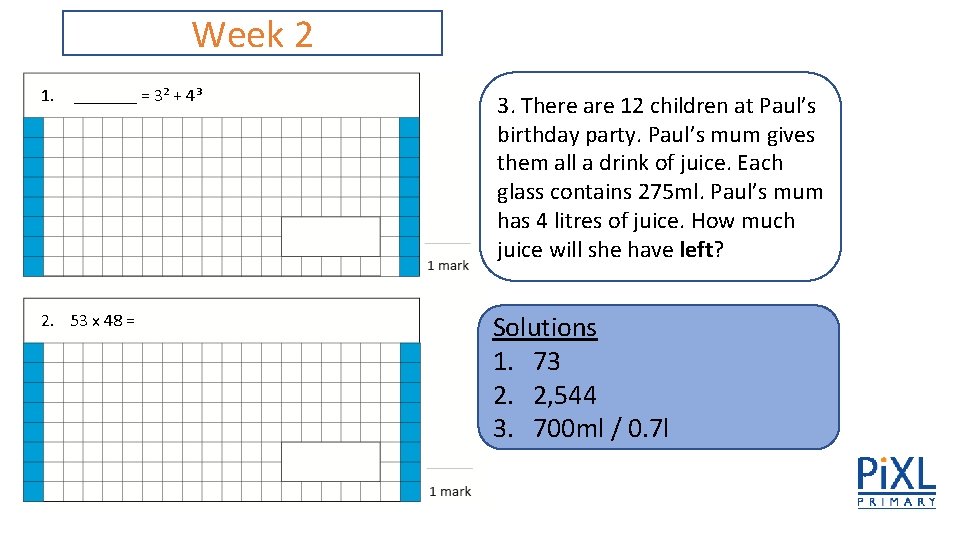
Week 2 1. _______ = 3² + 4³ 2. 53 x 48 = 3. There are 12 children at Paul’s birthday party. Paul’s mum gives them all a drink of juice. Each glass contains 275 ml. Paul’s mum has 4 litres of juice. How much juice will she have left? Solutions 1. 73 2. 2, 544 3. 700 ml / 0. 7 l
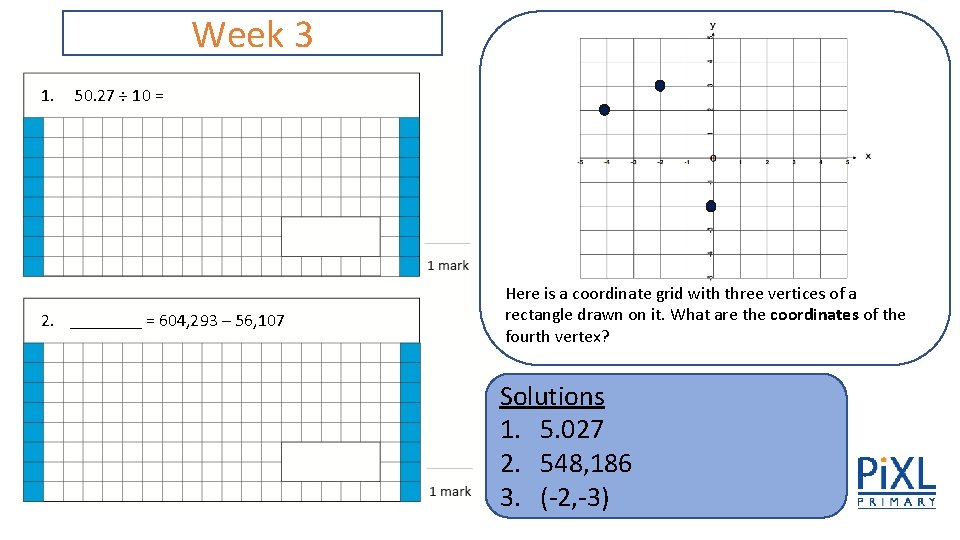
Week 3 1. 50. 27 ÷ 10 = 2. ____ = 604, 293 – 56, 107 Here is a coordinate grid with three vertices of a rectangle drawn on it. What are the coordinates of the fourth vertex? Solutions 1. 5. 027 2. 548, 186 3. (-2, -3)
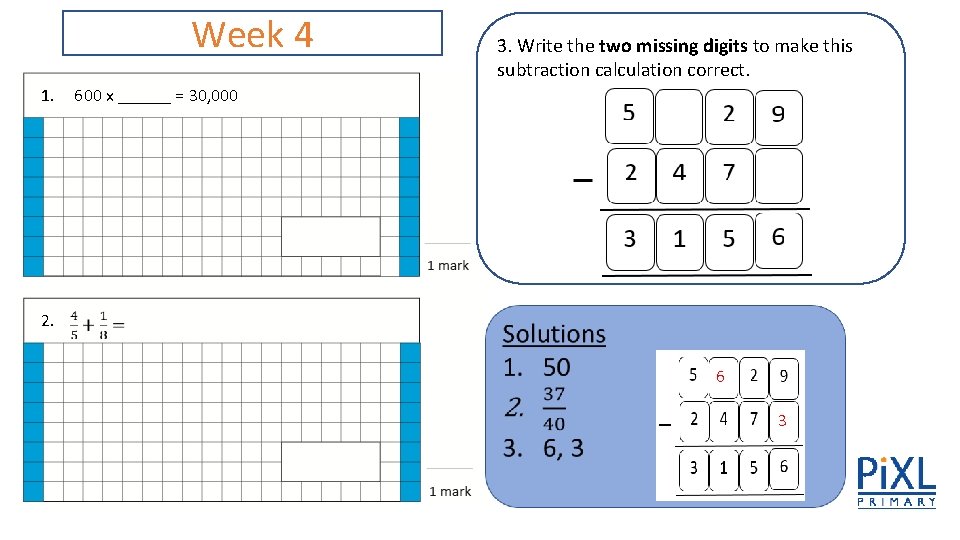
Week 4 1. 3. Write the two missing digits to make this subtraction calculation correct. 600 x ______ = 30, 000 2. 6 3
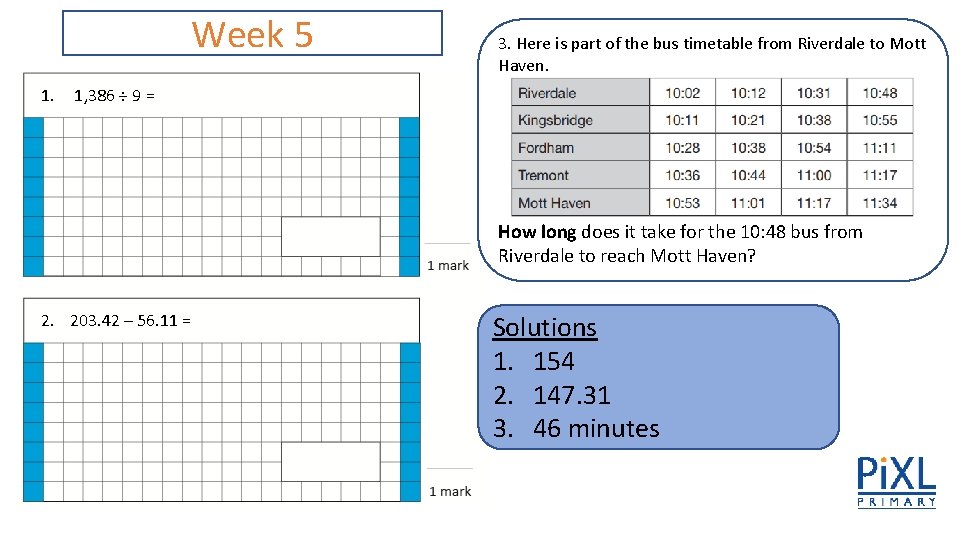
Week 5 1. 3. Here is part of the bus timetable from Riverdale to Mott Haven. 1, 386 ÷ 9 = How long does it take for the 10: 48 bus from Riverdale to reach Mott Haven? 2. 203. 42 – 56. 11 = Solutions 1. 154 2. 147. 31 3. 46 minutes
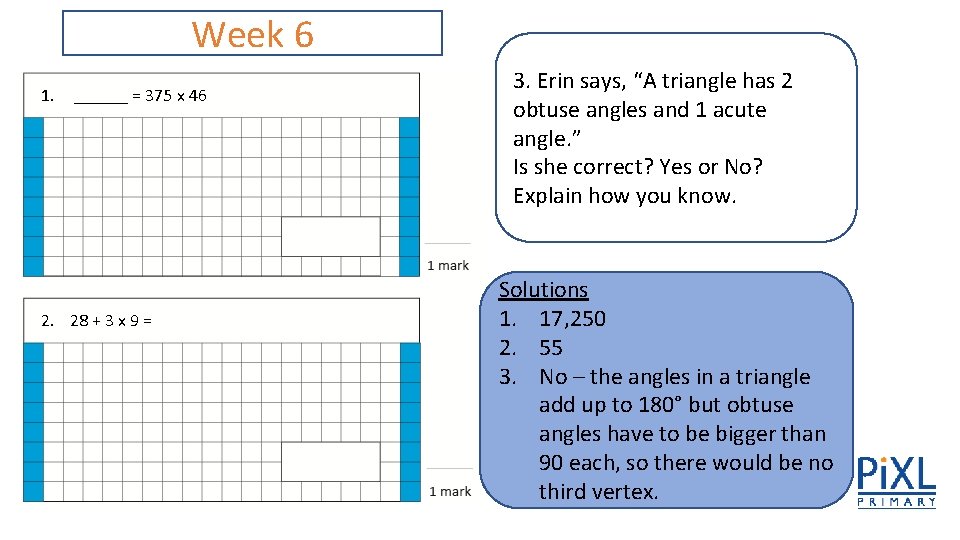
Week 6 1. ______ = 375 x 46 2. 28 + 3 x 9 = 3. Erin says, “A triangle has 2 obtuse angles and 1 acute angle. ” Is she correct? Yes or No? Explain how you know. Solutions 1. 17, 250 2. 55 3. No – the angles in a triangle add up to 180° but obtuse angles have to be bigger than 90 each, so there would be no third vertex.
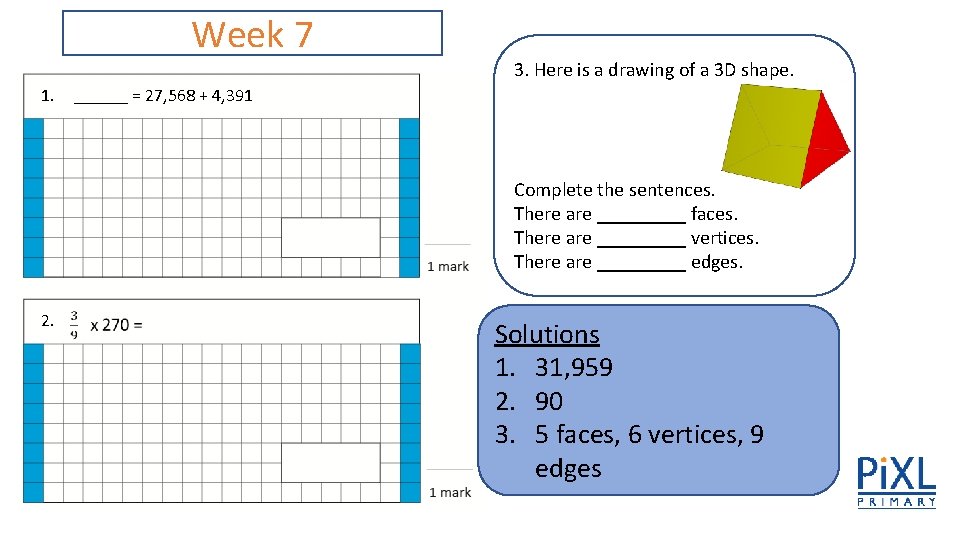
Week 7 1. 3. Here is a drawing of a 3 D shape. ______ = 27, 568 + 4, 391 Complete the sentences. There are _____ faces. There are _____ vertices. There are _____ edges. 2. Solutions 1. 31, 959 2. 90 3. 5 faces, 6 vertices, 9 edges
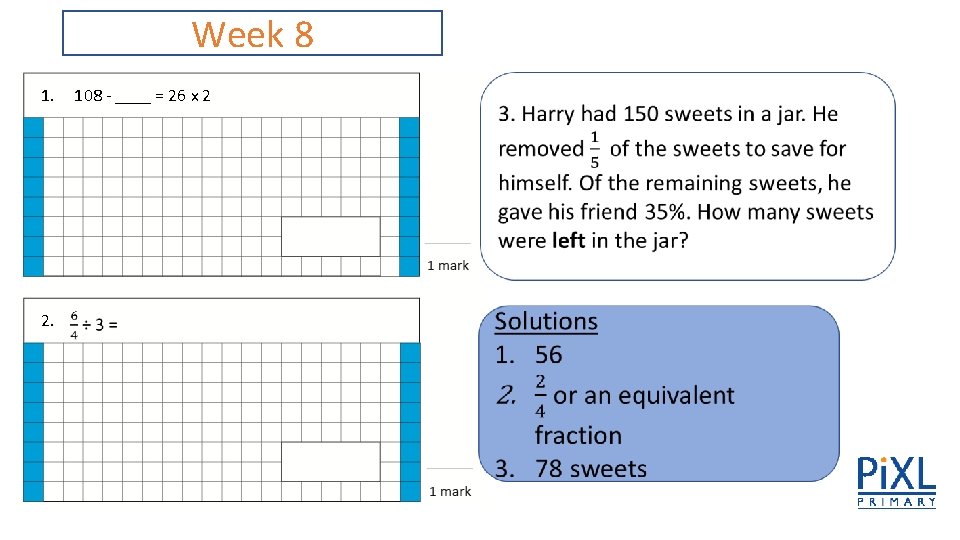
Week 8 1. 2. 108 - ____ = 26 x 2
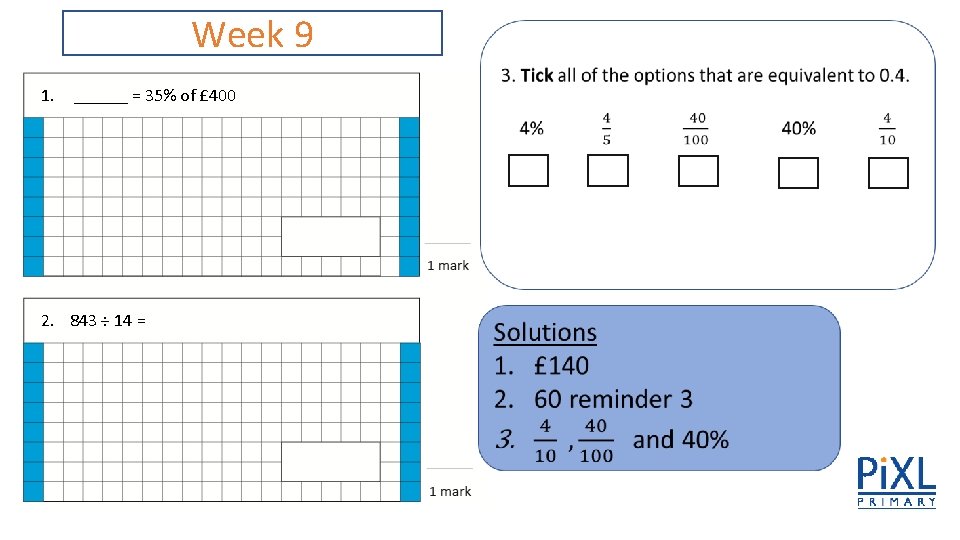
Week 9 1. ______ = 35% of £ 400 2. 843 ÷ 14 =
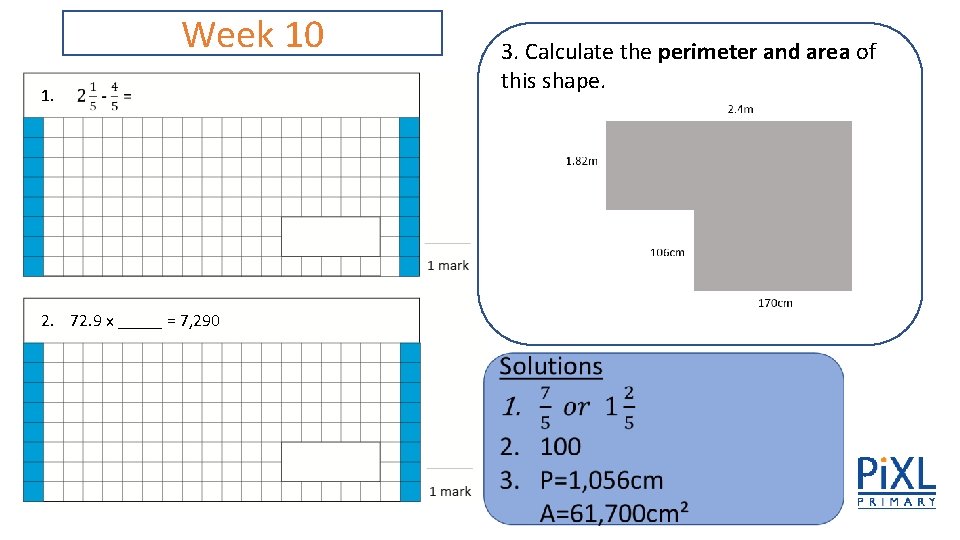
Week 10 1. 2. 72. 9 x _____ = 7, 290 3. Calculate the perimeter and area of this shape.
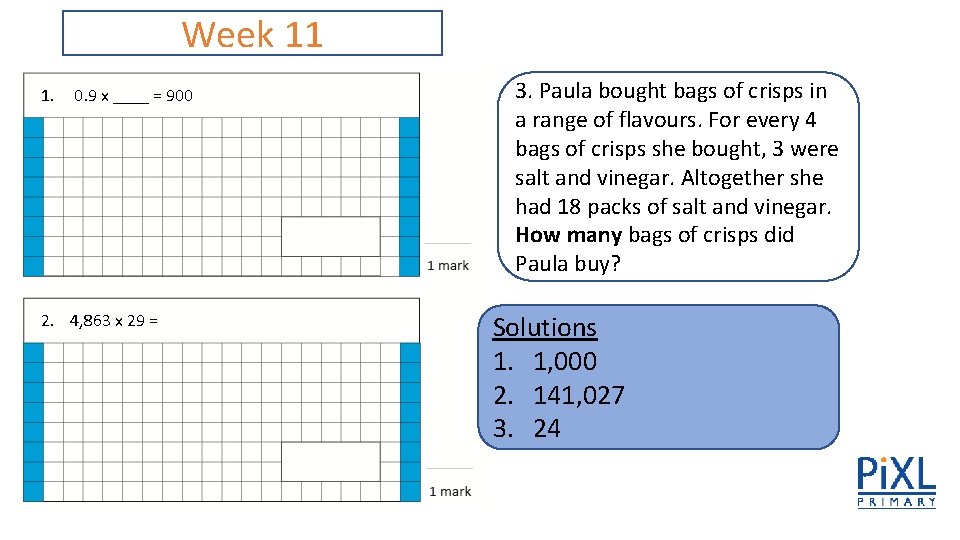
Week 11 1. 0. 9 x ____ = 900 2. 4, 863 x 29 = 3. Paula bought bags of crisps in a range of flavours. For every 4 bags of crisps she bought, 3 were salt and vinegar. Altogether she had 18 packs of salt and vinegar. How many bags of crisps did Paula buy? Solutions 1. 1, 000 2. 141, 027 3. 24
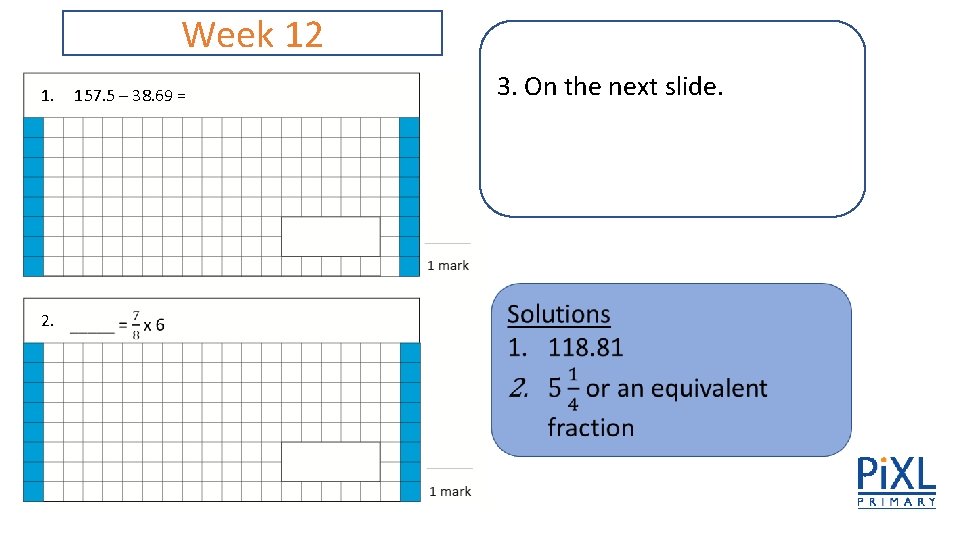
Week 12 1. 2. 157. 5 – 38. 69 = 3. On the next slide.
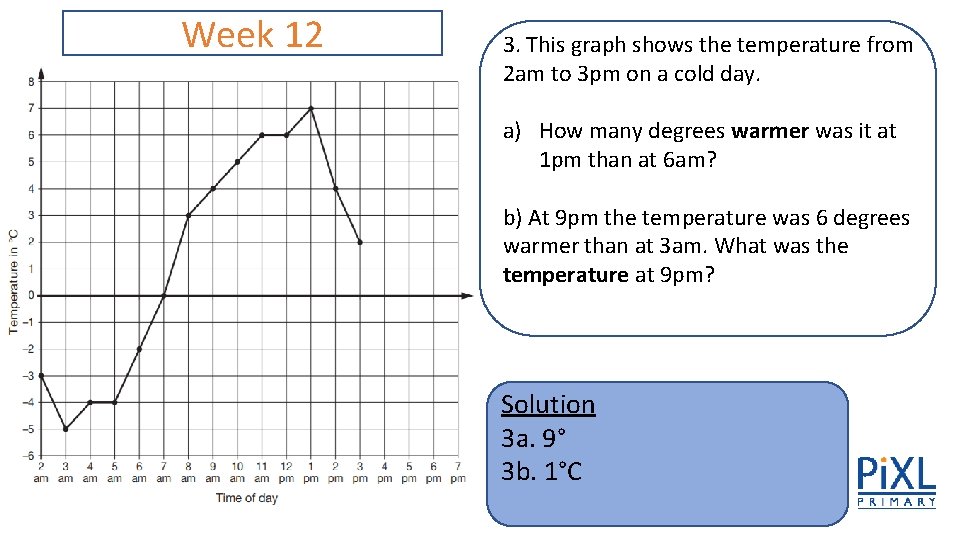
Week 12 3. This graph shows the temperature from 2 am to 3 pm on a cold day. a) How many degrees warmer was it at 1 pm than at 6 am? b) At 9 pm the temperature was 6 degrees warmer than at 3 am. What was the temperature at 9 pm? Solution 3 a. 9° 3 b. 1°C