Mathematical Induction F1 1 Fn1 Fn 2 n1
- Slides: 10
Mathematical Induction
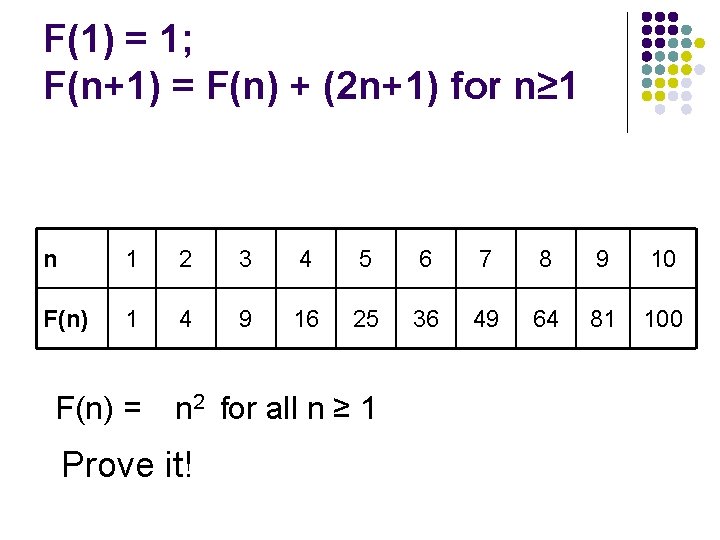
F(1) = 1; F(n+1) = F(n) + (2 n+1) for n≥ 1 n 1 2 3 4 5 6 7 8 9 10 F(n) 1 4 9 16 25 36 49 64 81 100 F(n) = n 2 for all n ≥ 1 Prove it!
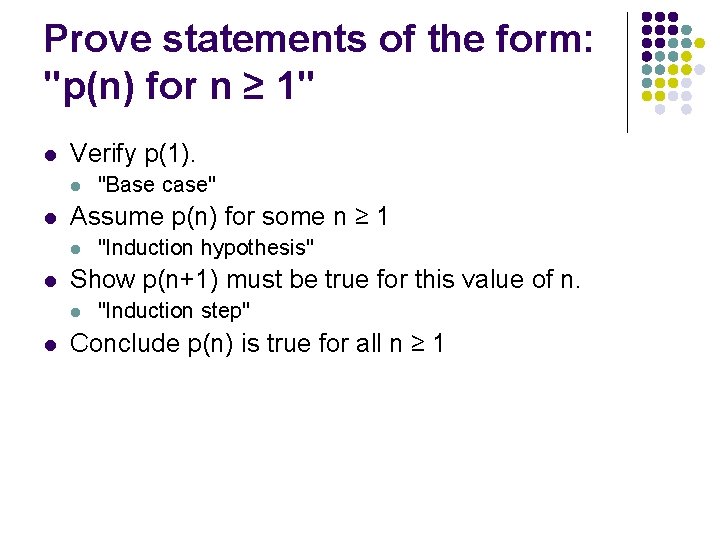
Prove statements of the form: "p(n) for n ≥ 1" l Verify p(1). l l Assume p(n) for some n ≥ 1 l l "Induction hypothesis" Show p(n+1) must be true for this value of n. l l "Base case" "Induction step" Conclude p(n) is true for all n ≥ 1
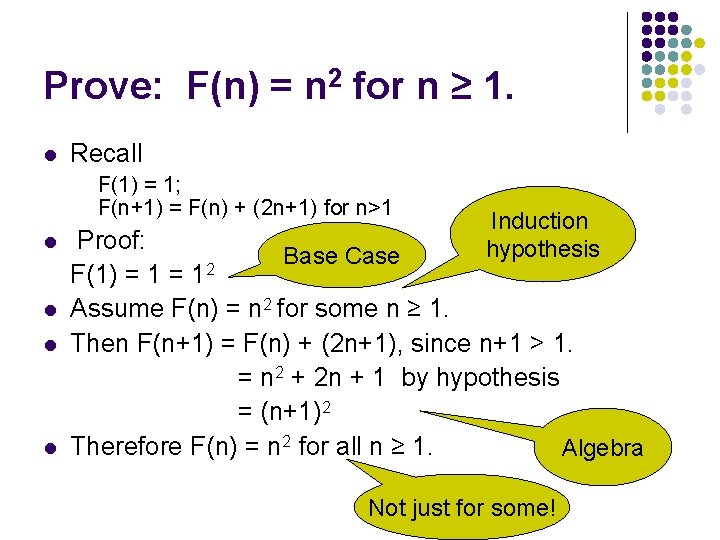
Prove: F(n) = n 2 for n ≥ 1. l Recall F(1) = 1; F(n+1) = F(n) + (2 n+1) for n>1 l l Induction hypothesis Proof: Base Case 2 F(1) = 1 Assume F(n) = n 2 for some n ≥ 1. Then F(n+1) = F(n) + (2 n+1), since n+1 > 1. = n 2 + 2 n + 1 by hypothesis = (n+1)2 Therefore F(n) = n 2 for all n ≥ 1. Algebra Not just for some!
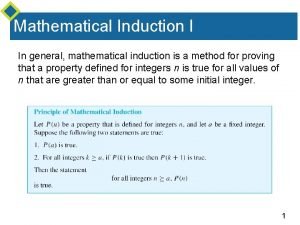
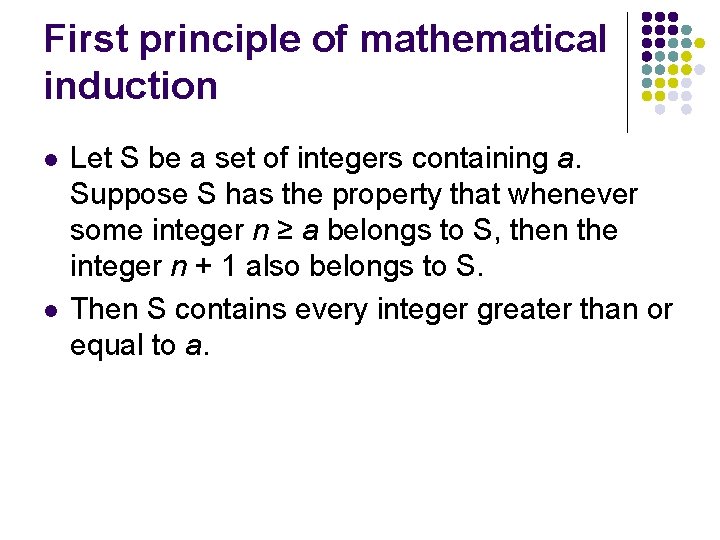
First principle of mathematical induction l l Let S be a set of integers containing a. Suppose S has the property that whenever some integer n ≥ a belongs to S, then the integer n + 1 also belongs to S. Then S contains every integer greater than or equal to a.
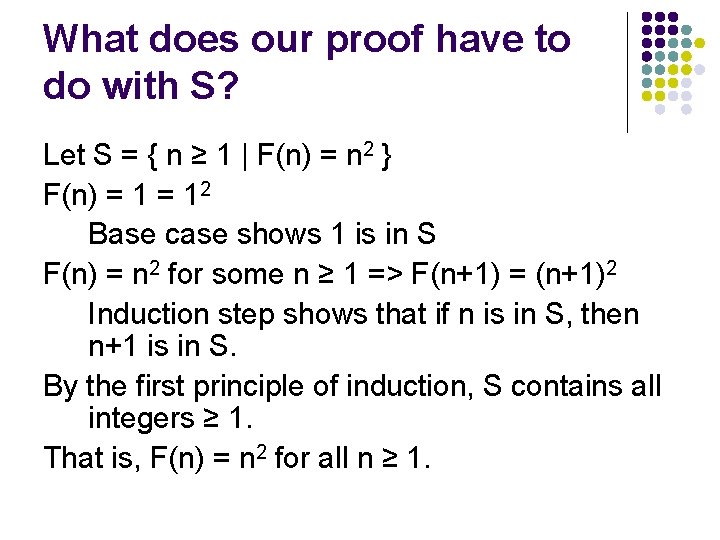
What does our proof have to do with S? Let S = { n ≥ 1 | F(n) = n 2 } F(n) = 12 Base case shows 1 is in S F(n) = n 2 for some n ≥ 1 => F(n+1) = (n+1)2 Induction step shows that if n is in S, then n+1 is in S. By the first principle of induction, S contains all integers ≥ 1. That is, F(n) = n 2 for all n ≥ 1.
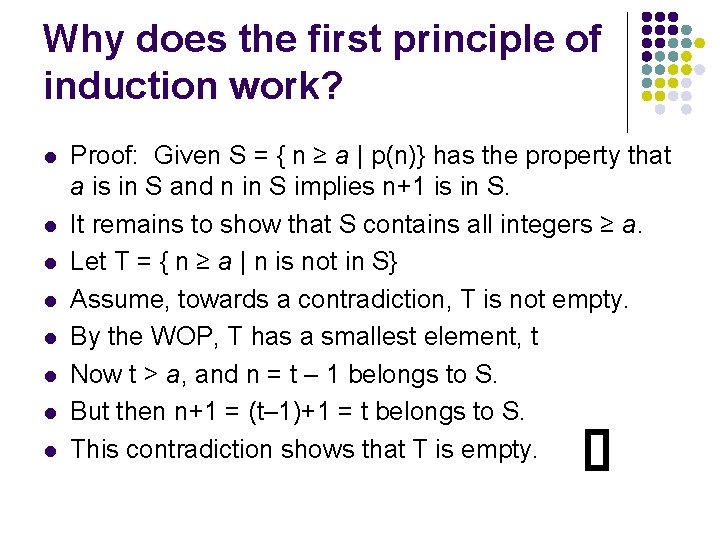
Why does the first principle of induction work? l l l l Proof: Given S = { n ≥ a | p(n)} has the property that a is in S and n in S implies n+1 is in S. It remains to show that S contains all integers ≥ a. Let T = { n ≥ a | n is not in S} Assume, towards a contradiction, T is not empty. By the WOP, T has a smallest element, t Now t > a, and n = t – 1 belongs to S. But then n+1 = (t– 1)+1 = t belongs to S. This contradiction shows that T is empty.
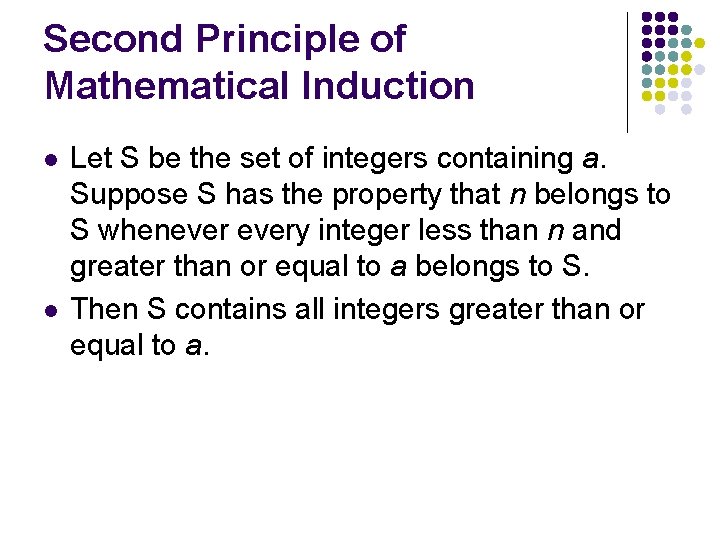
Second Principle of Mathematical Induction l l Let S be the set of integers containing a. Suppose S has the property that n belongs to S whenevery integer less than n and greater than or equal to a belongs to S. Then S contains all integers greater than or equal to a.
Proof of the 2 nd Principle of Mathematical Induction l l Almost identical to the proof of the first. Try it!
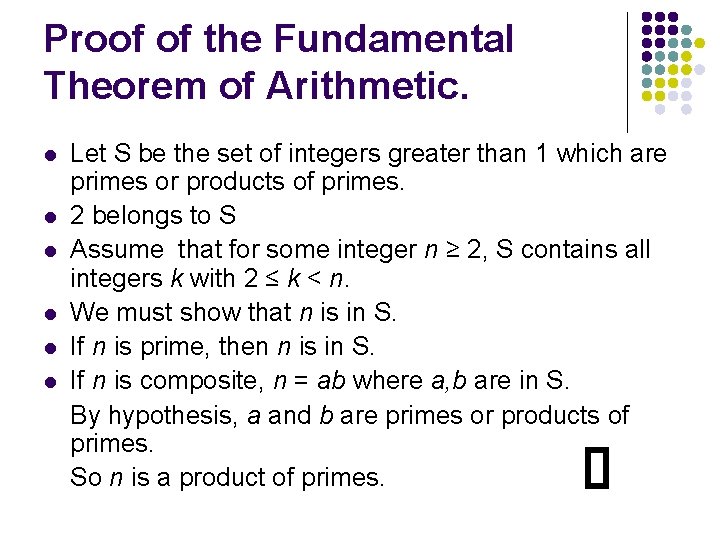
Proof of the Fundamental Theorem of Arithmetic. l l l Let S be the set of integers greater than 1 which are primes or products of primes. 2 belongs to S Assume that for some integer n ≥ 2, S contains all integers k with 2 ≤ k < n. We must show that n is in S. If n is prime, then n is in S. If n is composite, n = ab where a, b are in S. By hypothesis, a and b are primes or products of primes. So n is a product of primes.