MAT 199 Math Alive Voting Power and Sharing



- Slides: 17
MAT 199: Math Alive Voting, Power, and Sharing Ian Griffiths Mathematical Institute, University of Oxford, Department of Mathematics, Princeton University
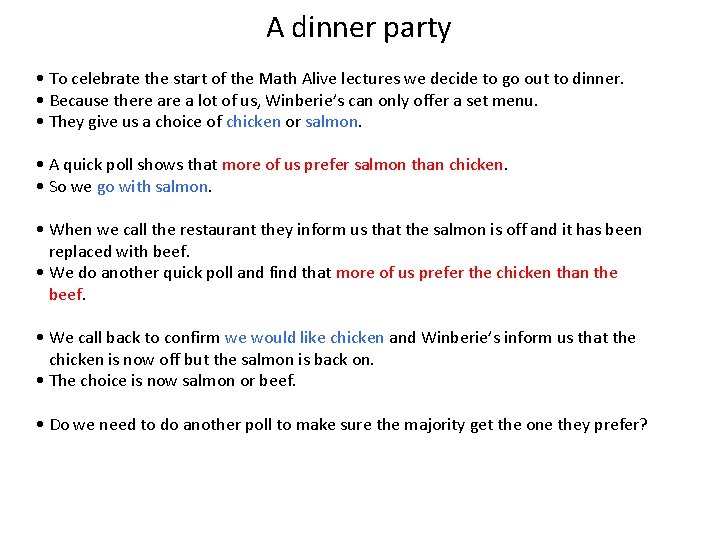
A dinner party • To celebrate the start of the Math Alive lectures we decide to go out to dinner. • Because there a lot of us, Winberie’s can only offer a set menu. • They give us a choice of chicken or salmon.
A dinner party • To celebrate the start of the Math Alive lectures we decide to go out to dinner. • Because there a lot of us, Winberie’s can only offer a set menu. • They give us a choice of chicken or salmon. • A quick poll shows that more of us prefer salmon than chicken. • So we go with salmon.
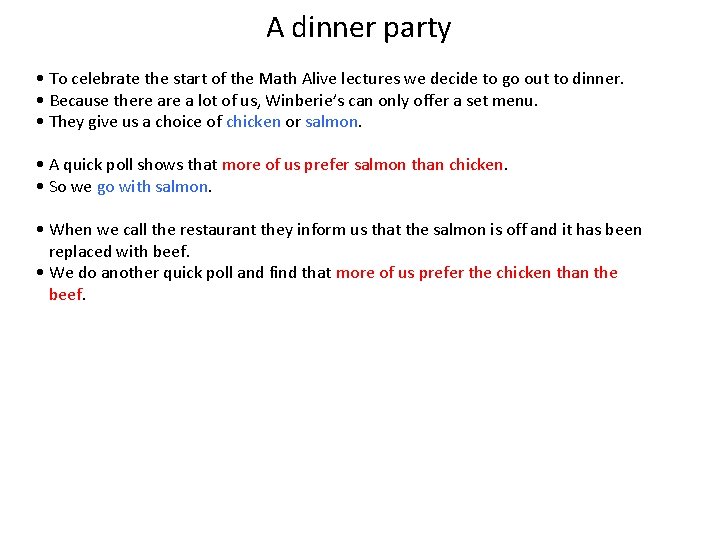
A dinner party • To celebrate the start of the Math Alive lectures we decide to go out to dinner. • Because there a lot of us, Winberie’s can only offer a set menu. • They give us a choice of chicken or salmon. • A quick poll shows that more of us prefer salmon than chicken. • So we go with salmon. • When we call the restaurant they inform us that the salmon is off and it has been replaced with beef. • We do another quick poll and find that more of us prefer the chicken than the beef.
A dinner party • To celebrate the start of the Math Alive lectures we decide to go out to dinner. • Because there a lot of us, Winberie’s can only offer a set menu. • They give us a choice of chicken or salmon. • A quick poll shows that more of us prefer salmon than chicken. • So we go with salmon. • When we call the restaurant they inform us that the salmon is off and it has been replaced with beef. • We do another quick poll and find that more of us prefer the chicken than the beef. • We call back to confirm we would like chicken and Winberie’s inform us that the chicken is now off but the salmon is back on. • The choice is now salmon or beef. • Do we need to do another poll to make sure the majority get the one they prefer?
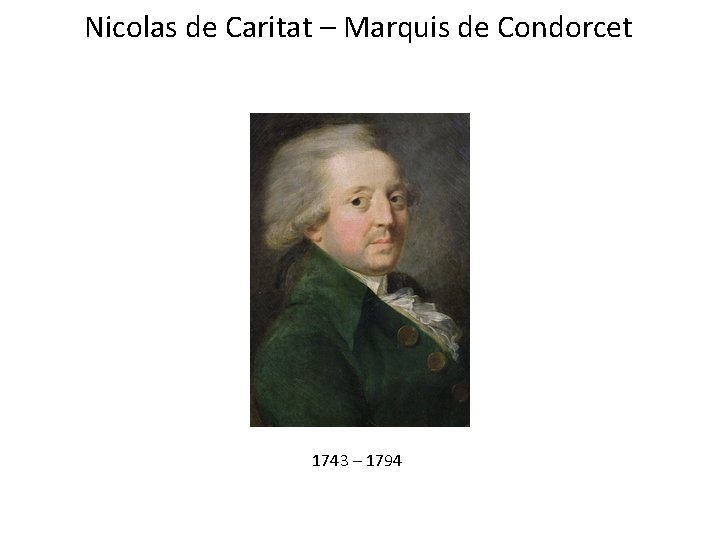
Nicolas de Caritat – Marquis de Condorcet 1743 – 1794
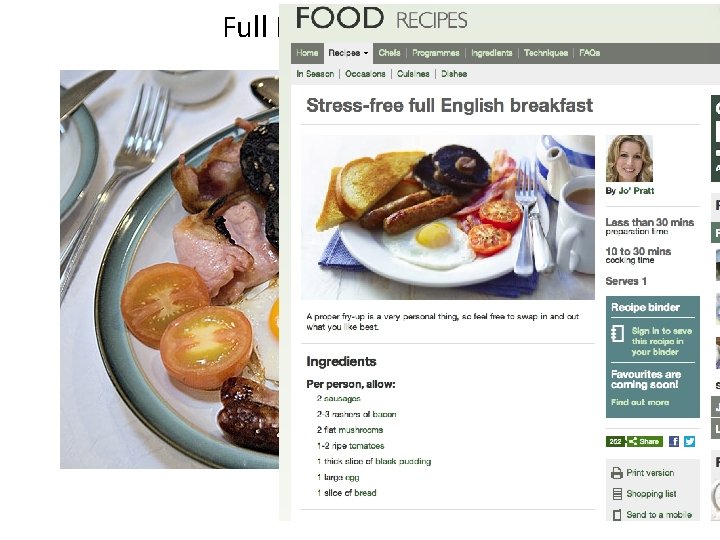
Full English breakfast 1743 – 1794
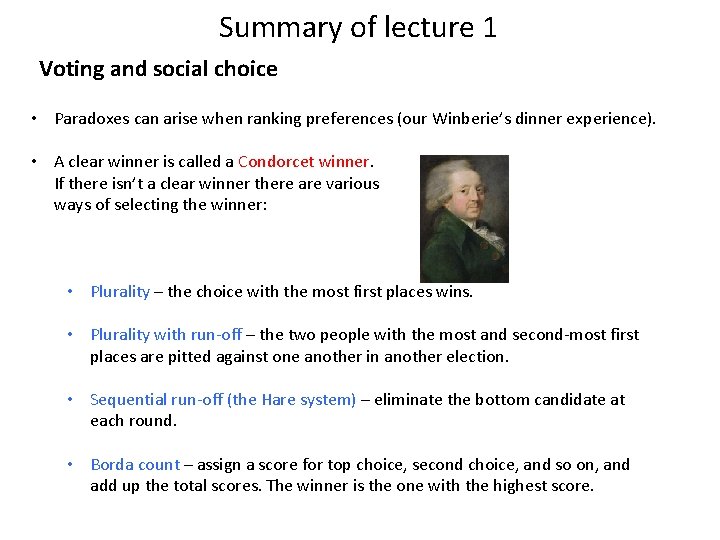
Summary of lecture 1 Voting and social choice • Paradoxes can arise when ranking preferences (our Winberie’s dinner experience). • A clear winner is called a Condorcet winner. If there isn’t a clear winner there are various ways of selecting the winner: • Plurality – the choice with the most first places wins. • Plurality with run-off – the two people with the most and second-most first places are pitted against one another in another election. • Sequential run-off (the Hare system) – eliminate the bottom candidate at each round. • Borda count – assign a score for top choice, second choice, and so on, and add up the total scores. The winner is the one with the highest score.
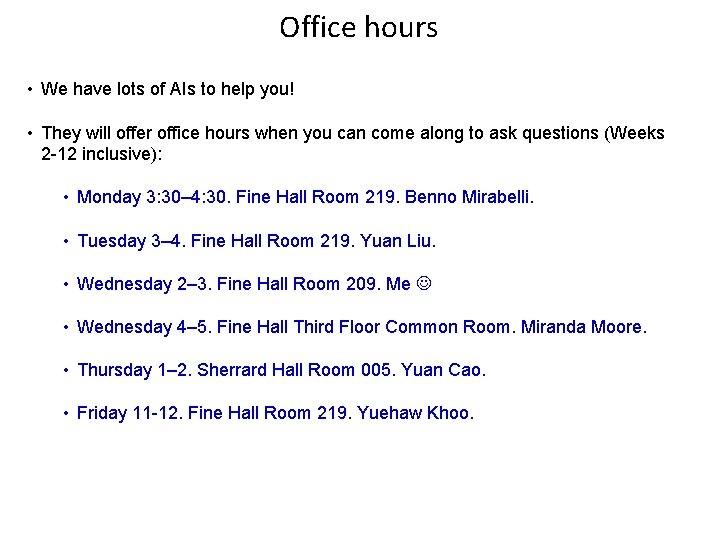
Office hours • We have lots of AIs to help you! • They will offer office hours when you can come along to ask questions (Weeks 2 -12 inclusive): • Monday 3: 30– 4: 30. Fine Hall Room 219. Benno Mirabelli. • Tuesday 3– 4. Fine Hall Room 219. Yuan Liu. • Wednesday 2– 3. Fine Hall Room 209. Me • Wednesday 4– 5. Fine Hall Third Floor Common Room. Miranda Moore. • Thursday 1– 2. Sherrard Hall Room 005. Yuan Cao. • Friday 11 -12. Fine Hall Room 219. Yuehaw Khoo.
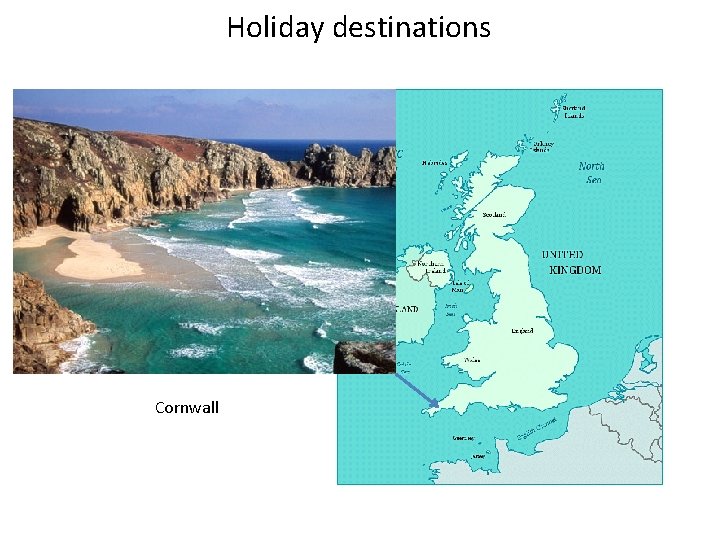
Holiday destinations Cornwall
Holiday destinations Scotland
Holiday destinations Jersey (the real one)
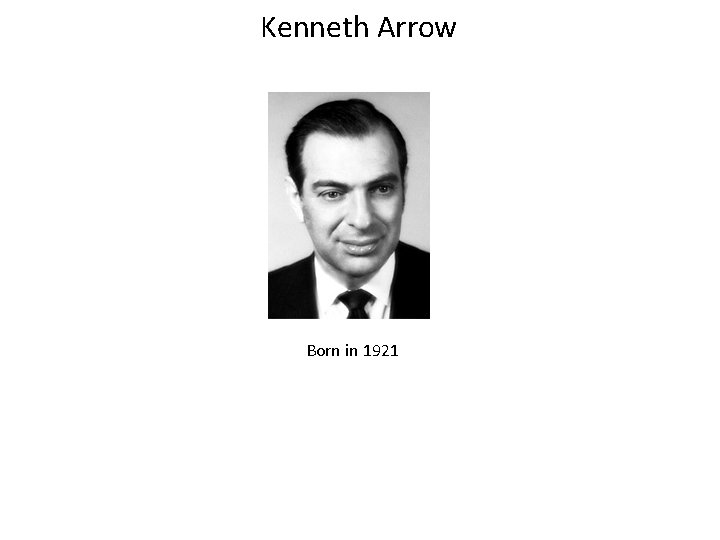
Kenneth Arrow Born in 1921
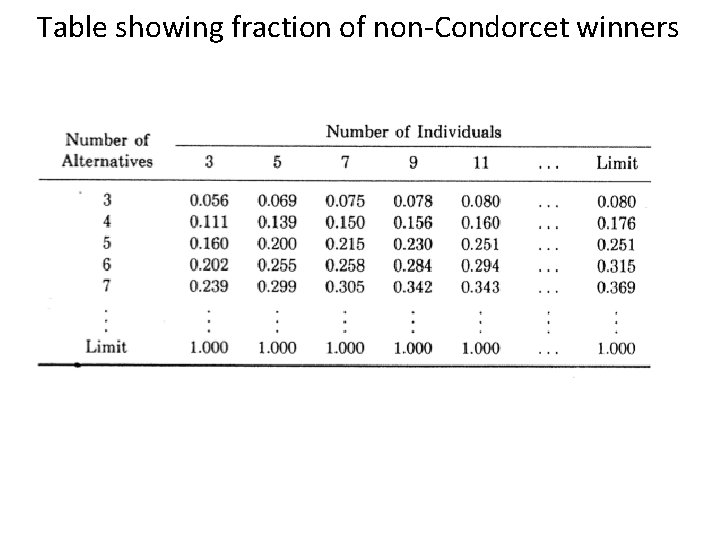
Table showing fraction of non-Condorcet winners
Summary of lecture 2 • If there isn’t a clear (Condorcet) winner then the way in which you determine the winner often leads to a different result. • You cannot produce a universal fair voting scheme (proof by Kenneth Arrow). • …but provided there aren’t too many choices, it is likely that you get a Condorcet winner anyway so there is no issue. • Today: Fair Division. How do we share things out fairly?
Summary of lecture 2 • If there isn’t a clear (Condorcet) winner then the way in which you determine the winner often leads to a different result. • You cannot produce a universal fair voting scheme (proof by Kenneth Arrow). • …but provided there aren’t too many choices, it is likely that you get a Condorcet winner anyway so there is no issue. • Today: Fair Division. How do we share things out fairly? • Something to think about while we are waiting to begin – can you work out the relevance of this song?
Summary of lecture 3 • A cake may be shared three ways in an envy-free way. • Generalization for four ways is harder (Brams and Taylor, 1992). • There is no clear way of generalizing this for five or more people. • We may divide up several items two ways in an envy-free way (e. g. , a divorce settlement). • We can divide up several items more than two ways in a fair but not envy-free way (e. g. , dividing up an estate).