Maliseet Nation Conservation Council Dedicated to the conservation

- Slides: 4
Maliseet Nation Conservation Council Dedicated to the conservation & co-management Of our Traditional Resources in the St John Watershed/ Bay of Fundy Visit our Website: www. maliseetnationconservation. ca and Like us on Facebook A Quarterly Newsletter Open House Page 1 WINTER 2018(Nipon)2017 Water quality study in the Wolastoq Page 2 Muk-ak'/ mokahk or Striped Bass Page 3 MNCC 6 th Annual Open House December 17 th, 2018 11 am to 3 pm Everyone is welcome Eel Fishing, Art work by Dozay Page 1 Word Search Page 4
Water quality study in the Wolastoq (By Aruna Jayawardane) The Wolastoq (St. John river) is one of the longest rivers in North America which is rich in biodiversity. The river provides spawning and rearing habitat for many commercially viable fish and other invertebrates. Certain areas of the river have already been identified as critical habitat for number of endangered and threatened fish, invertebrates etc. listed under SARA. More importantly thousands of people who live in townships and villages on the banks of Wolastoq (in Canada and United States) have been using the river as the major drinking water source. The river is extensively used for recreation including boating, swimming, fishing, snorkelling etc. in the summer. The water quality of the river is affected by natural processes and human activities. These activities include forestry operations and agriculture, hydroelectric facilities and their reservoirs, and discharge of municipal sewage and industrial effluents. There are close to 200 municipal and nonmunicipal waste water discharges, 19 aquaculture/fish hatcheries, 21 food processing plants, and 15 pulp and paper mills in the St. John River basin (Canadian Rivers Institute, 2011). These operations input sediment, nutrients, metals, chemicals, bacteria and oxygen consuming wastes into the river. The result will be reduction in the river's ability to support fish and other aquatic life or to be used for drinking water or recreation. Therefore, it is important to maintain the health of the riverine environment in particular the water quality, at an optimal level for its many uses. MNCC is planning to conduct a survey to evaluate water quality in the Wolastoq. Final objective of the project is to formulate a strategy for management of the water quality in the river. The project is funded by the Atlantic Ecosystems Initiative (AEI) of Environment and Climate Change Canada (ECCC) and MNCC is working in collaboration with Madawaska and Woodstock Maliseet First Nations to execute the project. Based on the outcome of the study, we will identify critical areas of the river in terms of water quality. The pollution sources will be identified and mapped using GIS to determine the relationship between the areas of impaired water quality in the river and sources of pollution. MNCC will work with industry, townships and other notable stakeholders of the river to formulate a comprehensive strategy to regulate their activities to improve water quality of the river. Monitoring of water quality in the Wolastoq A literature survey will be conducted to review current knowledge about water quality of the river and to identify critical areas. We will review outcomes of past surveys and more recent data collected by Department of Environment, NB, ECCC etc. to determine water quality in the river. Previous knowledge about water quality of the river will be used to determine sampling stations and intensity. Based on the outcome of the exercise, we will formulate an effective sampling strategy to estimate important water quality parameters for the river. For example, sampling intensity will be increased in areas near townships, villages, human settlements and industrial zones that are likely to get more pollutants compared to other areas of the river. The water quality parameters tested during the study will be nutrients (nitrates, nitrites and phosphates), sediments, coliform bacteria including E. coli, pesticides, Dissolved Oxygen (DO), Specific Conductance, Temperature, p. H and Oxidation Reduction Potential (ORP). A simple database will be created and maintained at MNCC to store water quality and other information collected during the proposed assessment. Analysis of data Public awareness Three open houses will be conducted in Edmundston, Woodstock and Fredericton to educate public about the current status of water quality in the river, sources of pollution, critical zones, vulnerable areas and current and foreseeable future The data collected during stressors on water quality. Provincial and the proposed study will be local government officials responsible for analyzed to ascertain the environment and representatives of the present status of water Departments of Environment and Climate quality in the river, Change and Fisheries and Oceans Canada vulnerable and critical zones will be invited to open houses. of Wolastoq due to current Arrangements will be made during open and foreseeable future houses to obtain views of participants stressors. Analysis will also about present status of water quality of be conducted to evaluate Wolastoq, impacts of current water cumulative impact of quality in the river on public health and multiple stressors on water other activities, and possible ways to quality. The Canadian improve water quality of the river. Council of Ministers of the Community meetings will also be Environment (CCME) has conducted in Maliseet communities in NB developed a set of to enhance their knowledge about guidelines to protect human ongoing process and also to understand health (drinking water or their views which would be of immense recreational use) and use in formulation of an effective strategy aquatic life. We will compare to improve water quality in the river. water quality parameters estimated for the river with Management strategy CCME guidelines. A draft management strategy and an Maliseet Traditional action plan will be formulated to address Knowledge (MTK) current and foreseeable future water quality problems in the Wolastoq in Traditional knowledge study consultation with rights and stakeholders will be conducted to of the river. We will identify priority understand historical trends, areas, current and foreseeable future impacts of current water problems and short, medium and longquality on traditional term action items for improvement of activities and also to identify water quality. MNCC is currently traditional indicators of poor spearheading a process to formulate a water quality in the management strategy for the Wolastoq. The outcome of and the proposed project will be the exercise will be used to conducted as a part of the above program identify critical and to fulfill some of its objectives. Necessary vulnerable areas of the river arrangements will be made to finalize and in terms of water quality and execute draft management strategy to sources of pollution. As a improve water quality of the river part of the exercise, "State (establishment of necessary committees, of the water quality public awareness, incorporation of public document for Wolastoq" will input to the draft management strategy be prepared. A list of etc. ). projects and priority actions will also be identified to execute on short-term, Literature cited medium-term and long-term basis for improvement of the Kidd, S. D. , Curry, A. R. & Munkittrick, K. R. water quality in the river. (Eds. ). (2011). The St. John River: A State of the Environment Report. Canadian Rivers Institute, University of New Brunswick. Retrieved from http: //canadianriversinstitute. com/uploa ds/St. +John+river+report. pdf Page 2
Muk-ak'/ mokahk or Striped Bass, Morone saxatilis were once an abundant member of the Wolastoq’s fish community and integral component in the diets of the Wolastoqwiyik and settlers along the Wolastoq for years to come. Striped Bass were typically fished during spring runs where they were present in large aggregations along the main river at or near the head of tide (Blair, 2004). The Wolastoqwiyik would fish bass with traps or harpoons (si-gawan), leisters (ni'gak), and other fish spears (ni-ka'-kwul). Striped Bass is a large anadromous (spends portions of its lifecycle in both fresh and saltwater) fish with a distribution along the Atlantic coast from Florida to Quebec with reported sightings as far north as Labrador. Striped Bass spawn in fresh or brackish water at or above the head of tide of rivers in the early spring when the water temperature reaches 10 degrees (Andrews et al. , 2017; Bradford et al. , 2015; COSEWIC, 2012). For management purposes, the species’ range within Atlantic Canada has been subdivided into three management groups called designatable units (DUs) by the Committee On the Status of Endangered Wildlife In Canada (COSEWIC). Essentially, this means that these are genetically distinct populations. The DUs are: the St. Lawrence River, the Southern Gulf of St. Lawrence, and the Bay of Fundy (Andrews et al. , 2017). The Bay of Fundy unit consists of fish originating from the Annapolis and the Shubenacadie rivers in Nova Scotia along with the Wolastoq/Saint John River (SJR) in New Brunswick. Due to the construction of a tidal power generating station, the Annapolis population is now believed to be extirpated (locally extinct). While spawning locations have been located in the Stewjacke -Shubenacadie system, it is still unknown if Striped Bass are currently reproducing within the Wolastoq. Historically, they were believed to spawn at the head of the tide in Fredericton. Other than in 1975, all sources unanimously report a lack of observed spawning behaviour after the construction of the Mactaquac Generating Station in 1968 and searches for juveniles have been unsuccessful although efforts have been limited in duration and spatial scope. In 2014, The Bay of Fundy population’s COSEWIC designation was changed from “Threatened” to “Endangered” as a result of continued threats that have yet to be addressed. A study published this past week highlights the possibility of a native, self-sustaining population persisting in the Wolastoq. Researchers from UNB took tissue samples from juvenile fish (ages 1 -3) caught in various locations the Wolastoq/SJR (Mactaquac, Grand Lake, & Kennebecasis River) and compared them with known populations in the Shubenacadie (NS), Hudson (US), and Chesapeake (US) rivers. What they found were members from both US populations as well as some from NS but also a genetically distinct population that did not match either the US or Shubie populations. Acoustic tagging and tracking data further supports the existence of a self-sustaining Wolastoq/SJR population as the data clearly show a contingent of adults who remain in the Wolastoq/SJR year-round, return to the same overwintering locations and some who even migrate to the Fredericton area during spawning season. Going forward, one of the most important conservation initiatives for protecting and developing management practices for this species in the Wolastoq is to define the characteristics needed for productive spawning and nursery habitat. By determining the similarities and differences in water conditions between years where spawning was found to be successful and years where no evidence of spawning activity was reported, insight can be gained into the potential environmental causes for spawning success or failure. (By Kaleb Zelman) Page 3
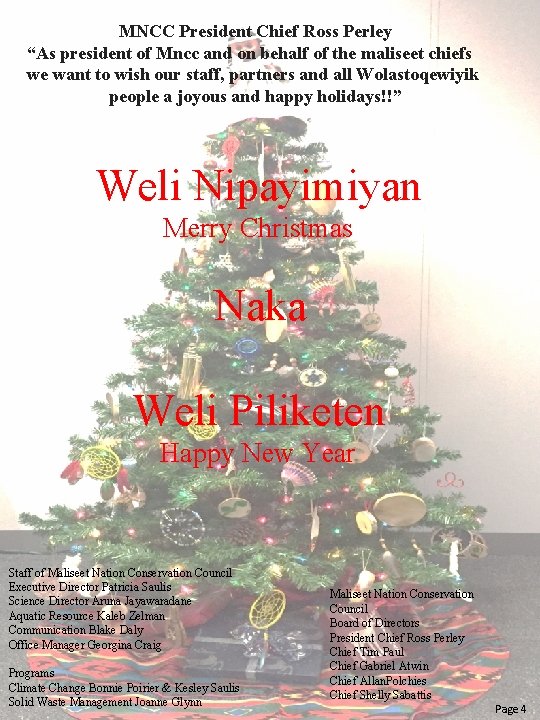
MNCC President Chief Ross Perley “As president of Mncc and on behalf of the maliseet chiefs we want to wish our staff, partners and all Wolastoqewiyik people a joyous and happy holidays!!” Weli Nipayimiyan Merry Christmas Naka Weli Piliketen Happy New Year Staff of Maliseet Nation Conservation Council Executive Director Patricia Saulis Science Director Aruna Jayawaradane Aquatic Resource Kaleb Zelman Communication Blake Daly Office Manager Georgina Craig Programs Climate Change Bonnie Poirier & Kesley Saulis Solid Waste Management Joanne Glynn Maliseet Nation Conservation Council Board of Directors President Chief Ross Perley Chief Tim Paul Chief Gabriel Atwin Chief Allan. Polchies Chief Shelly Sabattis Page 4