Living conditions in Middle Ages For peasants in
- Slides: 9
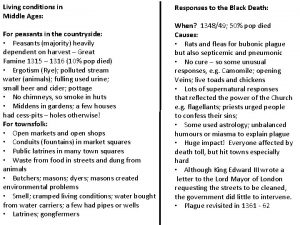
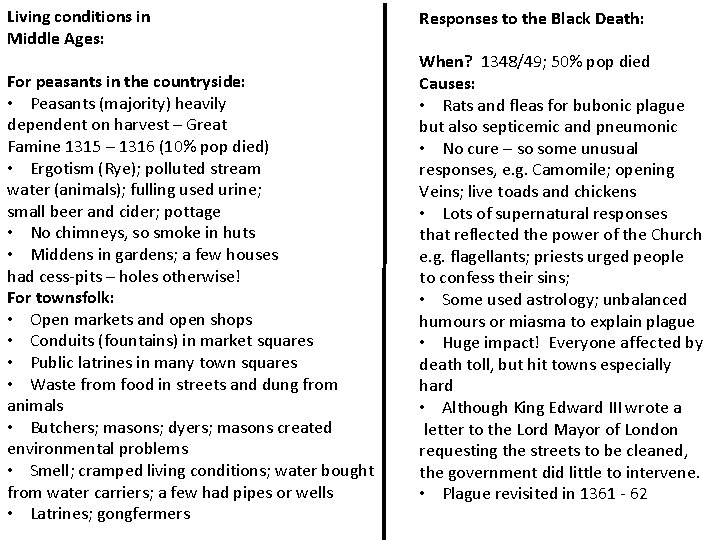
Living conditions in Middle Ages: For peasants in the countryside: • Peasants (majority) heavily dependent on harvest – Great Famine 1315 – 1316 (10% pop died) • Ergotism (Rye); polluted stream water (animals); fulling used urine; small beer and cider; pottage • No chimneys, so smoke in huts • Middens in gardens; a few houses had cess-pits – holes otherwise! For townsfolk: • Open markets and open shops • Conduits (fountains) in market squares • Public latrines in many town squares • Waste from food in streets and dung from animals • Butchers; masons; dyers; masons created environmental problems • Smell; cramped living conditions; water bought from water carriers; a few had pipes or wells • Latrines; gongfermers Responses to the Black Death: When? 1348/49; 50% pop died Causes: • Rats and fleas for bubonic plague but also septicemic and pneumonic • No cure – so some unusual responses, e. g. Camomile; opening Veins; live toads and chickens • Lots of supernatural responses that reflected the power of the Church e. g. flagellants; priests urged people to confess their sins; • Some used astrology; unbalanced humours or miasma to explain plague • Huge impact! Everyone affected by death toll, but hit towns especially hard • Although King Edward III wrote a letter to the Lord Mayor of London requesting the streets to be cleaned, the government did little to intervene. • Plague revisited in 1361 - 62
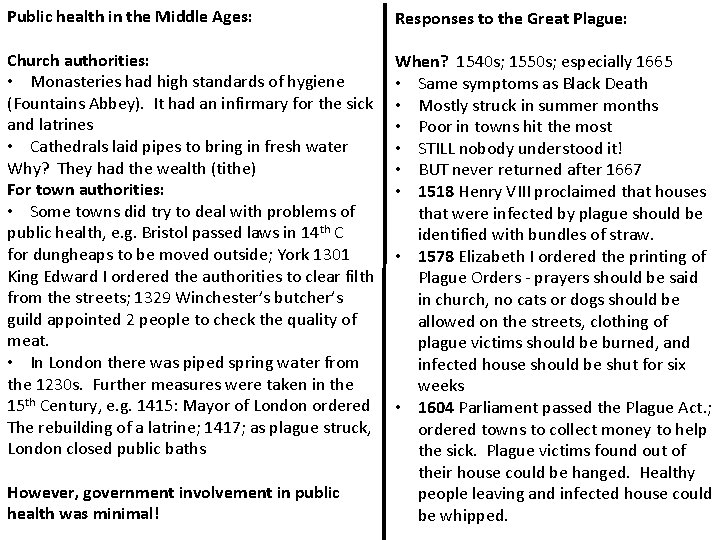
Public health in the Middle Ages: Responses to the Great Plague: Church authorities: • Monasteries had high standards of hygiene (Fountains Abbey). It had an infirmary for the sick and latrines • Cathedrals laid pipes to bring in fresh water Why? They had the wealth (tithe) For town authorities: • Some towns did try to deal with problems of public health, e. g. Bristol passed laws in 14 th C for dungheaps to be moved outside; York 1301 King Edward I ordered the authorities to clear filth from the streets; 1329 Winchester’s butcher’s guild appointed 2 people to check the quality of meat. • In London there was piped spring water from the 1230 s. Further measures were taken in the 15 th Century, e. g. 1415: Mayor of London ordered The rebuilding of a latrine; 1417; as plague struck, London closed public baths When? 1540 s; 1550 s; especially 1665 • Same symptoms as Black Death • Mostly struck in summer months • Poor in towns hit the most • STILL nobody understood it! • BUT never returned after 1667 • 1518 Henry VIII proclaimed that houses that were infected by plague should be identified with bundles of straw. • 1578 Elizabeth I ordered the printing of Plague Orders - prayers should be said in church, no cats or dogs should be allowed on the streets, clothing of plague victims should be burned, and infected house should be shut for six weeks • 1604 Parliament passed the Plague Act. ; ordered towns to collect money to help the sick. Plague victims found out of their house could be hanged. Healthy people leaving and infected house could be whipped. However, government involvement in public health was minimal!
Write a clear and well organised summary that analyses people’s living conditions in the Middle Ages. Support your summary with examples. How will you analyse?
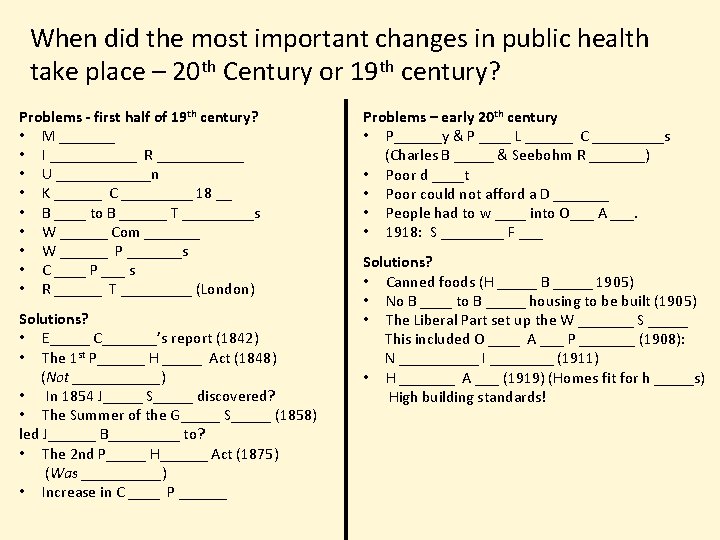
When did the most important changes in public health take place – 20 th Century or 19 th century? Problems - first half of 19 th century? • M _______ • I ______ R ______ • U ______n • K ______ C _____ 18 __ • B ____ to B ______ T _____s • W ______ Com _______ • W ______ P _______s • C ____ P ___ s • R ______ T _____ (London) Solutions? • E_____ C_______’s report (1842) • The 1 st P______ H _____ Act (1848) (Not ______) • In 1854 J_____ S_____ discovered? • The Summer of the G_____ S_____ (1858) led J______ B_____ to? • The 2 nd P_____ H______ Act (1875) (Was _____) • Increase in C ____ P ______ Problems – early 20 th century • P______y & P ____ L ______ C _____s (Charles B _____ & Seebohm R _______) • Poor d ____t • Poor could not afford a D _______ • People had to w ____ into O___ A ___. • 1918: S ____ F ___ Solutions? • Canned foods (H _____ B _____ 1905) • No B ____ to B _____ housing to be built (1905) • The Liberal Part set up the W _______ S _____ This included O ____ A ___ P _______ (1908): N _____ I ____ (1911) • H _______ A ___ (1919) (Homes fit for h _____s) High building standards!
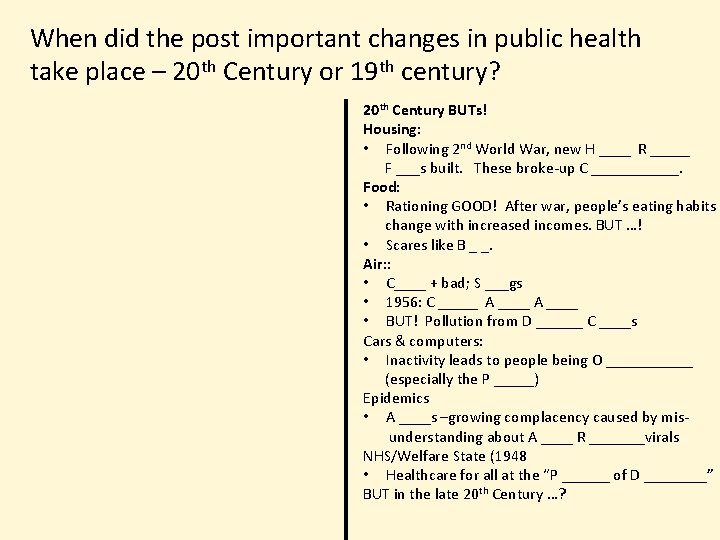
When did the post important changes in public health take place – 20 th Century or 19 th century? 20 th Century BUTs! Housing: • Following 2 nd World War, new H ____ R _____ F ___s built. These broke-up C ______. Food: • Rationing GOOD! After war, people’s eating habits change with increased incomes. BUT …! • Scares like B _ _. Air: : • C____ + bad; S ___gs • 1956: C _____ A ____ • BUT! Pollution from D ______ C ____s Cars & computers: • Inactivity leads to people being O ______ (especially the P _____) Epidemics • A ____s –growing complacency caused by misunderstanding about A ____ R _______virals NHS/Welfare State (1948 • Healthcare for all at the “P ______ of D ____” BUT in the late 20 th Century …?
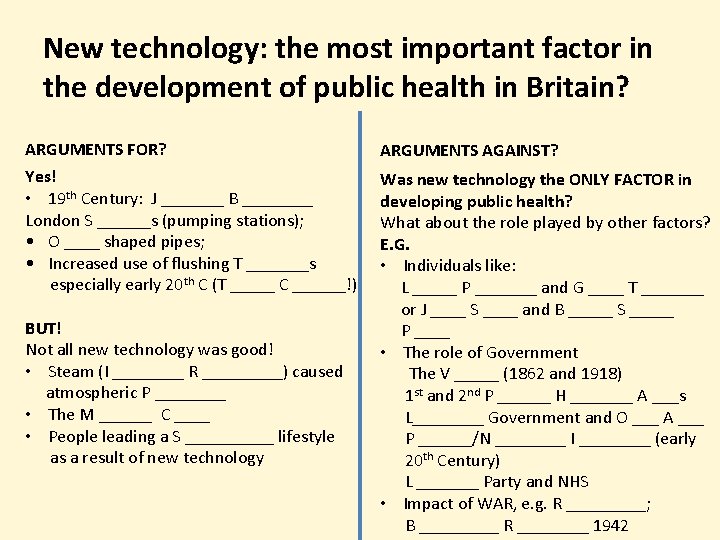
New technology: the most important factor in the development of public health in Britain? ARGUMENTS FOR? ARGUMENTS AGAINST? Yes! • 19 th Century: J _______ B ____ London S ______s (pumping stations); • O ____ shaped pipes; • Increased use of flushing T _______s especially early 20 th C (T _____ C ______!) Was new technology the ONLY FACTOR in developing public health? What about the role played by other factors? E. G. • Individuals like: L _____ P _______ and G ____ T _______ or J ____ S ____ and B _____ S _____ P ____ • The role of Government The V _____ (1862 and 1918) 1 st and 2 nd P ______ H _______ A ___s L____ Government and O ___ A ___ P ______/N ____ I ____ (early 20 th Century) L _______ Party and NHS • Impact of WAR, e. g. R _____; B _____ R ____ 1942 BUT! Not all new technology was good! • Steam (I ____ R _____) caused atmospheric P ____ • The M ______ C ____ • People leading a S _____ lifestyle as a result of new technology
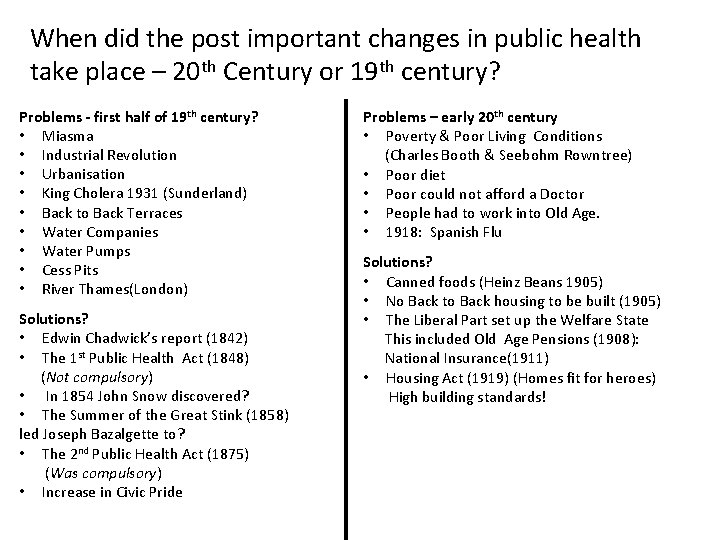
When did the post important changes in public health take place – 20 th Century or 19 th century? Problems - first half of 19 th century? • Miasma • Industrial Revolution • Urbanisation • King Cholera 1931 (Sunderland) • Back to Back Terraces • Water Companies • Water Pumps • Cess Pits • River Thames(London) Solutions? • Edwin Chadwick’s report (1842) • The 1 st Public Health Act (1848) (Not compulsory) • In 1854 John Snow discovered? • The Summer of the Great Stink (1858) led Joseph Bazalgette to? • The 2 nd Public Health Act (1875) (Was compulsory) • Increase in Civic Pride Problems – early 20 th century • Poverty & Poor Living Conditions (Charles Booth & Seebohm Rowntree) • Poor diet • Poor could not afford a Doctor • People had to work into Old Age. • 1918: Spanish Flu Solutions? • Canned foods (Heinz Beans 1905) • No Back to Back housing to be built (1905) • The Liberal Part set up the Welfare State This included Old Age Pensions (1908): National Insurance(1911) • Housing Act (1919) (Homes fit for heroes) High building standards!
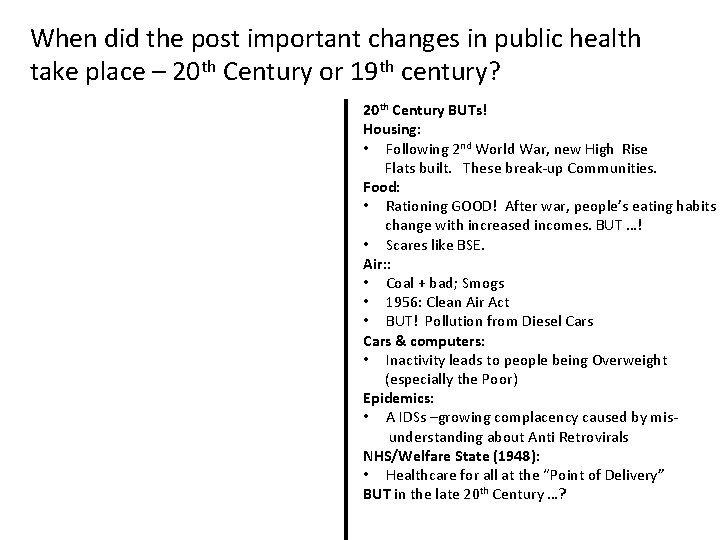
When did the post important changes in public health take place – 20 th Century or 19 th century? 20 th Century BUTs! Housing: • Following 2 nd World War, new High Rise Flats built. These break-up Communities. Food: • Rationing GOOD! After war, people’s eating habits change with increased incomes. BUT …! • Scares like BSE. Air: : • Coal + bad; Smogs • 1956: Clean Air Act • BUT! Pollution from Diesel Cars & computers: • Inactivity leads to people being Overweight (especially the Poor) Epidemics: • A IDSs –growing complacency caused by misunderstanding about Anti Retrovirals NHS/Welfare State (1948): • Healthcare for all at the “Point of Delivery” BUT in the late 20 th Century …?
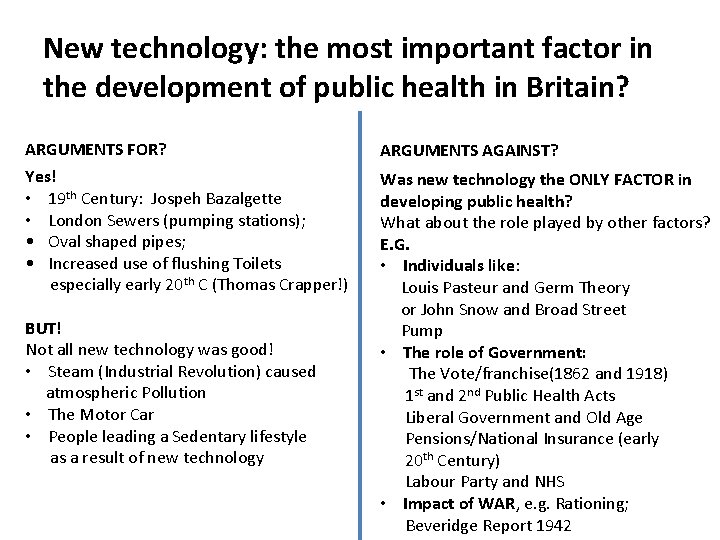
New technology: the most important factor in the development of public health in Britain? ARGUMENTS FOR? ARGUMENTS AGAINST? Yes! • 19 th Century: Jospeh Bazalgette • London Sewers (pumping stations); • Oval shaped pipes; • Increased use of flushing Toilets especially early 20 th C (Thomas Crapper!) Was new technology the ONLY FACTOR in developing public health? What about the role played by other factors? E. G. • Individuals like: Louis Pasteur and Germ Theory or John Snow and Broad Street Pump • The role of Government: The Vote/franchise(1862 and 1918) 1 st and 2 nd Public Health Acts Liberal Government and Old Age Pensions/National Insurance (early 20 th Century) Labour Party and NHS • Impact of WAR, e. g. Rationing; Beveridge Report 1942 BUT! Not all new technology was good! • Steam (Industrial Revolution) caused atmospheric Pollution • The Motor Car • People leading a Sedentary lifestyle as a result of new technology