Linked Lists Preliminaries l Options for implementing an



- Slides: 31
Linked Lists
Preliminaries l Options for implementing an ADT List l Array l Has a fixed size Data must be shifted during insertions and deletions Dynamic array Linked list l Is able to grow in size as needed l Does not require the shifting of items during insertions and deletions l Accessing an element does not take a constant time l l l
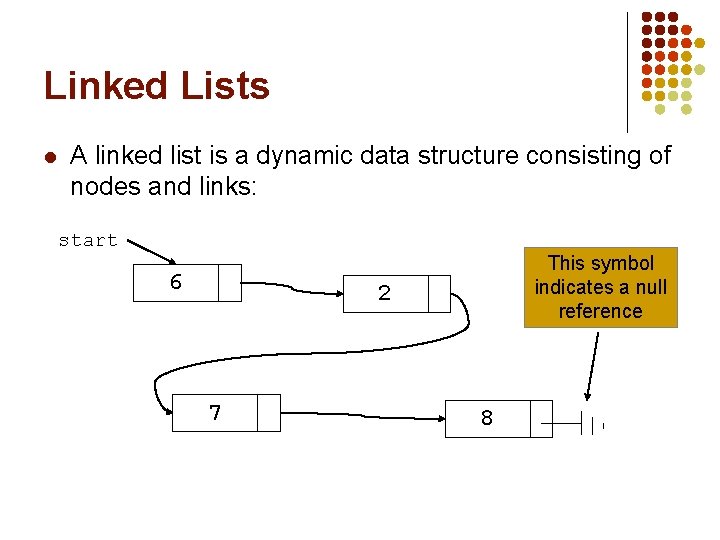
Linked Lists l A linked list is a dynamic data structure consisting of nodes and links: start 6 This symbol indicates a null reference 2 7 8
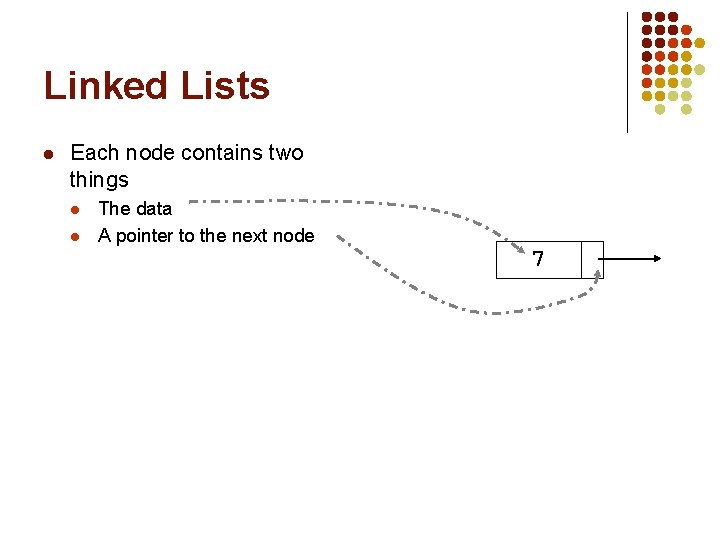
Linked Lists l Each node contains two things l l The data A pointer to the next node 7
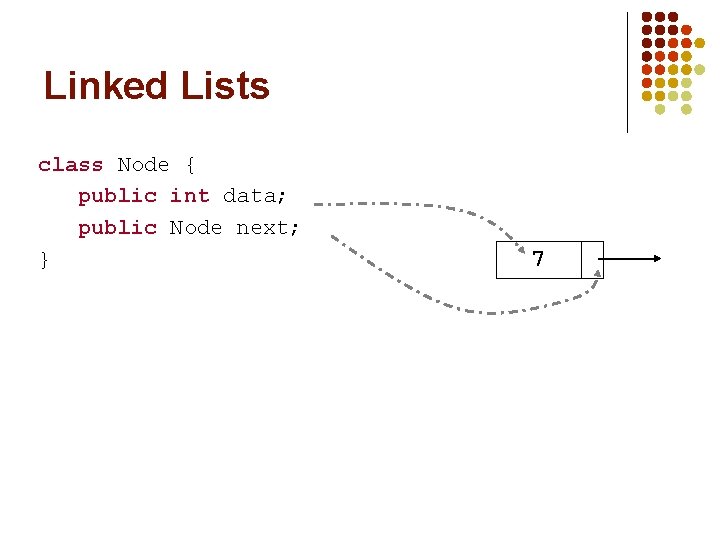
Linked Lists class Node { public int data; public Node next; } 7
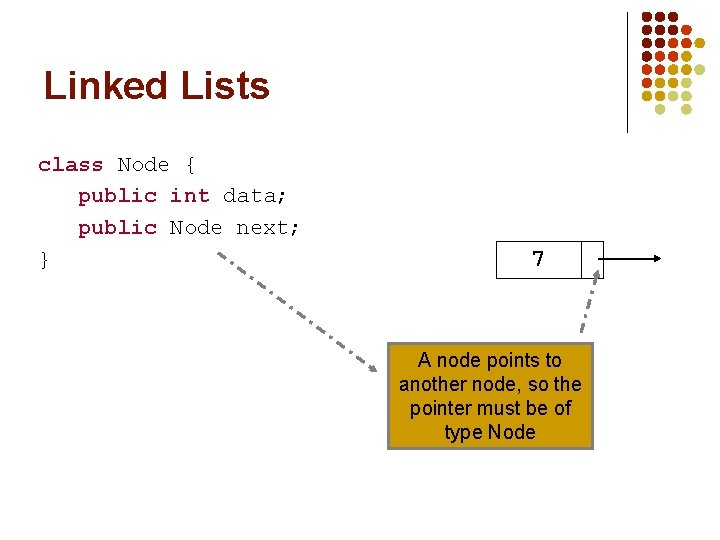
Linked Lists class Node { public int data; public Node next; } 7 A node points to another node, so the pointer must be of type Node
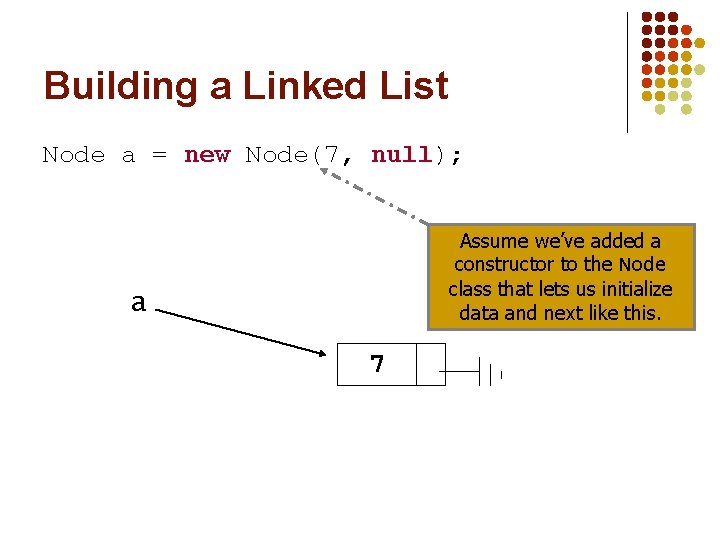
Building a Linked List Node a = new Node(7, null); Assume we’ve added a constructor to the Node class that lets us initialize data and next like this. a 7
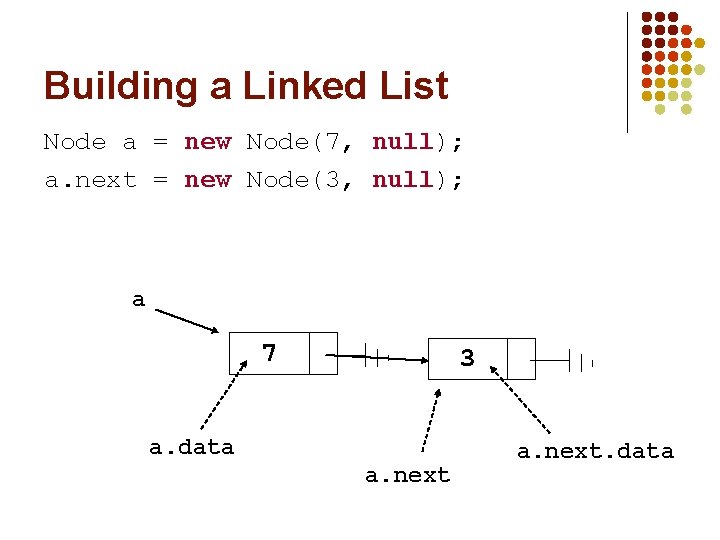
Building a Linked List Node a = new Node(7, null); a. next = new Node(3, null); a 7 3 a. data a. next. data
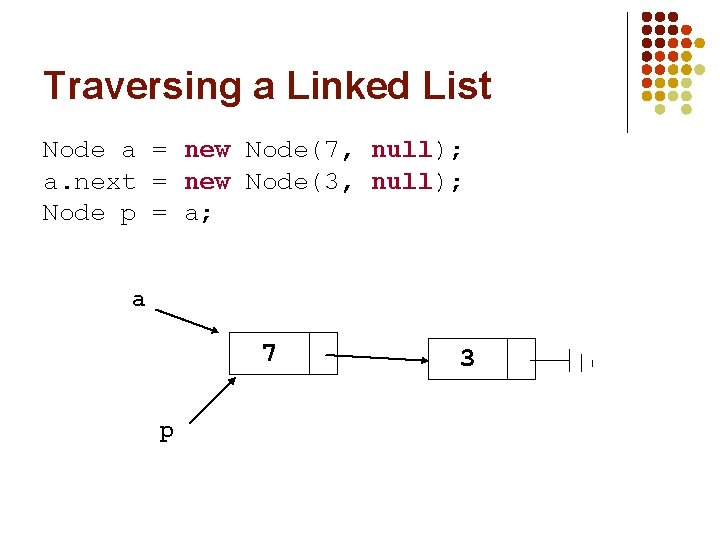
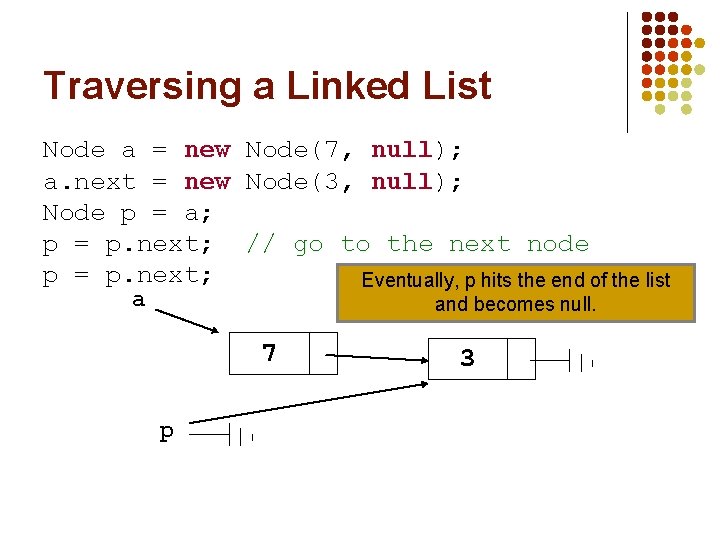
Traversing a Linked List Node a = new Node(7, null); a. next = new Node(3, null); Node p = a; a 7 p 3
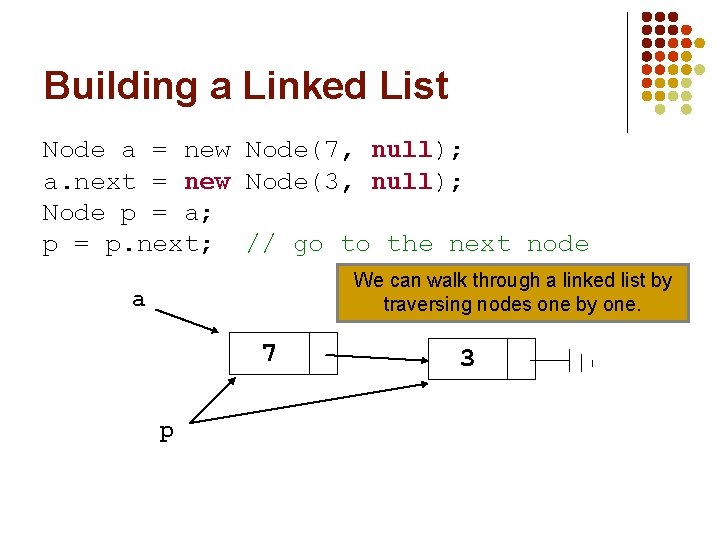
Building a Linked List Node a = new Node(7, null); a. next = new Node(3, null); Node p = a; p = p. next; // go to the next node We can walk through a linked list by traversing nodes one by one. a 7 p 3
Traversing a Linked List Node a = new Node(7, null); a. next = new Node(3, null); Node p = a; p = p. next; // go to the next node p = p. next; Eventually, p hits the end of the list a and becomes null. 7 p 3
Preliminaries Figure 5 -1 a) A linked list of integers; b) insertion; c) deletion
Reference-based implementation l l Reference-based implementations of ADT use Java references We are going to look at a reference-based implementation of ATD list (using linked lists)
Object References (review) A reference variable l l l Contains the location of an object Example Node node; node = new Node(5, null); As a data field of a class l has the default value null As a local reference variable (in a method) l does not have a default value
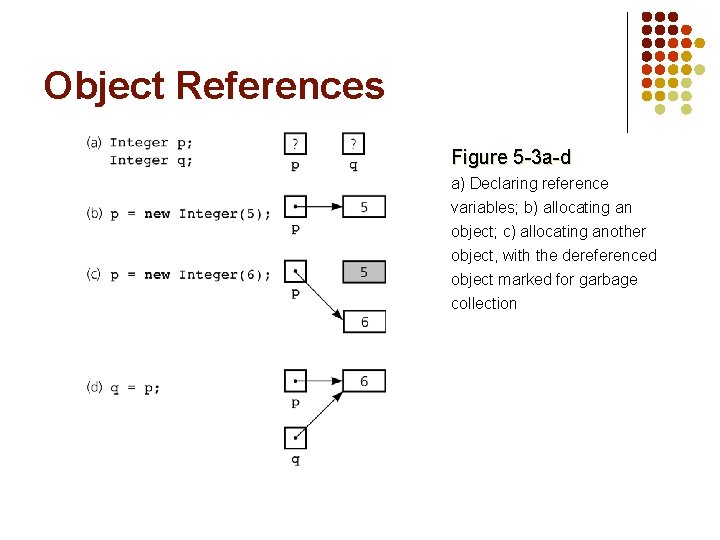
Object References l When one reference variable is assigned to another reference variable, both references then refer to the same object Integer p, q; p = new Integer(6); q = p; l A reference variable that no longer references any object is marked for garbage collection
Object References Figure 5 -3 a-d a) Declaring reference variables; b) allocating an object; c) allocating another object, with the dereferenced object marked for garbage collection
Object References Figure 5 -3 e-g e) allocating an object; f) assigning null to a reference variable; g) assigning a reference with a null value
Object References (arrays) l An array of objects l l l Is actually an array of references to the objects Example Integer[] scores = new Integer[30]; Instantiating Integer objects for each array reference scores[0] = new Integer(7); scores[1] = new Integer(9); // and so on …
Object References (equality) l Equality operators (== and !=) l l Compare the values of the reference variables, not the objects that they reference equals method l Compares objects by contents
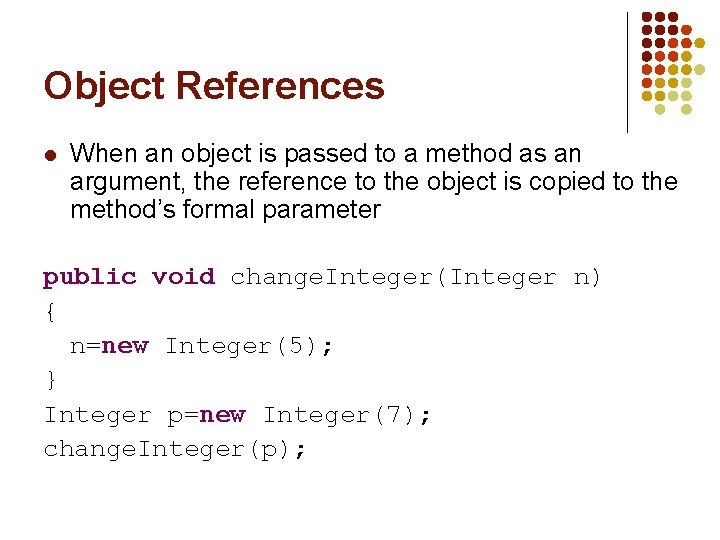
Object References l When an object is passed to a method as an argument, the reference to the object is copied to the method’s formal parameter public void change. Integer(Integer n) { n=new Integer(5); } Integer p=new Integer(7); change. Integer(p);
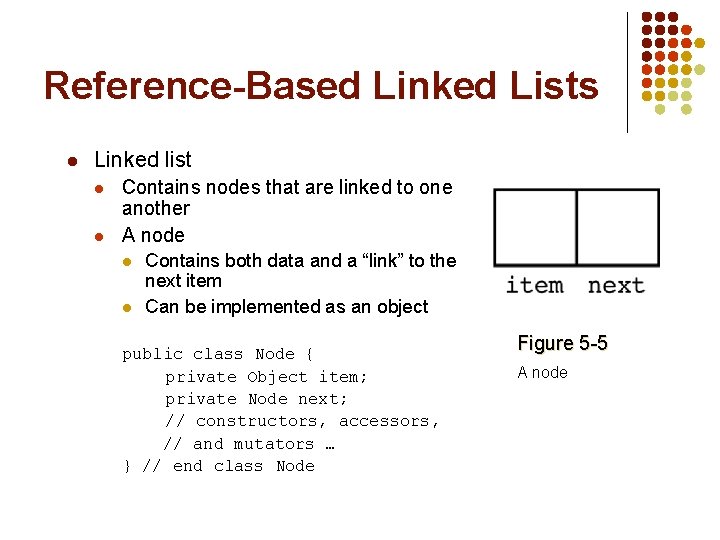
Reference-Based Linked Lists l Linked list l l Contains nodes that are linked to one another A node l l Contains both data and a “link” to the next item Can be implemented as an object public class Node { private Object item; private Node next; // constructors, accessors, // and mutators … } // end class Node Figure 5 -5 A node
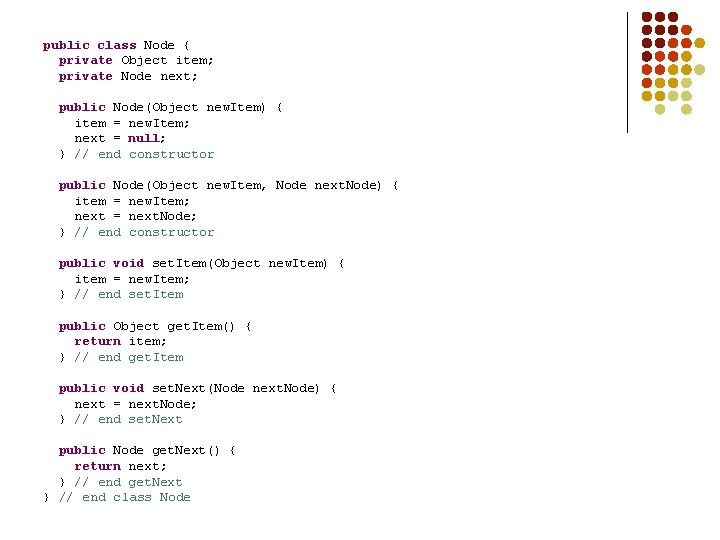
public class Node { private Object item; private Node next; public Node(Object new. Item) { item = new. Item; next = null; } // end constructor public Node(Object new. Item, Node next. Node) { item = new. Item; next = next. Node; } // end constructor public void set. Item(Object new. Item) { item = new. Item; } // end set. Item public Object get. Item() { return item; } // end get. Item public void set. Next(Node next. Node) { next = next. Node; } // end set. Next public Node get. Next() { return next; } // end get. Next } // end class Node
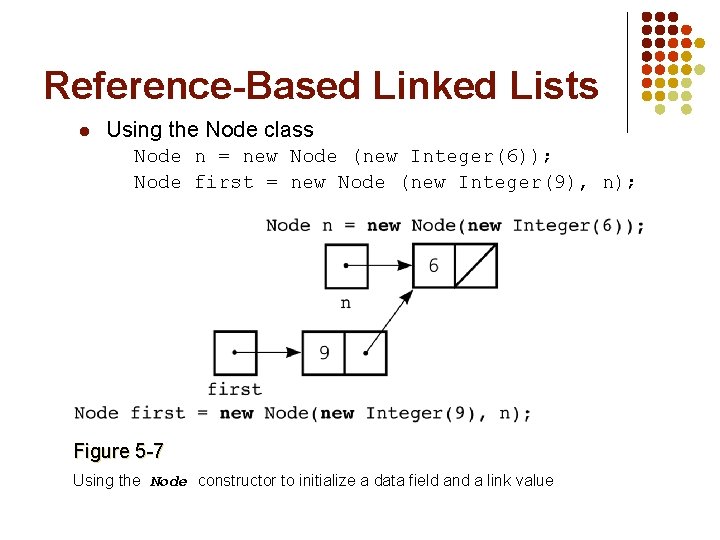
Reference-Based Linked Lists l Using the Node class Node n = new Node (new Integer(6)); Node first = new Node (new Integer(9), n); Figure 5 -7 Using the Node constructor to initialize a data field and a link value
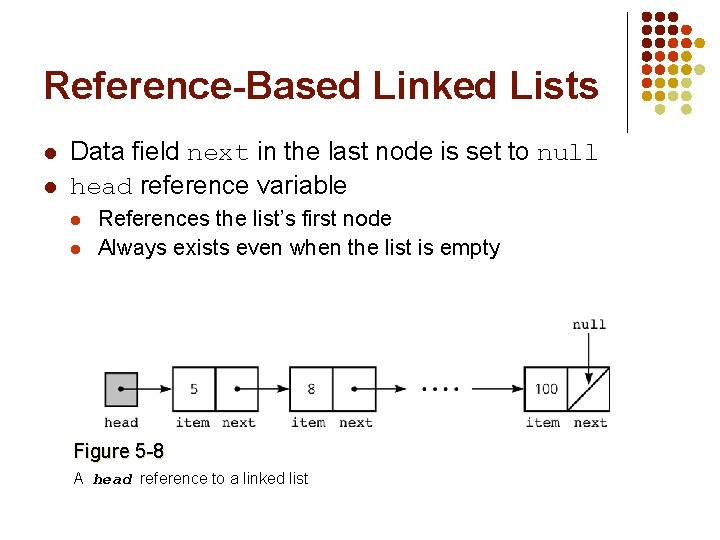
Reference-Based Linked Lists l l Data field next in the last node is set to null head reference variable l l References the list’s first node Always exists even when the list is empty Figure 5 -8 A head reference to a linked list
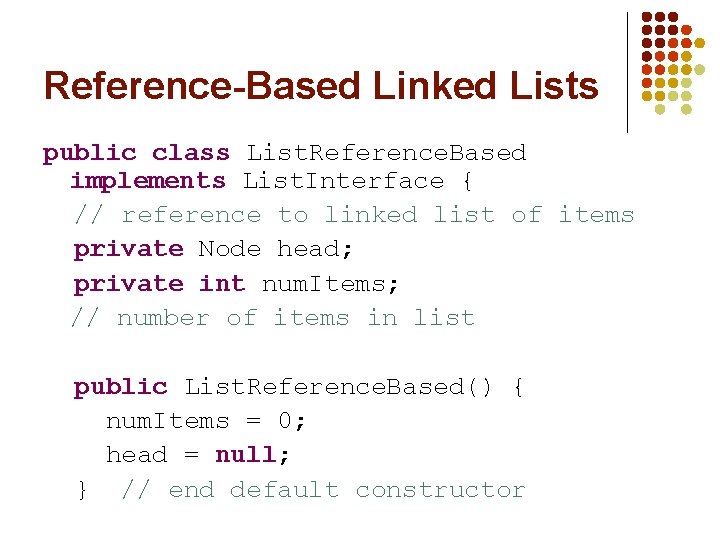
Reference-Based Linked Lists public class List. Reference. Based implements List. Interface { // reference to linked list of items private Node head; private int num. Items; // number of items in list public List. Reference. Based() { num. Items = 0; head = null; } // end default constructor
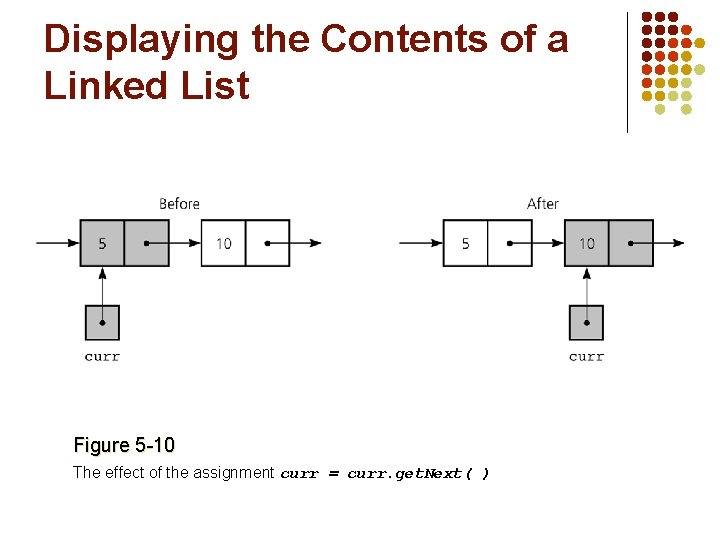
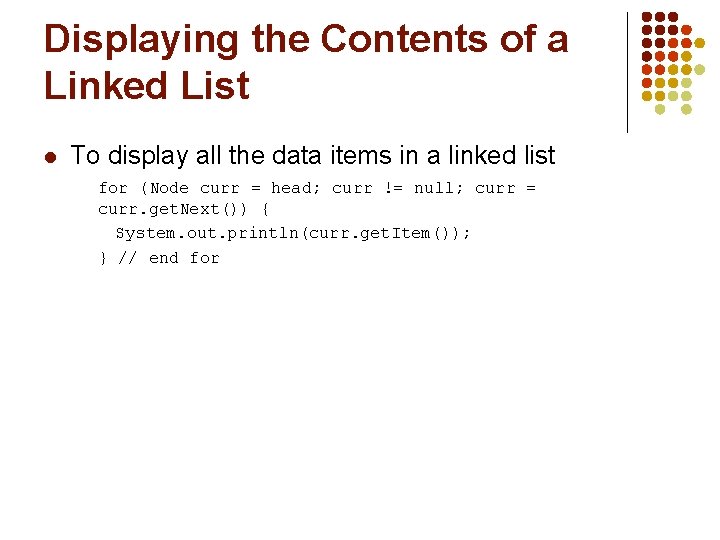
Programming with Linked Lists: Displaying the Contents of a Linked List l curr reference variable l l l References the current node Initially references the first node To display the data portion of the current node System. out. println(curr. get. Item()); l To advance the current position to the next node curr = curr. get. Next();
Displaying the Contents of a Linked List Figure 5 -10 The effect of the assignment curr = curr. get. Next( )
Displaying the Contents of a Linked List l To display all the data items in a linked list for (Node curr = head; curr != null; curr = curr. get. Next()) { System. out. println(curr. get. Item()); } // end for
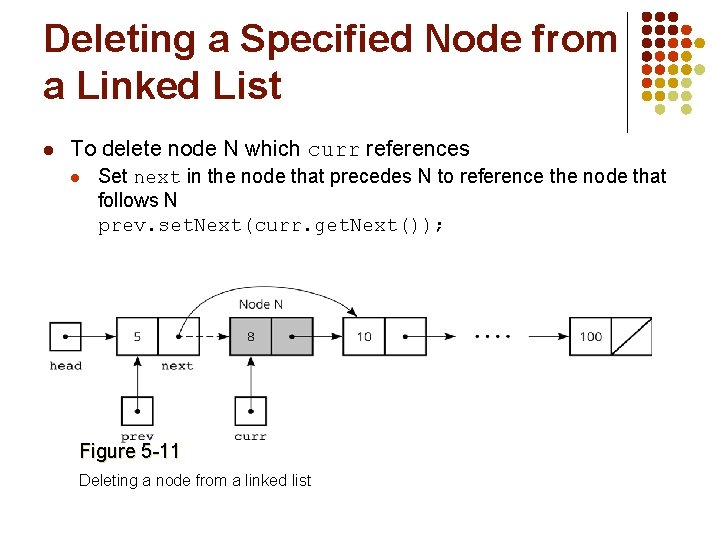
Deleting a Specified Node from a Linked List l To delete node N which curr references l Set next in the node that precedes N to reference the node that follows N prev. set. Next(curr. get. Next()); Figure 5 -11 Deleting a node from a linked list
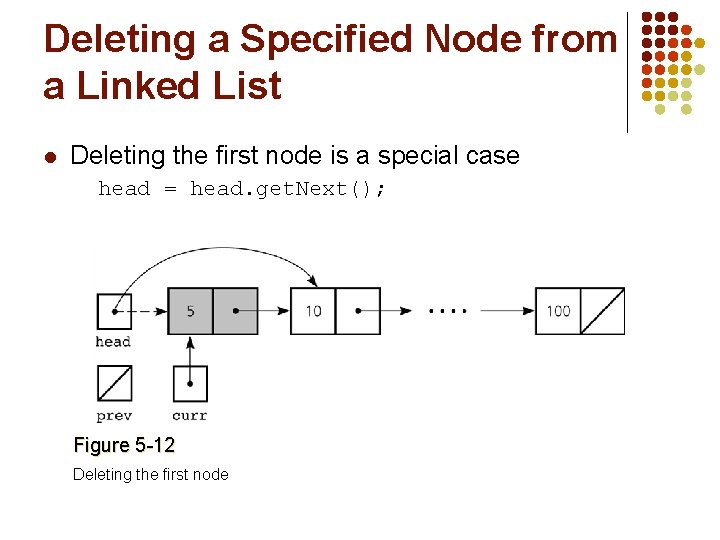
Deleting a Specified Node from a Linked List l Deleting the first node is a special case head = head. get. Next(); Figure 5 -12 Deleting the first node
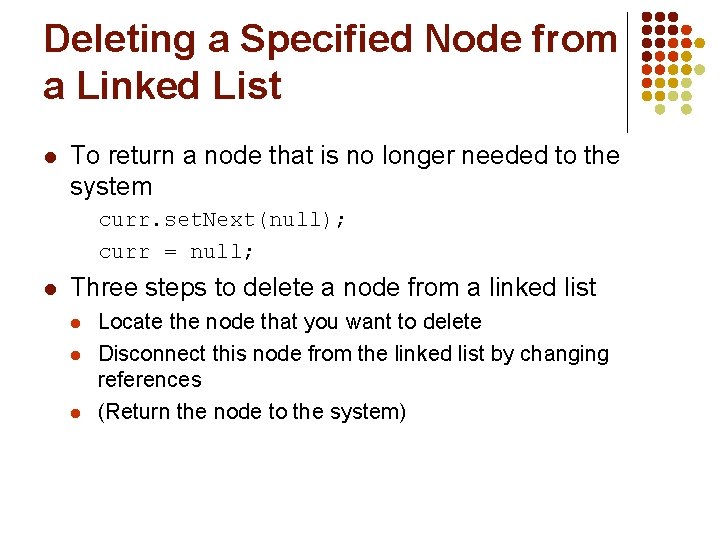
Deleting a Specified Node from a Linked List l To return a node that is no longer needed to the system curr. set. Next(null); curr = null; l Three steps to delete a node from a linked list l l l Locate the node that you want to delete Disconnect this node from the linked list by changing references (Return the node to the system)