Lets Argue AP Style Lets Play a Quick

- Slides: 12
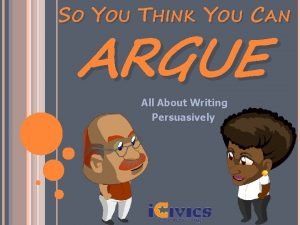
Let’s Argue… AP Style!
Let’s Play a Quick Game of Pyramid! Oprah Winfrey Buzz Lightyear Romeo & Juliet Parents Nelson Mandela Lebron James Firemen Rosa Parks Superman Teachers Martin Luther King Jr. Wonder Woman HEROES!
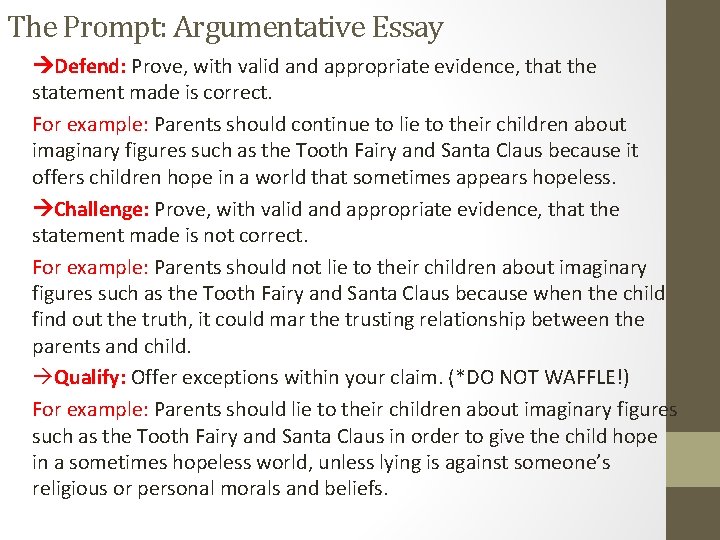
The Prompt: Argumentative Essay Defend: Prove, with valid and appropriate evidence, that the statement made is correct. For example: Parents should continue to lie to their children about imaginary figures such as the Tooth Fairy and Santa Claus because it offers children hope in a world that sometimes appears hopeless. Challenge: Prove, with valid and appropriate evidence, that the statement made is not correct. For example: Parents should not lie to their children about imaginary figures such as the Tooth Fairy and Santa Claus because when the child find out the truth, it could mar the trusting relationship between the parents and child. Qualify: Offer exceptions within your claim. (*DO NOT WAFFLE!) For example: Parents should lie to their children about imaginary figures such as the Tooth Fairy and Santa Claus in order to give the child hope in a sometimes hopeless world, unless lying is against someone’s religious or personal morals and beliefs.
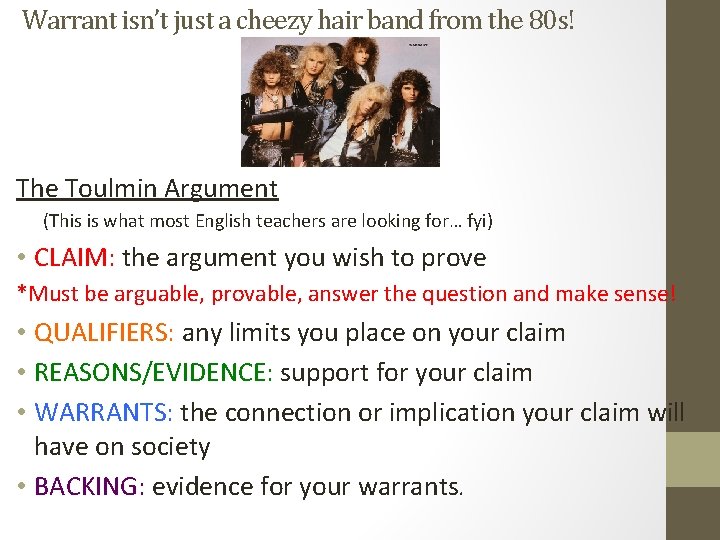
Warrant isn’t just a cheezy hair band from the 80 s! The Toulmin Argument (This is what most English teachers are looking for… fyi) • CLAIM: the argument you wish to prove *Must be arguable, provable, answer the question and make sense! • QUALIFIERS: any limits you place on your claim • REASONS/EVIDENCE: support for your claim • WARRANTS: the connection or implication your claim will have on society • BACKING: evidence for your warrants.
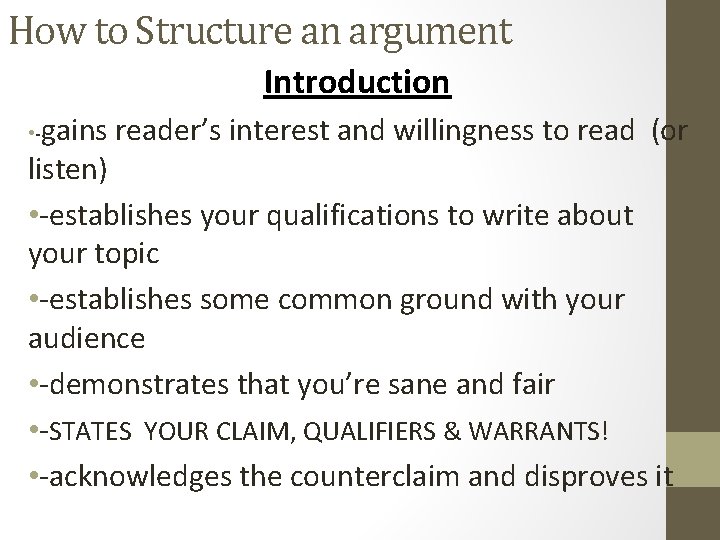
How to Structure an argument Introduction • -gains reader’s interest and willingness to read (or listen) • -establishes your qualifications to write about your topic • -establishes some common ground with your audience • -demonstrates that you’re sane and fair • -STATES YOUR CLAIM, QUALIFIERS & WARRANTS! • -acknowledges the counterclaim and disproves it
Do Now: Write a claim addressing the following prompt: “Intelligence is nothing without creativity and imagination. ” ~Anonymous With such high stakes on standardized testing, should schools offer more options for creativity and use of imagination in their curricula? *Remember to ask yourselves the 4 claim questions! *After discussion, expand your claim into a complete intro. *
How to structure an argument Body • -(background) presents information, including personal narrative, that’s important to your argument • -(lines of argument) presents good reasons, including logical and emotional appeals, in support of your claim • -(alternative arguments) examines alternative points of view and opposing arguments; notes the advantages and disadvantages of these views; explains why your view is better than others *Do not forget topic sentences!
Suggestions for Commonly Made Errors • Make sure you explain how ALL of your great points help to prove your claim (Reasoning) • Just because a word ends with an S, it does not mean the word requires an apostrophe • Be careful of pronouns… In fact, try not to use them at all. • Its (possessive); It’s (it is)/They’re (they are); Their (possessive); There (location)/Your (possessive); You’re (you are) • Be sure that you spend your energy proving your claim throughout your ENTIRE paper. • TOPIC SENTENCE: A head’s up on the point you will be making in the paragraph.
Do Now: • Add to your introduction to create body paragraphs. • Switch with a partner. • Using the 0 -9 AP Lang. rubric for the argument essay, discuss where you think your partner is headed and what he/she can do to bump up at least one point. *Remember to apply grammar and punctuation rules!
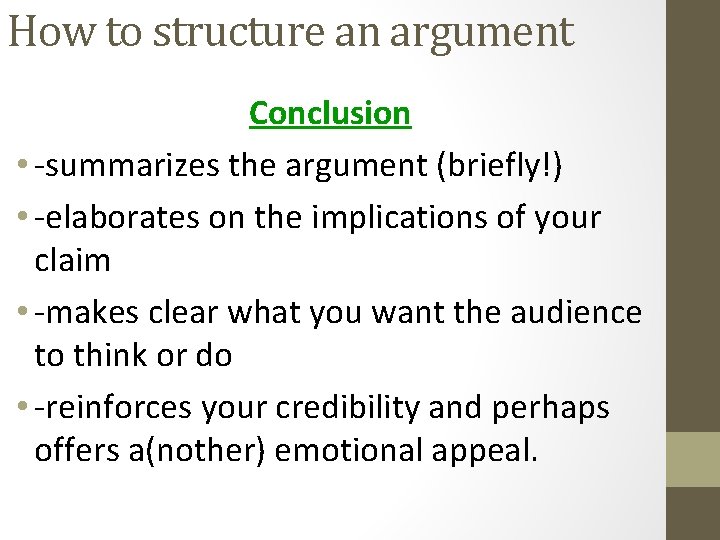
How to structure an argument Conclusion • -summarizes the argument (briefly!) • -elaborates on the implications of your claim • -makes clear what you want the audience to think or do • -reinforces your credibility and perhaps offers a(nother) emotional appeal.
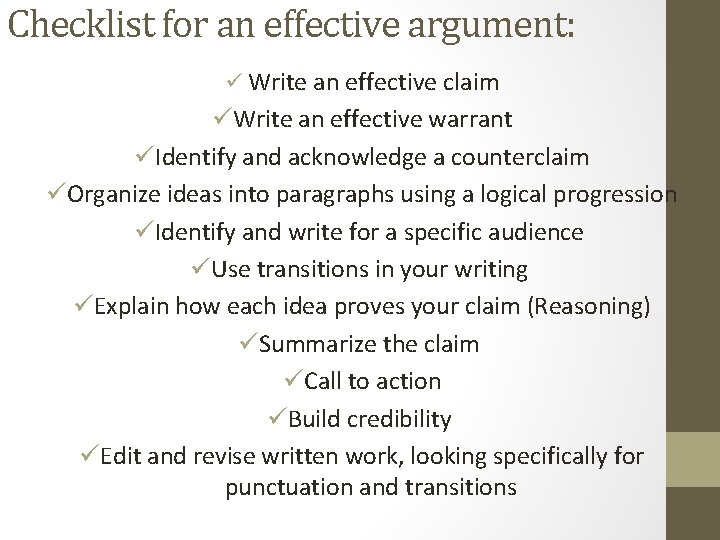
Checklist for an effective argument: ü Write an effective claim üWrite an effective warrant üIdentify and acknowledge a counterclaim üOrganize ideas into paragraphs using a logical progression üIdentify and write for a specific audience üUse transitions in your writing üExplain how each idea proves your claim (Reasoning) üSummarize the claim üCall to action üBuild credibility üEdit and revise written work, looking specifically for punctuation and transitions
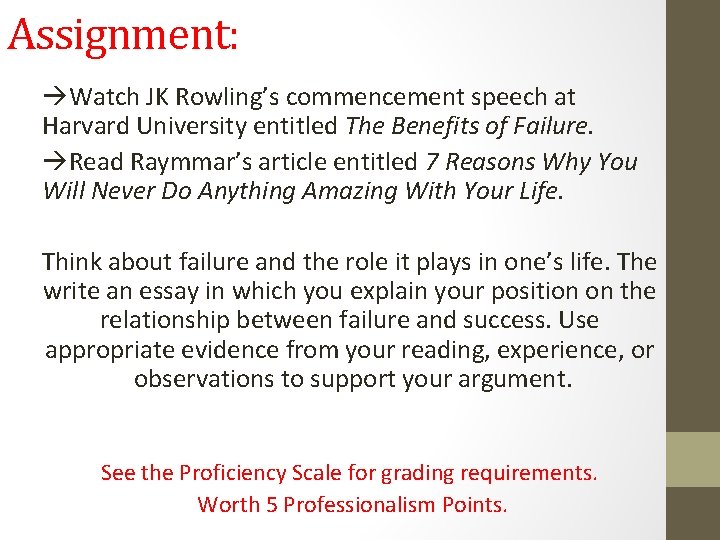
Assignment: Watch JK Rowling’s commencement speech at Harvard University entitled The Benefits of Failure. Read Raymmar’s article entitled 7 Reasons Why You Will Never Do Anything Amazing With Your Life. Think about failure and the role it plays in one’s life. The write an essay in which you explain your position on the relationship between failure and success. Use appropriate evidence from your reading, experience, or observations to support your argument. See the Proficiency Scale for grading requirements. Worth 5 Professionalism Points.