Lesson Topic Punctuation Name of Teacher Susan Strikovsky
- Slides: 30
Lesson Topic: Punctuation Name of Teacher: Susan Strikovsky Lesson Number: 7
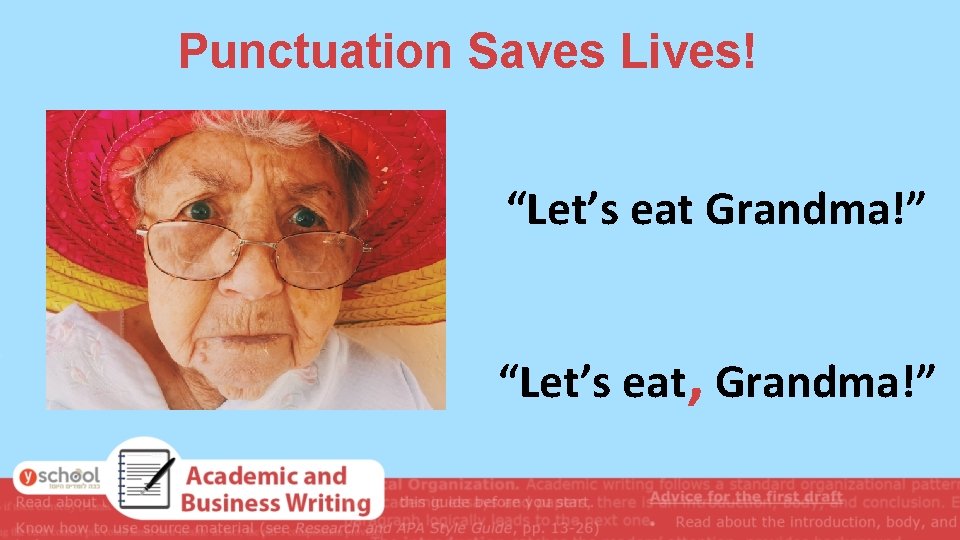
Punctuation Saves Lives! “Let’s eat Grandma!” “Let’s eat, Grandma!”
Table of Contents • Reasons for Punctuation • Common Punctuation Marks Used in English • Period or Full Stop • Examples for Period or Full Stop • Question Mark • Examples for Question Mark Use • Exclamation Mark • Examples for Exclamation Mark Use
Table of Contents • Colon • Comma • Dash • Examples for Comma Use • Order of Punctuation • Semi-colon • Conclusion • Apostrophe • Common Mistakes when Using Apostrophes • Quotation marks • Examples of Quotation Marks
Table of Contents • Comma • Examples for Comma Use • Semi-colon • Apostrophe • Common Mistakes when Using Apostrophes • Quotation marks • Examples of Quotation Marks
Reason for Punctuation "Punctuation” is the name for marks used in writing. They help understand correct reading.
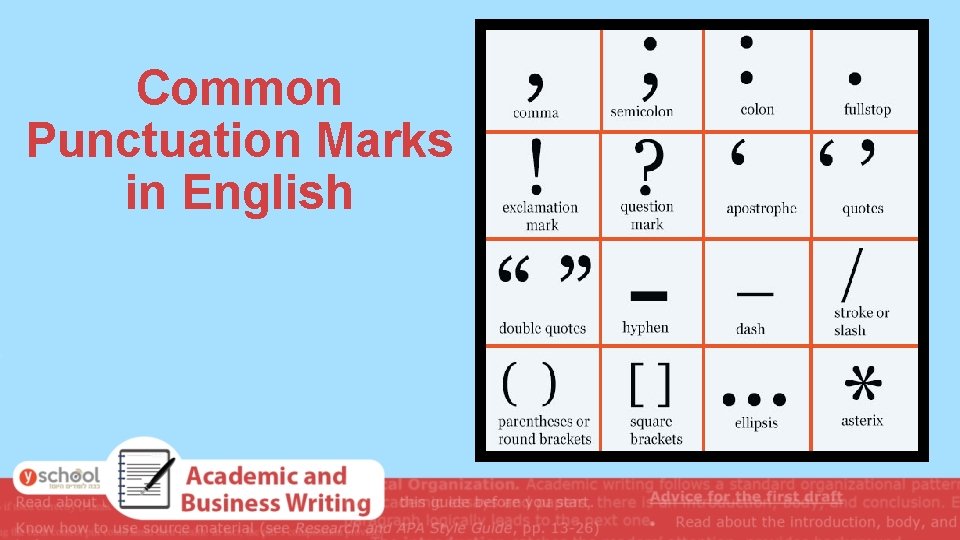
Common Punctuation Marks in English
Period or Full stop (. ) Full stops are used to show: The end of a statement or a sentence. The words following a full stop must begin with a capital letter.
Period or Full stop (. ) • A period (U. S. A. ), full stop (U. K. and Commonwealth) • A full stop is shown by a dot, and placed at the end of a sentence. • A sentence may be one, two or more words long.
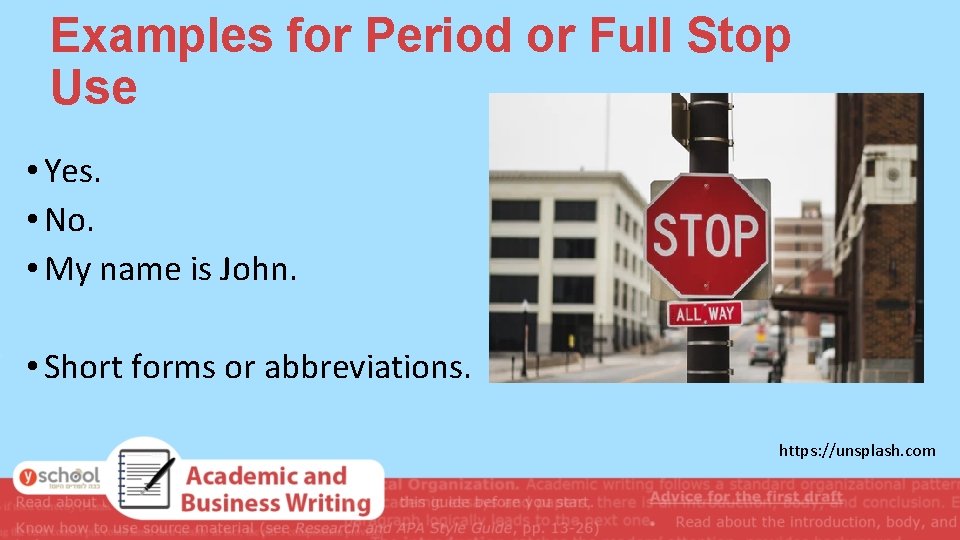
Examples for Period or Full Stop Use • Yes. • No. • My name is John. • Short forms or abbreviations. https: //unsplash. com
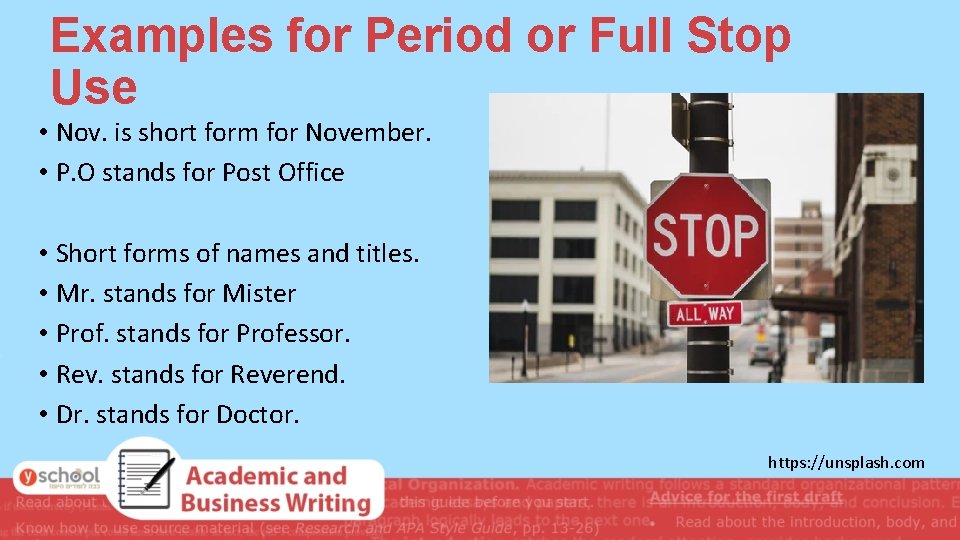
Examples for Period or Full Stop Use • Nov. is short form for November. • P. O stands for Post Office • Short forms of names and titles. • Mr. stands for Mister • Prof. stands for Professor. • Rev. stands for Reverend. • Dr. stands for Doctor. https: //unsplash. com
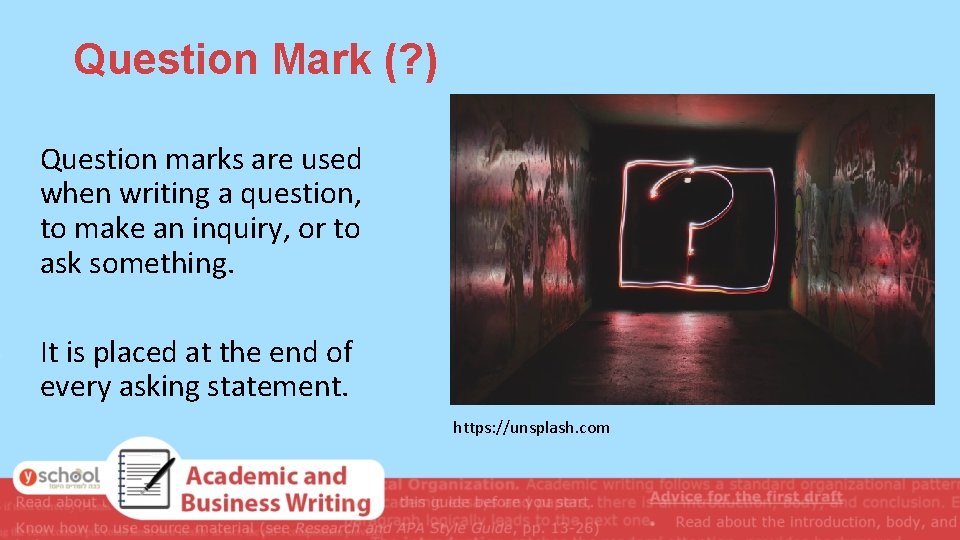
Question Mark (? ) Question marks are used when writing a question, to make an inquiry, or to ask something. It is placed at the end of every asking statement. https: //unsplash. com
Examples for Question Mark Use Examples: "Why is the sky blue? “ No question mark is needed at the end of reported speech. • She asked whether the baby had arrived. • The words following a question mark must start with a capital letter.
Exclamation Mark (!) • The exclamation mark is used to show surprise, excitement, pain, disgust or even satisfaction. • As with full stops and question marks, the word after an exclamation mark begins with a capital letter. https: //unsplash. com
Examples for Exclamation Mark Use • Examples: • "What a bad cat Mimi has!" • An exclamation mark can be used with a question mark, to make a question more forceful. • For example: • "'What did you do that for? !' she said angrily. "
Comma (, ) A comma is used to indicate the pauses that we make in speech.
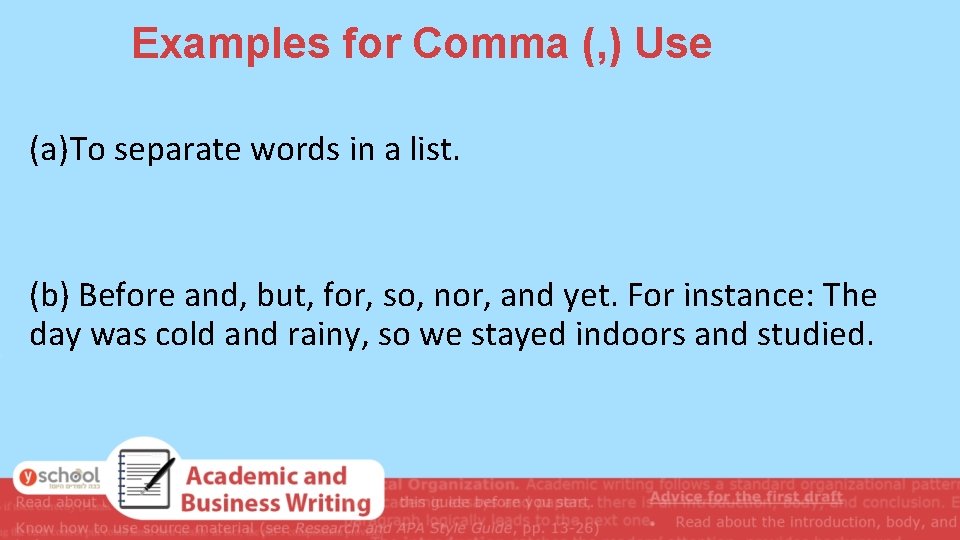
Examples for Comma (, ) Use (a)To separate words in a list. (b) Before and, but, for, so, nor, and yet. For instance: The day was cold and rainy, so we stayed indoors and studied.
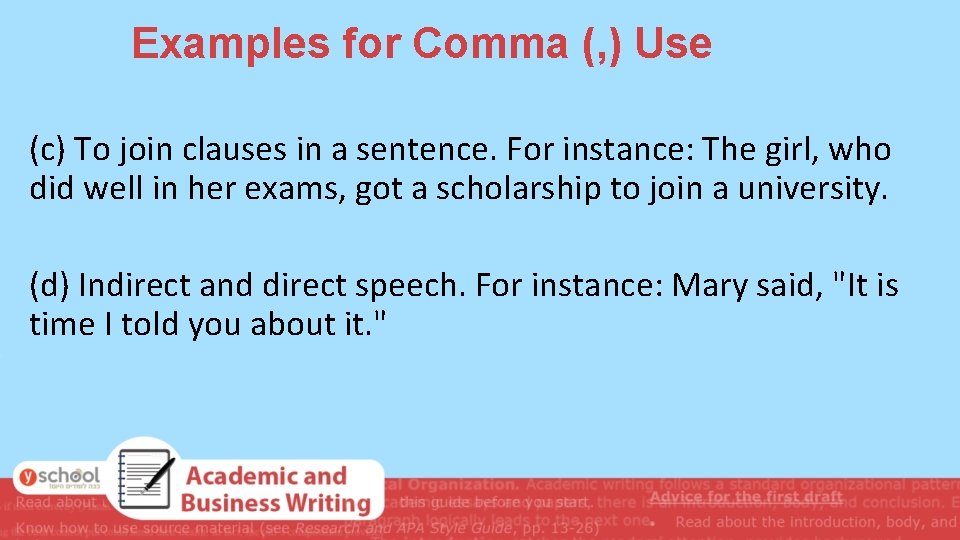
Examples for Comma (, ) Use (c) To join clauses in a sentence. For instance: The girl, who did well in her exams, got a scholarship to join a university. (d) Indirect and direct speech. For instance: Mary said, "It is time I told you about it. "
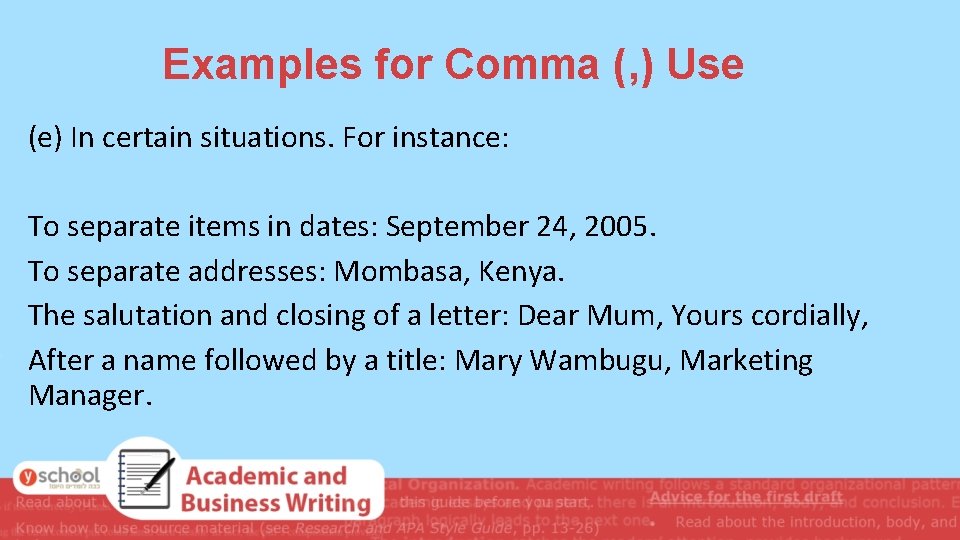
Examples for Comma (, ) Use (e) In certain situations. For instance: To separate items in dates: September 24, 2005. To separate addresses: Mombasa, Kenya. The salutation and closing of a letter: Dear Mum, Yours cordially, After a name followed by a title: Mary Wambugu, Marketing Manager.
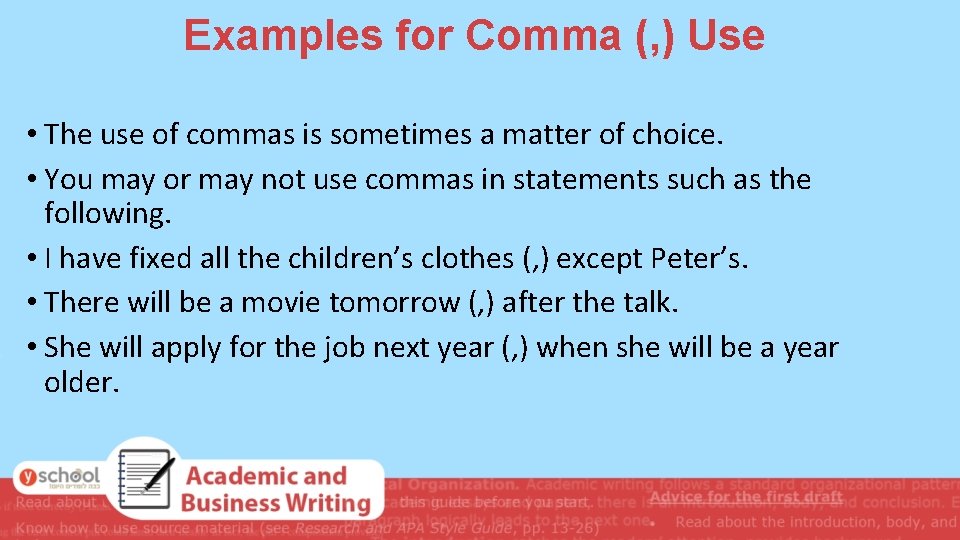
Examples for Comma (, ) Use • The use of commas is sometimes a matter of choice. • You may or may not use commas in statements such as the following. • I have fixed all the children’s clothes (, ) except Peter’s. • There will be a movie tomorrow (, ) after the talk. • She will apply for the job next year (, ) when she will be a year older.
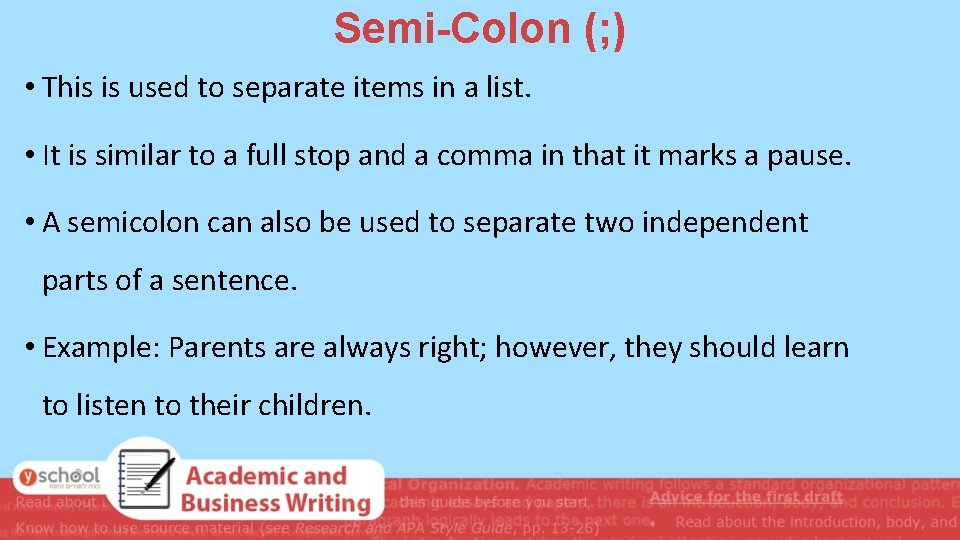
Semi-Colon (; ) • This is used to separate items in a list. • It is similar to a full stop and a comma in that it marks a pause. • A semicolon can also be used to separate two independent parts of a sentence. • Example: Parents are always right; however, they should learn to listen to their children.
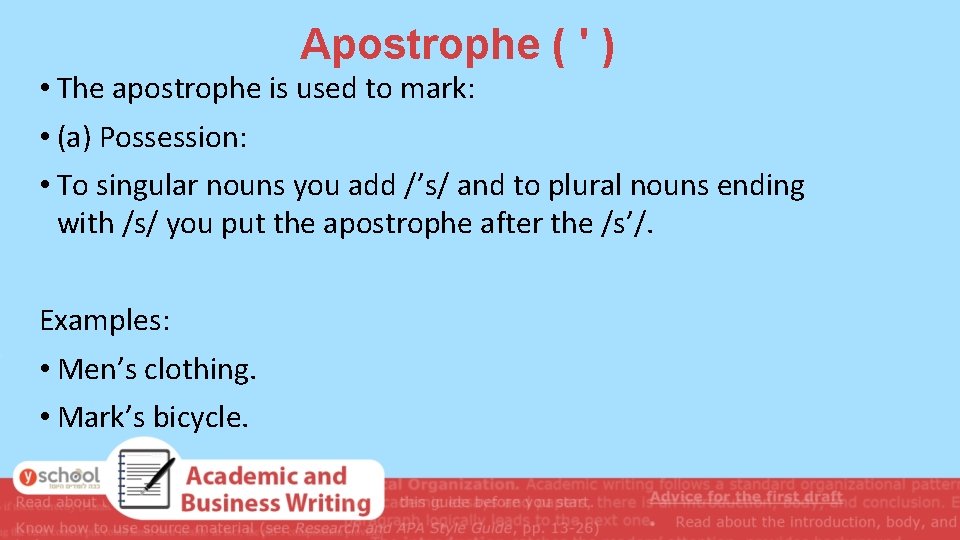
Apostrophe ( ' ) • The apostrophe is used to mark: • (a) Possession: • To singular nouns you add /’s/ and to plural nouns ending with /s/ you put the apostrophe after the /s’/. Examples: • Men’s clothing. • Mark’s bicycle.
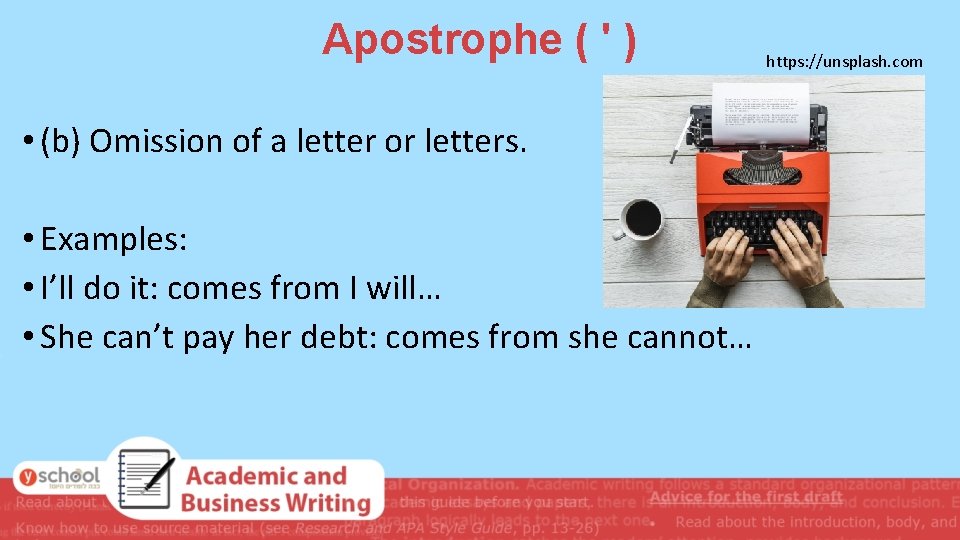
Apostrophe ( ' ) • (b) Omission of a letter or letters. • Examples: • I’ll do it: comes from I will… • She can’t pay her debt: comes from she cannot… https: //unsplash. com
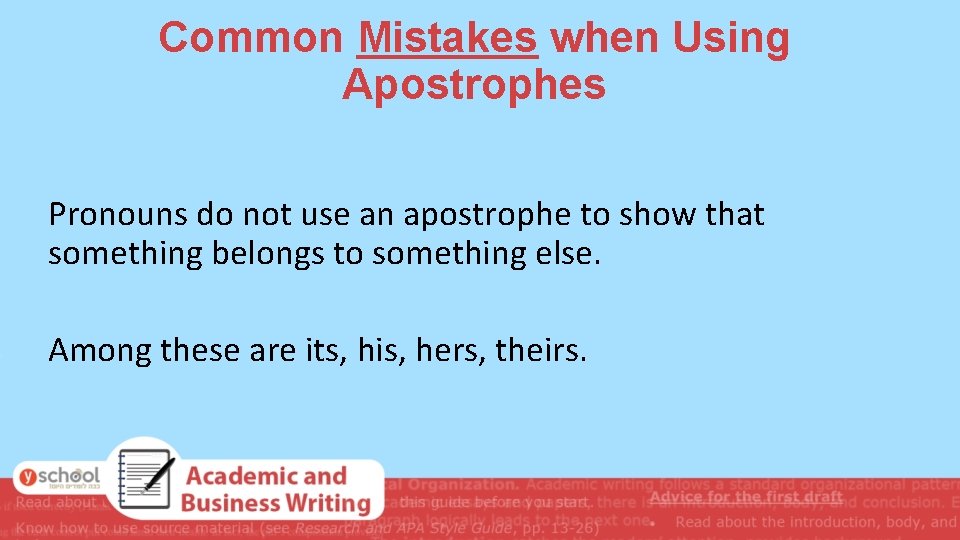
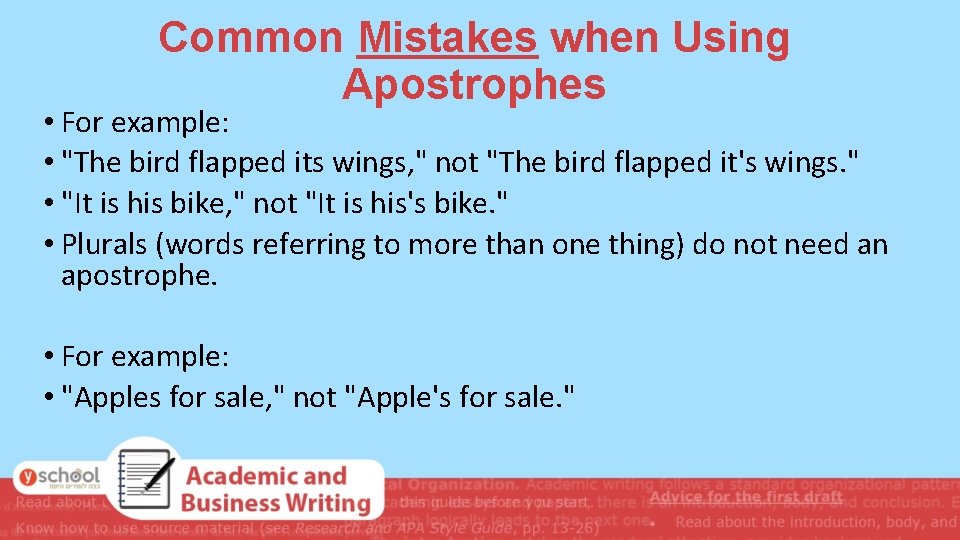
Common Mistakes when Using Apostrophes Pronouns do not use an apostrophe to show that something belongs to something else. Among these are its, his, hers, theirs.
Common Mistakes when Using Apostrophes • For example: • "The bird flapped its wings, " not "The bird flapped it's wings. " • "It is his bike, " not "It is his's bike. " • Plurals (words referring to more than one thing) do not need an apostrophe. • For example: • "Apples for sale, " not "Apple's for sale. "
Quotation Marks (‘ ’) or (“ ”) • These are sometimes called speech marks or inverted commas. • They are also referred to as opening (“…) and closing (…. . ”) inverted commas, because they are used at the opening and closing of spoken words. • They are used in direct speech to show words actually spoken.
Examples of Quotation Marks (‘ ’) or (“ ”) Use • ‘Come here, ’ said his mother. • ‘Well, ’ said the tour operator, ‘we shall set off for the National Park straight away. ’
Colon (: ) • The colon is usually used after a complete statement to introduce other related ideas like lists or series. Examples: • The main rivers of Africa are: the Nile, the Congo, and the Niger.
Dash (–) In writing, the dash serves the purpose of indicating an abrupt break in a sentence. Examples: • The doctors thought the lady had lost her mind- that she was insane.
Happy Writing!