Lesson 9 1 3 Area and perimeter of


- Slides: 13
Lesson 9. 1. 3 Area and perimeter of irregular shapes Pick up 2 different colored highlighters for your notes today
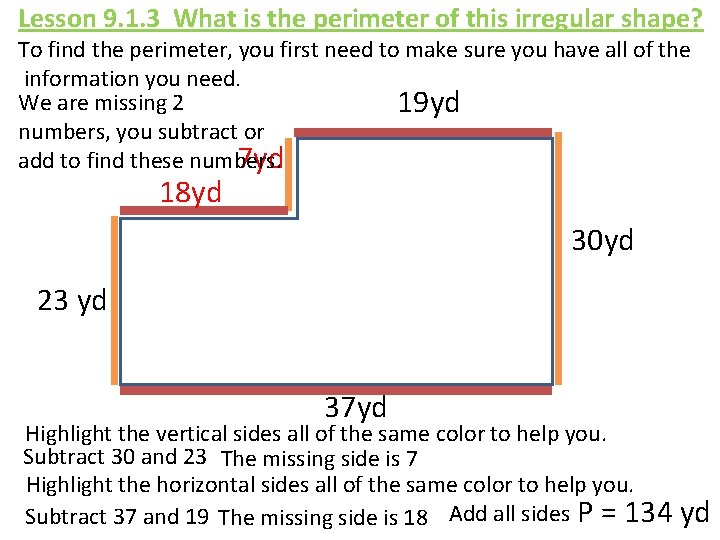
Lesson 9. 1. 3 What is the perimeter of this irregular shape? To find the perimeter, you first need to make sure you have all of the information you need. We are missing 2 19 yd numbers, you subtract or add to find these numbers. 7 yd 18 yd 30 yd 23 yd 37 yd Highlight the vertical sides all of the same color to help you. Subtract 30 and 23 The missing side is 7 Highlight the horizontal sides all of the same color to help you. Subtract 37 and 19 The missing side is 18 Add all sides P = 134 yd
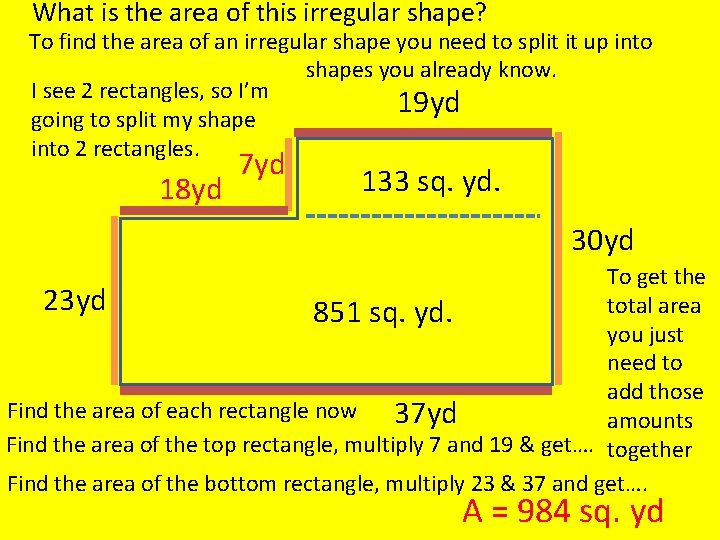
What is the area of this irregular shape? To find the area of an irregular shape you need to split it up into shapes you already know. I see 2 rectangles, so I’m 19 yd going to split my shape into 2 rectangles. 18 yd 7 yd 133 sq. yd. 30 yd To get the 23 yd total area 851 sq. yd. you just need to add those Find the area of each rectangle now 37 yd amounts Find the area of the top rectangle, multiply 7 and 19 & get…. together Find the area of the bottom rectangle, multiply 23 & 37 and get…. A = 984 sq. yd
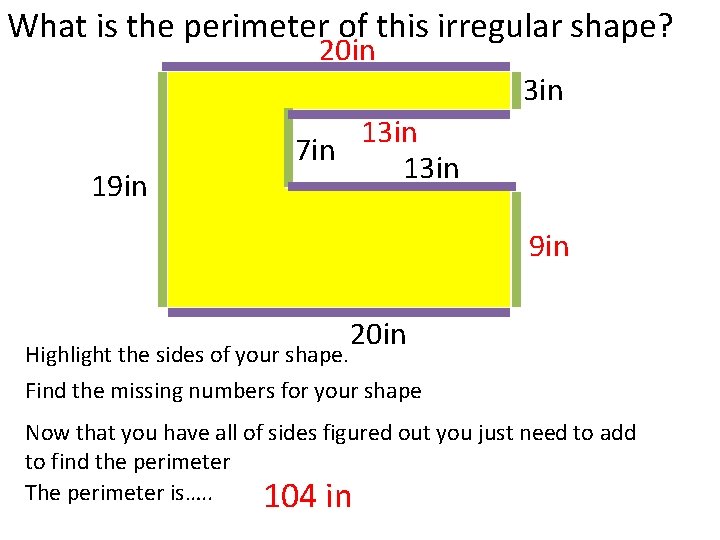
What is the perimeter of this irregular shape? 20 in 3 in 19 in 13 in 7 in 13 in 9 in 20 in Highlight the sides of your shape. Find the missing numbers for your shape Now that you have all of sides figured out you just need to add to find the perimeter The perimeter is…. . 104 in
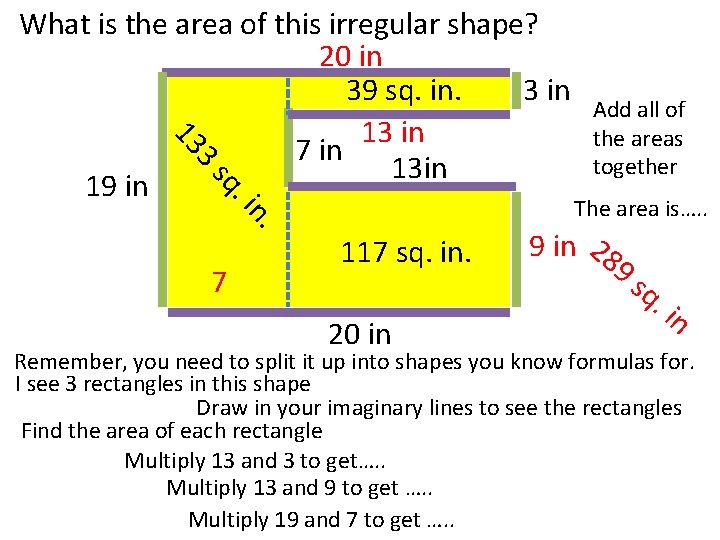
q. 3 s 13 What is the area of this irregular shape? 20 in 39 sq. in. 13 in 7 in 13 in 19 in 7 117 sq. in. 20 in Add all of the areas together The area is…. . 9 in 28 9 s q. in Remember, you need to split it up into shapes you know formulas for. I see 3 rectangles in this shape Draw in your imaginary lines to see the rectangles Find the area of each rectangle Multiply 13 and 3 to get…. . Multiply 13 and 9 to get …. . Multiply 19 and 7 to get …. .
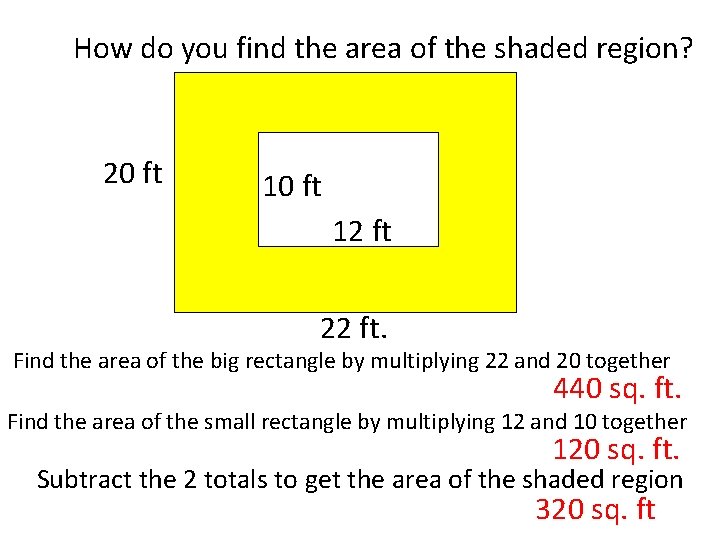
How do you find the area of the shaded region? 20 ft 12 ft 22 ft. Find the area of the big rectangle by multiplying 22 and 20 together 440 sq. ft. Find the area of the small rectangle by multiplying 12 and 10 together 120 sq. ft. Subtract the 2 totals to get the area of the shaded region 320 sq. ft
9 x 4= 36 sq. cm. 6 x 5 = 30 sq. cm. A = 66 cm² 4 cm 6 x 10 -6 = 4 P = 38 m
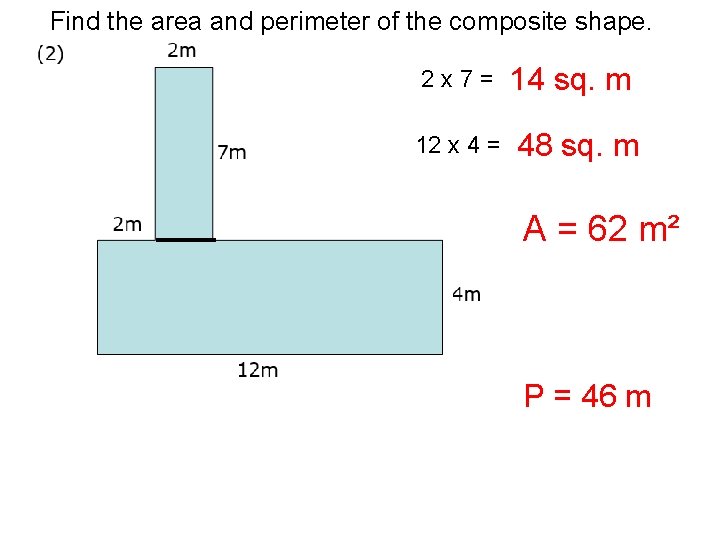
Find the area and perimeter of the composite shape. 2 x 7= 12 x 4 = 14 sq. m 48 sq. m A = 62 m² P = 46 m
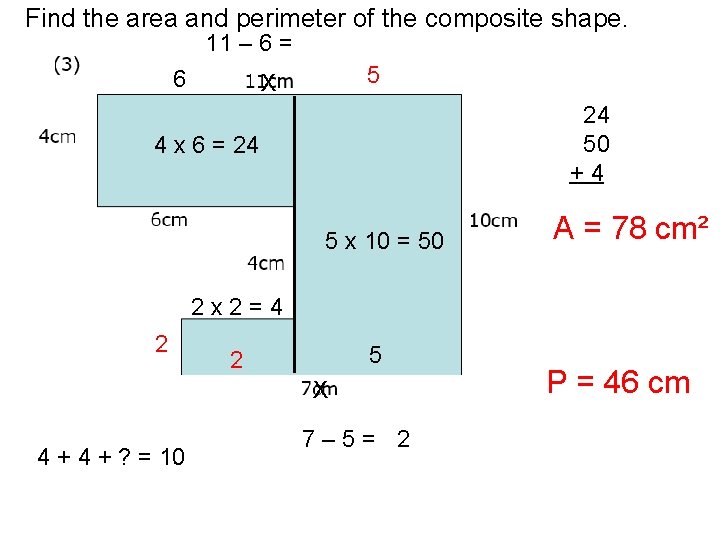
Find the area and perimeter of the composite shape. 11 – 6 = 6 5 X 24 50 +4 4 x 6 = 24 5 x 10 = 50 A = 78 cm² 2 x 2=4 2 5 2 X 4 + ? = 10 7– 5= 2 P = 46 cm
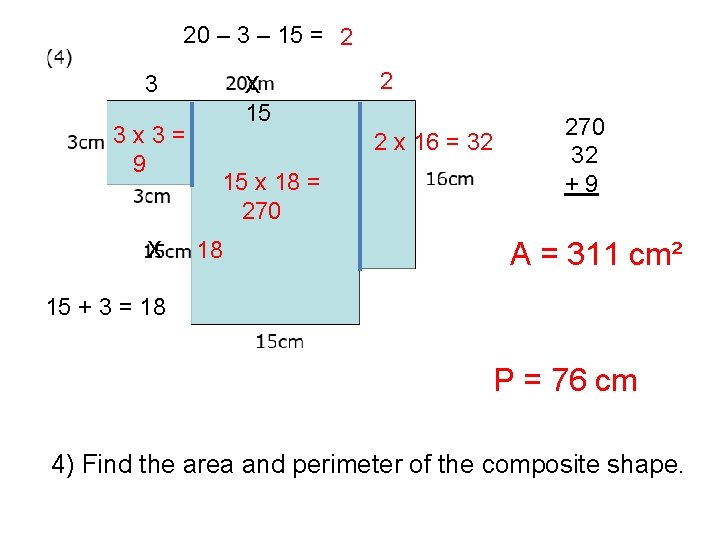
20 – 3 – 15 = 2 3 3 x 3= 9 X X 15 2 2 x 16 = 32 15 x 18 = 270 18 270 32 +9 A = 311 cm² 15 + 3 = 18 P = 76 cm 4) Find the area and perimeter of the composite shape.
6 x 8 = 48 2 x 4= 8 48 -8 40 cm²
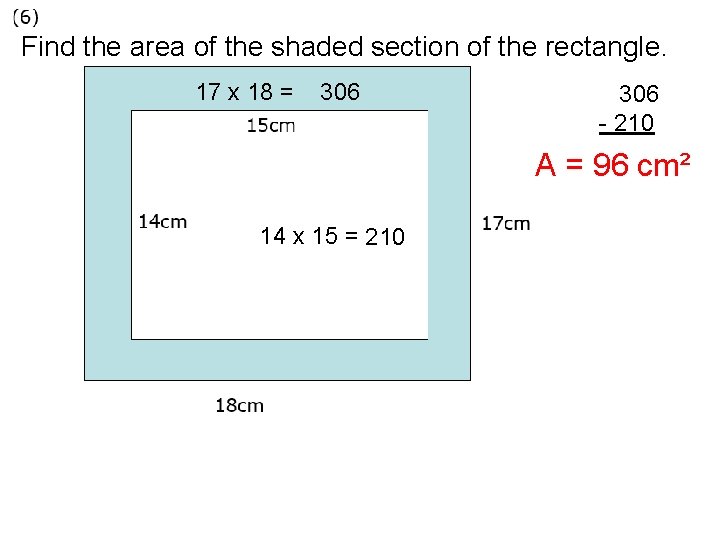
Find the area of the shaded section of the rectangle. 17 x 18 = 306 - 210 A = 96 cm² 14 x 15 = 210
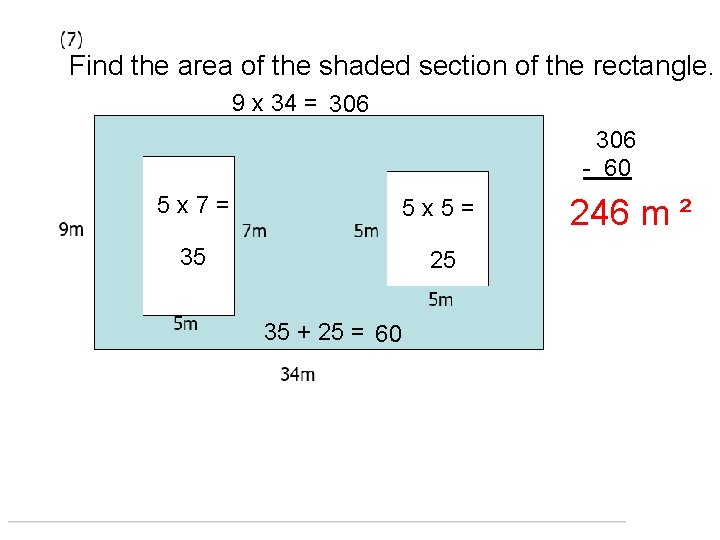
Find the area of the shaded section of the rectangle. 9 x 34 = 306 - 60 5 x 7= 5 x 5= 35 25 35 + 25 = 60 246 m ²