Legal Issues Advance Care Planning Advance Directives Nova







- Slides: 28
Legal Issues Advance Care Planning Advance Directives Nova Scotia Jeanne Desveaux May 9, 2014
Advance Health Care Directives § Two types: – Instructive Directive – Proxy Directive § Provides information to health care professionals if a patient is: – Unable to express their wishes – Unable to make decisions
The Instructive Directive § Referred to as “living will” § Documents health care preferences – Wishes regarding life-sustaining treatments § Outlines how health care decisions should be made on patient’s behalf § Helpful to both the proxy and health professionals
The Instructive Directive § Criteria: – Patient and proxy must be of the age of majority – Patient must be capable of giving consent to medical treatment § To be valid, the authorization must be: – In writing – Signed by the person giving it – Witnessed by a person who is not the proxy or the spouse of the proxy
The Proxy Directive § Known as durable power of attorney for health care § Proxy is the “substitute decision maker” – A person entrusted with responsibility to speak for another individual when they are unable to speak for themselves § Can incorporate the instructive directive
Reminders § Advance Care Directive must be available when crisis occurs – Not locked away in safety deposit box § Directive must be reflective of the individual’s current health situation § Must reflect future unknowns (e. g. heart attack) § Documents must be reviewed and updated
Goals of Advance Directives § Role for both the physician and the lawyer § Goal is to develop a document that is: – Individualized to the particular patient’s preferences – Reflective of their goals and values
Personal Directives Act
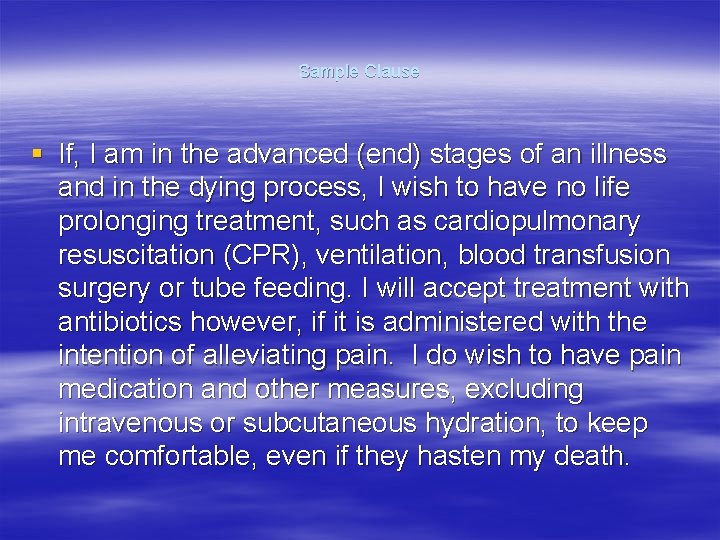
Sample Clause § If, I am in the advanced (end) stages of an illness and in the dying process, I wish to have no life prolonging treatment, such as cardiopulmonary resuscitation (CPR), ventilation, blood transfusion surgery or tube feeding. I will accept treatment with antibiotics however, if it is administered with the intention of alleviating pain. I do wish to have pain medication and other measures, excluding intravenous or subcutaneous hydration, to keep me comfortable, even if they hasten my death.
Some unique features Instructions about statutory decision-makers: § If for some unforeseen reason my delegate and alternative are unavailable, I am herein instructing that the following relatives are not to be consulted regarding any and all healthcare and personal decisions: Not Applicable
Consultation § Consultation when delegate making decisions § My delegate may consult with my family physician and other family members if my delegate determines that such consultation is advisable or necessary.
Purpose of the Act § Help individuals prepare for the onset of incapacity to make personal care decisions (nutrition, hydration, shelter, clothing, hygiene, comfort, recreation, support services, healthcare, placement) § Help individuals who have not prepared for incapacity regarding personal care decisions by providing a mechanism for the appointment of a statutory decision maker who can make decisions related to long term care placement, health care decisions and home care support services.
What does the Act allow for? § Appoint someone (delegate) to make personal care decisions for the maker § Set out instructions or general principles about what or how personal care decisions should be made § Hierarchy of statutory substitute decision makers for (1) health care (2) placement in continuing care home and (3) home care services
Jurisdictional Context § Nova Scotia’s approach is aligned with other Canadian provincial jurisdictions § Nova Scotia’s model is informed by a number of provincial programs that have been in existence for a number of years such as Ontario and the Yukon
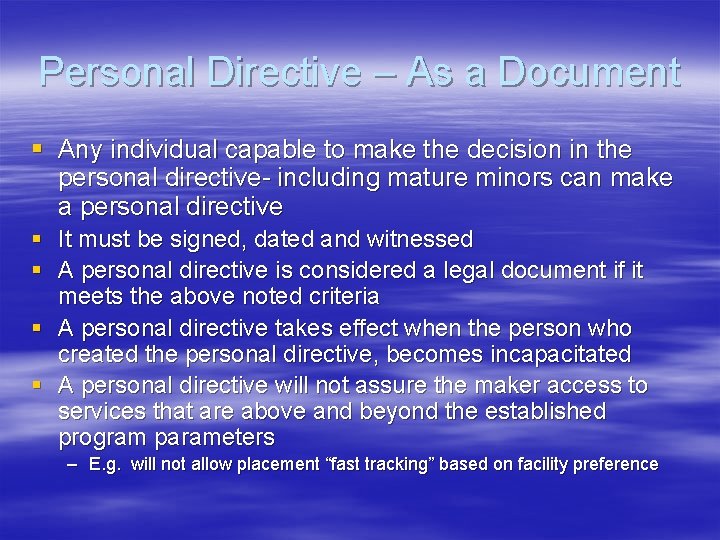
Personal Directive – As a Document § Any individual capable to make the decision in the personal directive- including mature minors can make a personal directive § It must be signed, dated and witnessed § A personal directive is considered a legal document if it meets the above noted criteria § A personal directive takes effect when the person who created the personal directive, becomes incapacitated § A personal directive will not assure the maker access to services that are above and beyond the established program parameters – E. g. will not allow placement “fast tracking” based on facility preference
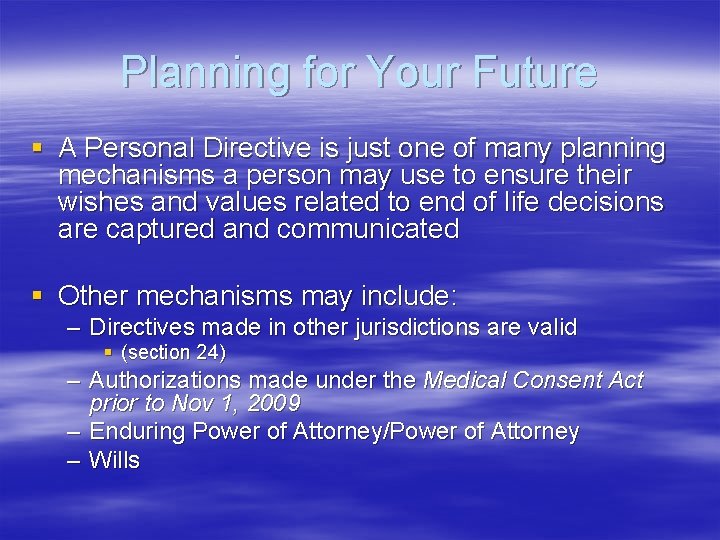
Planning for Your Future § A Personal Directive is just one of many planning mechanisms a person may use to ensure their wishes and values related to end of life decisions are captured and communicated § Other mechanisms may include: – Directives made in other jurisdictions are valid § (section 24) – Authorizations made under the Medical Consent Act prior to Nov 1, 2009 – Enduring Power of Attorney/Power of Attorney – Wills
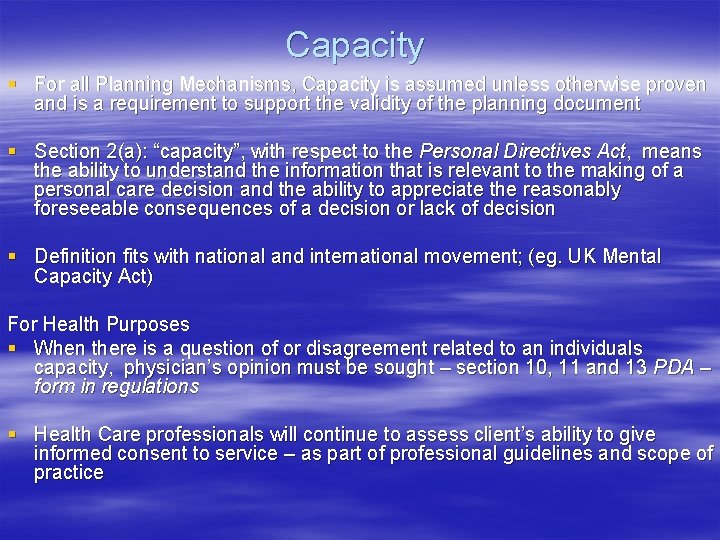
Capacity § For all Planning Mechanisms, Capacity is assumed unless otherwise proven and is a requirement to support the validity of the planning document § Section 2(a): “capacity”, with respect to the Personal Directives Act, means the ability to understand the information that is relevant to the making of a personal care decision and the ability to appreciate the reasonably foreseeable consequences of a decision or lack of decision § Definition fits with national and international movement; (eg. UK Mental Capacity Act) For Health Purposes § When there is a question of or disagreement related to an individuals capacity, physician’s opinion must be sought – section 10, 11 and 13 PDA – form in regulations § Health Care professionals will continue to assess client’s ability to give informed consent to service – as part of professional guidelines and scope of practice
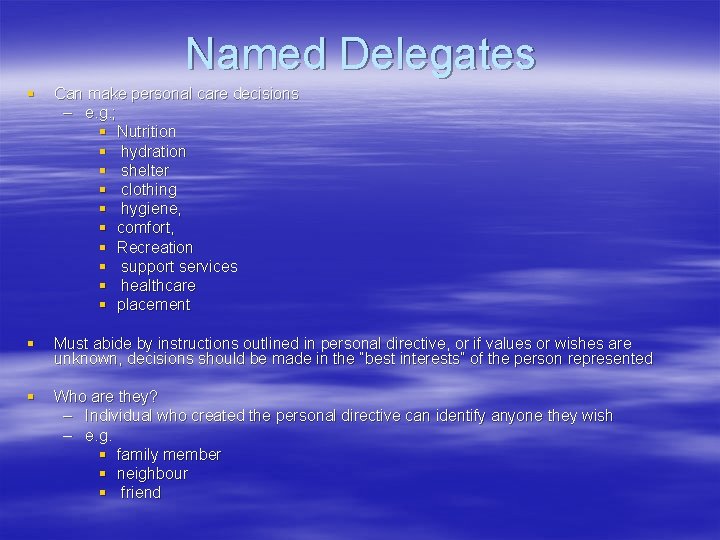
Named Delegates § Can make personal care decisions – e. g. ; § Nutrition § hydration § shelter § clothing § hygiene, § comfort, § Recreation § support services § healthcare § placement § Must abide by instructions outlined in personal directive, or if values or wishes are unknown, decisions should be made in the “best interests” of the person represented § Who are they? – Individual who created the personal directive can identify anyone they wish – e. g. § family member § neighbour § friend
Appointed Statutory Decision Makers § Can make decisions in relation to 3 areas: – – – health care placement in continuing care home care services § Must make decisions based on knowledge of or believed wishes of the person based on values and/or oral instructions; if they do not know the wishes, they base decision on the ‘best interests’ of the person § Who are they? – Nearest relative (hierarchy) – Public Trustee
Protections and Limitations Key protections: § Termination/revocation § Offences § Court powers (similar to issues of guardianship now) § Liability protection § Good Faith Clause Limitations § A personal directive does not permit an illegal act § An appointed substitute decision maker or delegate must comply with the requirements set out in the Personal Directives Act with respect to their role and responsibilities – Section 15 (4) of the Act
Benefits § Fill long-standing gaps in legislation to address informed consent issues for placement and ‘home care services’ and health care outside of hospital § Allow for Nova Scotians to be legally clear about their wishes related to their care and personal decisions once they no longer have the capacity to do so; § Provide clarity to health care workers in working with delegates/ substitute decision makers (families)
Challenges § Developing and sharing a Personal Directive to ensure that their wishes and values related to their decisions are captured and communicated § Ensuring that health care professionals understand both the development process associated with creating a document (a Plan) as well as the law
Cognitive Impairment § Talking specifically about dementia § The presence of dementia does not mean an inability to complete a Personal Directive – It means there is more burden on the lawyer receiving instructions (stats all over the map) – informed consent – Communication!
Capacity to make a Personal Directive § Decisional capacity includes at least four components: – understanding information relevant to the decision – appreciating the information (applying the information to one’s own situation) – using the information in reasoning – and expressing a consistent choice
Can capacity be improved? § Usually not, but understanding can § Communication can! § Supporting the efforts of “Speak Up”
Reminders 1. Everyone is assumed to be competent – Unless they have been declared incompetent by a court – then their attorney/ delegate or guardian should be the decision-maker 2. Ask Questions-re-ask questions – (make a note of the questions and answers when documenting the consent process)
Need More Information? § Information related the Personal Directives Act and developing a Personal Directive are available online at: http: //www. gov. ns. ca/jus/pda
Questions?