
Lecture Poles and Zeros Copyright Paul Oh Recall

![2 nd Order Damped System n Natural Frequency [rad/s] (1) Damping ratio (2 A)](https://slidetodoc.com/presentation_image/3e71278e5753c08a2b82ea1b2dbd85ea/image-8.jpg "2 nd Order Damped System n Natural Frequency [rad/s] (1) Damping ratio (2 A)")
- Slides: 10
Lecture: Poles and Zeros © Copyright Paul Oh
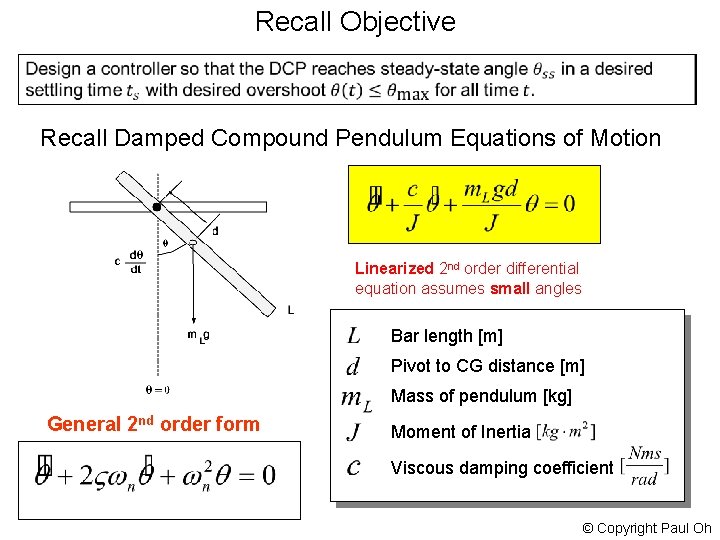
Recall Objective Recall Damped Compound Pendulum Equations of Motion Linearized 2 nd order differential equation assumes small angles Bar length [m] Pivot to CG distance [m] Mass of pendulum [kg] General 2 nd order form Moment of Inertia Viscous damping coefficient © Copyright Paul Oh
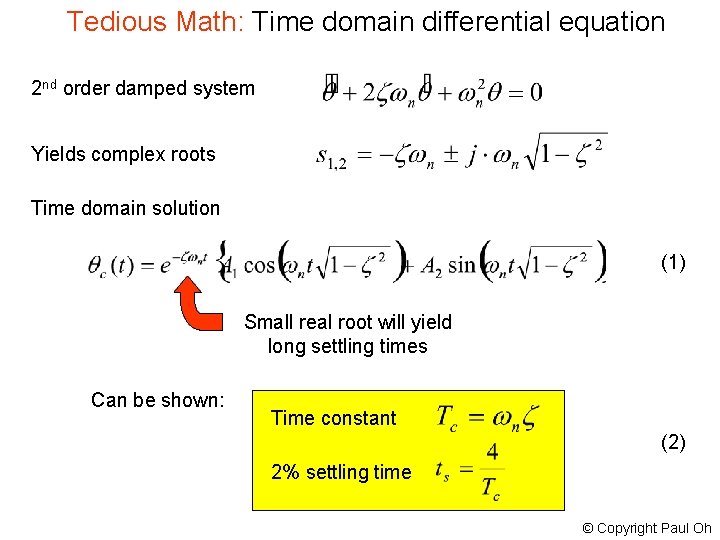
Tedious Math: Time domain differential equation 2 nd order damped system Yields complex roots Time domain solution (1) Small real root will yield long settling times Can be shown: Time constant (2) 2% settling time © Copyright Paul Oh
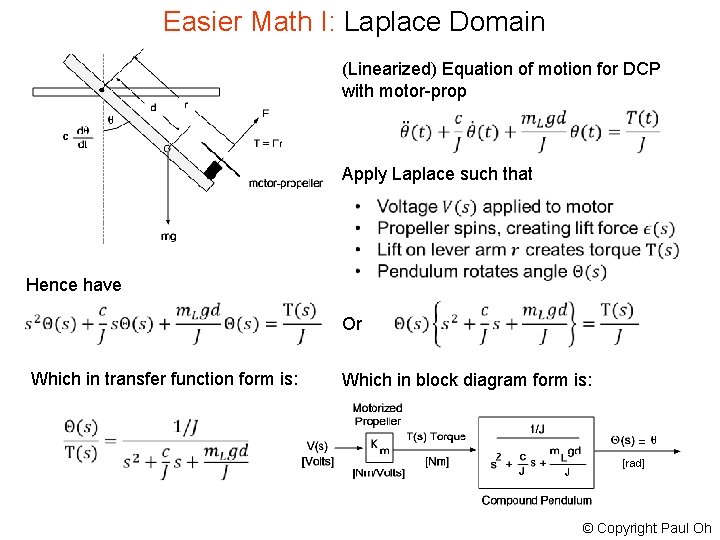
Easier Math I: Laplace Domain (Linearized) Equation of motion for DCP with motor-prop Apply Laplace such that Hence have Or Which in transfer function form is: Which in block diagram form is: [rad] © Copyright Paul Oh
© Copyright Paul Oh
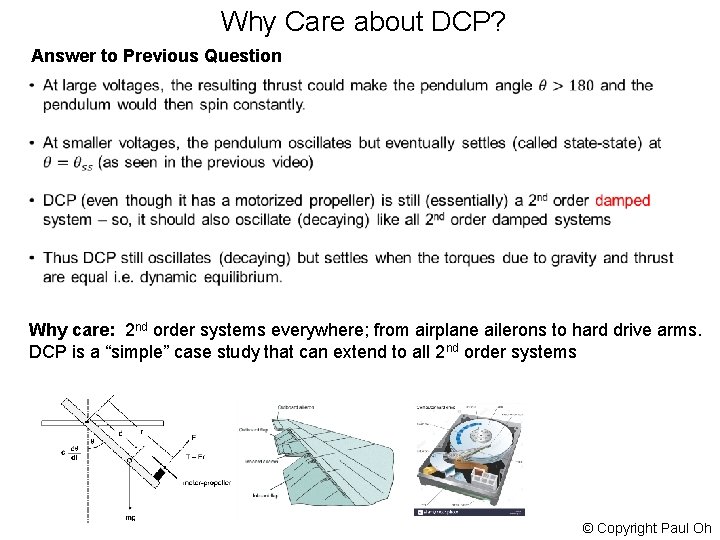
Why Care about DCP? Answer to Previous Question Why care: 2 nd order systems everywhere; from airplane ailerons to hard drive arms. DCP is a “simple” case study that can extend to all 2 nd order systems © Copyright Paul Oh
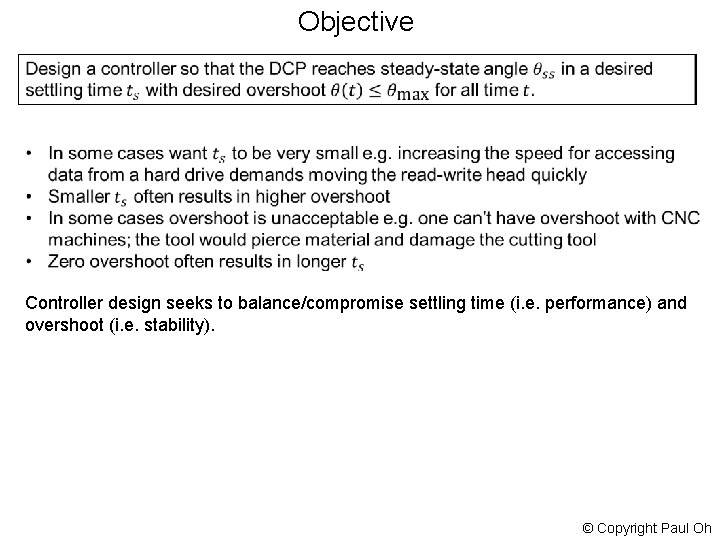
Objective Controller design seeks to balance/compromise settling time (i. e. performance) and overshoot (i. e. stability). © Copyright Paul Oh
2 nd Order Damped System n Natural Frequency [rad/s] (1) Damping ratio (2 A) Period [sec] Angle [rad] (2 B) © Copyright Paul Oh
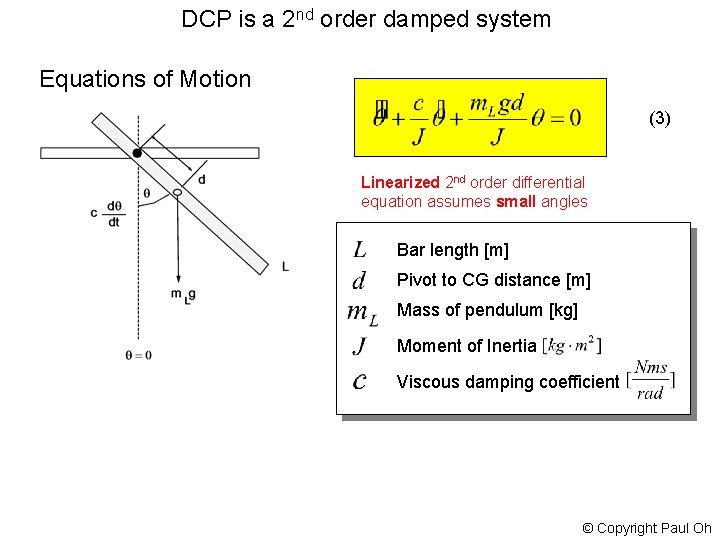
DCP is a 2 nd order damped system Equations of Motion (3) Linearized 2 nd order differential equation assumes small angles Bar length [m] Pivot to CG distance [m] Mass of pendulum [kg] Moment of Inertia Viscous damping coefficient © Copyright Paul Oh
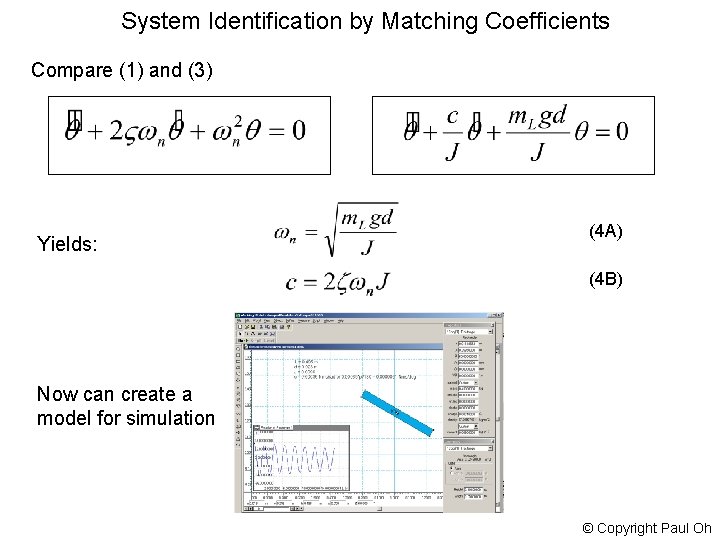
System Identification by Matching Coefficients Compare (1) and (3) Yields: (4 A) (4 B) Now can create a model for simulation © Copyright Paul Oh