Leadership in the Seventhday Adventist Church Policy and



- Slides: 13
Leadership in the Seventh-day Adventist Church Policy and Practice
Historical Background Late Industrial Revolution influence Mirroring current secular leadership behaviors 1861 marked the formal emergence of the word leadership George Butler Leadership essay and subsequent controversy The polarization of the church during the last 2 decades of the 19 th Century Reorganization at the 1901 and 1903 General Conference sessions
Mirroring of Secular L’ship Great Man Theory and Practice the norm Rockefeller, Carnegie, J. P. Morgan, Edison, etc Command control methods challenged Enlightenment Emergence of non-military management of large organizations Slavery outlawed but attitudes of control and coercion remain Kingly Power controversy pitted autocratic vs. representative leadership models U. S. President Theodore Roosevelt tackled autocratic models at the same time as we were dealing with Kingly attitudes in the SDA Church
Biblical Precedents Biblical history reveals God shares authority broadly in a distributed model Humans granted shared leadership before Adam was created Shared leadership restored in New Jerusalem Tendency of humans to centralize and consolidate authority into hands of a few Offer to Gideon Israel’s request for a king God’s intervention never consolidates but rather distributes and disperses authority as a solution Radical distribution of authority in the early church replaced by centralized leader (pope)
Symptoms in late 19 th Century SDA Church 1860’s- Poorly defined authority structure led to leadership stresses in 1870’s 1873 - Butler’s Leadership essay and GC acceptance promoted hierarchy of power C: UserspatterssDropboxArticlesterminal authorityButler Pamphlet Leadership. pdf Rescinded in 1875 -1900 - Polarization of attitudes related to autocracy 1900 - EG White returns from Australia with experience in formation and value of Unions Calls for change and challenges Kingly Power attitudes and practice Challenges commercial models of organization and leadership applied to church
1901 GC Session (affirmed at 1903 GC session) Reorganization was the solution for dysfunctional leadership Overreaction- No GC President elected in 1901 Illustrates the level of passion for an egalitarian model of governance SDA organizational structure cannot be understood apart from an awareness of the Kingly Power controversy Authority was vested in the people—not in leaders Leaders function on the basis of “loaned” authority limited by time and scope Leaders accountable to representatives of the body
Papal Model (Hierarchy of Power) 1/20/2014 Papal Authority Ex er cis e of au SDATS th or Archbishops S. E. Patterson, Ph. D Cardinals Few barriers or hindering buffers Bishops Priests 7 Members Subject to Authority
Representative Model (Hierarchy of Order) Union (authority limited to term) Conference (authority limited to term) de leg ati on of au SDATS tho rity S. E. Patterson, Ph. D General Conference/Division (authority limited to term) barriers or hindering buffers Local Church (Authority vested in Collective Membership) 8
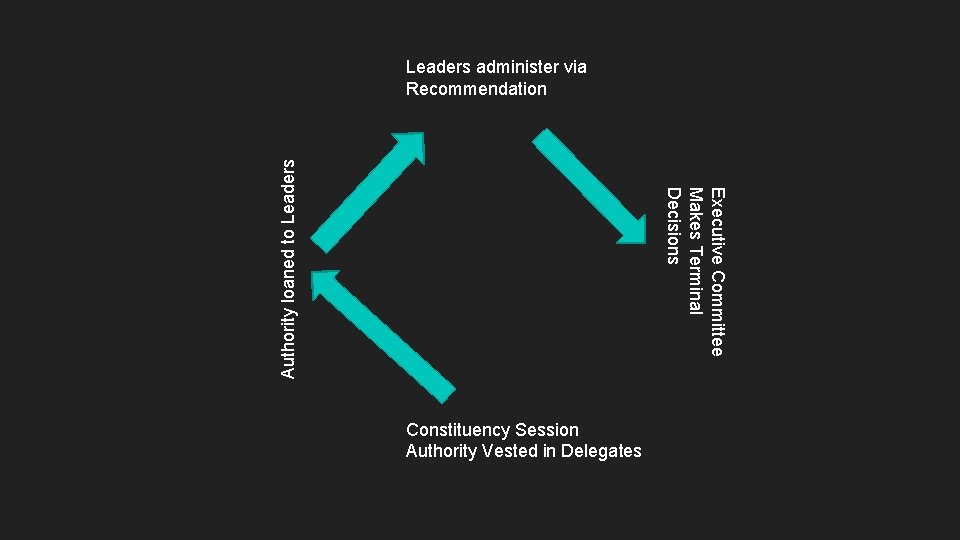
Safeguard: Terminal Authority Terminal authority is the point at which power can legitimately be exercised as decisions 1901 GC Session granted TA to sessions and executive committees Leaders called to analyze and craft recommendations —not decisions
Executive Committee Makes Terminal Decisions Authority loaned to Leaders administer via Recommendation Constituency Session Authority Vested in Delegates
Safeguard: Semi-autonomous structures Organizational structures bonded by relationship—not law Absence of coercive organizational bonds
Threats to 1901 Model Human nature historically reveals consistent move toward the kingly model Expediency drives us toward the power hierarchy model Complexity and size of the organizational challenge Influence of the US presidential model on executive leadership practices The subordination of Secretariat and Treasury- designed as a balance of power The adoption of the VP executive model
Threats to 1901 Model (cont. ) Ignorance of the people regarding their vested authority The ineffectiveness of the Executive Committee as a decision-making body The relational distance of Union, Division and GC leaders from local church Abandonment of the Business Meeting as the terminal point of local church decisions Hierarchy of Order replaced by Hierarchy of Power