Latin Idioms Pages 221 222 Idiom from a

- Slides: 4
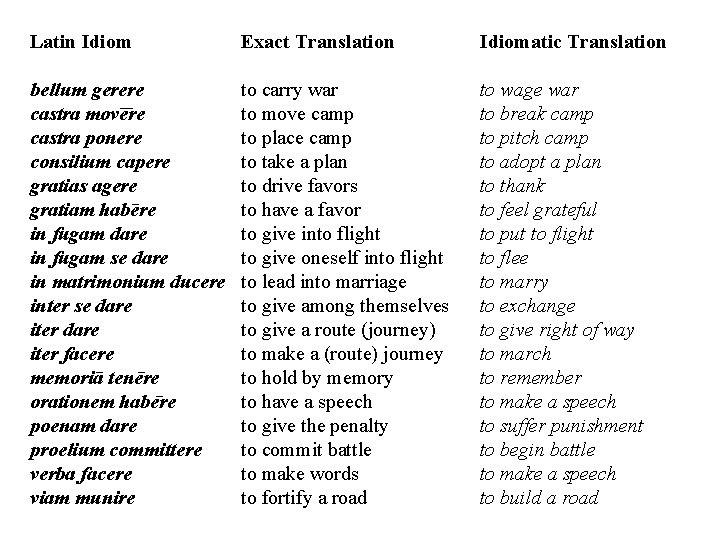
Latin Idioms (Pages 221 – 222) Idiom = ( from a Greek word meaning one’s own, peculiar) An idiom is an expression peculiar to a language. Every language has its own idioms. Good-by, which is a contraction of God be with you, is one of many idioms in English. Important idioms in Latin must be memorized. It is not always desirable to reproduce in English the exact translation of the idiom. The translation should represent the thought of the original rather than the grammatical construction.
Latin Idiom Exact Translation Idiomatic Translation bellum gerere castra movere castra ponere consilium capere gratias agere gratiam habere in fugam dare in fugam se dare in matrimonium ducere inter se dare iter facere memoria tenere orationem habere poenam dare proelium committere verba facere viam munire to carry war to move camp to place camp to take a plan to drive favors to have a favor to give into flight to give oneself into flight to lead into marriage to give among themselves to give a route (journey) to make a (route) journey to hold by memory to have a speech to give the penalty to commit battle to make words to fortify a road to wage war to break camp to pitch camp to adopt a plan to thank to feel grateful to put to flight to flee to marry to exchange to give right of way to march to remember to make a speech to suffer punishment to begin battle to make a speech to build a road
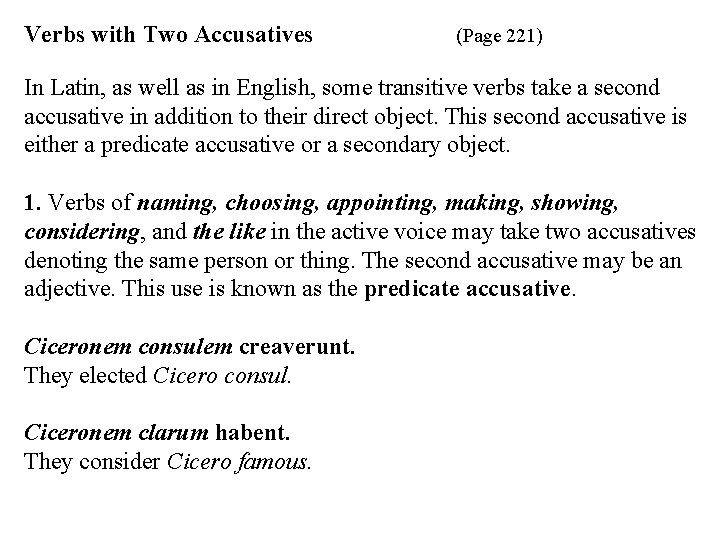
Verbs with Two Accusatives (Page 221) In Latin, as well as in English, some transitive verbs take a second accusative in addition to their direct object. This second accusative is either a predicate accusative or a secondary object. 1. Verbs of naming, choosing, appointing, making, showing, considering, and the like in the active voice may take two accusatives denoting the same person or thing. The second accusative may be an adjective. This use is known as the predicate accusative. Ciceronem consulem creaverunt. They elected Cicero consul. Ciceronem clarum habent. They consider Cicero famous.
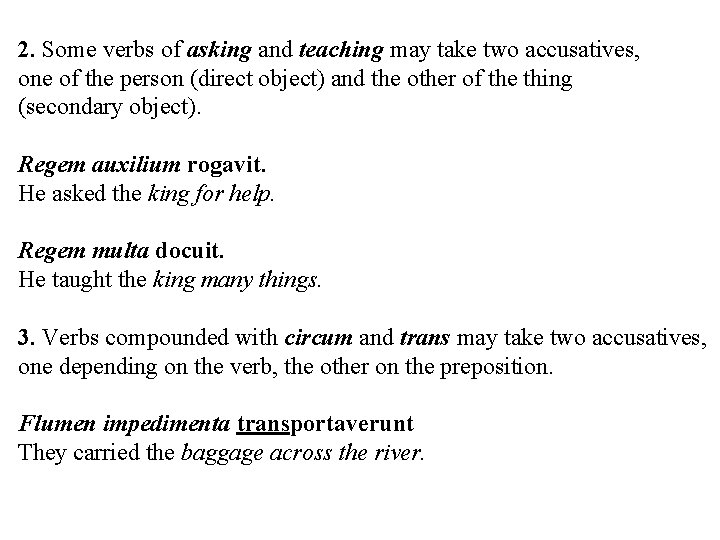
2. Some verbs of asking and teaching may take two accusatives, one of the person (direct object) and the other of the thing (secondary object). Regem auxilium rogavit. He asked the king for help. Regem multa docuit. He taught the king many things. 3. Verbs compounded with circum and trans may take two accusatives, one depending on the verb, the other on the preposition. Flumen impedimenta transportaverunt They carried the baggage across the river.