
Knowledge Organiser Medicine Through Time c 1250 Present
- Slides: 1
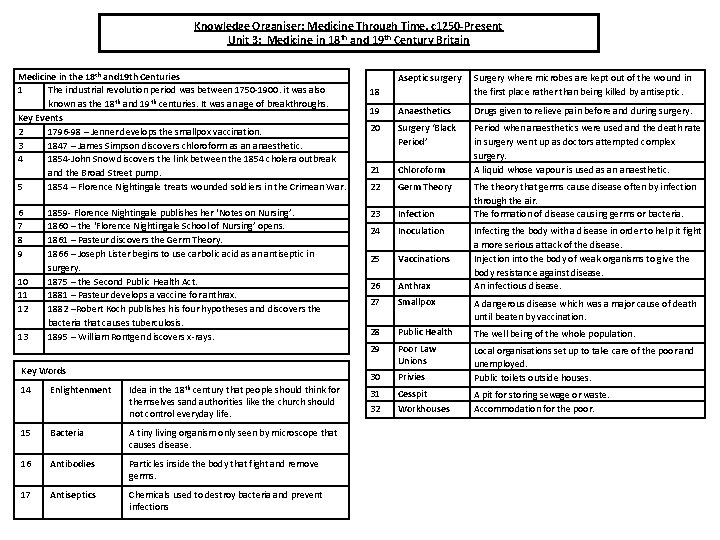
Knowledge Organiser: Medicine Through Time, c 1250 -Present Unit 3: Medicine in 18 th and 19 th Century Britain Medicine in the 18 th and 19 th Centuries 1 The industrial revolution period was between 1750 -1900. it was also known as the 18 th and 19 th centuries. It was an age of breakthroughs. Key Events 2 1796 -98 – Jenner develops the smallpox vaccination. 3 1847 – James Simpson discovers chloroform as an anaesthetic. 4 1854 -John Snow discovers the link between the 1854 cholera outbreak and the Broad Street pump. 5 1854 – Florence Nightingale treats wounded soldiers in the Crimean War. 6 7 8 9 10 11 12 13 1859 - Florence Nightingale publishes her ‘Notes on Nursing’. 1860 – the ‘Florence Nightingale School of Nursing’ opens. 1861 – Pasteur discovers the Germ Theory. 1866 – Joseph Lister begins to use carbolic acid as an antiseptic in surgery. 1875 – the Second Public Health Act. 1881 – Pasteur develops a vaccine for anthrax. 1882 –Robert Koch publishes his four hypotheses and discovers the bacteria that causes tuberculosis. 1895 – William Rontgen discovers x-rays. Key Words 14 Enlightenment 18 th Idea in the century that people should think for themselves sand authorities like the church should not control everyday life. 15 Bacteria A tiny living organism only seen by microscope that causes disease. 16 Antibodies Particles inside the body that fight and remove germs. 17 Antiseptics Chemicals used to destroy bacteria and prevent infections Aseptic surgery Surgery where microbes are kept out of the wound in the first place rather than being killed by antiseptic. 19 Anaesthetics Drugs given to relieve pain before and during surgery. 20 Surgery ‘Black Period’ 21 Chloroform Period when anaesthetics were used and the death rate in surgery went up as doctors attempted complex surgery. A liquid whose vapour is used as an anaesthetic. 22 Germ Theory 23 Infection 24 Inoculation 25 Vaccinations 26 Anthrax 27 Smallpox A dangerous disease which was a major cause of death until beaten by vaccination. 28 Public Health The well being of the whole population. 29 Poor Law Unions 30 Privies Local organisations set up to take care of the poor and unemployed. Public toilets outside houses. 31 Cesspit 32 Workhouses 18 The theory that germs cause disease often by infection through the air. The formation of disease causing germs or bacteria. Infecting the body with a disease in order to help it fight a more serious attack of the disease. Injection into the body of weak organisms to give the body resistance against disease. An infectious disease. A pit for storing sewage or waste. Accommodation for the poor.

