Keplers Three Laws Honors Physics In the early

- Slides: 5
Kepler’s Three Laws Honors Physics
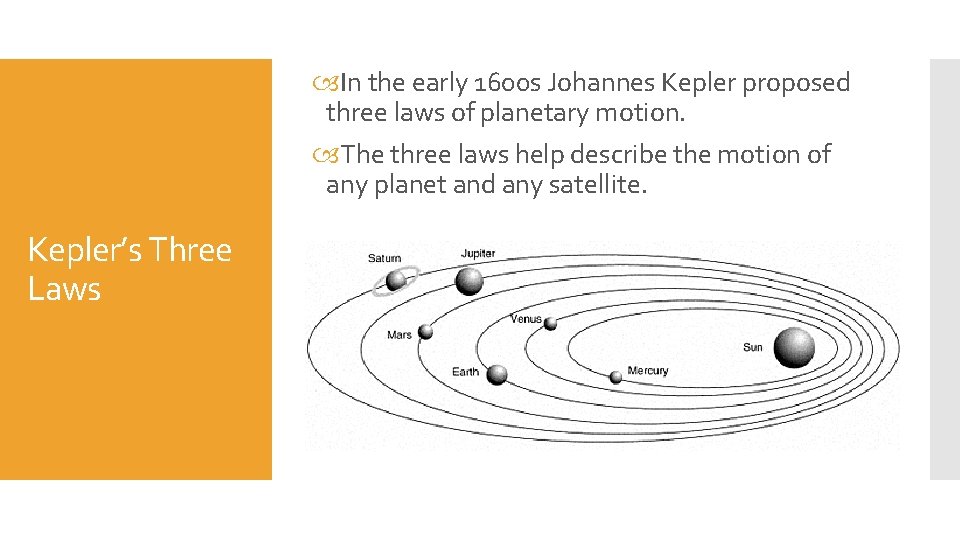
In the early 1600 s Johannes Kepler proposed three laws of planetary motion. The three laws help describe the motion of any planet and any satellite. Kepler’s Three Laws
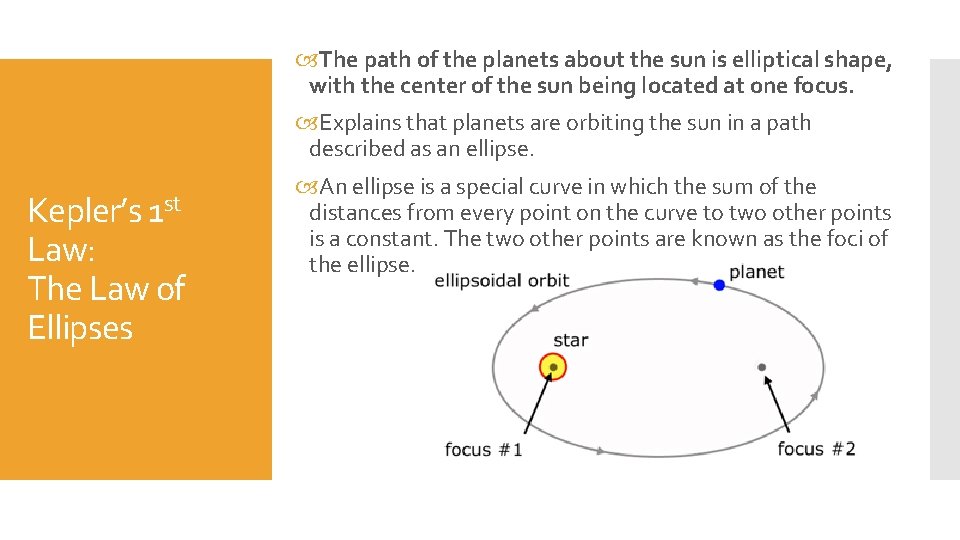
The path of the planets about the sun is elliptical shape, with the center of the sun being located at one focus. Explains that planets are orbiting the sun in a path described as an ellipse. Kepler’s 1 st Law: The Law of Ellipses An ellipse is a special curve in which the sum of the distances from every point on the curve to two other points is a constant. The two other points are known as the foci of the ellipse.
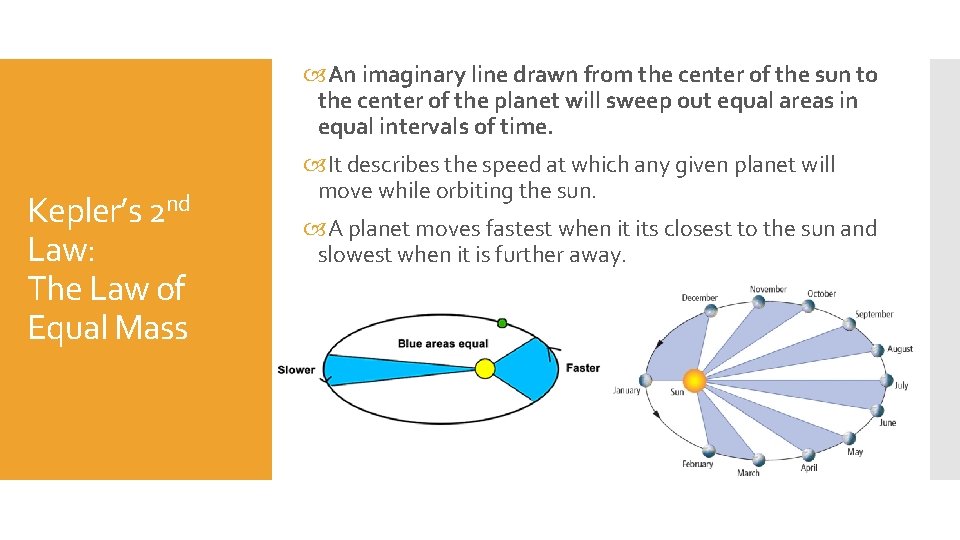
An imaginary line drawn from the center of the sun to the center of the planet will sweep out equal areas in equal intervals of time. Kepler’s 2 nd Law: The Law of Equal Mass It describes the speed at which any given planet will move while orbiting the sun. A planet moves fastest when it its closest to the sun and slowest when it is further away.
Kepler’s 3 rd Law: The Law of Harmonies The ratio of the squares of the periods of any two planets is equal to the ratios of the cubes of their average distances from the sun. Compares the orbital period and radius of orbit of a planet to those of other planets. The comparison is that the ratio of the periods squared and radius cube is the same for every planet.