JOHN DONNE POETRY ANALYSIS Celina Medina Stephanie Perez



- Slides: 11
JOHN DONNE POETRY ANALYSIS Celina Medina Stephanie Perez Nathalie Toro
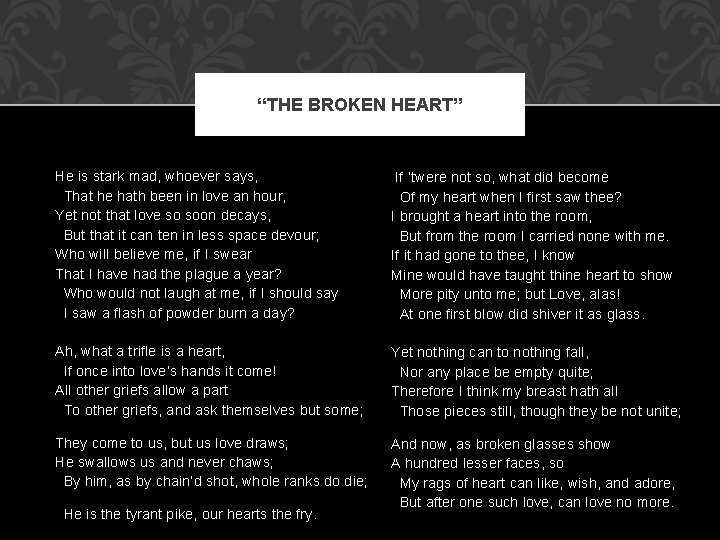
“THE BROKEN HEART” He is stark mad, whoever says, That he hath been in love an hour, Yet not that love so soon decays, But that it can ten in less space devour; Who will believe me, if I swear That I have had the plague a year? Who would not laugh at me, if I should say I saw a flash of powder burn a day? If ’twere not so, what did become Of my heart when I first saw thee? I brought a heart into the room, But from the room I carried none with me. If it had gone to thee, I know Mine would have taught thine heart to show More pity unto me; but Love, alas! At one first blow did shiver it as glass. Ah, what a trifle is a heart, If once into love’s hands it come! All other griefs allow a part To other griefs, and ask themselves but some; Yet nothing can to nothing fall, Nor any place be empty quite; Therefore I think my breast hath all Those pieces still, though they be not unite; They come to us, but us love draws; He swallows us and never chaws; By him, as by chain’d shot, whole ranks do die; And now, as broken glasses show A hundred lesser faces, so My rags of heart can like, wish, and adore, But after one such love, can love no more. He is the tyrant pike, our hearts the fry.
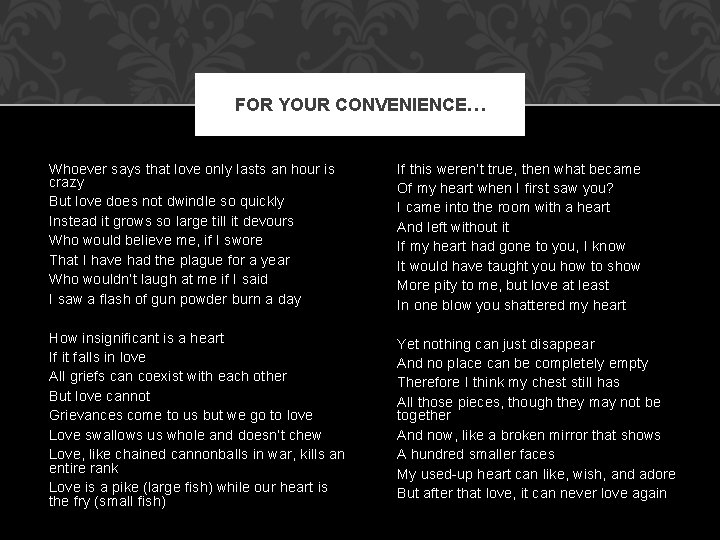
FOR YOUR CONVENIENCE… Whoever says that love only lasts an hour is crazy But love does not dwindle so quickly Instead it grows so large till it devours Who would believe me, if I swore That I have had the plague for a year Who wouldn’t laugh at me if I said I saw a flash of gun powder burn a day If this weren’t true, then what became Of my heart when I first saw you? I came into the room with a heart And left without it If my heart had gone to you, I know It would have taught you how to show More pity to me, but love at least In one blow you shattered my heart How insignificant is a heart If it falls in love All griefs can coexist with each other But love cannot Grievances come to us but we go to love Love swallows us whole and doesn’t chew Love, like chained cannonballs in war, kills an entire rank Love is a pike (large fish) while our heart is the fry (small fish) Yet nothing can just disappear And no place can be completely empty Therefore I think my chest still has All those pieces, though they may not be together And now, like a broken mirror that shows A hundred smaller faces My used-up heart can like, wish, and adore But after that love, it can never love again
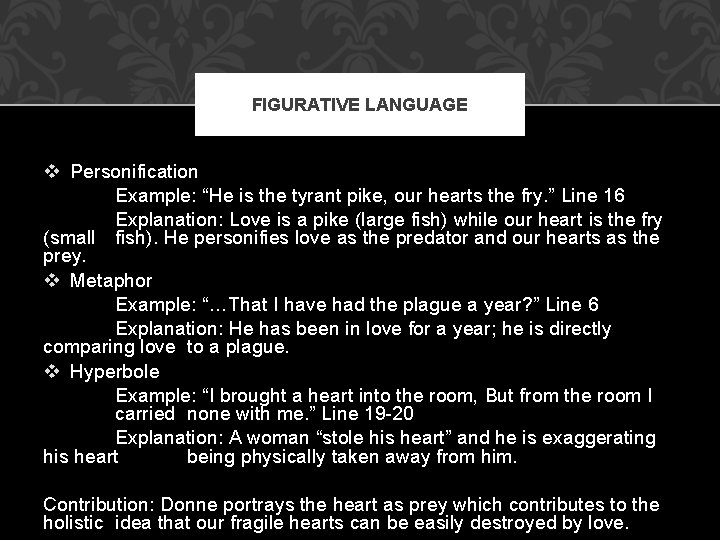
FIGURATIVE LANGUAGE v Personification Example: “He is the tyrant pike, our hearts the fry. ” Line 16 Explanation: Love is a pike (large fish) while our heart is the fry (small fish). He personifies love as the predator and our hearts as the prey. v Metaphor Example: “…That I have had the plague a year? ” Line 6 Explanation: He has been in love for a year; he is directly comparing love to a plague. v Hyperbole Example: “I brought a heart into the room, But from the room I carried none with me. ” Line 19 -20 Explanation: A woman “stole his heart” and he is exaggerating his heart being physically taken away from him. Contribution: Donne portrays the heart as prey which contributes to the holistic idea that our fragile hearts can be easily destroyed by love.
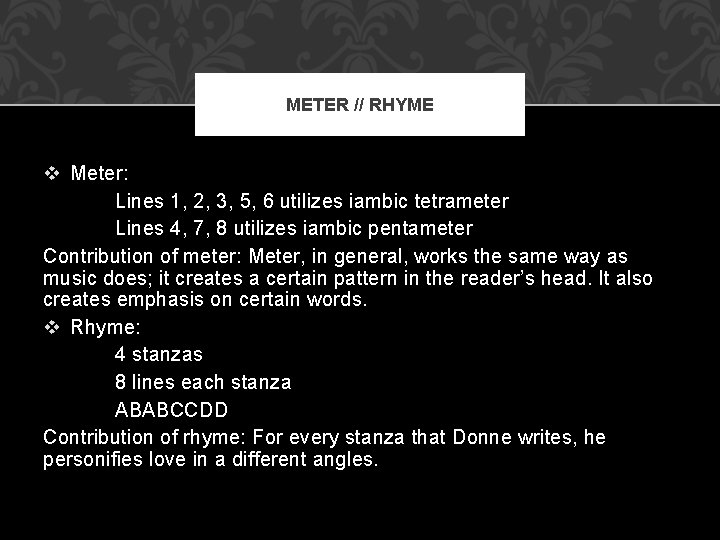
METER // RHYME v Meter: Lines 1, 2, 3, 5, 6 utilizes iambic tetrameter Lines 4, 7, 8 utilizes iambic pentameter Contribution of meter: Meter, in general, works the same way as music does; it creates a certain pattern in the reader’s head. It also creates emphasis on certain words. v Rhyme: 4 stanzas 8 lines each stanza ABABCCDD Contribution of rhyme: For every stanza that Donne writes, he personifies love in a different angles.
THEME AND SUMMARY STATEMENTS v Theme Statement: “ My rags of heart can like, wish, and adore, but after one such love, can love no more. ” v Summary Statement: Donne’s idea of love strays from the usual, he views it as a deadly disease that devours its victim: the heart. Because of the violent nature of love, once it destroys you, you can never love the same way again.
“DEATH, BE NOT PROUD” Death, be not proud, though some have called thee Mighty and dreadful, for thou art not so; For those whom thou think'st thou dost overthrow Die not, poor death, nor yet canst thou kill me. From rest and sleep, which but thy pictures be, Much pleasure; then from thee much more must flow, And soonest our best men with thee do go Rest of their bones, and soul’s delivery. Thou art slave to Fate, Chance, kings, and desperate men, And dost with poison, war, and sickness dwell, And poppy, or charms can make us sleep as well, And better than thy stroke; why swell'st thou then? One short sleep past, we wake eternally And death shall be no more; Death, thou shalt die.
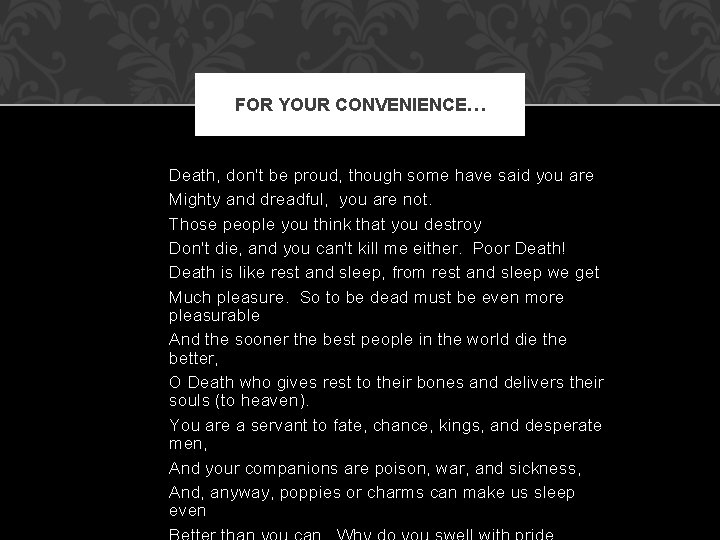
FOR YOUR CONVENIENCE… Death, don't be proud, though some have said you are Mighty and dreadful, you are not. Those people you think that you destroy Don't die, and you can't kill me either. Poor Death! Death is like rest and sleep, from rest and sleep we get Much pleasure. So to be dead must be even more pleasurable And the sooner the best people in the world die the better, O Death who gives rest to their bones and delivers their souls (to heaven). You are a servant to fate, chance, kings, and desperate men, And your companions are poison, war, and sickness, And, anyway, poppies or charms can make us sleep even
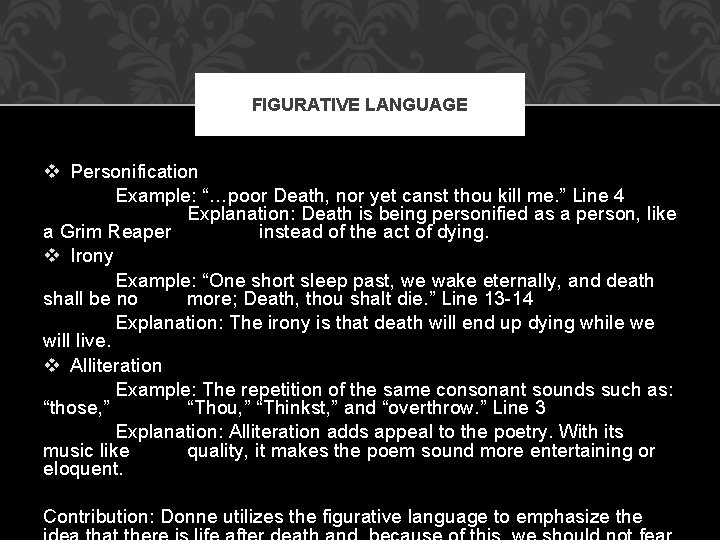
FIGURATIVE LANGUAGE v Personification Example: “…poor Death, nor yet canst thou kill me. ” Line 4 Explanation: Death is being personified as a person, like a Grim Reaper instead of the act of dying. v Irony Example: “One short sleep past, we wake eternally, and death shall be no more; Death, thou shalt die. ” Line 13 -14 Explanation: The irony is that death will end up dying while we will live. v Alliteration Example: The repetition of the same consonant sounds such as: “those, ” “Thou, ” “Thinkst, ” and “overthrow. ” Line 3 Explanation: Alliteration adds appeal to the poetry. With its music like quality, it makes the poem sound more entertaining or eloquent. Contribution: Donne utilizes the figurative language to emphasize the
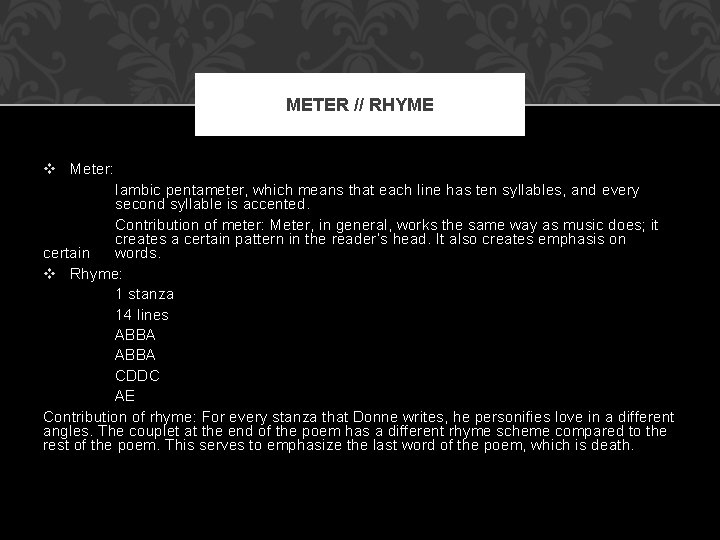
METER // RHYME v Meter: Iambic pentameter, which means that each line has ten syllables, and every second syllable is accented. Contribution of meter: Meter, in general, works the same way as music does; it creates a certain pattern in the reader’s head. It also creates emphasis on certain words. v Rhyme: 1 stanza 14 lines ABBA CDDC AE Contribution of rhyme: For every stanza that Donne writes, he personifies love in a different angles. The couplet at the end of the poem has a different rhyme scheme compared to the rest of the poem. This serves to emphasize the last word of the poem, which is death.
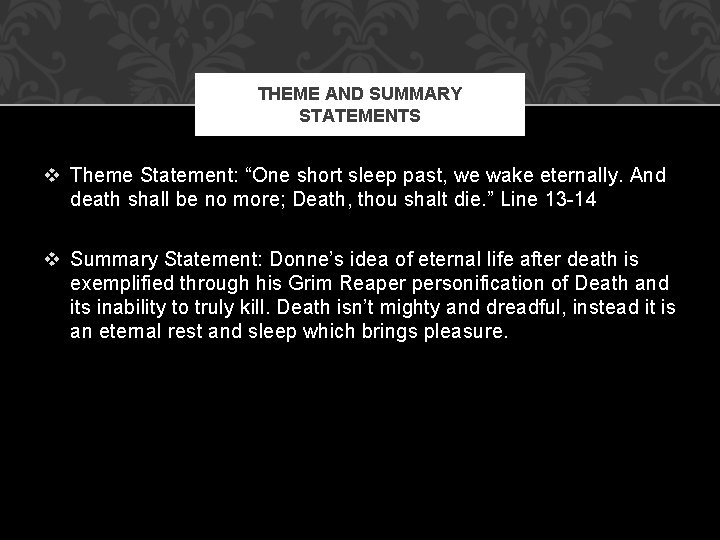
THEME AND SUMMARY STATEMENTS v Theme Statement: “One short sleep past, we wake eternally. And death shall be no more; Death, thou shalt die. ” Line 13 -14 v Summary Statement: Donne’s idea of eternal life after death is exemplified through his Grim Reaper personification of Death and its inability to truly kill. Death isn’t mighty and dreadful, instead it is an eternal rest and sleep which brings pleasure.