Java Modeling Language JML EECE 310 Software Engineering




- Slides: 15
Java Modeling Language (JML) EECE 310: Software Engineering (NOT Tested for Midterm/Final exams)
Learning Objectives • Identify uses and syntax of JML • Write specifications of simple methods in JML
Java Modeling Language (JML) • JML is a behavioral interface specification language • JML is a specification language that allows specification of the behavior of an API – not just its syntax, but its semantics • JML specifications are written as annotations – As far as Java compiler is concerned they are comments but a JML compiler can interpret them
JML • Goal: Make writing specifications easily understandable and usable by Java programmers, – so it stays close to the Java syntax and semantics • JML supports design by contract style specifications with – Pre-conditions – Post-conditions – (Class) invariants
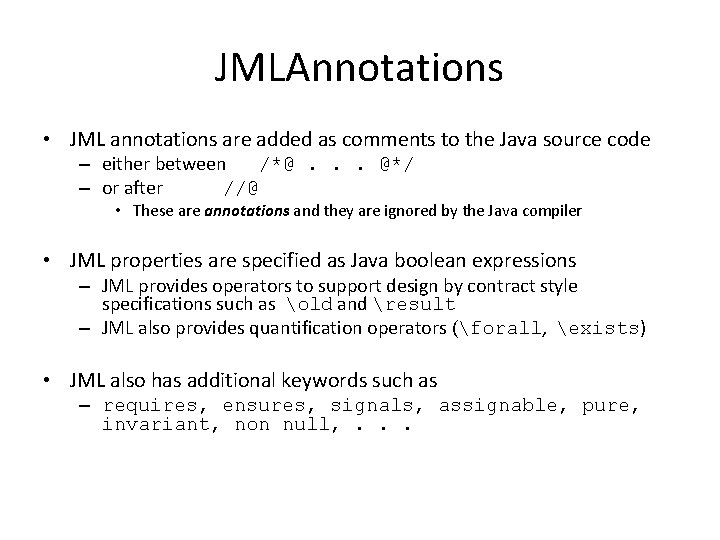
JMLAnnotations • JML annotations are added as comments to the Java source code – either between /*@. . . @*/ – or after //@ • These are annotations and they are ignored by the Java compiler • JML properties are specified as Java boolean expressions – JML provides operators to support design by contract style specifications such as old and result – JML also provides quantification operators (forall, exists) • JML also has additional keywords such as – requires, ensures, signals, assignable, pure, invariant, non null, . . .
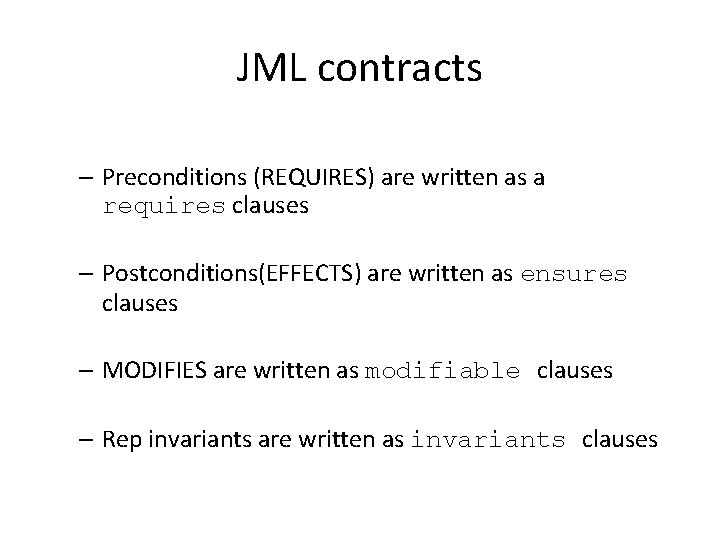
JML contracts – Preconditions (REQUIRES) are written as a requires clauses – Postconditions(EFFECTS) are written as ensures clauses – MODIFIES are written as modifiable clauses – Rep invariants are written as invariants clauses
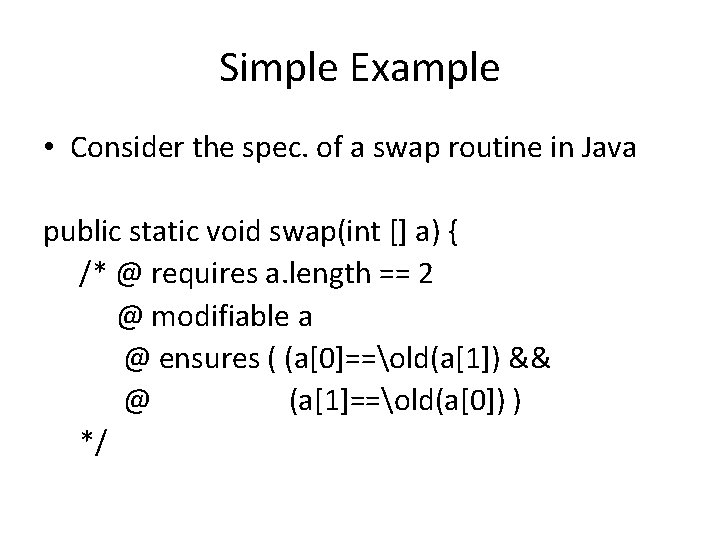
Simple Example • Consider the spec. of a swap routine in Java public static void swap(int [] a) { /* @ requires a. length == 2 @ modifiable a @ ensures ( (a[0]==old(a[1]) && @ (a[1]==old(a[0]) ) */
Simple Example: Exception • Consider the spec. of a swap routine in Java • But assume that it throws an exception when given an array of length != 2. public static void swap(int [] a) { /* @ modifiable a @ ensures ( (a[0]==old(a[1]) && @ (a[1]==old(a[0]) ) @ signals Null. Ptr. Exception (a == NULL) @ signals Length. Exception (a. length != 2) */
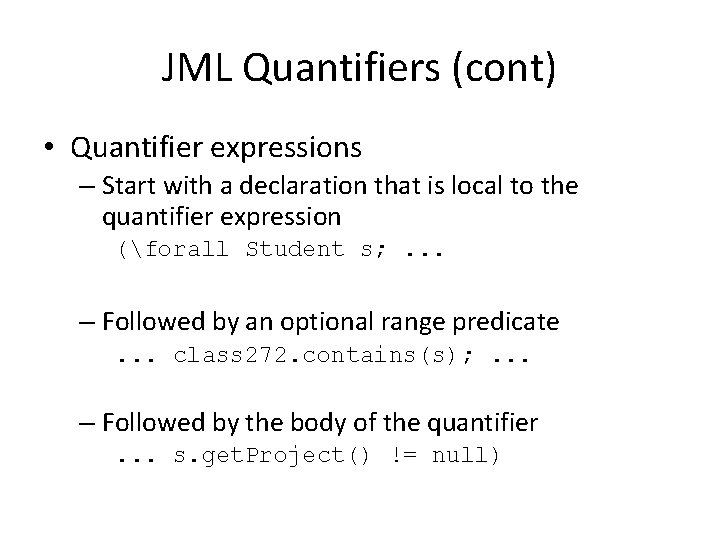
JML Quantifiers • JML supports several forms of quantifiers – Universal and existential (forall and exists) – General quantifiers (sum, product, min, max) – Numeric quantifier (num_of) (forall Student s; class 272. contains(s); s. get. Project() != null) (forall Student s; class 272. contains(s) ==> s. get. Project() != null) • Without quantifiers, we would need to write loops to specify these types of constraints
JML Quantifiers (cont) • Quantifier expressions – Start with a declaration that is local to the quantifier expression (forall Student s; . . . – Followed by an optional range predicate. . . class 272. contains(s); . . . – Followed by the body of the quantifier. . . s. get. Project() != null)
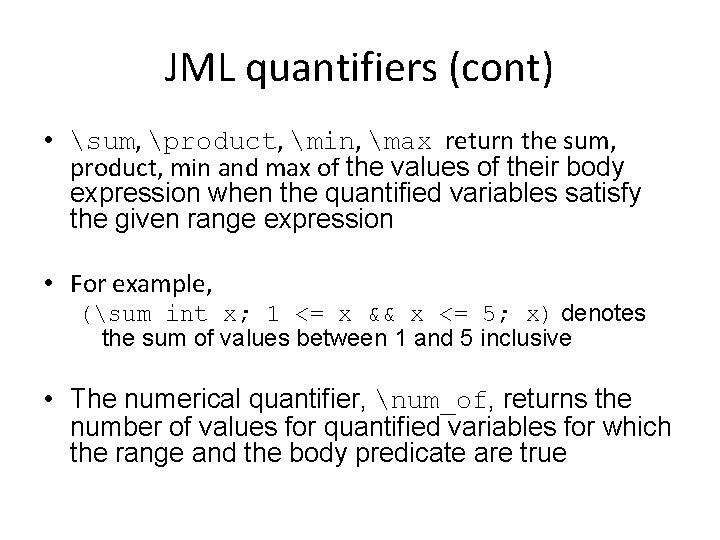
JML quantifiers (cont) • sum, product, min, max return the sum, product, min and max of the values of their body expression when the quantified variables satisfy the given range expression • For example, (sum int x; 1 <= x && x <= 5; x) denotes the sum of values between 1 and 5 inclusive • The numerical quantifier, num_of, returns the number of values for quantified variables for which the range and the body predicate are true
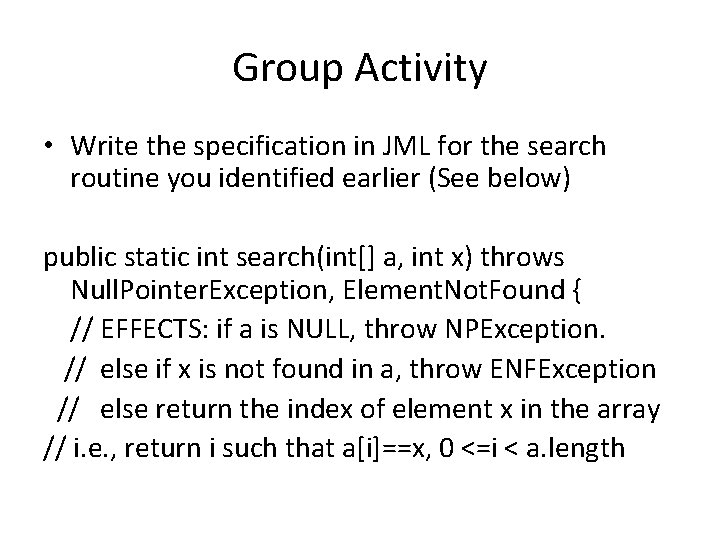
Group Activity • Write the specification in JML for the search routine you identified earlier (See below) public static int search(int[] a, int x) throws Null. Pointer. Exception, Element. Not. Found { // EFFECTS: if a is NULL, throw NPException. // else if x is not found in a, throw ENFException // else return the index of element x in the array // i. e. , return i such that a[i]==x, 0 <=i < a. length
JML Libraries • JML has an extensive library that supports concepts such as sets, sequences, and relations. • These can be used in JML assertions directly without needing to re-specify these mathematical concepts
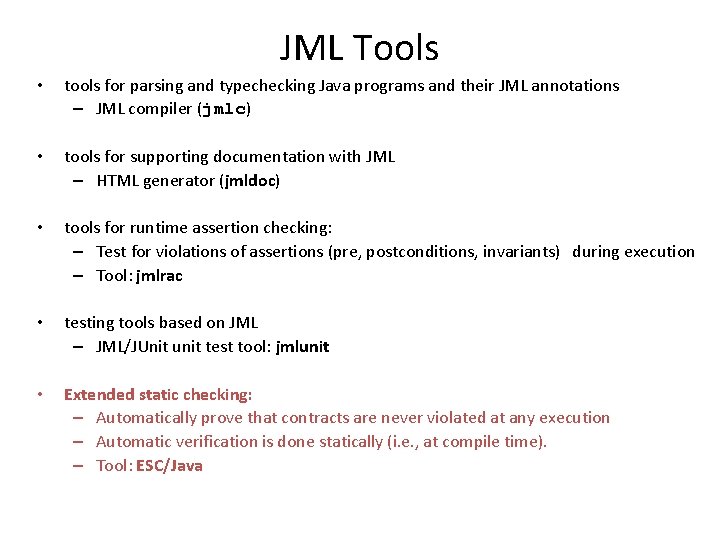
JML Tools • tools for parsing and typechecking Java programs and their JML annotations – JML compiler (jmlc) • tools for supporting documentation with JML – HTML generator (jmldoc) • tools for runtime assertion checking: – Test for violations of assertions (pre, postconditions, invariants) during execution – Tool: jmlrac • testing tools based on JML – JML/JUnit unit test tool: jmlunit • Extended static checking: – Automatically prove that contracts are never violated at any execution – Automatic verification is done statically (i. e. , at compile time). – Tool: ESC/Java
Summary • JML is a formal mathematical languages for writing specifications in Java – Can use most Java features such as objects, fields – Loops and side-effects not allowed however – Use quantifiers (forall, exists) in place of loops • You will NOT need to use JML for the exams. But, you will need it for the assignments.