January 2018 doc IEEE 115 18 0021 00
- Slides: 8
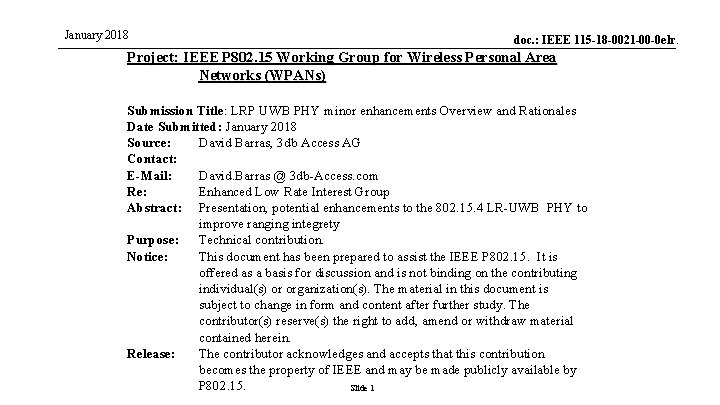
January 2018 doc. : IEEE 115 -18 -0021 -00 -0 elr. Project: IEEE P 802. 15 Working Group for Wireless Personal Area Networks (WPANs) Submission Title: LRP UWB PHY minor enhancements Overview and Rationales Date Submitted: January 2018 Source: David Barras, 3 db Access AG Contact: E-Mail: David. Barras @ 3 db-Access. com Re: Enhanced Low Rate Interest Group Abstract: Presentation, potential enhancements to the 802. 15. 4 LR-UWB PHY to improve ranging integrety Purpose: Technical contribution. Notice: This document has been prepared to assist the IEEE P 802. 15. It is offered as a basis for discussion and is not binding on the contributing individual(s) or organization(s). The material in this document is subject to change in form and content after further study. The contributor(s) reserve(s) the right to add, amend or withdraw material contained herein. Release: The contributor acknowledges and accepts that this contribution becomes the property of IEEE and may be made publicly available by P 802. 15. Slide 1
January 2018 doc. : IEEE 115 -18 -0021 -00 -0 elr. LRP UWB PHY minor enhancements Overview and Rationales David Barras – 3 db Access AG
January 2018 doc. : IEEE 115 -18 -0021 -00 -0 elr. Motivations • Enable a new class of devices that will be used for secure access based on ranging • These new devices shall features ultra-low power consumption: – typical markets: automotive, house+building access, payment, automatic logging, … – small devices such as keys, tags, wristwatches, … with long battery life. • Ensure interoperability for a secure access function between manufacturers – to trigger interest of “big” players
January 2018 doc. : IEEE 115 -18 -0021 -00 -0 elr. Why LRP UWB PHY ? • This standard has been identified as the closest to enable – “secure access” : 1 pulse per bit – “ultra-low power” : coherent and/or non-coherent, OOK-based implementation • Acceptance of the technology – – Low cost of ownership (e. g. , small size) Low power Low complexity Provably secure
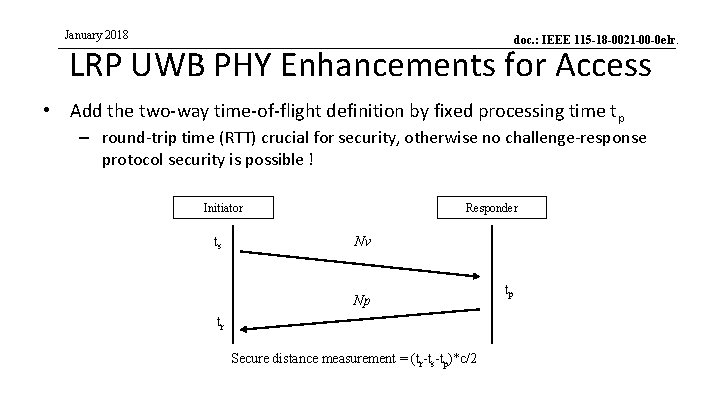
January 2018 doc. : IEEE 115 -18 -0021 -00 -0 elr. LRP UWB PHY Enhancements for Access • Add the two-way time-of-flight definition by fixed processing time tp – round-trip time (RTT) crucial for security, otherwise no challenge-response protocol security is possible ! Initiator ts Responder Nv Np tr Secure distance measurement = (tr-ts-tp)*c/2 tp
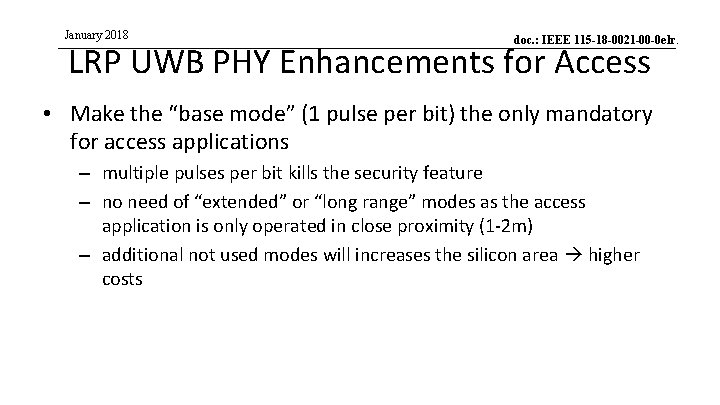
January 2018 doc. : IEEE 115 -18 -0021 -00 -0 elr. LRP UWB PHY Enhancements for Access • Make the “base mode” (1 pulse per bit) the only mandatory for access applications – multiple pulses per bit kills the security feature – no need of “extended” or “long range” modes as the access application is only operated in close proximity (1 -2 m) – additional not used modes will increases the silicon area higher costs
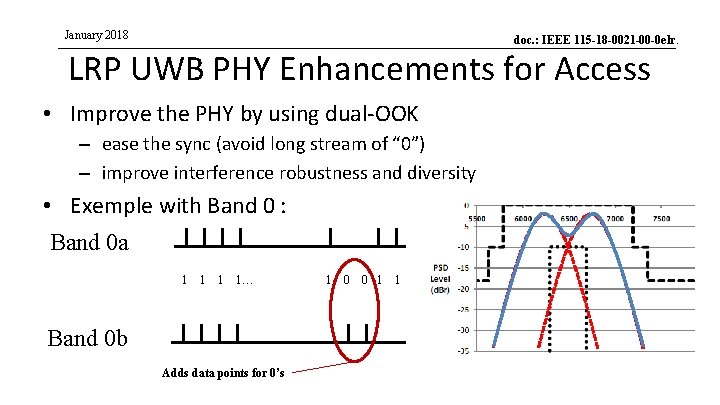
January 2018 doc. : IEEE 115 -18 -0021 -00 -0 elr. LRP UWB PHY Enhancements for Access • Improve the PHY by using dual-OOK – ease the sync (avoid long stream of “ 0”) – improve interference robustness and diversity • Exemple with Band 0 : Band 0 a 1 1… Band 0 b Adds data points for 0’s 1 0 0 1 1
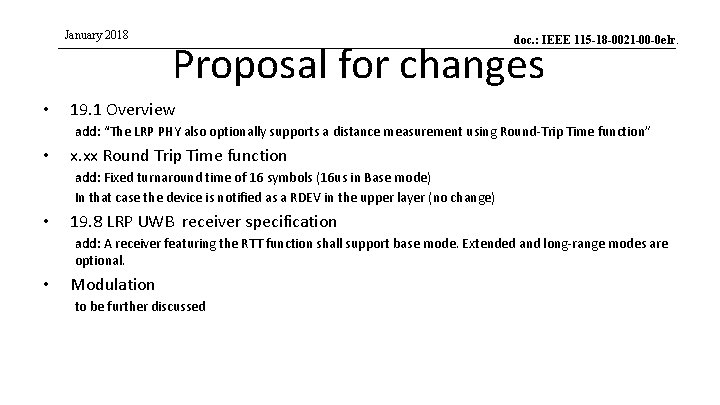
January 2018 • doc. : IEEE 115 -18 -0021 -00 -0 elr. Proposal for changes 19. 1 Overview add: “The LRP PHY also optionally supports a distance measurement using Round-Trip Time function” • x. xx Round Trip Time function add: Fixed turnaround time of 16 symbols (16 us in Base mode) In that case the device is notified as a RDEV in the upper layer (no change) • 19. 8 LRP UWB receiver specification add: A receiver featuring the RTT function shall support base mode. Extended and long-range modes are optional. • Modulation to be further discussed