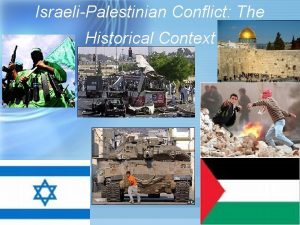
IsraeliPalestinian Conflict The Historical Context Our Focus Question
- Slides: 29
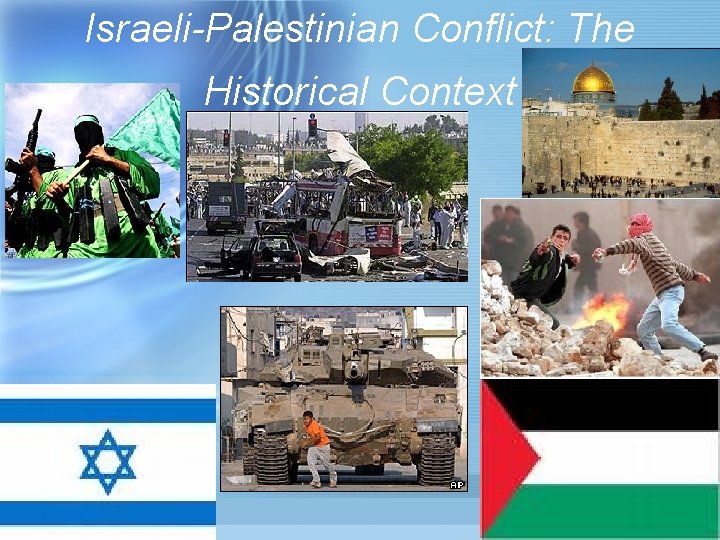
Israeli-Palestinian Conflict: The Historical Context
Our Focus Question Who has a better claim to the land?
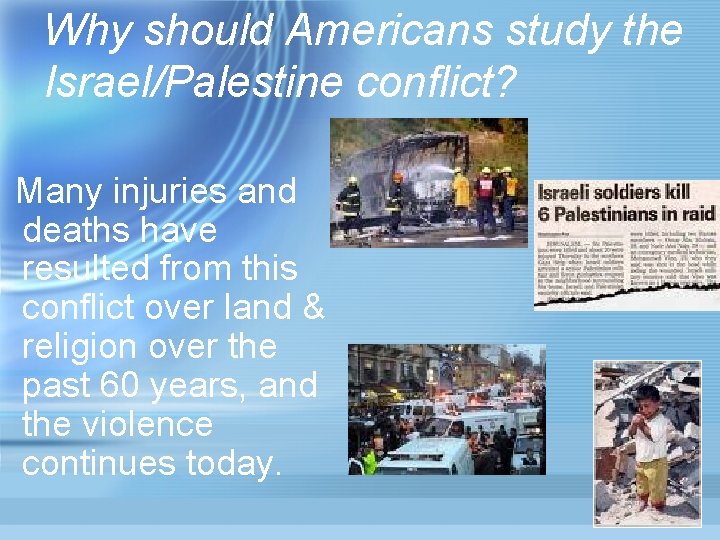
Why should Americans study the Israel/Palestine conflict? Many injuries and deaths have resulted from this conflict over land & religion over the past 60 years, and the violence continues today.
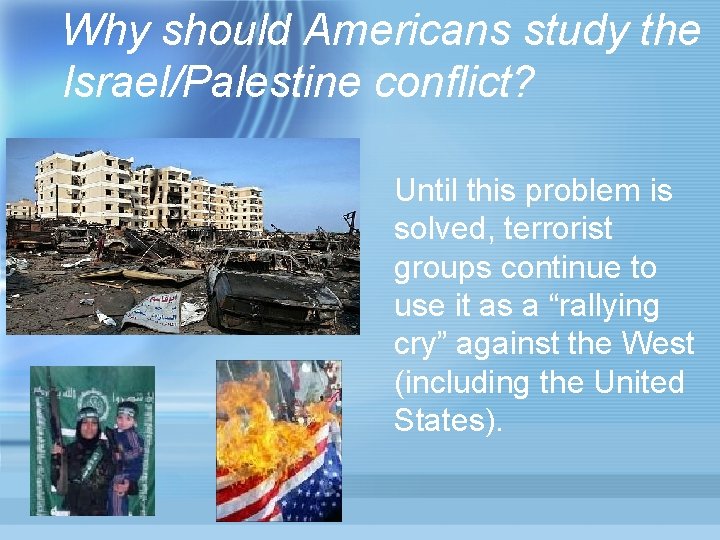
Why should Americans study the Israel/Palestine conflict? Until this problem is solved, terrorist groups continue to use it as a “rallying cry” against the West (including the United States).
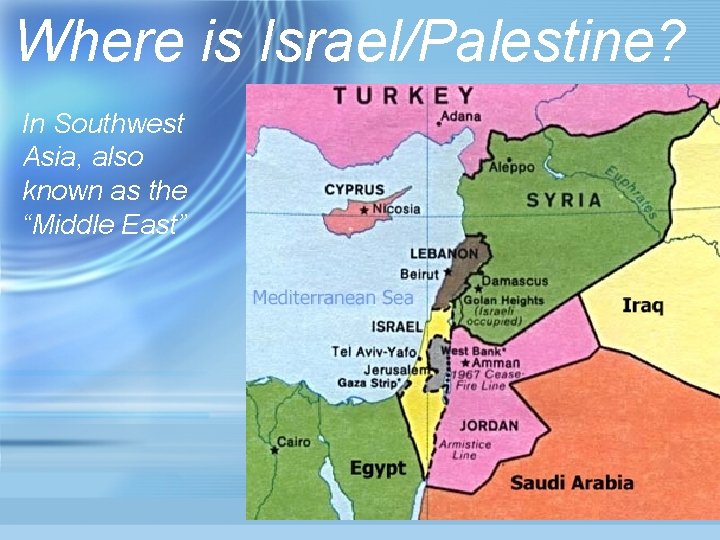
Where is Israel/Palestine? In Southwest Asia, also known as the “Middle East”
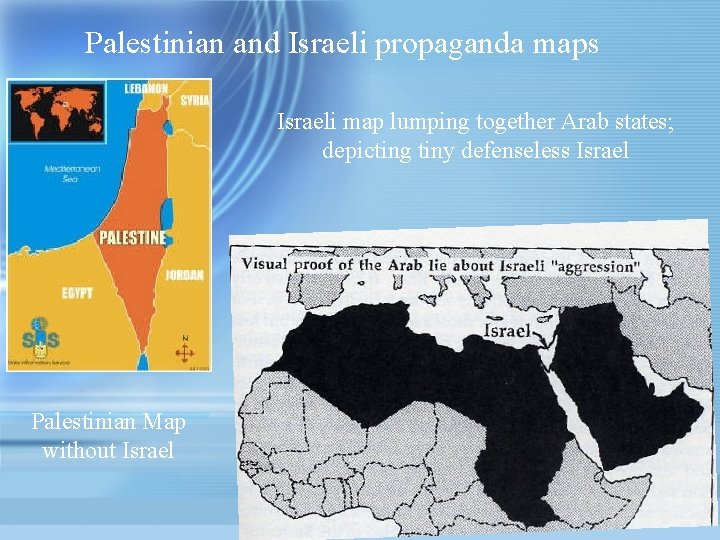
Palestinian and Israeli propaganda maps Israeli map lumping together Arab states; depicting tiny defenseless Israel Palestinian Map without Israel
Israelis Palestinians Israel (West Bank and Gaza Strip) Israelis are multiethnic European, Middle Eastern, Newer Russian, Ethiopian immigrants Arab (ethnic) territoriality Arab Israeli minority Ethnic nationalist movement Palestinians are multi-religious Muslims and Christians
Why is this land the center of controversy? • There are currently two national groups who claim “rightful ownership” of this territory (Israelis and Palestinians) Most Israelis are Jews – Most Palestinians are Muslims
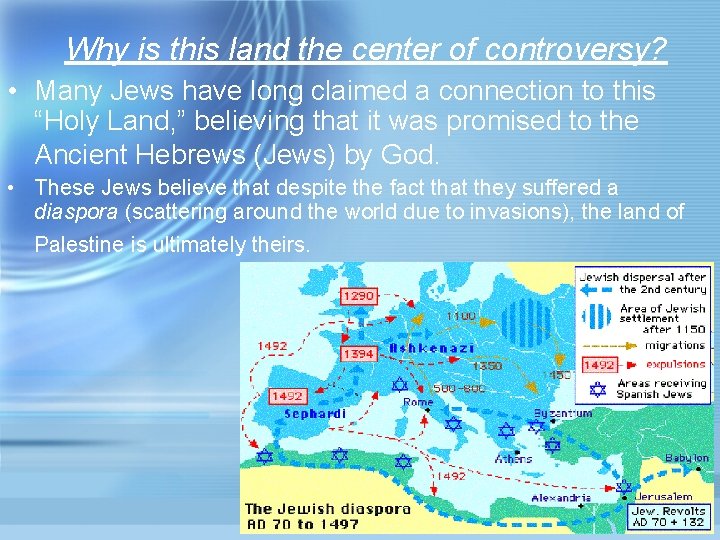
Why is this land the center of controversy? • Many Jews have long claimed a connection to this “Holy Land, ” believing that it was promised to the Ancient Hebrews (Jews) by God. • These Jews believe that despite the fact that they suffered a diaspora (scattering around the world due to invasions), the land of Palestine is ultimately theirs.
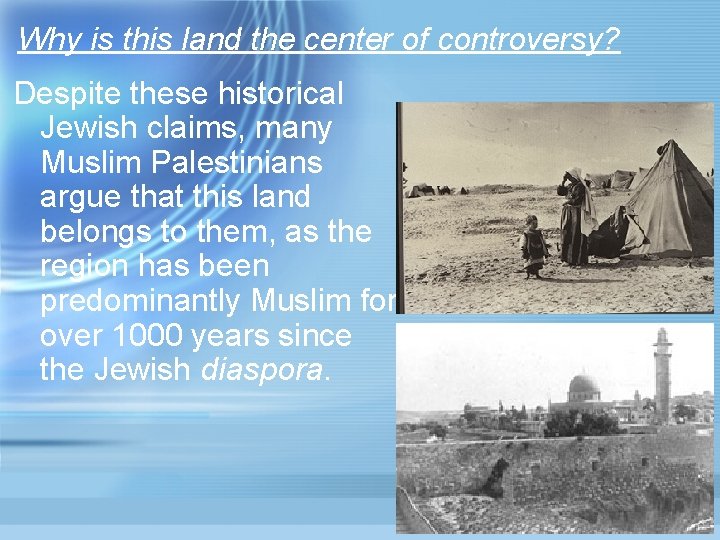
Why is this land the center of controversy? Despite these historical Jewish claims, many Muslim Palestinians argue that this land belongs to them, as the region has been predominantly Muslim for over 1000 years since the Jewish diaspora.
Why did Jews expect that they would receive a homeland? • The Balfour Declaration (1917) – Statement by the British government that advocated for the creation of Israel – "His Majesty's Government view with favour the establishment in Palestine of a national home for the Jewish people, and will use their best endeavours to facilitate the achievement of this object…”
Why did Jews feel that they needed a homeland? • Anti-Semitism extremely common in virtually all Jewish diaspora destinations – Anti-Jewish violence and discrimination have occurred throughout world history • 70 C. E. --Roman Empire destroys Jerusalem temple • 1348 C. E. --900 Jews burned to death as suspects in causing/spreading the Bubonic Plague in Strasbourg • 1543 C. E. --Martin Luther writes On the Jews and Their Lies, a fiercely Anti-Semitic work
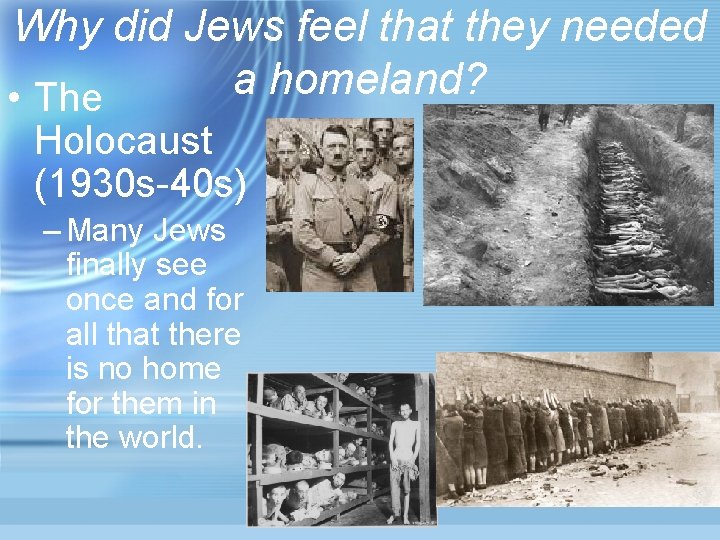
Why did Jews feel that they needed a homeland? • The Holocaust (1930 s-40 s) – Many Jews finally see once and for all that there is no home for them in the world.
In response to these historical connections and events, the United Nations decides to create a Jewish homeland.
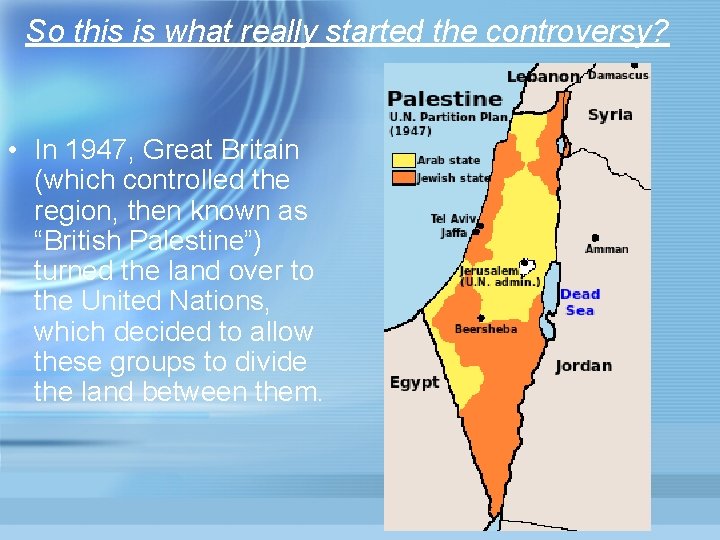
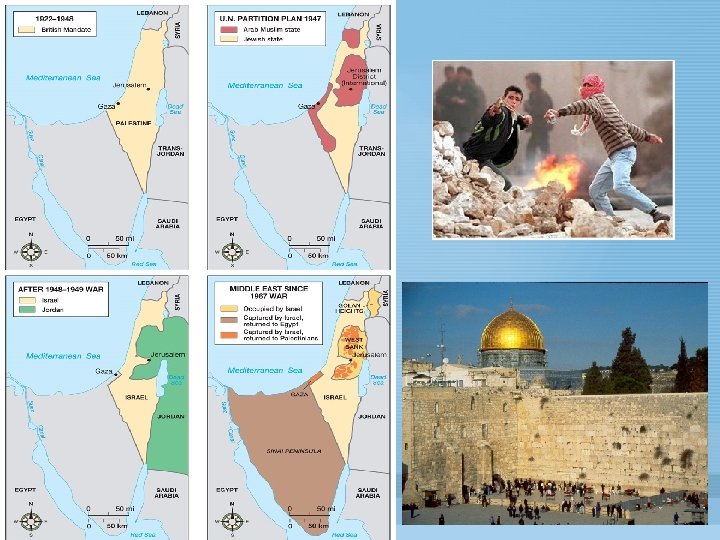
So this is what really started the controversy? • In 1947, Great Britain (which controlled the region, then known as “British Palestine”) turned the land over to the United Nations, which decided to allow these groups to divide the land between them.
Why did the UN decide to “partition” this land in 1947? • A movement called “Zionism” became active in Europe in the late 1800 s. – Zionism--the desire to create a Jewish homeland called Israel in “British Palestine”
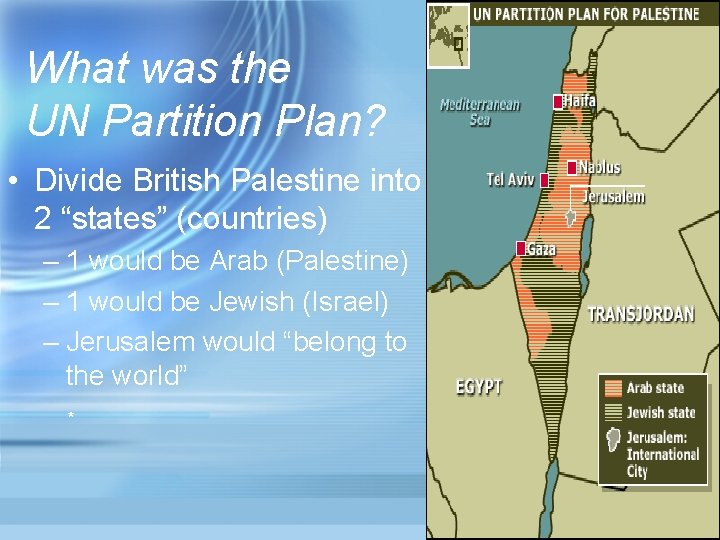
What was the UN Partition Plan? • Divide British Palestine into 2 “states” (countries) – 1 would be Arab (Palestine) – 1 would be Jewish (Israel) – Jerusalem would “belong to the world” *
What were the immediate effects of the Partition of 1947? Israel declares independence as a new country in 1948 & is immediately attacked by its Arab neighbors. Palestinians do not recognize Israel, and therefore do not declare an Arab country called “Palestine”
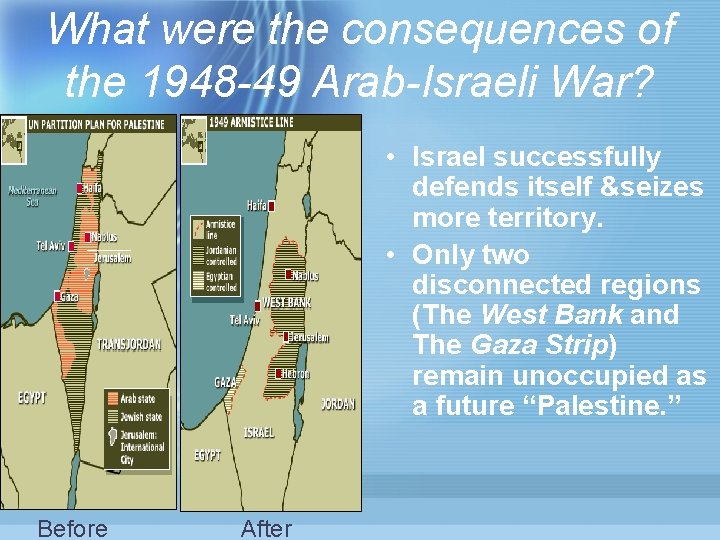
What were the consequences of the 1948 -49 Arab-Israeli War? • Israel successfully defends itself &seizes more territory. • Only two disconnected regions (The West Bank and The Gaza Strip) remain unoccupied as a future “Palestine. ” Before After
What were the long-term consequences of the 1948 -49 Arab. Israeli War? • Palestinian refugees lose homes and land. • Palestinian extremists become furious at Israeli occupation of what was supposed to be the Arab country of “Palestine. ” • Israelis know that they must defend themselves with military force--they will NOT wait to be attacked again. • Israel asserts its claims over the city of Jerusalem. • Israeli extremists are easily able to use the war as evidence for the “rightness” of the Israeli cause.
What were the long-term consequences of the 1948 -49 Arab -Israeli War? • 1967, Israel’s Arab neighbors plan to annihilate the Jewish state, but Israel strikes 1 st, easily defeating the Arab nations; they then occupy the West Bank, Gaza Strip, Sinai Peninsula and Golan Heights. – known as The Six-Day War • Israel maintains control over 2 of these controversial regions (W. Bank, Golan Heights)
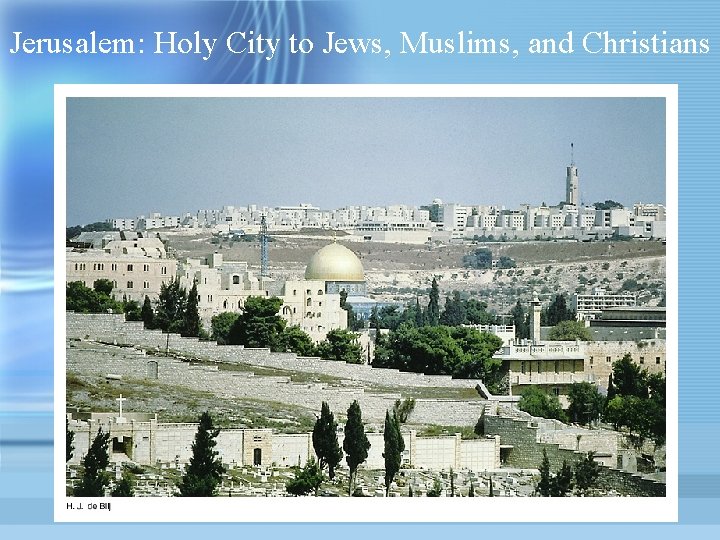
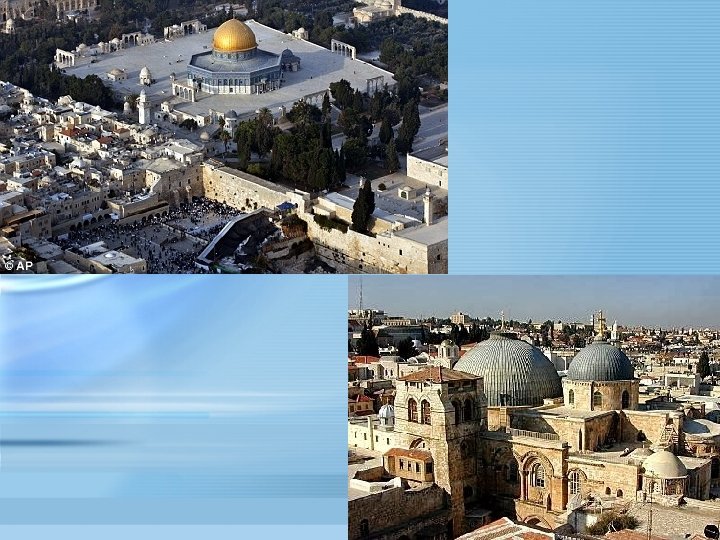
Jerusalem: Holy City to Jews, Muslims, and Christians
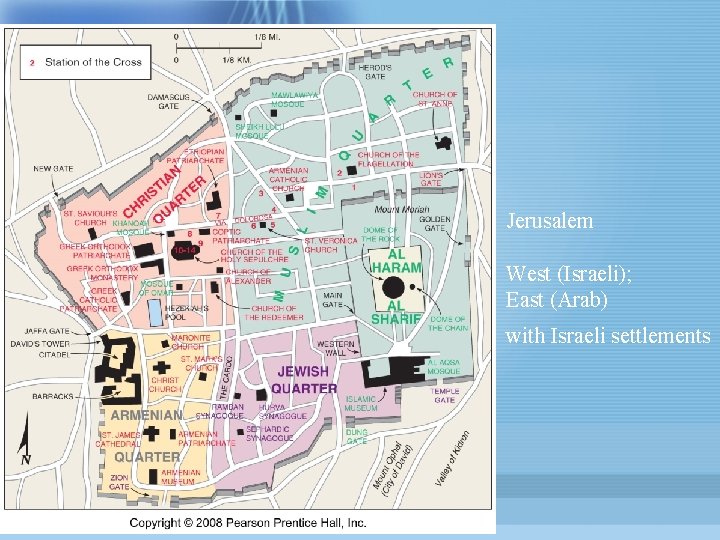
Jerusalem West (Israeli); East (Arab) with Israeli settlements
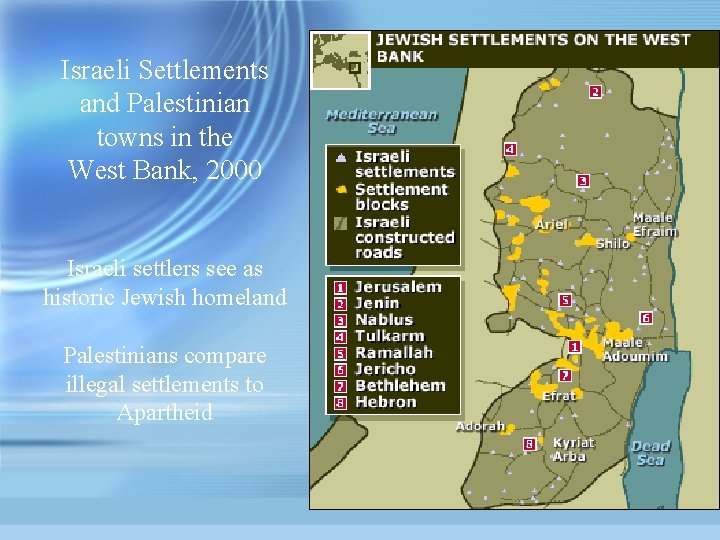
Israeli Settlements and Palestinian towns in the West Bank, 2000 Israeli settlers see as historic Jewish homeland Palestinians compare illegal settlements to Apartheid
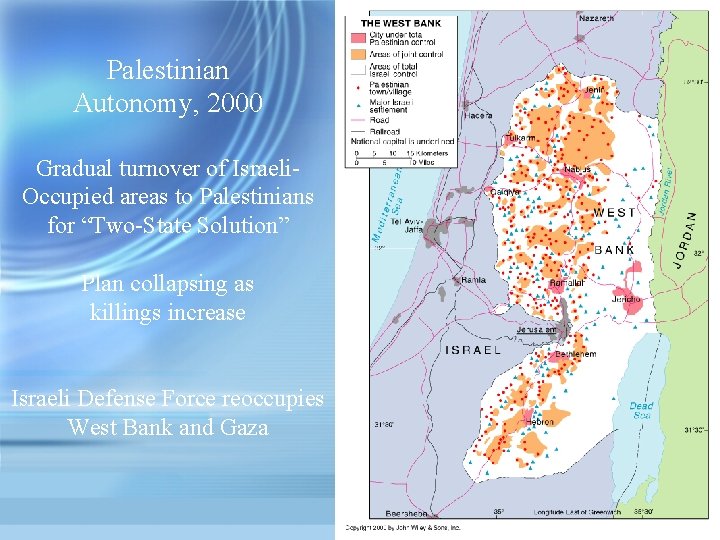
Palestinian Autonomy, 2000 Gradual turnover of Israeli. Occupied areas to Palestinians for “Two-State Solution” Plan collapsing as killings increase Israeli Defense Force reoccupies West Bank and Gaza
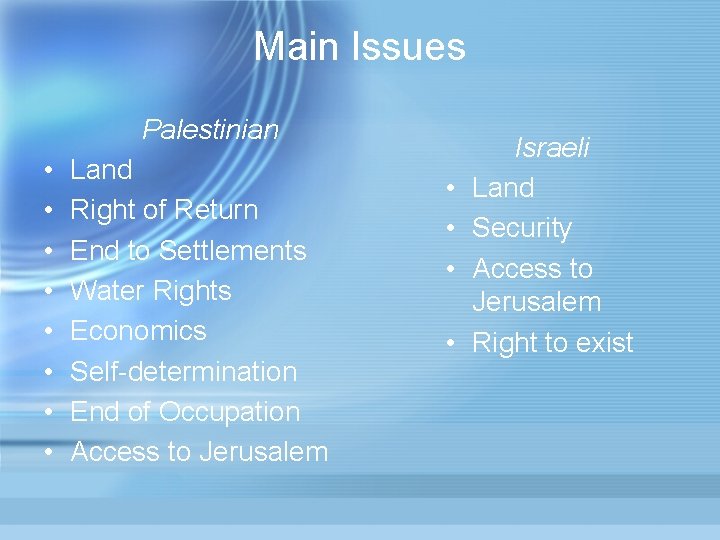
Main Issues Palestinian • • Land Right of Return End to Settlements Water Rights Economics Self-determination End of Occupation Access to Jerusalem • • Israeli Land Security Access to Jerusalem Right to exist
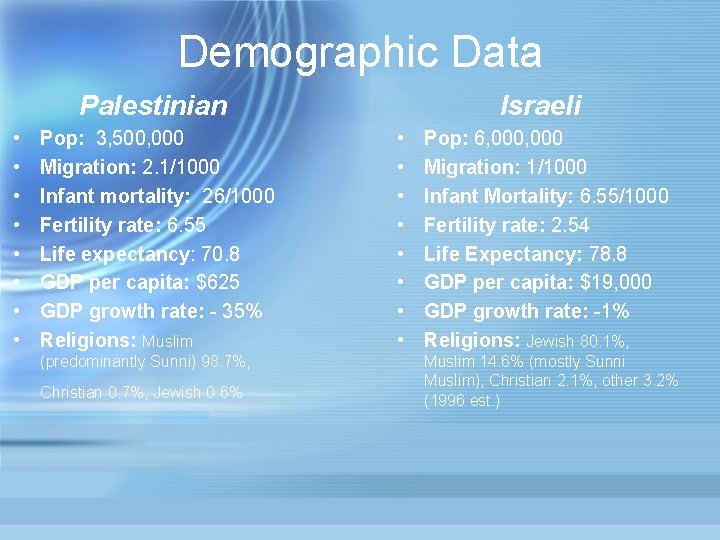
Demographic Data Palestinian • • Pop: 3, 500, 000 Migration: 2. 1/1000 Infant mortality: 26/1000 Fertility rate: 6. 55 Life expectancy: 70. 8 GDP per capita: $625 GDP growth rate: - 35% Religions: Muslim (predominantly Sunni) 98. 7%, Christian 0. 7%, Jewish 0. 6% Israeli • • Pop: 6, 000 Migration: 1/1000 Infant Mortality: 6. 55/1000 Fertility rate: 2. 54 Life Expectancy: 78. 8 GDP per capita: $19, 000 GDP growth rate: -1% Religions: Jewish 80. 1%, Muslim 14. 6% (mostly Sunni Muslim), Christian 2. 1%, other 3. 2% (1996 est. )