In Mrs Tilschers Class Carol Ann Duffy Learning
- Slides: 20
In Mrs Tilscher’s Class Carol Ann Duffy Learning Intention; I can develop my understanding and analysis of a text I am studying
Overview • This poem is autobiographical • Mrs Tilscher is a real person, who taught Carol Ann Duffy in her last year at junior school. • The poem is about rites of passage, the transition (move or change) from childhood to adolescence and the things we learn at school from our teachers and from our peers.
Overview • In the poem Duffy associates the oppressive feeling we have in humid weather with the physical changes of puberty. • The poem examines the change that takes place between childhood and adolescence. The safety of Mrs Tilscher’s primary school classroom is contrasted with life outside against a background including the Moors Murderers Ian Brady and Myra Hindley. A growing sexual awareness marks the end of innocence. • Leaving primary school for the last time is like an escape we are eager to make but which takes us from safety into a dangerous unknown.
Overview • Throughout the poem Duffy refers to ‘you’. She means herself as she was in Mrs Tilscher’s class in the 1960’s, but by writing in the second person she invites us to share her experience. • Most readers will have had experiences like those of Carol Ann Duffy Depicts in this poem.
Form and Structure • This poem is written in free verse with Duffy reflecting on her childhood experiences. • The stanzas help to add emphasis to the “snapshots” of childhood and adolescence that Duffy is presenting. • The most important thing to notice bout the structure of this poem is the change in stanza length. • The first two stanzas have 8 lines each and the last two have 7 lines each. Duffy does this to reflect the changes, which are taking place in the poem.
Form and Structure • Duffy is very talented at creating SENSORY poetry. That is poems which appeal to our senses, images which we can feel, smell, taste, hear. • She is also highly effective in creating snap shot images so we really get a sense of the environment she is creating. (This is also something she does very well in ‘War Photographer’) • She manages to describe scenes so they are almost as clear as photographs, picking up on not only her own memories but tapping into those of her readers also.
Form and Structure • The first two stanzas are full of the excitement felt by children as they learn and discover new facts. • They are full of references to the senses of sight, touch, sound and smell as you, the reader are lead on a journey of discovery. • The overwhelming feeling is one of safety as you see the world through the eyes of the children. The syntax reflects the language of childhood.
Form and Structure • However, even in the midst of all this happiness, the threat of adult knowledge pervades. • Although ‘faded’, the faces of Brady and Hindley thrust themselves. The child is able to remove them from his world but the poem shows that this level of innocence is not able to continue. • The change from childhood to adolescence starts in the third stanza with the growth of the tadpoles. At first, the frogs are presented in as an object of fun and enjoyment. However, the ‘rough boy’ marks the end of the child’s innocence by telling her where she came from.
Form and Structure • The child rejects this news, but it has still altered how they regard their parents. • The disjointed syntax of the final sentence reflects the shock felt by the child. • The final stanza is full of images of passion and sexual frustration. • The end of childhood is tied in with the end of term. • The innocence of primary school remains but now seems to be harder. • The child runs out into an unknown future as an adolescent.
Tone and style üA reflective tone is created throughout as Duffy explores her childhood experiences and encourages the reader to identify with similar memories of their own. üPositive/warm - In the first two stanzas the tone is POSITIVE and WARM highlighted by the fact that ‘Mrs Tilscher loved you’ üUncertain/afraid - Following the pattern of the poems content the TONE changes in the last two stanzas to become UNCERTAIN and OMINOUS as growing sexuality causes confusion and irritability ‘fractious under the heavy sexy sky’.
Stanza One In Mrs Tilscher's class You could travel up the Blue Nile with your finger, tracing the route while Mrs Tilscher chanted the scenery. ”Tana. Ethiopia. Khartoum. Aswan. ” That for an hour, then a skittle of milk and the chalky Pyramids rubbed into dust. A window opened with a long pole. The laugh of a bell swung by a running child. ‘You’ - Opening introduces informal tone, engages reader. Brings us into the poem, makes real it to the reader. ‘chanted the scenery’ – Word choice of ‘chanting’ helps describes small details of the school day. Establishes the situation, creates a word picture. We can imagine the situation. ‘Tana. Ethiopia. Khartoum. Aswan. ’ Short sentence structure brings the setting alive reinforces the ‘chanting’/learning of the exotic place names. ‘That for an hour’ – suggests passage of time/reflects on how time appears to pass slowly when we are young. We see the routine, and with it the certainty and security afforded in the classroom. ‘skittle of milk’ - Metaphor, describes the shape of the bottle, an element of play involved, also puts poem in a specific time. Helps to reinforce the routine of the school day. laugh of a bell swung by a running child Personification – it is not the bell –an old fashioned hand bell -that is laughing, but the child (all children). School seems to be a happy place, full of laughter. The bell also puts the poem into a specific time.
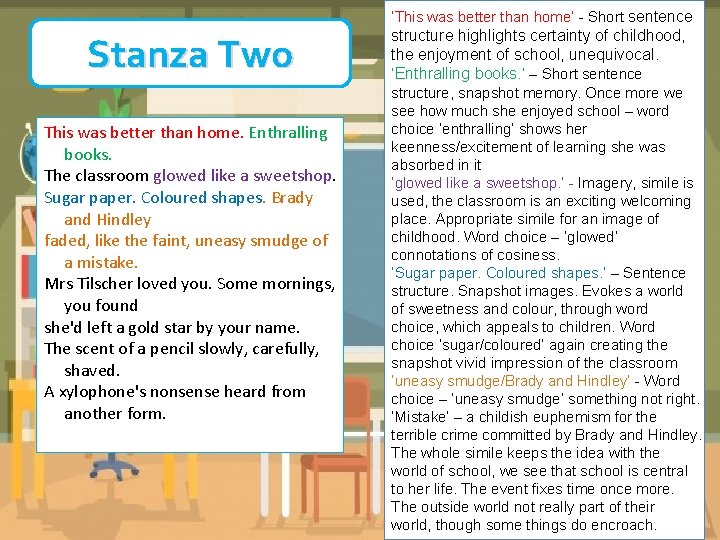
‘This was better than home’ - Short sentence Stanza Two This was better than home. Enthralling books. The classroom glowed like a sweetshop. Sugar paper. Coloured shapes. Brady and Hindley faded, like the faint, uneasy smudge of a mistake. Mrs Tilscher loved you. Some mornings, you found she'd left a gold star by your name. The scent of a pencil slowly, carefully, shaved. A xylophone's nonsense heard from another form. structure highlights certainty of childhood, the enjoyment of school, unequivocal. ‘Enthralling books. ’ – Short sentence structure, snapshot memory. Once more we see how much she enjoyed school – word choice ‘enthralling’ shows her keenness/excitement of learning she was absorbed in it ‘glowed like a sweetshop. ’ - Imagery, simile is used, the classroom is an exciting welcoming place. Appropriate simile for an image of childhood. Word choice – ‘glowed’ connotations of cosiness. ‘Sugar paper. Coloured shapes. ’ – Sentence structure. Snapshot images. Evokes a world of sweetness and colour, through word choice, which appeals to children. Word choice ‘sugar/coloured’ again creating the snapshot vivid impression of the classroom ‘uneasy smudge/Brady and Hindley’ - Word choice – ‘uneasy smudge’ something not right. ‘Mistake’ – a childish euphemism for the terrible crime committed by Brady and Hindley. The whole simile keeps the idea with the world of school, we see that school is central to her life. The event fixes time once more. The outside world not really part of their world, though some things do encroach.
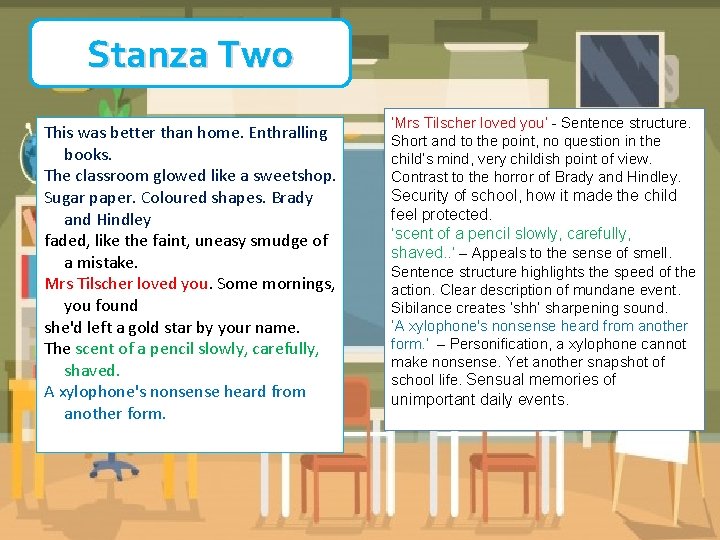
Stanza Two This was better than home. Enthralling books. The classroom glowed like a sweetshop. Sugar paper. Coloured shapes. Brady and Hindley faded, like the faint, uneasy smudge of a mistake. Mrs Tilscher loved you. Some mornings, you found she'd left a gold star by your name. The scent of a pencil slowly, carefully, shaved. A xylophone's nonsense heard from another form. ‘Mrs Tilscher loved you’ - Sentence structure. Short and to the point, no question in the child’s mind, very childish point of view. Contrast to the horror of Brady and Hindley. Security of school, how it made the child feel protected. ‘scent of a pencil slowly, carefully, shaved. . ’ – Appeals to the sense of smell. Sentence structure highlights the speed of the action. Clear description of mundane event. Sibilance creates ‘shh’ sharpening sound. ‘A xylophone's nonsense heard from another form. ’ – Personification, a xylophone cannot make nonsense. Yet another snapshot of school life. Sensual memories of unimportant daily events.
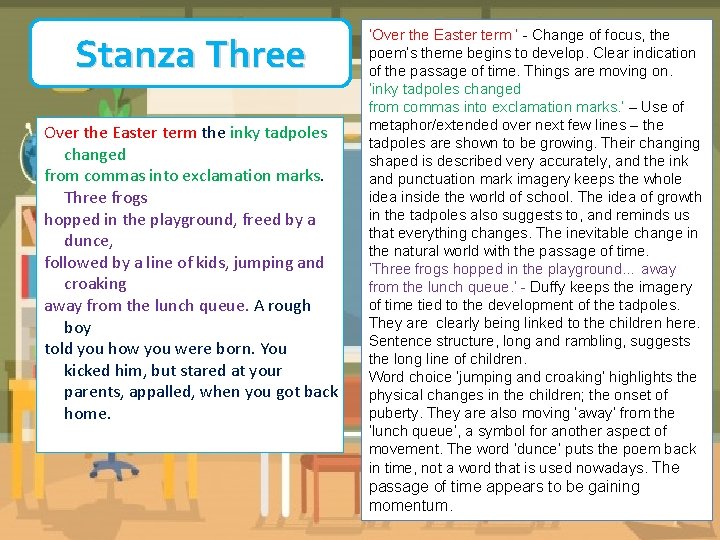
Stanza Three Over the Easter term the inky tadpoles changed from commas into exclamation marks. Three frogs hopped in the playground, freed by a dunce, followed by a line of kids, jumping and croaking away from the lunch queue. A rough boy told you how you were born. You kicked him, but stared at your parents, appalled, when you got back home. ‘Over the Easter term ’ - Change of focus, the poem’s theme begins to develop. Clear indication of the passage of time. Things are moving on. ‘inky tadpoles changed from commas into exclamation marks. ’ – Use of metaphor/extended over next few lines – the tadpoles are shown to be growing. Their changing shaped is described very accurately, and the ink and punctuation mark imagery keeps the whole idea inside the world of school. The idea of growth in the tadpoles also suggests to, and reminds us that everything changes. The inevitable change in the natural world with the passage of time. ‘Three frogs hopped in the playground… away from the lunch queue. ’ - Duffy keeps the imagery of time tied to the development of the tadpoles. They are clearly being linked to the children here. Sentence structure, long and rambling, suggests the long line of children. Word choice ‘jumping and croaking’ highlights the physical changes in the children; the onset of puberty. They are also moving ‘away’ from the ‘lunch queue’, a symbol for another aspect of movement. The word ‘dunce’ puts the poem back in time, not a word that is used nowadays. The passage of time appears to be gaining momentum.
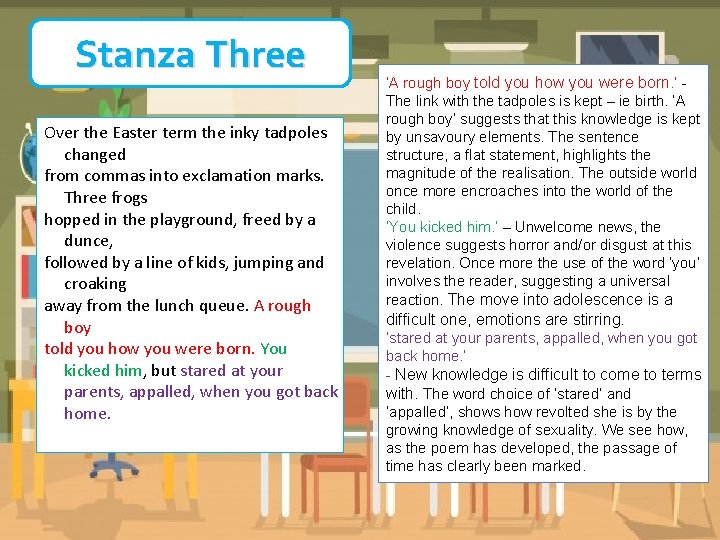
Stanza Three Over the Easter term the inky tadpoles changed from commas into exclamation marks. Three frogs hopped in the playground, freed by a dunce, followed by a line of kids, jumping and croaking away from the lunch queue. A rough boy told you how you were born. You kicked him, but stared at your parents, appalled, when you got back home. ‘A rough boy told you how you were born. ’ The link with the tadpoles is kept – ie birth. ‘A rough boy’ suggests that this knowledge is kept by unsavoury elements. The sentence structure, a flat statement, highlights the magnitude of the realisation. The outside world once more encroaches into the world of the child. ‘You kicked him. ’ – Unwelcome news, the violence suggests horror and/or disgust at this revelation. Once more the use of the word ‘you’ involves the reader, suggesting a universal reaction. The move into adolescence is a difficult one, emotions are stirring. ‘stared at your parents, appalled, when you got back home. ’ - New knowledge is difficult to come to terms with. The word choice of ‘stared’ and ‘appalled’, shows how revolted she is by the growing knowledge of sexuality. We see how, as the poem has developed, the passage of time has clearly been marked.
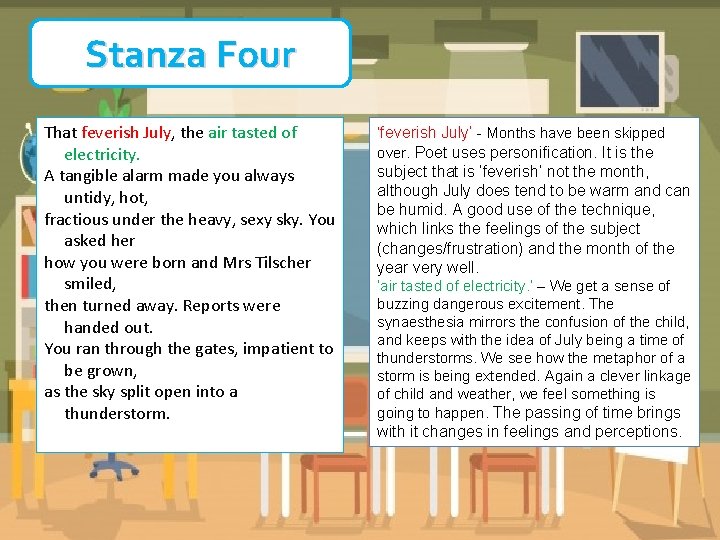
Stanza Four That feverish July, the air tasted of electricity. A tangible alarm made you always untidy, hot, fractious under the heavy, sexy sky. You asked her how you were born and Mrs Tilscher smiled, then turned away. Reports were handed out. You ran through the gates, impatient to be grown, as the sky split open into a thunderstorm. ‘feverish July’ - Months have been skipped over. Poet uses personification. It is the subject that is ‘feverish’ not the month, although July does tend to be warm and can be humid. A good use of the technique, which links the feelings of the subject (changes/frustration) and the month of the year very well. ‘air tasted of electricity. ’ – We get a sense of buzzing dangerous excitement. The synaesthesia mirrors the confusion of the child, and keeps with the idea of July being a time of thunderstorms. We see how the metaphor of a storm is being extended. Again a clever linkage of child and weather, we feel something is going to happen. The passing of time brings with it changes in feelings and perceptions.
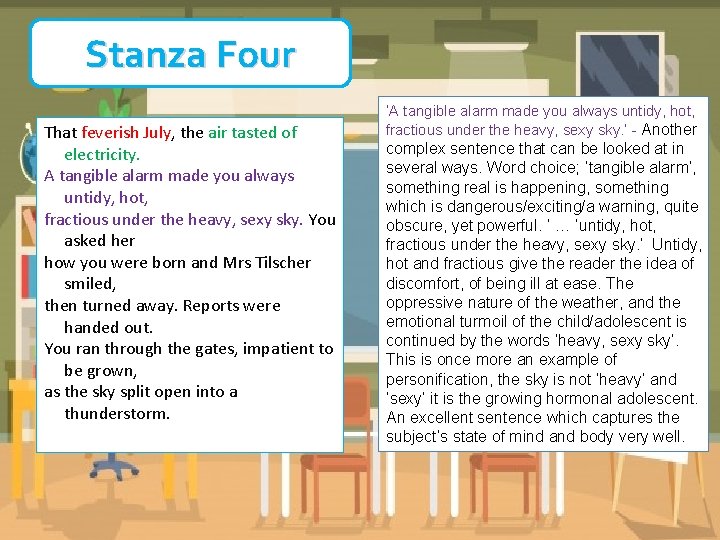
Stanza Four That feverish July, the air tasted of electricity. A tangible alarm made you always untidy, hot, fractious under the heavy, sexy sky. You asked her how you were born and Mrs Tilscher smiled, then turned away. Reports were handed out. You ran through the gates, impatient to be grown, as the sky split open into a thunderstorm. ‘A tangible alarm made you always untidy, hot, fractious under the heavy, sexy sky. ’ - Another complex sentence that can be looked at in several ways. Word choice; ‘tangible alarm’, something real is happening, something which is dangerous/exciting/a warning, quite obscure, yet powerful. ‘ … ‘untidy, hot, fractious under the heavy, sexy sky. ’ Untidy, hot and fractious give the reader the idea of discomfort, of being ill at ease. The oppressive nature of the weather, and the emotional turmoil of the child/adolescent is continued by the words ‘heavy, sexy sky’. This is once more an example of personification, the sky is not ‘heavy’ and ‘sexy’ it is the growing hormonal adolescent. An excellent sentence which captures the subject’s state of mind and body very well.
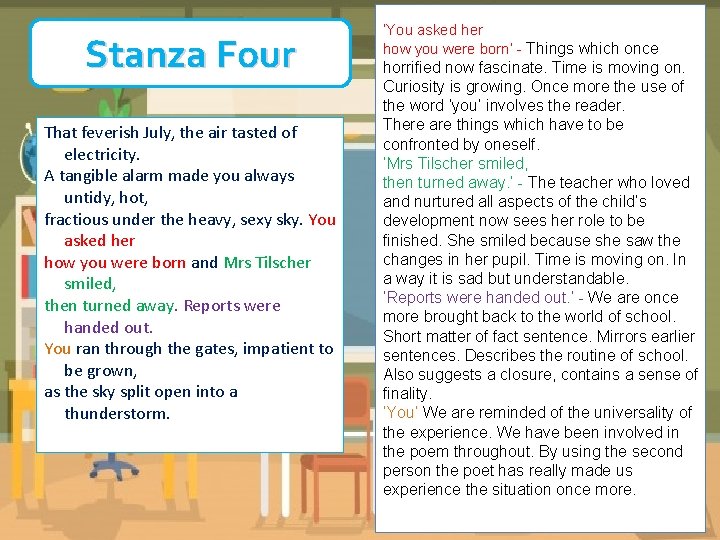
Stanza Four That feverish July, the air tasted of electricity. A tangible alarm made you always untidy, hot, fractious under the heavy, sexy sky. You asked her how you were born and Mrs Tilscher smiled, then turned away. Reports were handed out. You ran through the gates, impatient to be grown, as the sky split open into a thunderstorm. ‘You asked her how you were born’ - Things which once horrified now fascinate. Time is moving on. Curiosity is growing. Once more the use of the word ‘you’ involves the reader. There are things which have to be confronted by oneself. ‘Mrs Tilscher smiled, then turned away. ’ - The teacher who loved and nurtured all aspects of the child’s development now sees her role to be finished. She smiled because she saw the changes in her pupil. Time is moving on. In a way it is sad but understandable. ‘Reports were handed out. ’ - We are once more brought back to the world of school. Short matter of fact sentence. Mirrors earlier sentences. Describes the routine of school. Also suggests a closure, contains a sense of finality. ‘You’ We are reminded of the universality of the experience. We have been involved in the poem throughout. By using the second person the poet has really made us experience the situation once more.
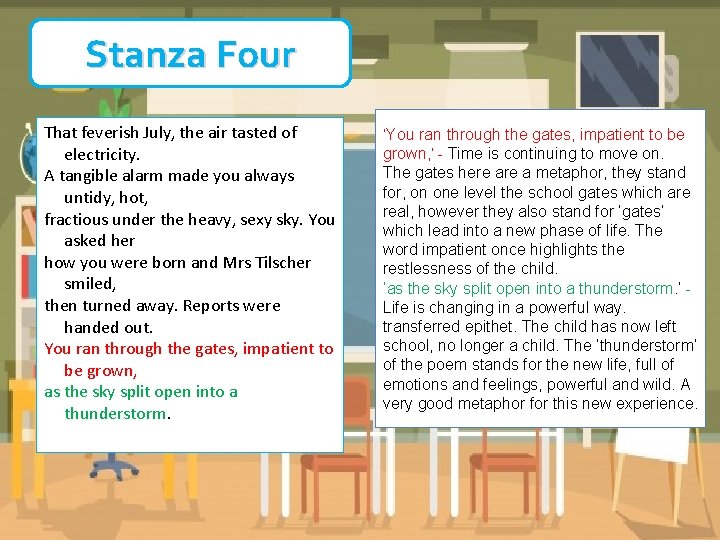
Stanza Four That feverish July, the air tasted of electricity. A tangible alarm made you always untidy, hot, fractious under the heavy, sexy sky. You asked her how you were born and Mrs Tilscher smiled, then turned away. Reports were handed out. You ran through the gates, impatient to be grown, as the sky split open into a thunderstorm. ‘You ran through the gates, impatient to be grown, ’ - Time is continuing to move on. The gates here a metaphor, they stand for, on one level the school gates which are real, however they also stand for ‘gates’ which lead into a new phase of life. The word impatient once highlights the restlessness of the child. ‘as the sky split open into a thunderstorm. ’ Life is changing in a powerful way. transferred epithet. The child has now left school, no longer a child. The ‘thunderstorm’ of the poem stands for the new life, full of emotions and feelings, powerful and wild. A very good metaphor for this new experience.
Themes • Maturity/Growing up There is a very effective contrast between the first half of the poem and the last two stanzas, as one moves from childhood security to dangerous growing up. This is matched by a movement from images of the classroom and school to natural phenomena (tadpoles, frogs, weather) outside the security of Mrs. Tilscher's classroom. The poem gives specific details from the poet's childhood, but it records an almost universal experience. • Passage of time: In the first half of the poem there is no sense of time passing. This comes in the second half. The growth of the tadpoles is explained in terms of punctuation marks, about which the children would have learned in Mrs. Tilscher's class. The action of the dunce, in letting the frogs out, hints at trouble to come: the children are amused, not concerned for the animals. (Today this might be less likely. And no child would be identified as a "dunce", a word which places the poem in the 1960 s. ) But the real catalyst for change is the revelation from "a rough boy" about sexual reproduction. He is kicked for his pains but the poet, as a child, suspects he is speaking the truth. This is confirmed by Mrs. Tilscher's evasion when she is asked about childbirth - and the teacher's smile is a confirmation that it is time to move on. • Childhood Innocence. Leaving primary school for the last time is like an escape we are eager to make but which takes us from safety into a dangerous unknown. Throughout the poem Duffy refers to "you". She means herself as she was in Mrs. Tilscher's class in the 1960 s. But by writing in the second person she invites us to share her experience. Most readers will have had experiences like those Carol Ann Duffy depicts in this poem.