Implications of Complex Adaptive Systems Theory for Research


- Slides: 16
Implications of Complex Adaptive Systems Theory for Research Design Reuben R. Mc. Daniel, Jr. Professor of Information Management and Charles and Elizabeth Prothro Regents Chair in Health Care Management Mc. Combs School of Business The University of Texas at Austin In collaboration with: Holly J. Lanham, The University of Texas at Austin Ruth A. Anderson, Duke University 1
Introduction l Studying organizations as CAS l l l challenges the research process requires expanded mental models of research and how it is done Key themes l l Weick’s idea of “design as a verb” March, Sproull, and Tamuz’ idea of “learning from samples of one or fewer” Reuben R. Mc. Daniel, Jr. Frontiers – Kansas July 24, 2007 Implications of CAS Theory for Research Design 2
We used to believe… The purpose of this research is to … Reuben R. Mc. Daniel, Jr. Frontiers – Kansas July 24, 2007 Implications of CAS Theory for Research Design 3
Why Research Designing? l l Interesting ideas that have the potential of affecting the research design often emerge during the research process How can researchers incorporate these new ideas into the design of the research? Not a qualitative vs. quantitative issue Reuben R. Mc. Daniel, Jr. Frontiers – Kansas July 24, 2007 Implications of CAS Theory for Research Design 4
Organizations as Complex Adaptive Systems (CAS) l l l Diverse agents that learn Nonlinear interdependencies Self-organization Emergence Co-evolution …lead to uncertainty and surprise Reuben R. Mc. Daniel, Jr. Frontiers – Kansas July 24, 2007 Implications of CAS Theory for Research Design 5
Design as a Verb (Weick, 1993) l l l Research design itself is a process that is unfolding – it is not a design but a process of designing Data, theories, methods, and analysis strategies determine the unfolding of the process Researchers must: l l l Continuously allocate and reallocate attention Develop tentative guides for action Participate in a process of designing Reuben R. Mc. Daniel, Jr. Frontiers – Kansas July 24, 2007 Implications of CAS Theory for Research Design 6
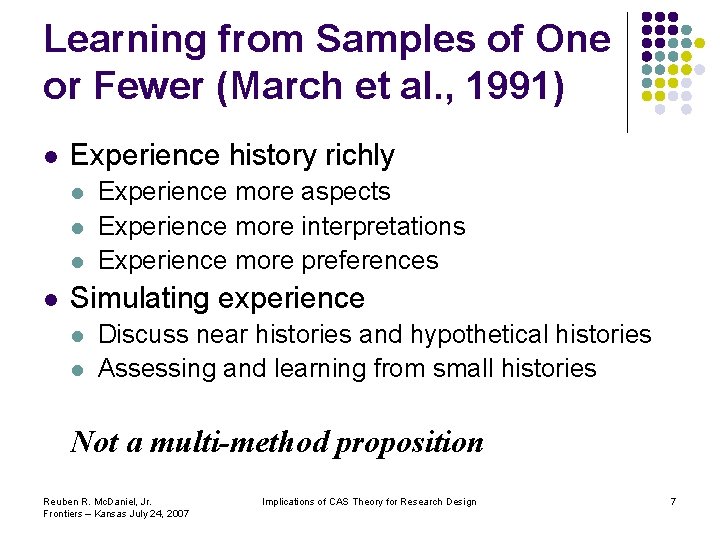
Learning from Samples of One or Fewer (March et al. , 1991) l Experience history richly l l Experience more aspects Experience more interpretations Experience more preferences Simulating experience l l Discuss near histories and hypothetical histories Assessing and learning from small histories Not a multi-method proposition Reuben R. Mc. Daniel, Jr. Frontiers – Kansas July 24, 2007 Implications of CAS Theory for Research Design 7
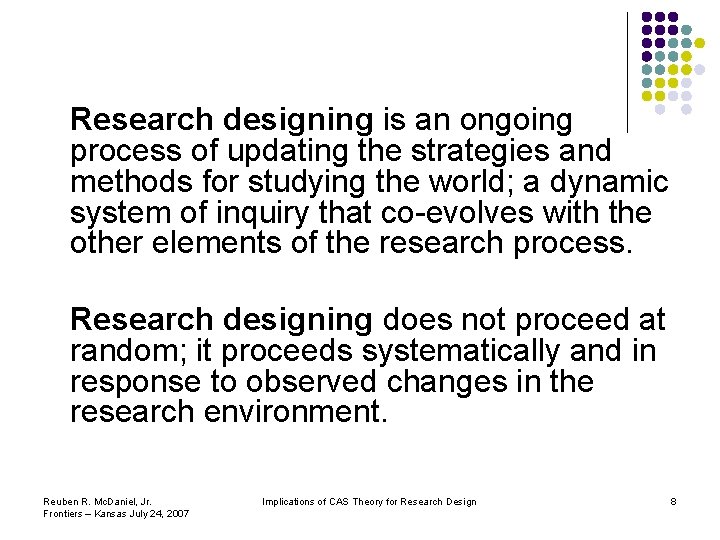
Research designing is an ongoing process of updating the strategies and methods for studying the world; a dynamic system of inquiry that co-evolves with the other elements of the research process. Research designing does not proceed at random; it proceeds systematically and in response to observed changes in the research environment. Reuben R. Mc. Daniel, Jr. Frontiers – Kansas July 24, 2007 Implications of CAS Theory for Research Design 8
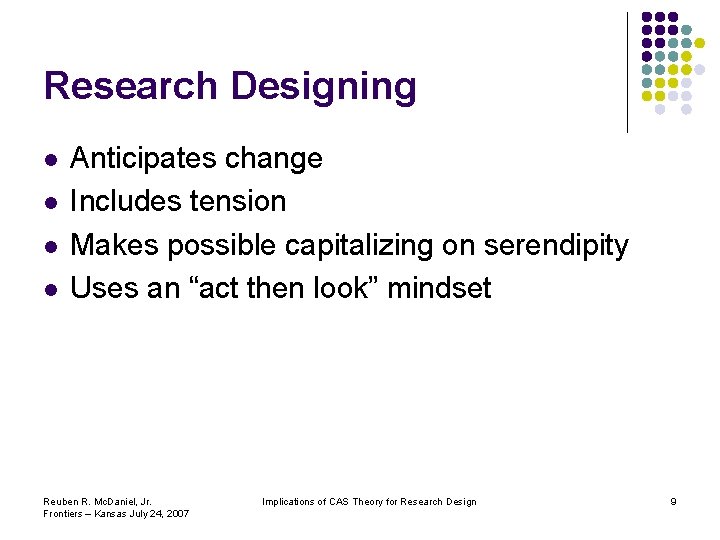
Research Designing l l Anticipates change Includes tension Makes possible capitalizing on serendipity Uses an “act then look” mindset Reuben R. Mc. Daniel, Jr. Frontiers – Kansas July 24, 2007 Implications of CAS Theory for Research Design 9
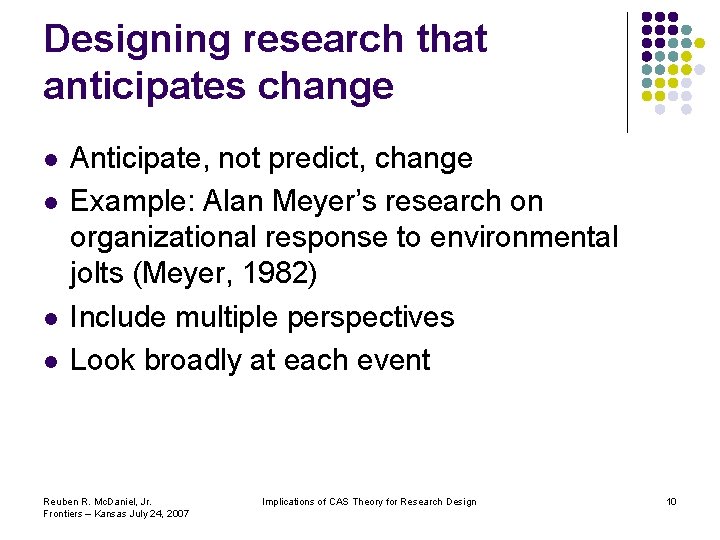
Designing research that anticipates change l l Anticipate, not predict, change Example: Alan Meyer’s research on organizational response to environmental jolts (Meyer, 1982) Include multiple perspectives Look broadly at each event Reuben R. Mc. Daniel, Jr. Frontiers – Kansas July 24, 2007 Implications of CAS Theory for Research Design 10
Designing tension into research l l l Range of ideas and perspectives creates space for social exchange Foster interactions Semi-confusing information systems (Hedberg and Jonsson, 1978) l l Proper destabilization Planned confusion Use novice and senior researchers Exit interviews Reuben R. Mc. Daniel, Jr. Frontiers – Kansas July 24, 2007 Implications of CAS Theory for Research Design 11
Designing to capitalize on serendipity l l l Unanticipated events happen Treat unanticipated events as opportunities for study Not all unanticipated events will evolve into major funded studies Example: Wild Zebra Edmondson’s research program capitalizes on serendipity Reuben R. Mc. Daniel, Jr. Frontiers – Kansas July 24, 2007 Implications of CAS Theory for Research Design 12
Designing to act then look l l Look for unexpected sources of data Recognize emergent questions Foster alternative explanations Make small adjustments l l l Weick’s work on small wins Arthur’s work in economics Bayesian thinking -- belief updating based on new information Reuben R. Mc. Daniel, Jr. Frontiers – Kansas July 24, 2007 Implications of CAS Theory for Research Design 13
Designing to Act then Look (cont. ) Researchers do not need to keep looking at the world and making adjustments because they are unintelligent or because they have made an error. Rather, researchers need to keep looking at the world and making adjustments because the worlds we study change as we observe them. Reuben R. Mc. Daniel, Jr. Frontiers – Kansas July 24, 2007 Implications of CAS Theory for Research Design 14
Conclusions l l l Studying organizations as CAS requires researchers to change their thinking Research desisgning is a dynamic, ongoing process Research designing must enable learning from meager evidence Reuben R. Mc. Daniel, Jr. Frontiers – Kansas July 24, 2007 Implications of CAS Theory for Research Design 15
Research is about finding answers to questions; it is about developing models that enable better understanding of the world. Reuben R. Mc. Daniel, Jr. Frontiers – Kansas July 24, 2007 Implications of CAS Theory for Research Design 16