Human Resource Management Performance Management Appraisal Week 7

- Slides: 23
Human Resource Management Performance Management & Appraisal Week 7 MAN 404 Tuğberk Kaya tugberk. kaya@neu. edu. tr Near East University
Definitions �Performance appraisal �Evaluating an employee’s current and/or past performance relative to his or her performance standards. �Performance management �The process employers use to make sure employees are working toward organizational goals.
Why Performance Management? �Increasing use by employers of performance management reflects: �The popularity of the total quality management (TQM) concepts. �The belief that traditional performance appraisals are often not just useless but counterproductive. �The necessity in today’s globally competitive industrial environment for every employee’s efforts to focus on helping the company to achieve its strategic goals.
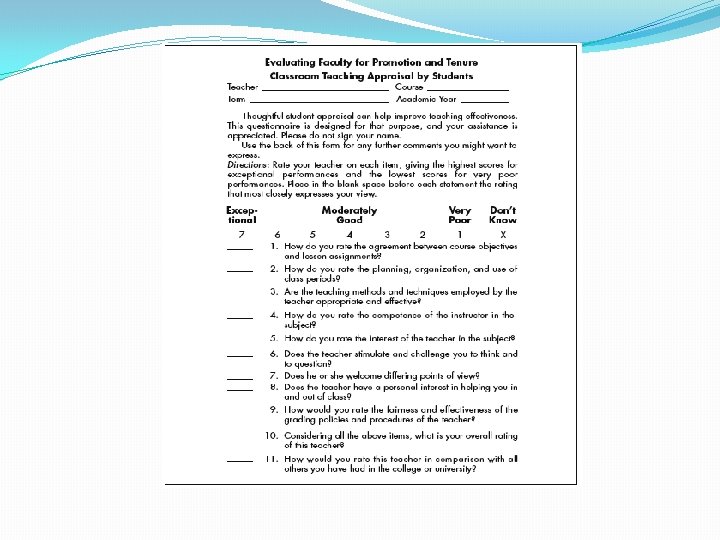
Why appraise performance? 1. Appraisals play an integral role in the employer’s performance management process. 2. Appraisals help in planning for correcting deficiencies and reinforce things done correctly. 3. Appraisals, in identifying employee strengths and weaknesses, are useful for career planning 4. Appraisals affect the employer’s salary raise decisions.
Realistic Appraisals �Motivations for soft appraisals �The fear of having to hire and train someone new �The unpleasant reaction of the appraisee �A company appraisal process that’s not conducive to candor �Hazards of giving soft appraisals �Employee loses the chance to improve before being forced to change jobs. �Lawsuits arising from dismissals involving inaccurate performance appraisals.
Continuous improvement �A management philosophy that requires employers to continuously set and relentlessly meet ever-higher quality, cost, delivery, and availability goals by: �Eradicating the seven wastes: � overproduction, defective products, and unnecessary downtime, transportation, processing costs, motion, and inventory. �Requiring each employee to continuously improve his or her own personal performance, from one appraisal period to the next.
The Components of an Effective Performance Management Process �Direction sharing �Role clarification �Goal alignment �Developmental goal setting �Ongoing performance monitoring �Ongoing feedback �Coaching and support �Performance assessment (appraisal) �Rewards, recognition, and compensation �Workflow and process control and return
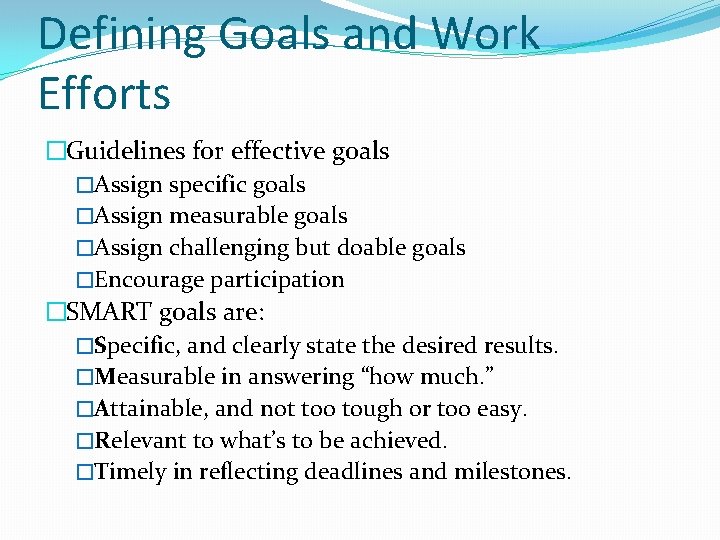
Defining Goals and Work Efforts �Guidelines for effective goals �Assign specific goals �Assign measurable goals �Assign challenging but doable goals �Encourage participation �SMART goals are: �Specific, and clearly state the desired results. �Measurable in answering “how much. ” �Attainable, and not too tough or too easy. �Relevant to what’s to be achieved. �Timely in reflecting deadlines and milestones.
Performance Appraisal Roles �HR department �Serves a policy-making and advisory role. �Provides advice and assistance regarding the appraisal tool to use. �Prepares forms and procedures and insists that all departments use them. �Responsible for training supervisors to improve their appraisal skills.
Performance Appraisal Roles �Supervisors �Usually do the actual appraising. �Must be familiar with basic appraisal techniques. �Must understand avoid problems that can cripple appraisals. �Must know how to conduct appraisals fairly.
Steps in Appraising Performance �Defining the job �Making sure that you and your subordinate agree on his or her duties and job standards. �Appraising performance �Comparing your subordinate’s actual performance to the standards that have been set; this usually involves some type of rating form. �Providing feedback �Discussing the subordinate’s performance and progress, and making plans for any development required.
Designing the Appraisal Tool �What to measure? �Work output (quality and quantity) �Personal competencies �Goal (task) achievement �How to measure? �Graphic rating scales �Alternation ranking method �Graphic rating scale
Management by Objectives (MBO) � Involves setting specific measurable goals with each employee and then periodically reviewing the progress made. 1. Set the organization’s goals. 2. Set departmental goals. 3. Discuss departmental goals. 4. Define expected results (set individual goals). 5. Performance reviews. 6. Provide feedback.
Potential Rating Scale Appraisal Problems �Unclear standards �An appraisal that is too open to interpretation. �Halo effect �Occurs when a supervisor’s rating of a subordinate on one trait biases the rating of that person on other traits. �Central tendency �A tendency to rate all employees the same way, such as rating them all average.
Potential Rating Scale Appraisal Problems �Strictness/leniency �The problem that occurs when a supervisor has a tendency to rate all subordinates either high or low. �Bias �The tendency to allow individual differences such as age, race, and sex to affect the appraisal ratings employees receive.
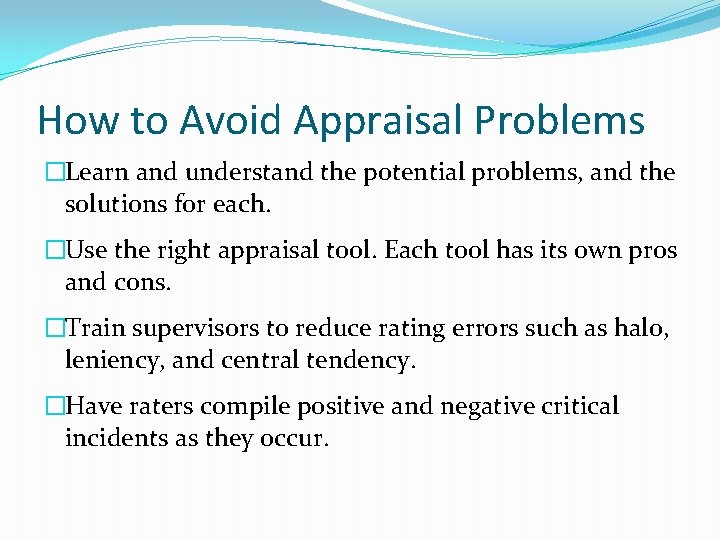
How to Avoid Appraisal Problems �Learn and understand the potential problems, and the solutions for each. �Use the right appraisal tool. Each tool has its own pros and cons. �Train supervisors to reduce rating errors such as halo, leniency, and central tendency. �Have raters compile positive and negative critical incidents as they occur.
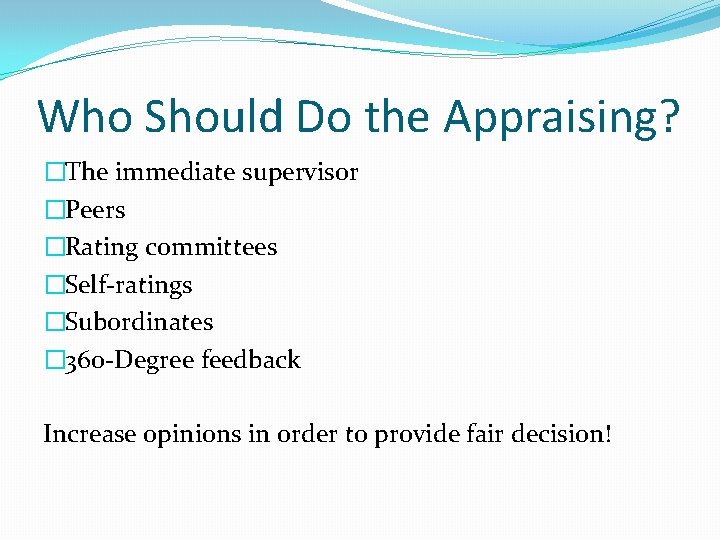
Who Should Do the Appraising? �The immediate supervisor �Peers �Rating committees �Self-ratings �Subordinates � 360 -Degree feedback Increase opinions in order to provide fair decision!
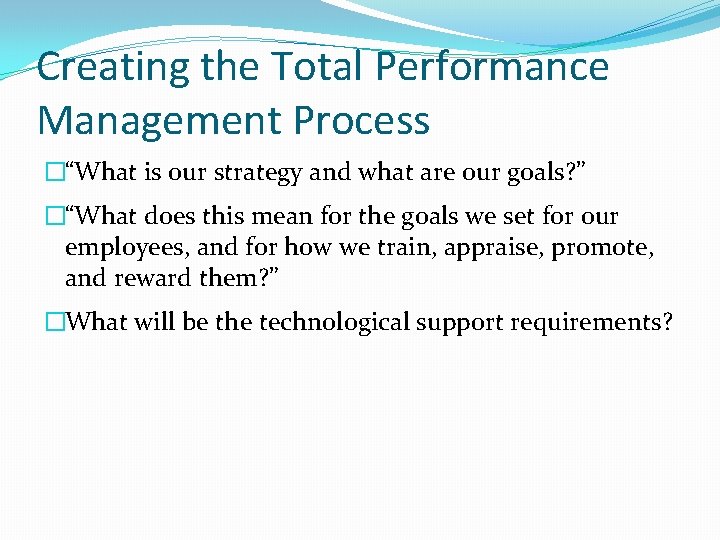
Creating the Total Performance Management Process �“What is our strategy and what are our goals? ” �“What does this mean for the goals we set for our employees, and for how we train, appraise, promote, and reward them? ” �What will be the technological support requirements?
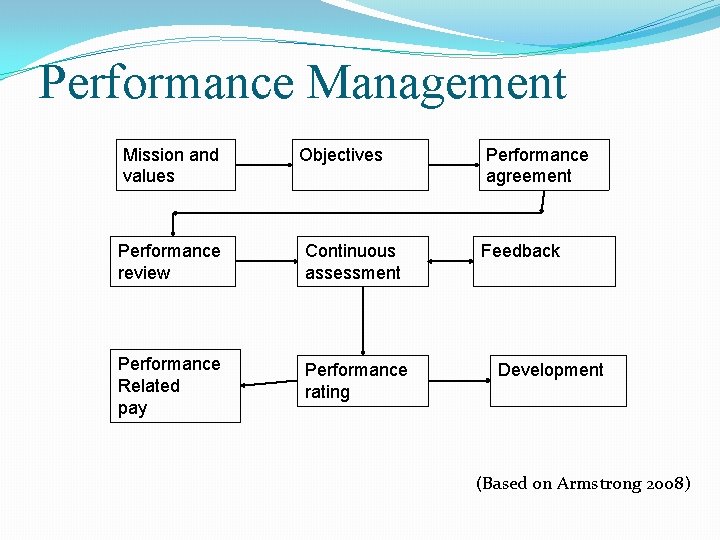
Performance Management Mission and values Objectives Performance review Continuous assessment Performance Related pay Performance rating Performance agreement Feedback Development (Based on Armstrong 2008)
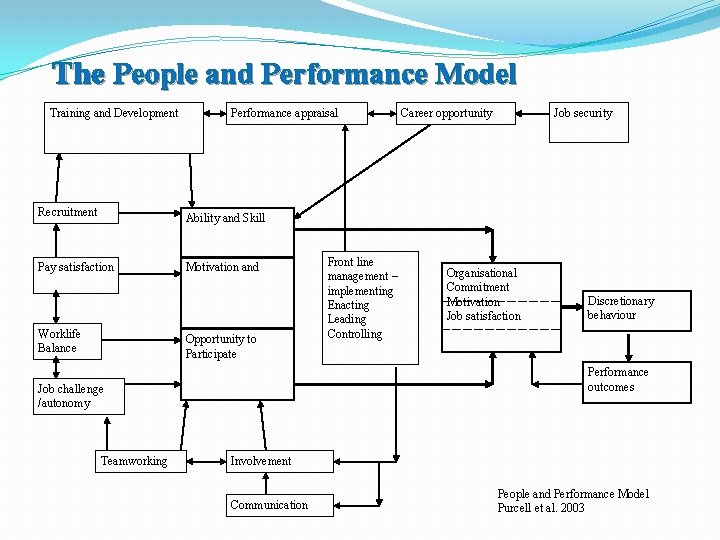
The People and Performance Model Training and Development Performance appraisal Recruitment Ability and Skill Pay satisfaction Motivation and Worklife Balance Opportunity to Participate Job security Organisational Commitment Motivation Job satisfaction Discretionary behaviour Performance outcomes Job challenge /autonomy Teamworking Front line management – implementing Enacting Leading Controlling Career opportunity Involvement Communication People and Performance Model Purcell et al. 2003
References � Armstrong, M. (2008) Armstrong's Handbook of Human Resource Management Practice. 12 th edn. London: Kogan Page Ltd � Dessler, G. (2008) Human Resource Management. 11 th edn. Harlow: Pearson Education Ltd � Guest, D. (1987), “Human resource management and industrial relations”, Journal of � Management Studies, Vol. 24 No. 5, pp. 503 -21. DOI: http: //dx. doi. org/10. 1108/17410400810867508 � Mondy, R. (2005) Human Resource Management. Harlow: Pearson Education Ltd � Purcell, J. , Kinnie, N. , Hutchinson, S. , Rayton, B. and Swart, J. (2003) Understanding the People and Performance Link: Unlocking the Black Box. London: CIPD
Any Questions? tugberk. kaya@neu. edu. tr