How to Make Simple Solutions and Dilutions Taken




- Slides: 12
How to Make Simple Solutions and Dilutions Taken from: Resource Materials for the Biology Core Courses-Bates College (there may be errors!!)
WHY? ? ? • You want to subject your DNA to a. 5 M solution of EDTA. HUM!!!! • How would you do that? ? ? • You want to subject your cells to a. 54% KCl hypotonic solution. HUM!!!! • How would you do that? • You want to dilute your buffer 5 fold. HUM!!!!! • How would you do that?
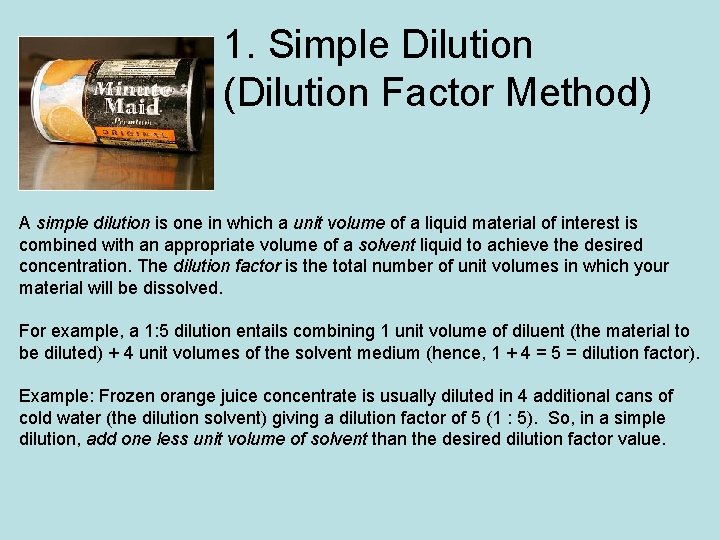
1. Simple Dilution (Dilution Factor Method) A simple dilution is one in which a unit volume of a liquid material of interest is combined with an appropriate volume of a solvent liquid to achieve the desired concentration. The dilution factor is the total number of unit volumes in which your material will be dissolved. For example, a 1: 5 dilution entails combining 1 unit volume of diluent (the material to be diluted) + 4 unit volumes of the solvent medium (hence, 1 + 4 = 5 = dilution factor). Example: Frozen orange juice concentrate is usually diluted in 4 additional cans of cold water (the dilution solvent) giving a dilution factor of 5 (1 : 5). So, in a simple dilution, add one less unit volume of solvent than the desired dilution factor value.
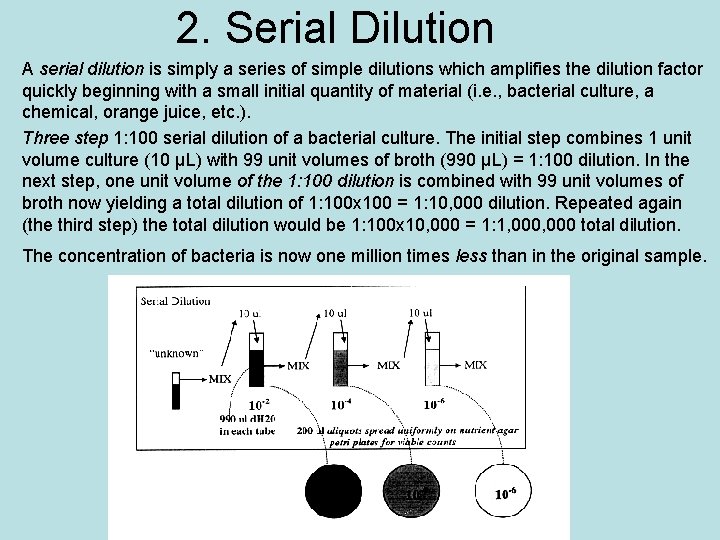
• • 2. Serial Dilution A serial dilution is simply a series of simple dilutions which amplifies the dilution factor quickly beginning with a small initial quantity of material (i. e. , bacterial culture, a chemical, orange juice, etc. ). Three step 1: 100 serial dilution of a bacterial culture. The initial step combines 1 unit volume culture (10 µL) with 99 unit volumes of broth (990 µL) = 1: 100 dilution. In the next step, one unit volume of the 1: 100 dilution is combined with 99 unit volumes of broth now yielding a total dilution of 1: 100 x 100 = 1: 10, 000 dilution. Repeated again (the third step) the total dilution would be 1: 100 x 10, 000 = 1: 1, 000 total dilution. The concentration of bacteria is now one million times less than in the original sample.
3. Making fixed volumes of specific concentrations from liquid reagents: C 1 V 1=C 2 V 2 Method • Suppose you have 3 m. Lof a stock solution of 100 mg/m. L ampicillin (= C 1) and you want to make 200 µL(= V 2)of solution having 25 mg/ m. L (= C 2). You need to know what volume (V 1) of the stock to use as part of the 200 µL total volume needed. • V 1 = the volume of stock you will start with. This is your unknown. C 1 = 100 mg/ m. L in the stock solution V 2 = total volume needed at the new concentration = 200 ul = 0. 2 m. L C 2 = the new concentration = 25 mg/ m. L
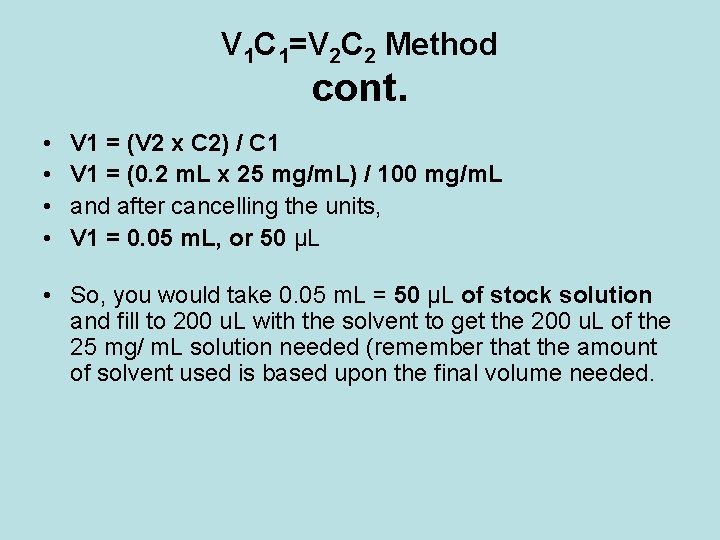
V 1 C 1=V 2 C 2 Method cont. • • V 1 = (V 2 x C 2) / C 1 V 1 = (0. 2 m. L x 25 mg/m. L) / 100 mg/m. L and after cancelling the units, V 1 = 0. 05 m. L, or 50 µL • So, you would take 0. 05 m. L = 50 µL of stock solution and fill to 200 u. L with the solvent to get the 200 u. L of the 25 mg/ m. L solution needed (remember that the amount of solvent used is based upon the final volume needed.
4. Moles and Molar solutions (unit = M = moles/L) • Sometimes it may be more efficient to use molarity when calculating concentrations. • A mole is “one gram molecular weight” of an element or compound, and comprised of exactly 6. 023 x 10^23 atoms or molecules (this is called Avogadro's number). – Sodium Chloride = 58. 44 g/mole • The mass attributed to one mole of any element or compound is called its atomic weight (element) or molecular weight, or formula weight for compounds. The number of moles of a given dry reagent can be calculated as: – # of moles = weight (g)/ molecular weight (g)
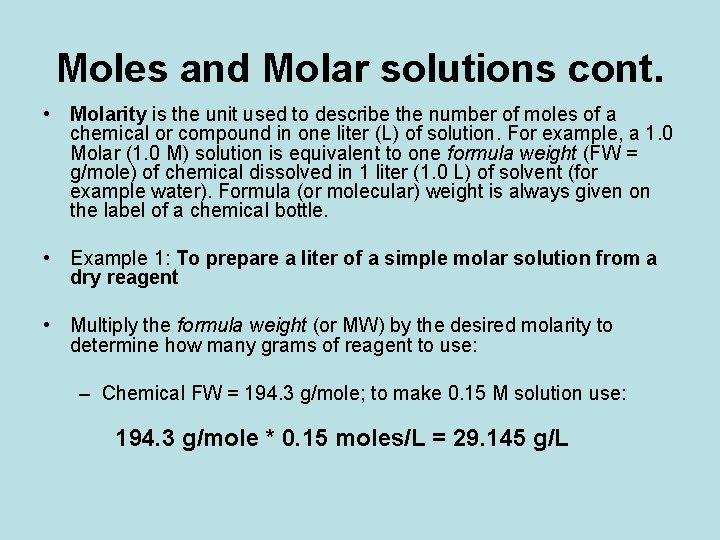
Moles and Molar solutions cont. • Molarity is the unit used to describe the number of moles of a chemical or compound in one liter (L) of solution. For example, a 1. 0 Molar (1. 0 M) solution is equivalent to one formula weight (FW = g/mole) of chemical dissolved in 1 liter (1. 0 L) of solvent (for example water). Formula (or molecular) weight is always given on the label of a chemical bottle. • Example 1: To prepare a liter of a simple molar solution from a dry reagent • Multiply the formula weight (or MW) by the desired molarity to determine how many grams of reagent to use: – Chemical FW = 194. 3 g/mole; to make 0. 15 M solution use: 194. 3 g/mole * 0. 15 moles/L = 29. 145 g/L
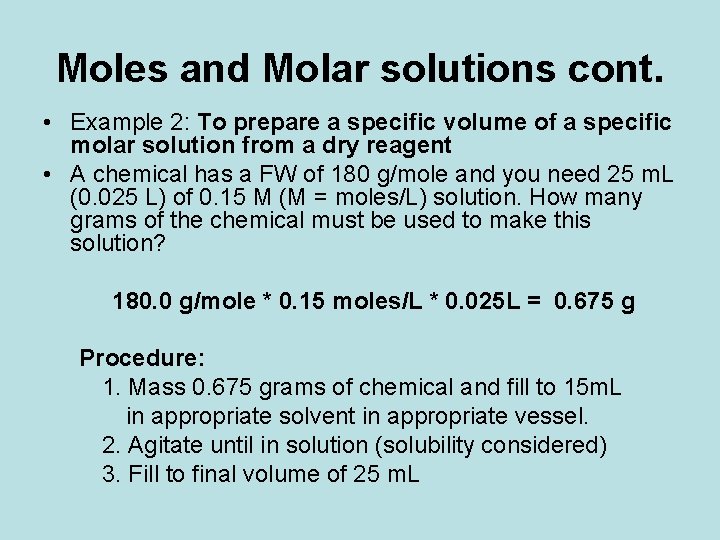
Moles and Molar solutions cont. • Example 2: To prepare a specific volume of a specific molar solution from a dry reagent • A chemical has a FW of 180 g/mole and you need 25 m. L (0. 025 L) of 0. 15 M (M = moles/L) solution. How many grams of the chemical must be used to make this solution? 180. 0 g/mole * 0. 15 moles/L * 0. 025 L = 0. 675 g Procedure: 1. Mass 0. 675 grams of chemical and fill to 15 m. L in appropriate solvent in appropriate vessel. 2. Agitate until in solution (solubility considered) 3. Fill to final volume of 25 m. L
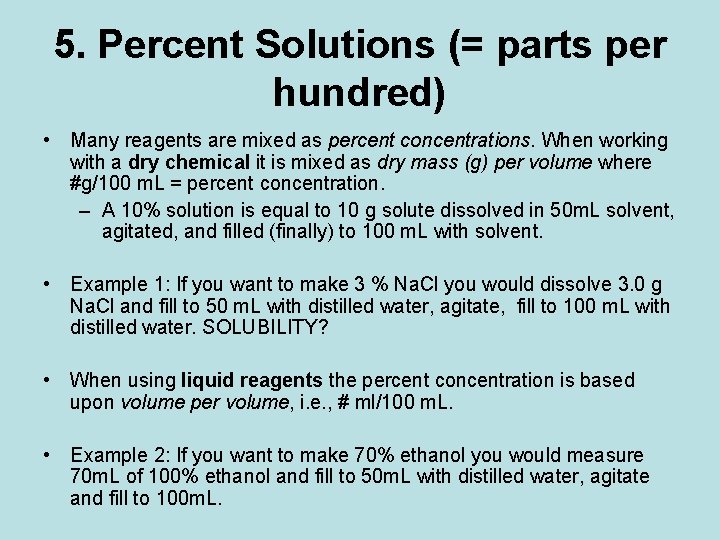
5. Percent Solutions (= parts per hundred) • Many reagents are mixed as percent concentrations. When working with a dry chemical it is mixed as dry mass (g) per volume where #g/100 m. L = percent concentration. – A 10% solution is equal to 10 g solute dissolved in 50 m. L solvent, agitated, and filled (finally) to 100 m. L with solvent. • Example 1: If you want to make 3 % Na. Cl you would dissolve 3. 0 g Na. Cl and fill to 50 m. L with distilled water, agitate, fill to 100 m. L with distilled water. SOLUBILITY? • When using liquid reagents the percent concentration is based upon volume per volume, i. e. , # ml/100 m. L. • Example 2: If you want to make 70% ethanol you would measure 70 m. L of 100% ethanol and fill to 50 m. L with distilled water, agitate and fill to 100 m. L.
• To convert from % solution to molarity, multiply the percent solution value by 10 to get grams/L, then divide by the formula weight. • Molarity = (% solution) * 10 FW • Example 3: Convert a 6. 5 % solution of a chemical with FW = 325. 6 to molarity • [(6. 5 g/100 ml) * 10] / 325. 6 g/L = 0. 1996 M • To convert from molarity to percent solution, multiply the molarity by the FW and divide by 10: • % solution = molarity * FW 10 • Example 4: Convert a 0. 0045 M solution of a chemical having FW 178. 7 to percent solution: • • [0. 0045 moles/L * 178. 7 g/mole] / 10 = 0. 08 % solution
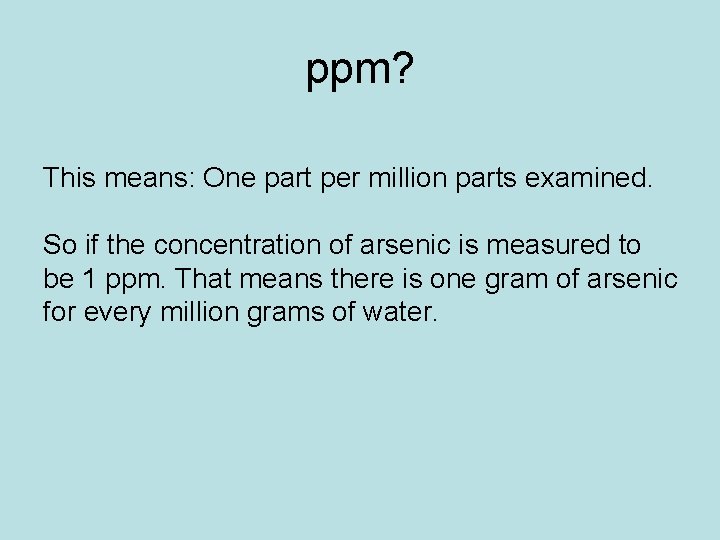
ppm? This means: One part per million parts examined. So if the concentration of arsenic is measured to be 1 ppm. That means there is one gram of arsenic for every million grams of water.