Historical context of Alaska Reclaiming the role of


- Slides: 29
Historical context of Alaska: Reclaiming the role of Elders Rosellen M. Rosich, Ph. D. Professor Emerita of Psychology, PI-UAA School of Allied Health AK GILD (GWEP) University of Alaska Anchorage, AK. , United States November 20, 2015
Learning Objectives After attending this session participants will be able to • Identify several geographical factors that may impact accessibility of health care by Alaska Native Peoples • Distinguish Elder from elder and what that means for functioning within Alaska Native culture • Name two historical events that have greatly impacted Alaska Native People and their health care belief system
Where are you from ? • Born and raised in Cleveland, OH, US • Ethnic background is not all European (Croatian/German/Scandinavian, Italian/Greek, British/Irish, Middle Eastern, Oceanic) • Daughter of Peter Rosich and Margaret Caprett(a) • Grandaughter of John/Helen Rosich (Rosic’) and Alberto Caprett(a)/Rosa Gentile
Significance & Background • Paucity of information on aging in Circumpolar North nor among Native Peoples of Alaska • To understand the environmental context in which Alaska Native People age one must familiarize themselves with the geography of AK as well as sociohistorical and cultural factors impacting the indigenous peoples of the state • This presentation provides an overview of the context of Alaska and historical factors which have impacted Alaska Native Elders and their health care belief systems
Alaska Geographical Context & Demographics
How Big is Alaska? Comparison to US www. Matadomework. com/trips/just-how-big-is-alaska-anway
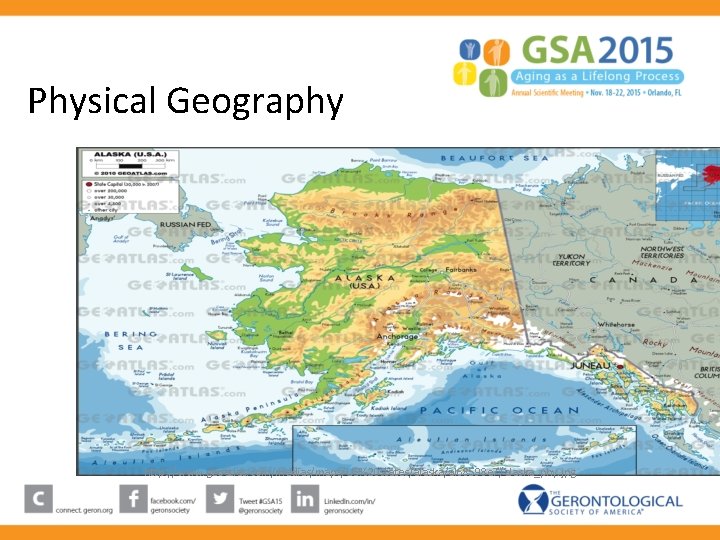
Physical Geography http: //www. geoatlas. com/medias/maps/US%20 states/alaska/al 68598 e 7/alaska_phy. jpg
Overall Demographics • Last Frontier is home to 736, 732 residents according to the 2014 U. S. Census Bureau • Average population density consists of 1. 2 people per square mile (overall U. S. is 89. 5) • Alaska Natives/American Indians constitute 19% of population (one of six residents selfidentifies as Alaska Native or in combination with another race)*
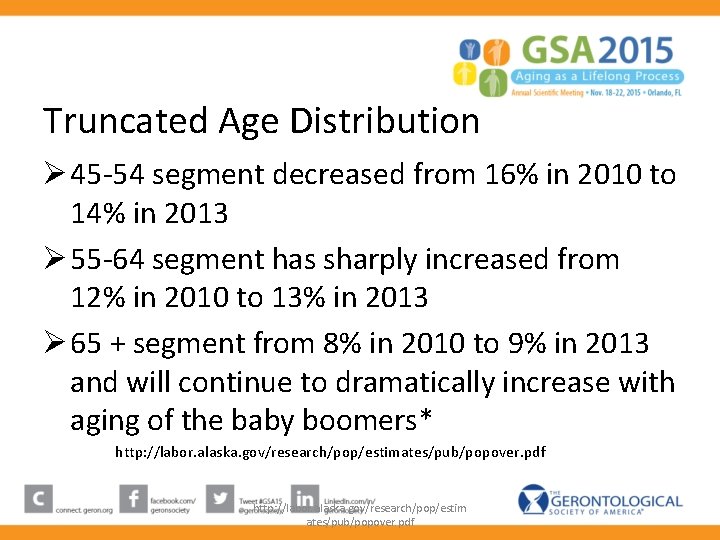
Truncated Age Distribution Ø 45 -54 segment decreased from 16% in 2010 to 14% in 2013 Ø 55 -64 segment has sharply increased from 12% in 2010 to 13% in 2013 Ø 65 + segment from 8% in 2010 to 9% in 2013 and will continue to dramatically increase with aging of the baby boomers* http: //labor. alaska. gov/research/pop/estimates/pub/popover. pdf http: //labor. alaska. gov/research/pop/estim ates/pub/popover. pdf
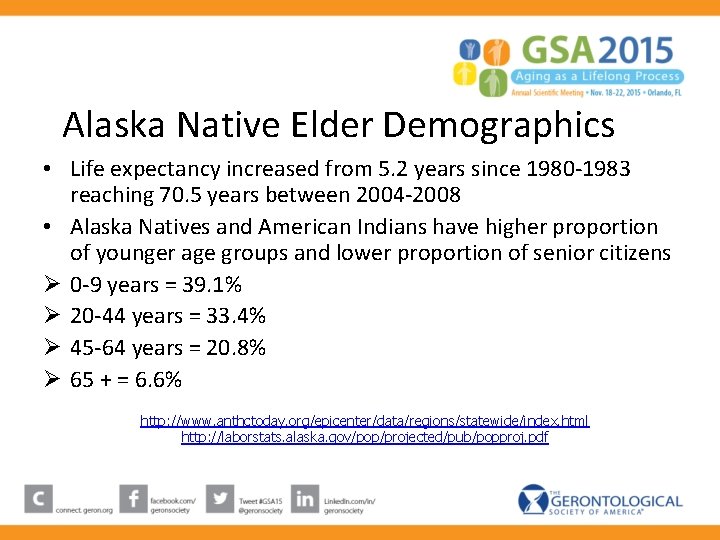
Alaska Native Elder Demographics • Life expectancy increased from 5. 2 years since 1980 -1983 reaching 70. 5 years between 2004 -2008 • Alaska Natives and American Indians have higher proportion of younger age groups and lower proportion of senior citizens Ø 0 -9 years = 39. 1% Ø 20 -44 years = 33. 4% Ø 45 -64 years = 20. 8% Ø 65 + = 6. 6% http: //www. anthctoday. org/epicenter/data/regions/statewide/index. html http: //laborstats. alaska. gov/pop/projected/pub/popproj. pdf
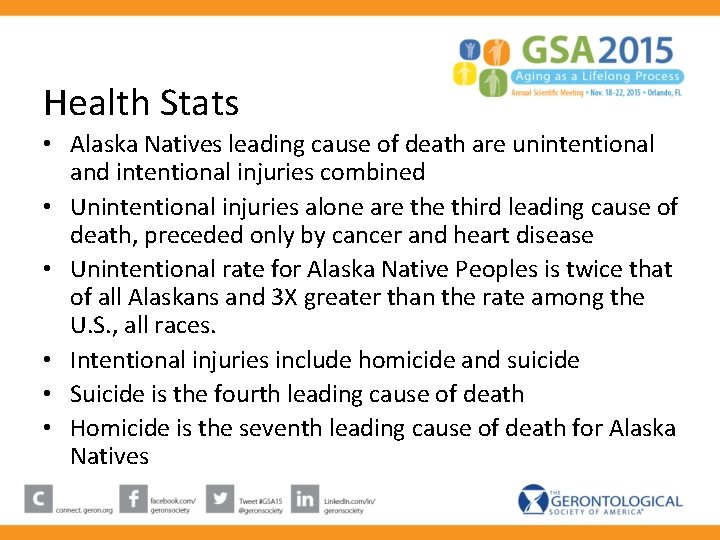
Health Stats • Alaska Natives leading cause of death are unintentional and intentional injuries combined • Unintentional injuries alone are third leading cause of death, preceded only by cancer and heart disease • Unintentional rate for Alaska Native Peoples is twice that of all Alaskans and 3 X greater than the rate among the U. S. , all races. • Intentional injuries include homicide and suicide • Suicide is the fourth leading cause of death • Homicide is the seventh leading cause of death for Alaska Natives
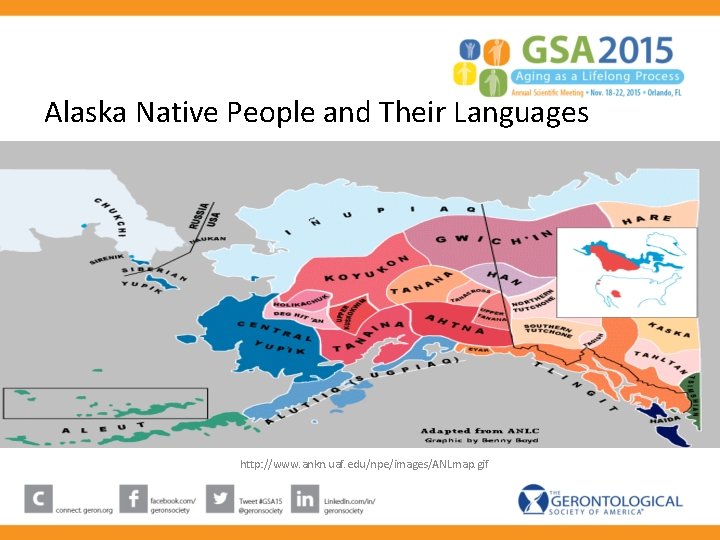
Alaska Native People and Their Languages http: //www. ankn. uaf. edu/npe/images/ANLmap. gif
Historical Context and Alaska Natives: The Cohort Analysis Method
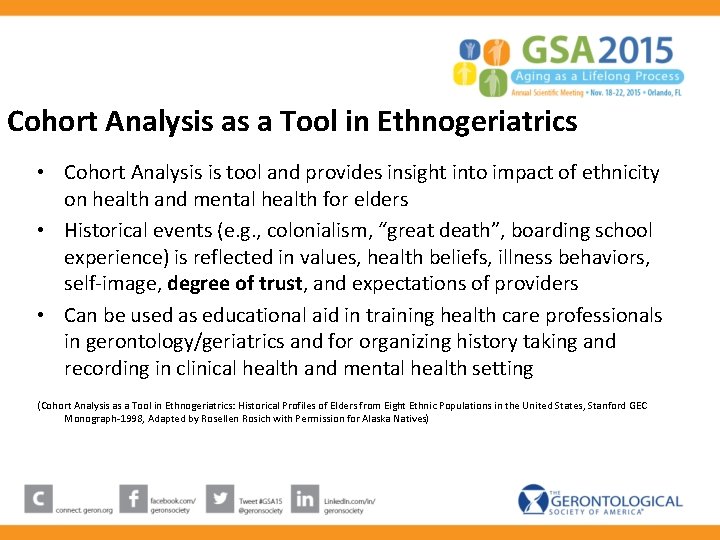
Cohort Analysis as a Tool in Ethnogeriatrics • Cohort Analysis is tool and provides insight into impact of ethnicity on health and mental health for elders • Historical events (e. g. , colonialism, “great death”, boarding school experience) is reflected in values, health beliefs, illness behaviors, self-image, degree of trust, and expectations of providers • Can be used as educational aid in training health care professionals in gerontology/geriatrics and for organizing history taking and recording in clinical health and mental health setting (Cohort Analysis as a Tool in Ethnogeriatrics: Historical Profiles of Elders from Eight Ethnic Populations in the United States, Stanford GEC Monograph-1998, Adapted by Rosellen Rosich with Permission for Alaska Natives)
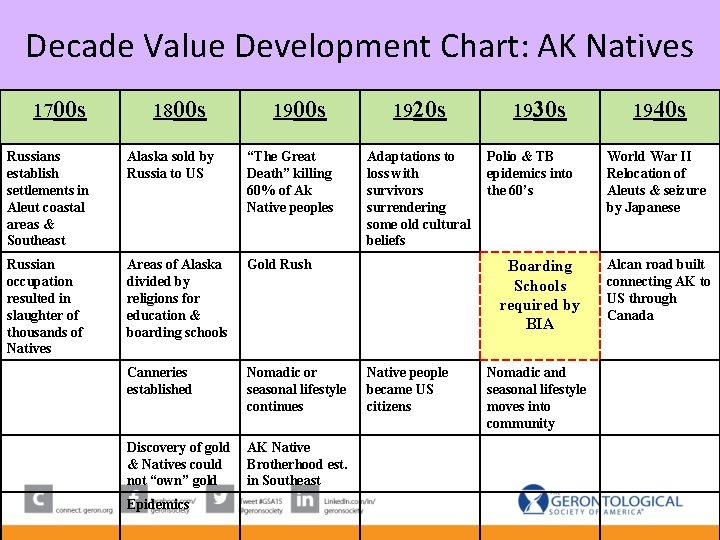
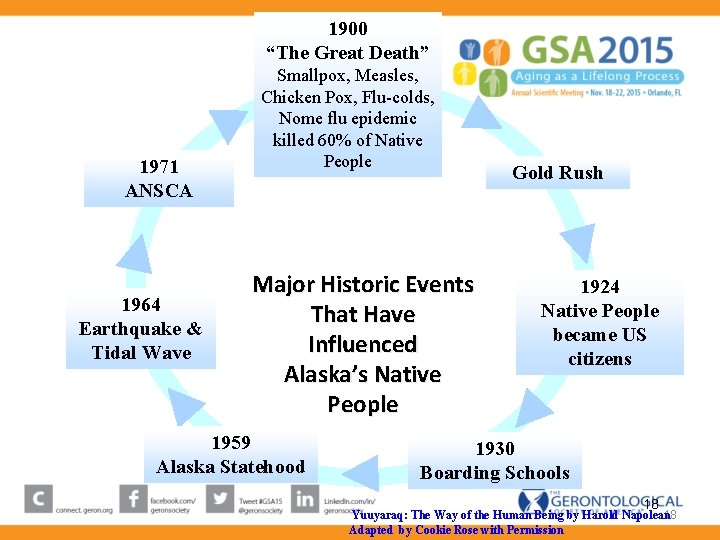
Decade Value Development Chart: AK Natives 1700 s 1800 s 1900 s Russians establish settlements in Aleut coastal areas & Southeast Alaska sold by Russia to US “The Great Death” killing 60% of Ak Native peoples Russian occupation resulted in slaughter of thousands of Natives Areas of Alaska divided by religions for education & boarding schools Gold Rush Canneries established Nomadic or seasonal lifestyle continues Discovery of gold & Natives could not “own” gold AK Native Brotherhood est. in Southeast Epidemics 1920 s Adaptations to loss with survivors surrendering some old cultural beliefs 1930 s Polio & TB epidemics into the 60’s Boarding Schools required by BIA Native people became US citizens Nomadic and seasonal lifestyle moves into community 1940 s World War II Relocation of Aleuts & seizure by Japanese Alcan road built connecting AK to US through Canada
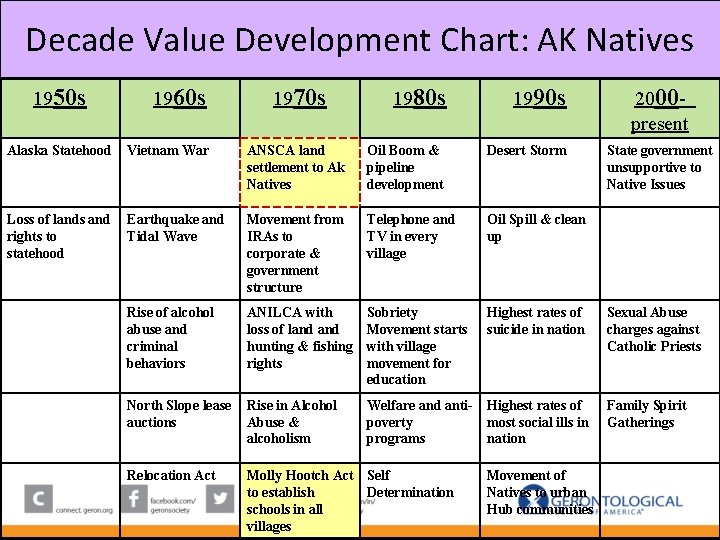
Decade Value Development Chart: AK Natives 1950 s 1960 s 1970 s 1980 s 1990 s 2000 present Alaska Statehood Vietnam War ANSCA land settlement to Ak Natives Oil Boom & pipeline development Desert Storm Loss of lands and rights to statehood Earthquake and Tidal Wave Movement from IRAs to corporate & government structure Telephone and TV in every village Oil Spill & clean up Rise of alcohol abuse and criminal behaviors ANILCA with loss of land hunting & fishing rights Sobriety Movement starts with village movement for education Highest rates of suicide in nation Sexual Abuse charges against Catholic Priests North Slope lease auctions Rise in Alcohol Abuse & alcoholism Welfare and antipoverty programs Highest rates of most social ills in nation Family Spirit Gatherings Relocation Act Molly Hootch Act Self to establish Determination schools in all villages Movement of Natives to urban Hub communities State government unsupportive to Native Issues
1900 “The Great Death” 1971 ANSCA 1964 Earthquake & Tidal Wave Smallpox, Measles, Chicken Pox, Flu-colds, Nome flu epidemic killed 60% of Native People Major Historic Events That Have Influenced Alaska’s Native People 1959 Alaska Statehood Gold Rush 1924 Native People became US citizens 1930 Boarding Schools 18 Yuuyaraq: The Way of the Human Being by Harold Napolean 18 Adapted by Cookie Rose with Permission
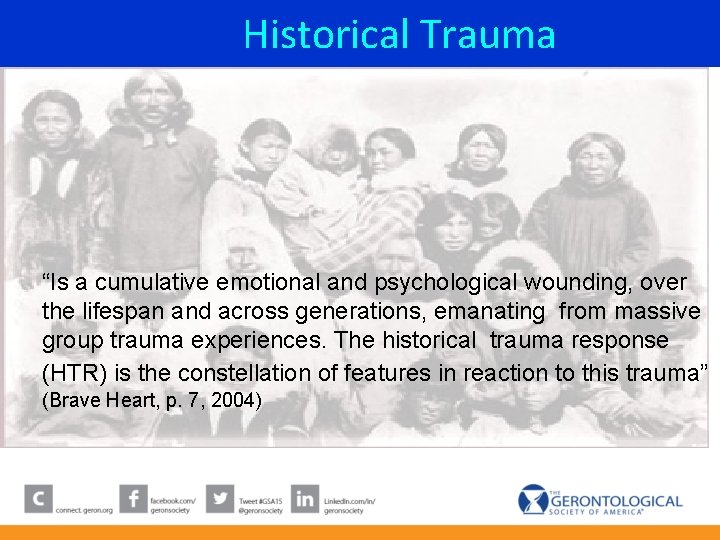
Historical Trauma “Is a cumulative emotional and psychological wounding, over the lifespan and across generations, emanating from massive group trauma experiences. The historical trauma response (HTR) is the constellation of features in reaction to this trauma” (Brave Heart, p. 7, 2004)
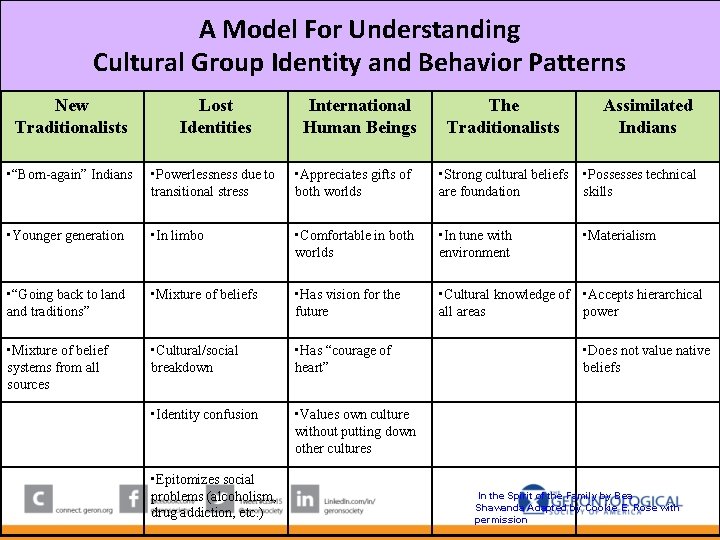
A Model For Understanding Cultural Group Identity and Behavior Patterns New Traditionalists Lost Identities • “Born-again” Indians • Powerlessness due to transitional stress • Appreciates gifts of both worlds • Strong cultural beliefs are foundation • Possesses technical skills • Younger generation • In limbo • Comfortable in both worlds • In tune with environment • Materialism • “Going back to land traditions” • Mixture of beliefs • Has vision for the future • Cultural knowledge of • Accepts hierarchical all areas power • Mixture of belief systems from all sources • Cultural/social breakdown • Has “courage of heart” • Identity confusion • Values own culture without putting down other cultures • Epitomizes social problems (alcoholism, drug addiction, etc. ) International Human Beings The Traditionalists Assimilated Indians • Does not value native beliefs In the Spirit of the Family by Bea Shawanda Adapted by Cookie E. Rose with permission
Role of Native Elders “Reclaiming the role of the Elder” • Transmits ancestral knowledge to youth, community, and family • Instructs, guides and enhances self awareness and teaches self-control, proper behavior and thought processes • Teaches interdependency (collectivistic sense of self) • More recent-wellness counselors
Acknowledgements • • • Elizabeth (Cookie) Rose (Athabascan) Kathy Graves ( Sugpiaq –Athabascan) Harold Napolean (Yupik) Bea Shawanda Stanford Geriatric Education Center (SGEC) Former Alaska Geriatric Education Center (AKGEC)
Contact Information Rosellen M. Rosich, Ph. D. Professor Emerita of Psychology, PI-UAA School of Allied Health AK GILD (GWEP) University of Alaska Anchorage 3211 Providence Drive Department of Psychology Anchorage, AK. , 99508 United States E-mail: rmrosich@uaa. alaska. edu
Thank you for your attendance! Enjoy the rest of the conference.
References • Brave Heart, M. (2003). The historical trauma response among natives and its relationship with substance abuse: a Lakota illustration. Journal of Psychoactive Drugs, 35 (1), p. 7 -13. • Injury Prevention Program and The AK Native Epidemology Center-AK Native Tribal Health Consortium (2008). Alaska Native Injury, Atlas of Mortality and Mordibity. Retrieved November from http: //www. anthc. org/chs/wp/injprev/upload/ANTHC-Injury. Atlas-2008. pdf
References (cont. ) • Graves, K. & Shavings , L. (2004. ). Our view of dignified aging. National Resource Center for American Indian, Alaska Native and Native Hawaiian Elders, http: //elders. uaa. alaska. edu/Publications/yr 1_2 qualitative. pd f. • La. Bella, J. , Smith, S. , Easley, C. , & Charles, G (2005). Boarding School: Historical Trauma among Alaska Native People. White paper by the National Resource Center for America Indian, Alaska Native, and Native Hawaiian Elders. • Napolean, H. (1996) Yuuyaraq: The way of the human being. (Ed. ) Eric Madsen. Alaska Native Knowledge Network, University of Chicago Press.
References (Cont. ) • Mc. Bride & Rosich, (2013) Cohort Analysis and Life-Span Stages Linkage With Avatar-Case Study, AGHE & Diversity Rx conferences. • Rosich, R. M. & Rose, E. (2006). ELLAM IINGA, The eye of awareness: Alaska Native elders healing and strengthening communities. Presentation at 2006 Joint Conference of The National Council on the Aging and the American Society on Aging, Anaheim, CA. , March.
References (cont. ) • Yeo, G. , M. Mc. Bride, Hikoyeda, N. , Edwards, M. Soo-Young, L. , & Hendrix, L. (1998) Cohort analysis as a tool in ethnogeriatrics: Historical profiles of elders from eight ethnic populations in the U. S. (Working Paper Series No. 12, 2 nd ed. ) Palo Alto, CA: Stanford Geriatric Education Center, Stanford University
Web Resources: Maps • How Big is Alaska Anway-www. Matadomework. com/trips/just-how-big-isalaska-anway • Physical Geographyhttp: //www. geoatlas. com/medias/maps/US%20 states/alaska/al 68598 e 7/ alaska_phy. jpg • Alaska Native people and their languageshttp: //www. ankn. uaf. edu/npe/images/ANLmap. gif