HIGHER EDUCATION ACT 101 3 24 2019 Alisha
- Slides: 13
HIGHER EDUCATION ACT 101 3 / 24 / 2019 Alisha Hyslop, Director of Public Policy Association for Career and Technical Education Jennifer Stiddard, Director of Government Relations Association of Community College Trustees
Higher Education Act 101 § § § § Title I – General Provisions Title II – Teacher Quality Enhancement Title III – Institutional Aid Title IV – Student Assistance Title V – Developing Institutions Title VI – International Education Programs Title VII – Graduate and Postsecondary Improvement Programs Title VIII – Additional Programs
Title I – General Provision § Definitions o What is an institution of higher education? § Protection of student free speech § College navigator, data collection, consumer information § Textbook provisions
Title II – Teacher Quality Enhancement § Provisions on program accountability and evaluation o program data collection o state and institutional report cards o identifying low-performing programs § Teacher Quality Partnership Grants o partnerships among institutions of higher education, high-need local education agencies, high-need schools, and other eligible entities that work together to develop a pipeline of profession-ready teachers o Grantees must provide clinical experience and induction program o Requires 3 -year teaching commitment § Enhancing Teachers o increasing educator diversity, educator use of technology in classrooms, adjunct teacher corps, and PD on teaching students with disabilities o Never received funding
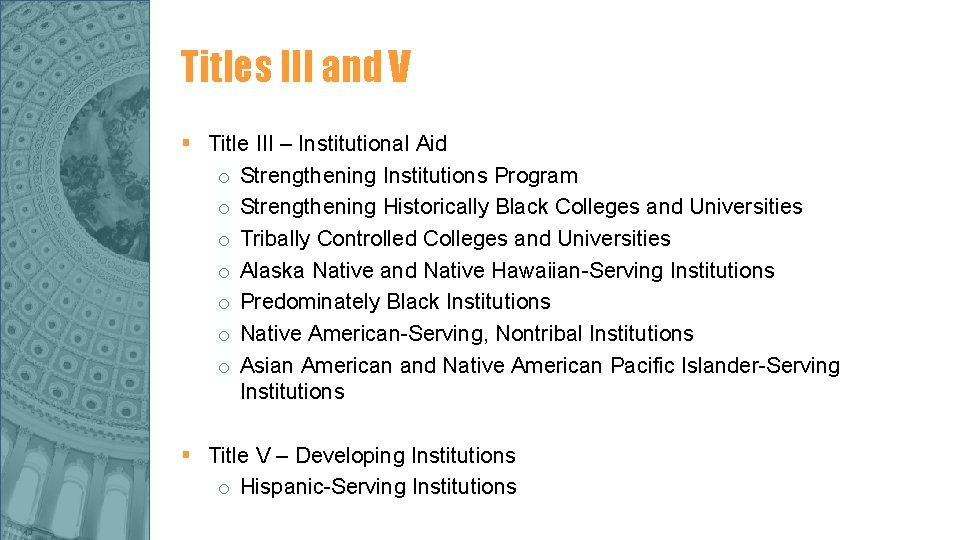
Titles III and V § Title III – Institutional Aid o Strengthening Institutions Program o Strengthening Historically Black Colleges and Universities o Tribally Controlled Colleges and Universities o Alaska Native and Native Hawaiian-Serving Institutions o Predominately Black Institutions o Native American-Serving, Nontribal Institutions o Asian American and Native American Pacific Islander-Serving Institutions § Title V – Developing Institutions o Hispanic-Serving Institutions
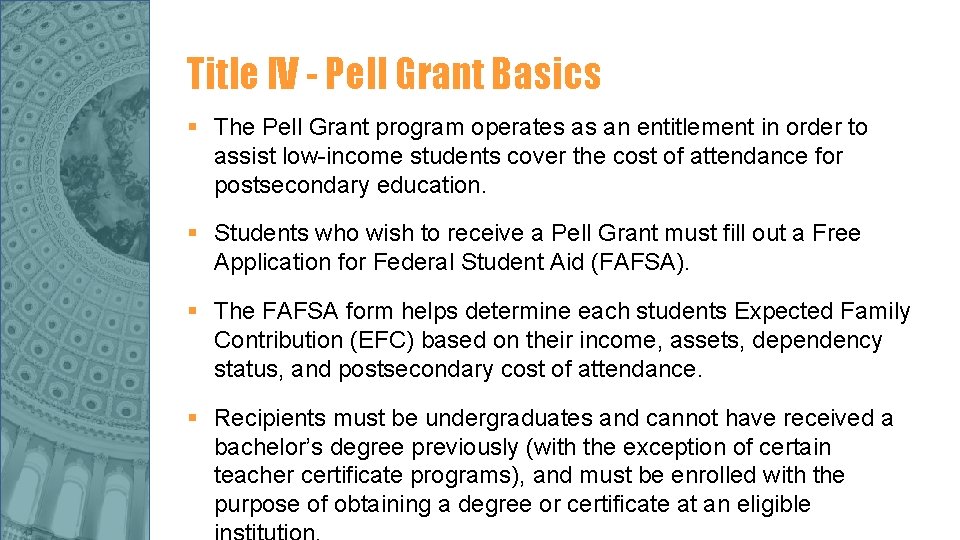
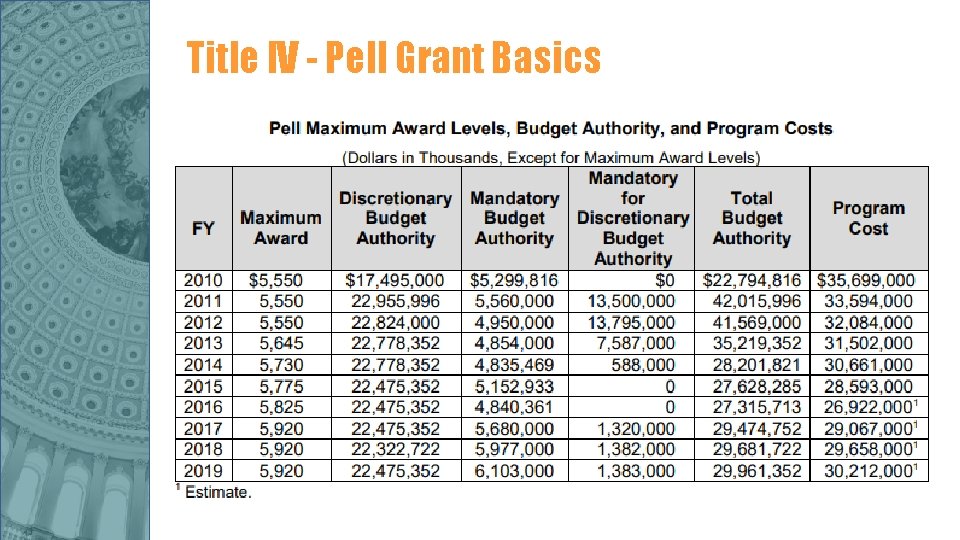
Title IV - Pell Grant Basics § The Pell Grant program operates as an entitlement in order to assist low-income students cover the cost of attendance for postsecondary education. § Students who wish to receive a Pell Grant must fill out a Free Application for Federal Student Aid (FAFSA). § The FAFSA form helps determine each students Expected Family Contribution (EFC) based on their income, assets, dependency status, and postsecondary cost of attendance. § Recipients must be undergraduates and cannot have received a bachelor’s degree previously (with the exception of certain teacher certificate programs), and must be enrolled with the purpose of obtaining a degree or certificate at an eligible
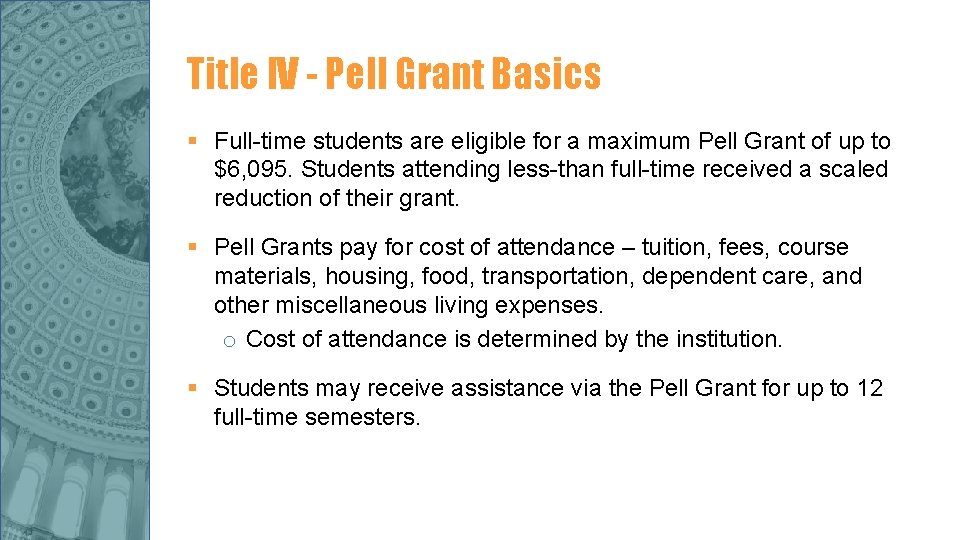
Title IV - Pell Grant Basics § Full-time students are eligible for a maximum Pell Grant of up to $6, 095. Students attending less-than full-time received a scaled reduction of their grant. § Pell Grants pay for cost of attendance – tuition, fees, course materials, housing, food, transportation, dependent care, and other miscellaneous living expenses. o Cost of attendance is determined by the institution. § Students may receive assistance via the Pell Grant for up to 12 full-time semesters.
Title IV - Pell Grant Basics
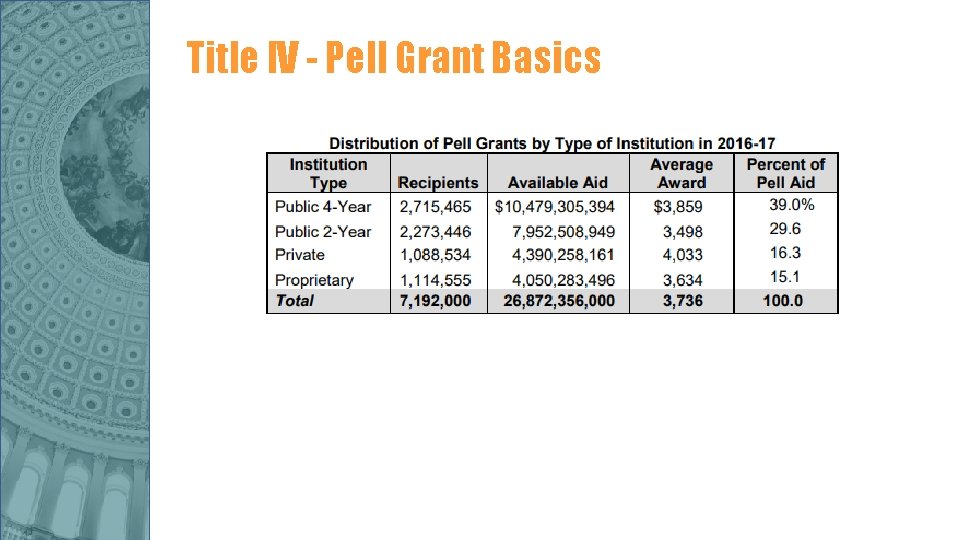
Title IV - Pell Grant Basics
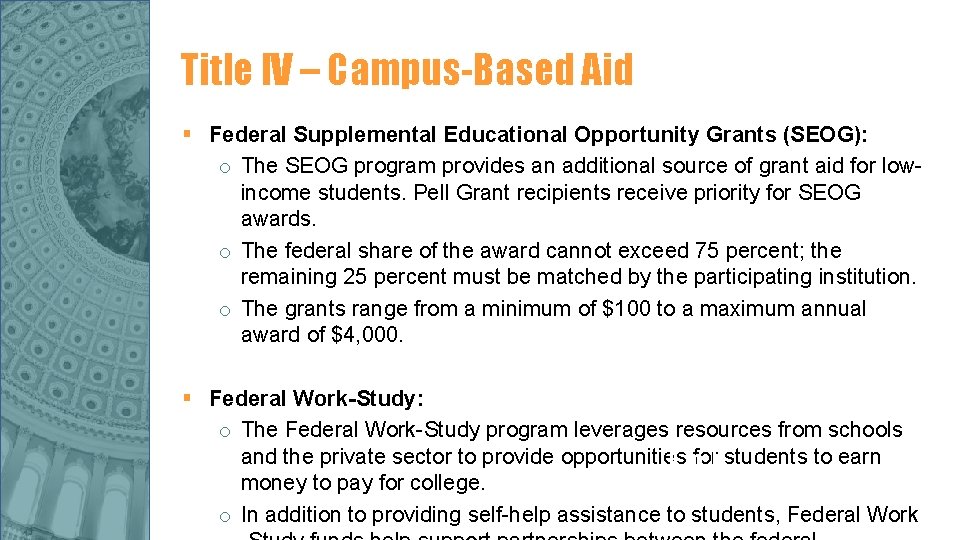
Title IV – Campus-Based Aid § Federal Supplemental Educational Opportunity Grants (SEOG): o The SEOG program provides an additional source of grant aid for lowincome students. Pell Grant recipients receive priority for SEOG awards. o The federal share of the award cannot exceed 75 percent; the remaining 25 percent must be matched by the participating institution. o The grants range from a minimum of $100 to a maximum annual award of $4, 000. § Federal Work-Study: o The Federal Work-Study program leverages resources from schools and the private sector to provide opportunities for students to earn 10 money to pay for college. o In addition to providing self-help assistance to students, Federal Work
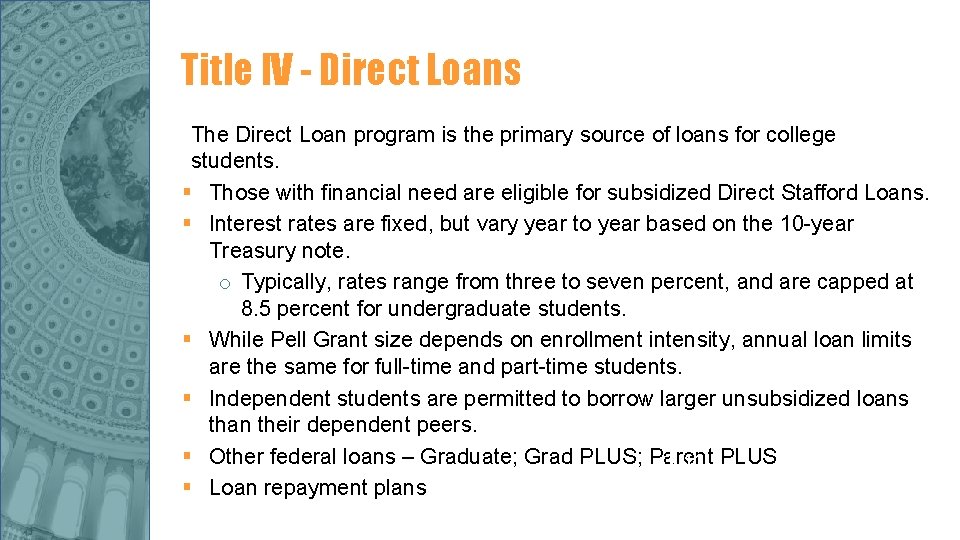
Title IV - Direct Loans The Direct Loan program is the primary source of loans for college students. § Those with financial need are eligible for subsidized Direct Stafford Loans. § Interest rates are fixed, but vary year to year based on the 10 -year Treasury note. o Typically, rates range from three to seven percent, and are capped at 8. 5 percent for undergraduate students. § While Pell Grant size depends on enrollment intensity, annual loan limits are the same for full-time and part-time students. § Independent students are permitted to borrow larger unsubsidized loans than their dependent peers. § Other federal loans – Graduate; Grad PLUS; Parent PLUS 11 § Loan repayment plans
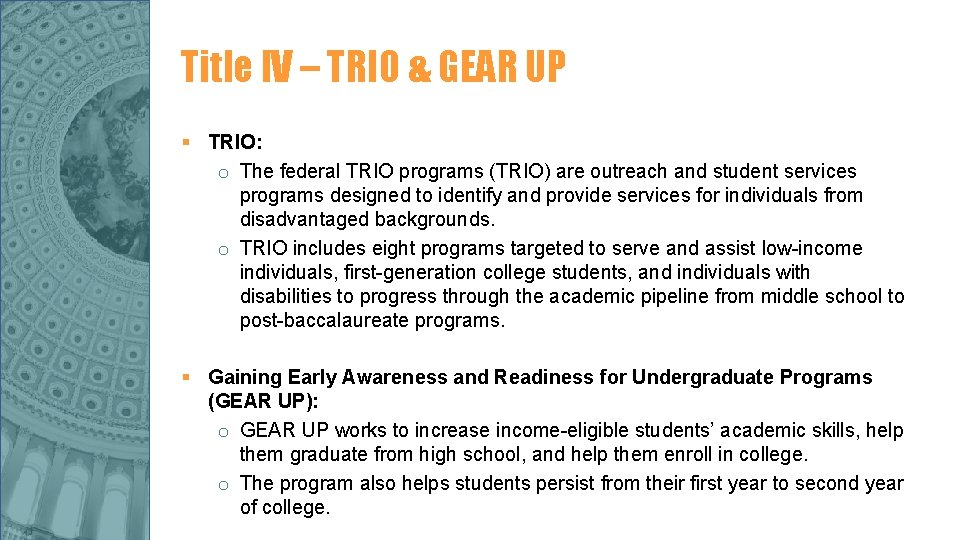
Title IV – TRIO & GEAR UP § TRIO: o The federal TRIO programs (TRIO) are outreach and student services programs designed to identify and provide services for individuals from disadvantaged backgrounds. o TRIO includes eight programs targeted to serve and assist low-income individuals, first-generation college students, and individuals with disabilities to progress through the academic pipeline from middle school to post-baccalaureate programs. § Gaining Early Awareness and Readiness for Undergraduate Programs (GEAR UP): o GEAR UP works to increase income-eligible students’ academic skills, help them graduate from high school, and help them enroll in college. o The program also helps students persist from their first year to second year of college.
Q&A