High Field program in Europe Gijs de Rijk
- Slides: 19
High Field program in Europe Gijs de Rijk CERN 22 May 2008 Gijs de Rijk 1
Outline • Ongoing HFM programs – Collaborative programs: FP 6 -CARE-NED – Core programs • Starting HFM programs – CERN High Field Magnet program – FP 7 -Eu. CARD WP 8 HFMs 22 May 2008 Gijs de Rijk 2
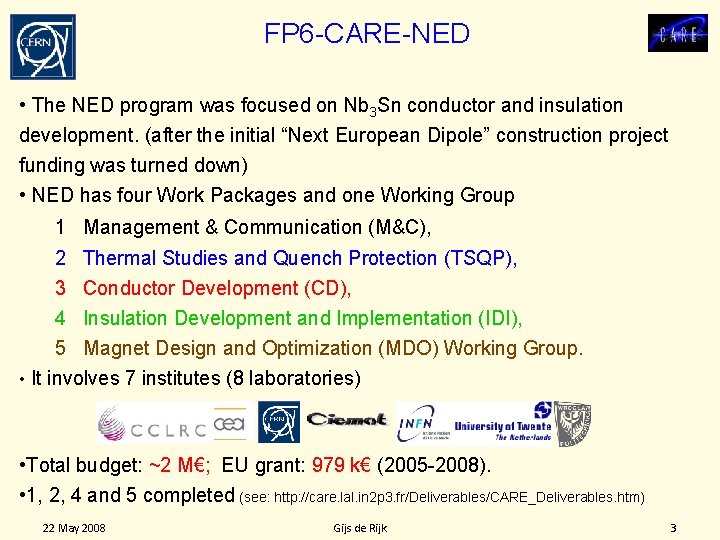
FP 6 -CARE-NED • The NED program was focused on Nb 3 Sn conductor and insulation development. (after the initial “Next European Dipole” construction project funding was turned down) • NED has four Work Packages and one Working Group 1 Management & Communication (M&C), 2 Thermal Studies and Quench Protection (TSQP), 3 Conductor Development (CD), 4 Insulation Development and Implementation (IDI), 5 Magnet Design and Optimization (MDO) Working Group. • It involves 7 institutes (8 laboratories) • Total budget: ~2 M€; EU grant: 979 k€ (2005 -2008). • 1, 2, 4 and 5 completed (see: http: //care. lal. in 2 p 3. fr/Deliverables/CARE_Deliverables. htm) 22 May 2008 Gijs de Rijk 3
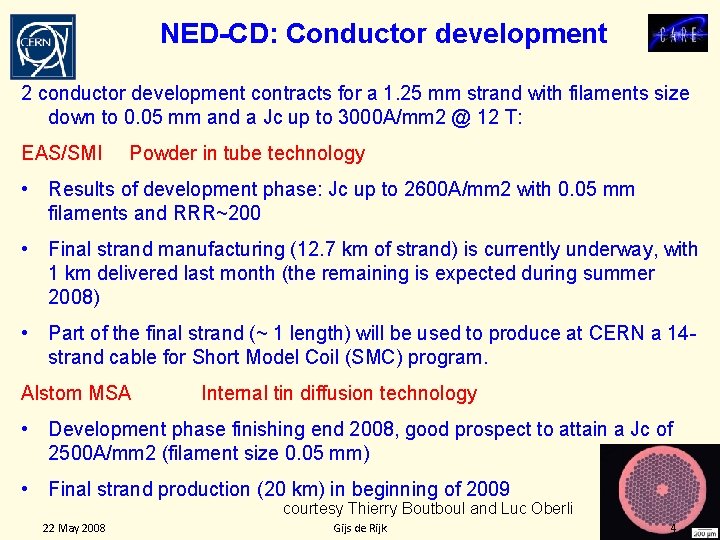
NED-CD: Conductor development 2 conductor development contracts for a 1. 25 mm strand with filaments size down to 0. 05 mm and a Jc up to 3000 A/mm 2 @ 12 T: EAS/SMI Powder in tube technology • Results of development phase: Jc up to 2600 A/mm 2 with 0. 05 mm filaments and RRR~200 • Final strand manufacturing (12. 7 km of strand) is currently underway, with 1 km delivered last month (the remaining is expected during summer 2008) • Part of the final strand (~ 1 length) will be used to produce at CERN a 14 strand cable for Short Model Coil (SMC) program. Alstom MSA Internal tin diffusion technology • Development phase finishing end 2008, good prospect to attain a Jc of 2500 A/mm 2 (filament size 0. 05 mm) • Final strand production (20 km) in beginning of 2009 courtesy Thierry Boutboul and Luc Oberli 22 May 2008 Gijs de Rijk 4
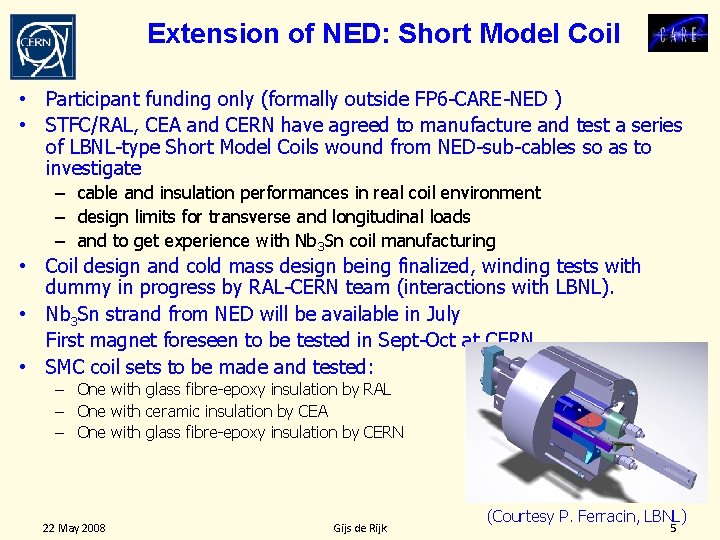
Extension of NED: Short Model Coil • Participant funding only (formally outside FP 6 -CARE-NED ) • STFC/RAL, CEA and CERN have agreed to manufacture and test a series of LBNL-type Short Model Coils wound from NED-sub-cables so as to investigate – cable and insulation performances in real coil environment – design limits for transverse and longitudinal loads – and to get experience with Nb 3 Sn coil manufacturing • Coil design and cold mass design being finalized, winding tests with dummy in progress by RAL-CERN team (interactions with LBNL). • Nb 3 Sn strand from NED will be available in July First magnet foreseen to be tested in Sept-Oct at CERN • SMC coil sets to be made and tested: – One with glass fibre-epoxy insulation by RAL – One with ceramic insulation by CEA – One with glass fibre-epoxy insulation by CERN 22 May 2008 Gijs de Rijk (Courtesy P. Ferracin, LBNL) 5
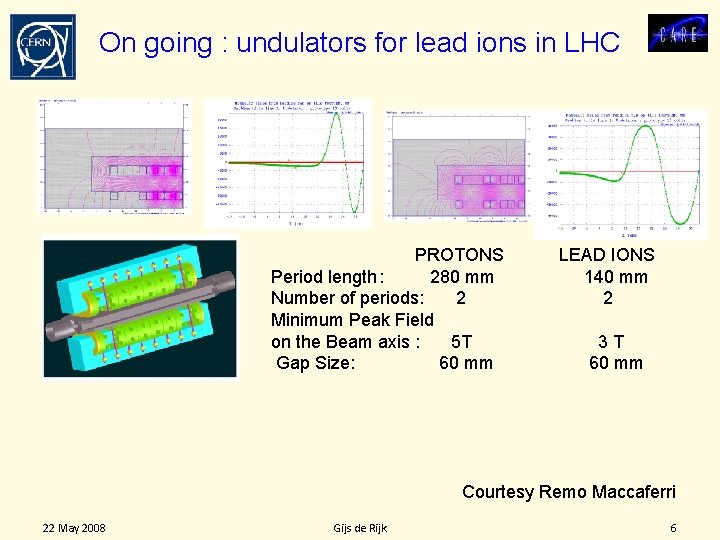
On going : undulators for lead ions in LHC PROTONS Period length : 280 mm Number of periods: 2 Minimum Peak Field on the Beam axis : 5 T Gap Size: 60 mm LEAD IONS 140 mm 2 3 T 60 mm Courtesy Remo Maccaferri 22 May 2008 Gijs de Rijk 6
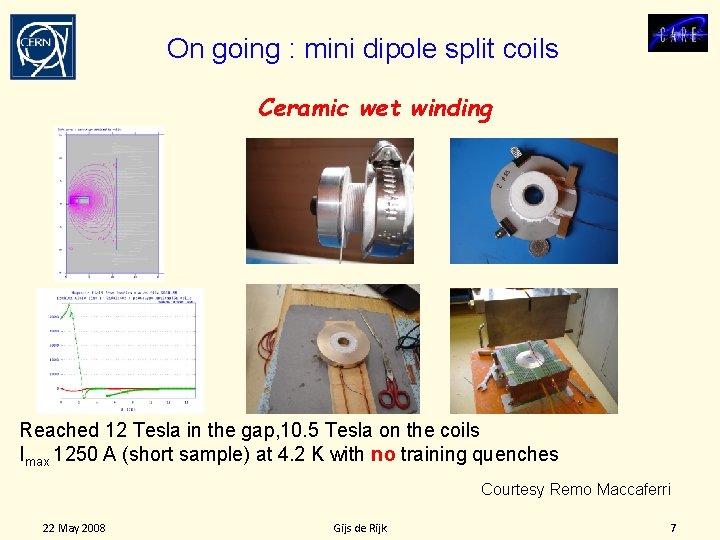
On going : mini dipole split coils Ceramic wet winding Reached 12 Tesla in the gap, 10. 5 Tesla on the coils Imax 1250 A (short sample) at 4. 2 K with no training quenches Courtesy Remo Maccaferri 22 May 2008 Gijs de Rijk 7
CEA Nb 3 Sn quadrupole Model 1 m quadrupole with Nb 3 Sn coils with the identical cross section as the LHC main arc quadrupole • aim learn Nb 3 Sn coil technology • Design gradient 211 T/m in a 56 mm diameter bore • Test this summer See presentation by J-M. Rifflet 22 May 2008 Gijs de Rijk 8
CERN High field magnet program • Need for HFM program – LHC luminosity upgrade: high field low beta quadrupole magnets • Increase luminosity by a factor 1. 4 due to the high fields alone • Larger apertures possible (high Bmax) ==> needed for high beam currents – Special magnets in LHC at high radiation zones (cleaning insertions, dispersion suppressors, etc. ). Presently posing limits – (far) Future new machines: neutrino factories, LHC doubler • The conductor: Nb 3 Sn (and some HTS) – Critical parameters Nb 3 Sn vs Nb-Ti field: 27 T vs 13 T temp: 18 K vs 9 K – But : not easy due to brittleness and stress sensitivity • Vigorous R&D program needed if we want this technology to be applied for the LHC phase II upgrade in 2017 • CERN High Field Magnet program starting in 2008 with several funding sources: “white paper” program, FP 7 -IA-Eu. CARD, CERN core program 22 May 2008 Gijs de Rijk 9
Nb 3 Sn magnets • To date: – Accelerator quality Nb 3 Sn magnet start to exist but are not yet ‘installable’ – All dipole or quadrupoles are either short or have an insufficient field quality or a too small aperture – One 4 m racetrack magnet exists now since this summer (LARP) – The LARP program (FNAL, LBNL, BNL) is working on Nb 3 Sn quadrupoles since a few years (+ FNAL, LBNL, BNL core programs) and getting to working magnets. They need support and competition/collaboration (hardware). • Nb-Ti technology is limited to a maximum field of 9 T at operational currents and with limited temperature margin • Nb 3 Sn solenoids exist commercially up to ~20 T • If we need higher fields ( Max B > 9 T ) in accelerators then we have to get Nb 3 Sn technology under control also for dipole and quadrupole coil geometries 22 May 2008 Gijs de Rijk 10
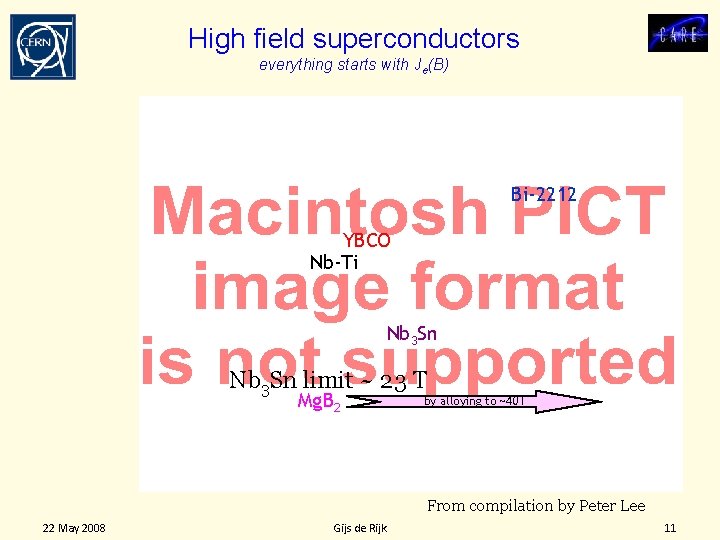
High field superconductors everything starts with Je(B) Bi-2212 YBCO Nb-Ti Nb 3 Sn limit ~ 23 T Mg. B 2 by alloying to ~40 T From compilation by Peter Lee 22 May 2008 Gijs de Rijk 11
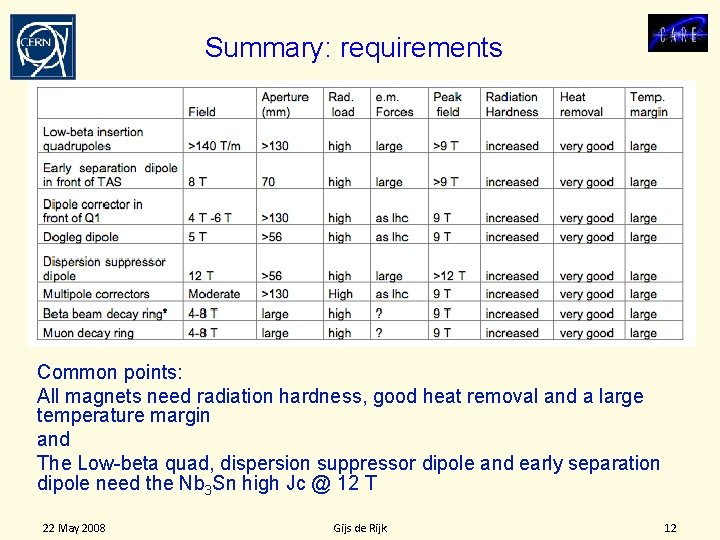
Summary: requirements Common points: All magnets need radiation hardness, good heat removal and a large temperature margin and The Low-beta quad, dispersion suppressor dipole and early separation dipole need the Nb 3 Sn high Jc @ 12 T 22 May 2008 Gijs de Rijk 12
CERN High field magnet program: 4 “chapters” of R&D • Conductor – 6 yr continuous development program (aim: Jc=3000 A/mm 2, filaments < mm, low and understood stress sensitivity) • Enabling technologies – – design choices( cos(theta) vs block coil, collars vs shell ) Insulation, thermal effects, radiation hardness, mechanical tests Subscale models ( racetrack coil tests ) High temp superconductor: prospect insert coils to go up to 20 T • Models – Dipole model (1. 5 m long, 100 mm aperture, 13 T) ==> FP 7 -IA-Eu. CARD 2010 -2011 – Quadrupole model (1 m, 130 mm aperture, >150 T/m) 2012 – Corrector models 2012 • Prototype magnet – 4 m long prototype 2012 -2013 Very important: In collaboration with other institutes: ( e. g. BNL, CEA, CIEMAT, CNRS, FNAL, FZK, INFN, KEK, LBNL, RAL, TUT, UNIGE, UT, PWR, etc ) 22 May 2008 Gijs de Rijk 13
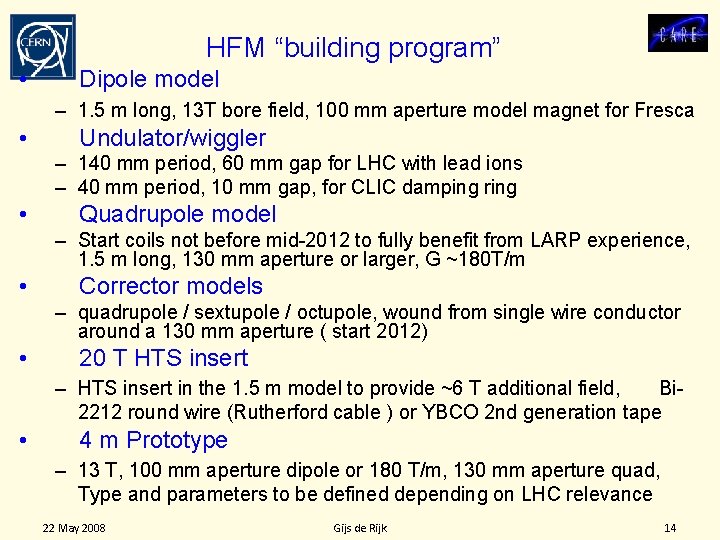
HFM “building program” • Dipole model – 1. 5 m long, 13 T bore field, 100 mm aperture model magnet for Fresca • Undulator/wiggler – 140 mm period, 60 mm gap for LHC with lead ions – 40 mm period, 10 mm gap, for CLIC damping ring • Quadrupole model – Start coils not before mid-2012 to fully benefit from LARP experience, 1. 5 m long, 130 mm aperture or larger, G ~180 T/m • Corrector models – quadrupole / sextupole / octupole, wound from single wire conductor around a 130 mm aperture ( start 2012) • 20 T HTS insert – HTS insert in the 1. 5 m model to provide ~6 T additional field, Bi 2212 round wire (Rutherford cable ) or YBCO 2 nd generation tape • 4 m Prototype – 13 T, 100 mm aperture dipole or 180 T/m, 130 mm aperture quad, Type and parameters to be defined depending on LHC relevance 22 May 2008 Gijs de Rijk 14
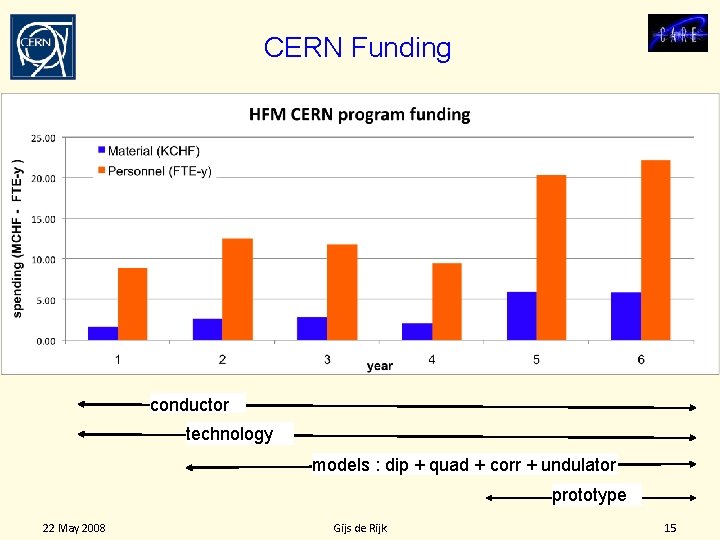
CERN Funding conductor technology models : dip + quad + corr + undulator prototype 22 May 2008 Gijs de Rijk 15
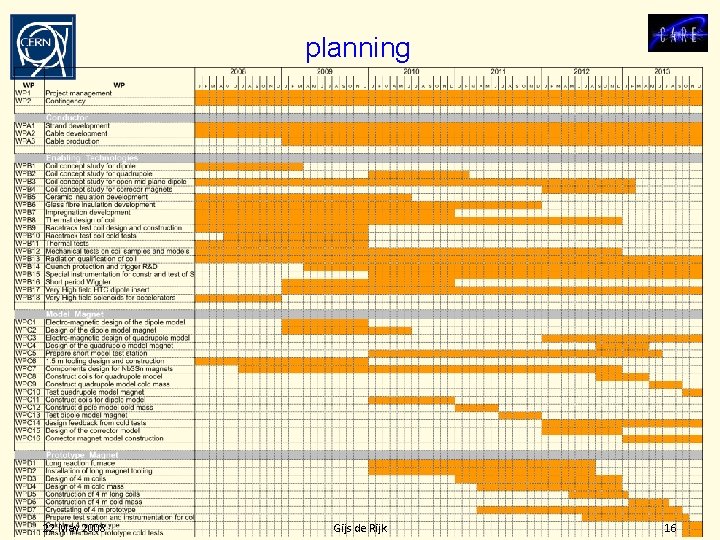
planning 22 May 2008 Gijs de Rijk 16
FP 7 -Eu. Card-WP 8 • WP 8 HFM: Superconducting High Field Magnets for higher luminosities and energies – – – – Task 1: Coordination and Communication. Task 2: Support studies Task 3 High field model Task 4 Very high field dipole insert Task 5 High Tc superconducting link Task 6 Superconducting wiggler for ANKA Task 7 Short period helical superconducting undulator • WP 8 is a CERN, CEA, CNRS, COLUMBUS, DESY, EHTS, FZK, INFN, PWR, SOTON, STFC, TUT, UNIGE collaboration • Status: proposal submitted • Project time span: 2009 -2012 • “cog-wheels” with the programs in the participating labs (at CERN it is part of the HFM program) 22 May 2008 Gijs de Rijk 17
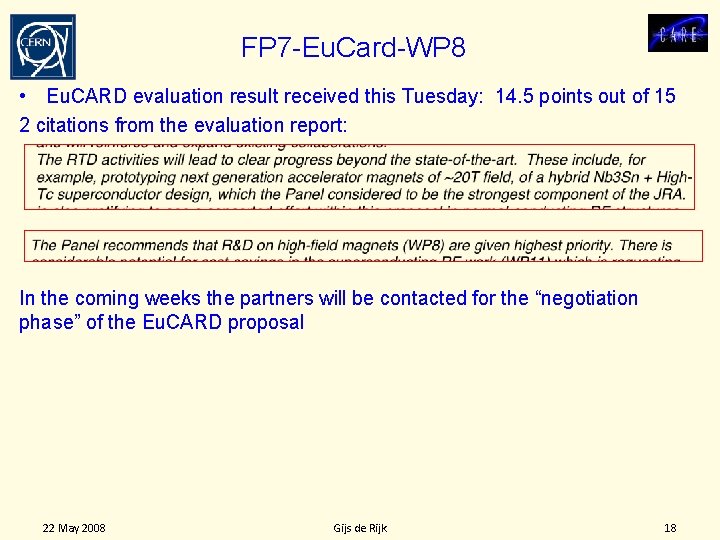
FP 7 -Eu. Card-WP 8 • Eu. CARD evaluation result received this Tuesday: 14. 5 points out of 15 2 citations from the evaluation report: In the coming weeks the partners will be contacted for the “negotiation phase” of the Eu. CARD proposal 22 May 2008 Gijs de Rijk 18
Outlook • After the LHC completion we enter again in a new round of HFM R&D • The difference with the last round in the 1990 -ies : x 1. 5 in field for SLHC and x 2. 5 for DLHC • The last round took 22 years between first ideas and machine commissioning (1986 -2008) • We have to hurry up if we want 12 T grade magnets in 20172018 for SLHC • The 20 T frontier has to be attacked now in order to have something ready for a DLHC in 20 years 22 May 2008 Gijs de Rijk 19