High energy particle emission as a challenging method
- Slides: 13
High energy α particle emission as a challenging method for synthesis of very heavy nuclei Catalin Borcea IFIN-HH INPC 2019, Glasgow, United Kingdom C. Borcea, IFIN-HH, INPC 2019 1
Outline Ø Super-Heavy Elements (SHE): The status Ø Spectra of light particle emission in heavy-ion induced reactions at incident energy <10 Me. V/A: implications for the SHE research Ø Necessary developments of the experimental methods Ø Conclusions C. Borcea, IFIN-HH, INPC 2019 2
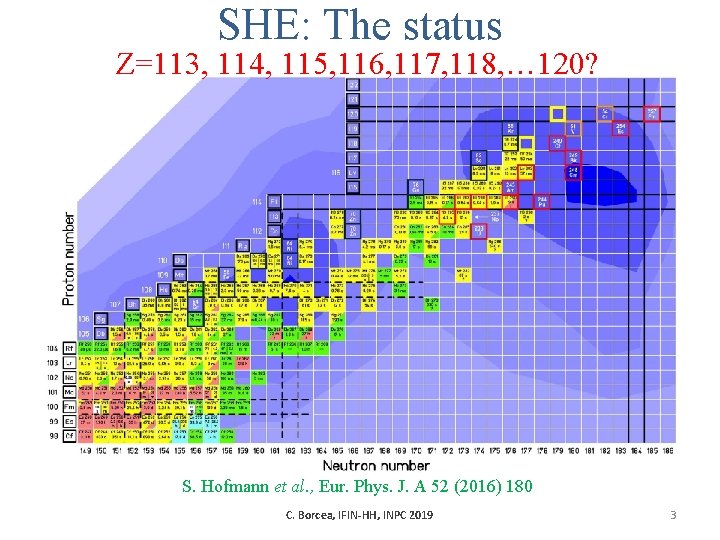
SHE: The status Z=113, 114, 115, 116, 117, 118, … 120? S. Hofmann et al. , Eur. Phys. J. A 52 (2016) 180 C. Borcea, IFIN-HH, INPC 2019 3
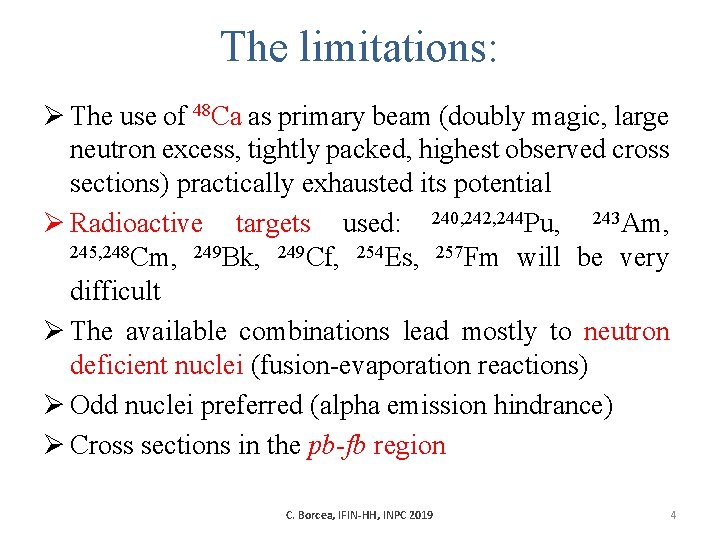
The limitations: Ø The use of 48 Ca as primary beam (doubly magic, large neutron excess, tightly packed, highest observed cross sections) practically exhausted its potential Ø Radioactive targets used: 240, 242, 244 Pu, 243 Am, 245, 248 Cm, 249 Bk, 249 Cf, 254 Es, 257 Fm will be very difficult Ø The available combinations lead mostly to neutron deficient nuclei (fusion-evaporation reactions) Ø Odd nuclei preferred (alpha emission hindrance) Ø Cross sections in the pb-fb region C. Borcea, IFIN-HH, INPC 2019 4
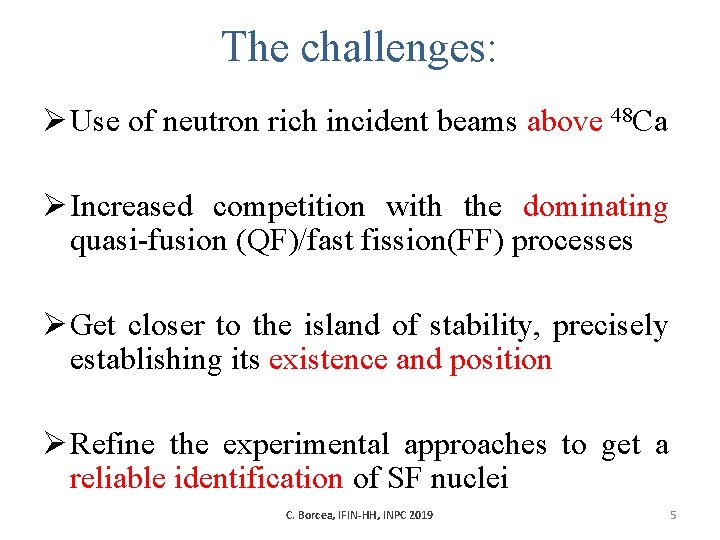
The challenges: Ø Use of neutron rich incident beams above 48 Ca Ø Increased competition with the dominating quasi-fusion (QF)/fast fission(FF) processes Ø Get closer to the island of stability, precisely establishing its existence and position Ø Refine the experimental approaches to get a reliable identification of SF nuclei C. Borcea, IFIN-HH, INPC 2019 5
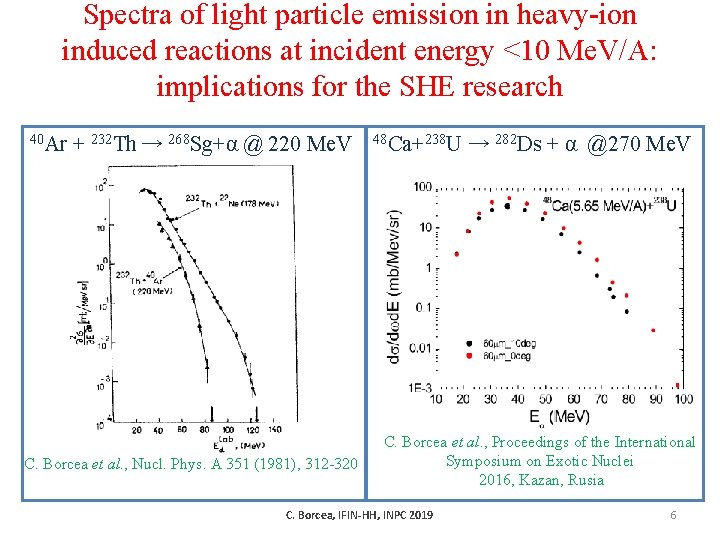
Spectra of light particle emission in heavy-ion induced reactions at incident energy <10 Me. V/A: implications for the SHE research 40 Ar + 232 Th → 268 Sg+α @ 220 Me. V C. Borcea et al. , Nucl. Phys. A 351 (1981), 312 -320 48 Ca+238 U → 282 Ds + α @270 Me. V C. Borcea et al. , Proceedings of the International Symposium on Exotic Nuclei 2016, Kazan, Rusia C. Borcea, IFIN-HH, INPC 2019 6
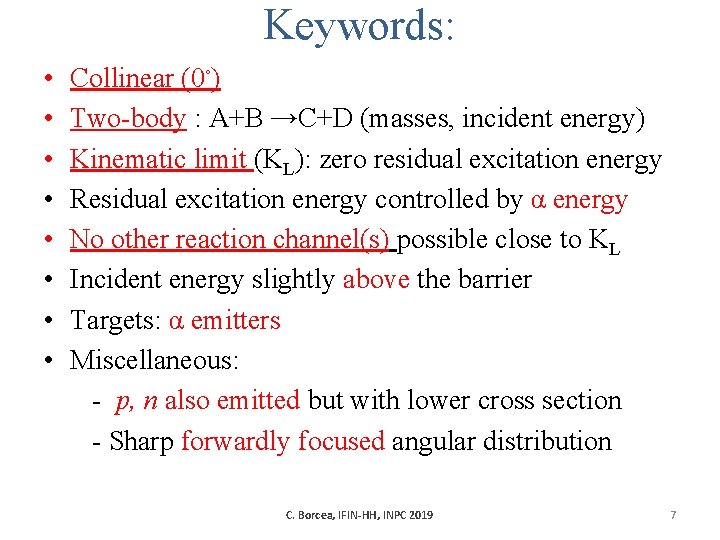
Keywords: • • Collinear (0◦) Two-body : A+B →C+D (masses, incident energy) Kinematic limit (KL): zero residual excitation energy Residual excitation energy controlled by α energy No other reaction channel(s) possible close to KL Incident energy slightly above the barrier Targets: α emitters Miscellaneous: - p, n also emitted but with lower cross section - Sharp forwardly focused angular distribution C. Borcea, IFIN-HH, INPC 2019 7
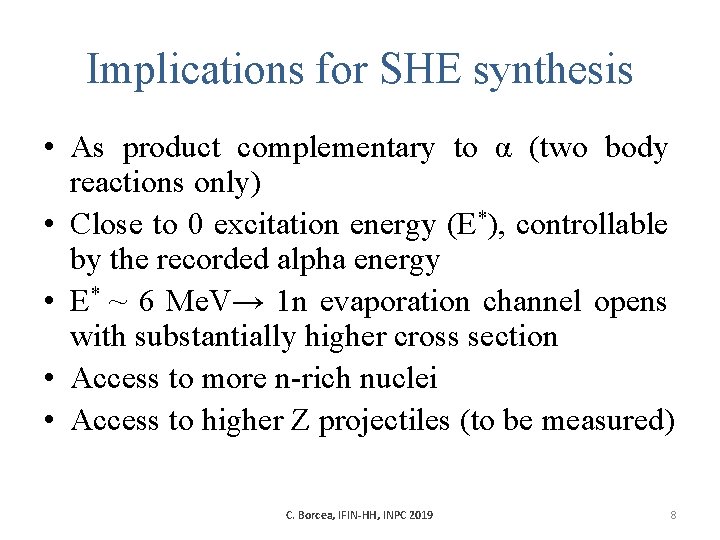
Implications for SHE synthesis • As product complementary to α (two body reactions only) • Close to 0 excitation energy (E*), controllable by the recorded alpha energy • E* ~ 6 Me. V→ 1 n evaporation channel opens with substantially higher cross section • Access to more n-rich nuclei • Access to higher Z projectiles (to be measured) C. Borcea, IFIN-HH, INPC 2019 8
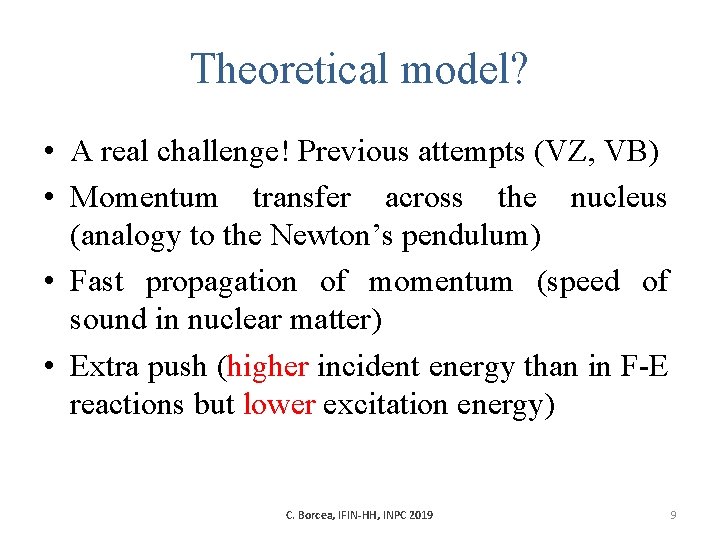
Theoretical model? • A real challenge! Previous attempts (VZ, VB) • Momentum transfer across the nucleus (analogy to the Newton’s pendulum) • Fast propagation of momentum (speed of sound in nuclear matter) • Extra push (higher incident energy than in F-E reactions but lower excitation energy) C. Borcea, IFIN-HH, INPC 2019 9
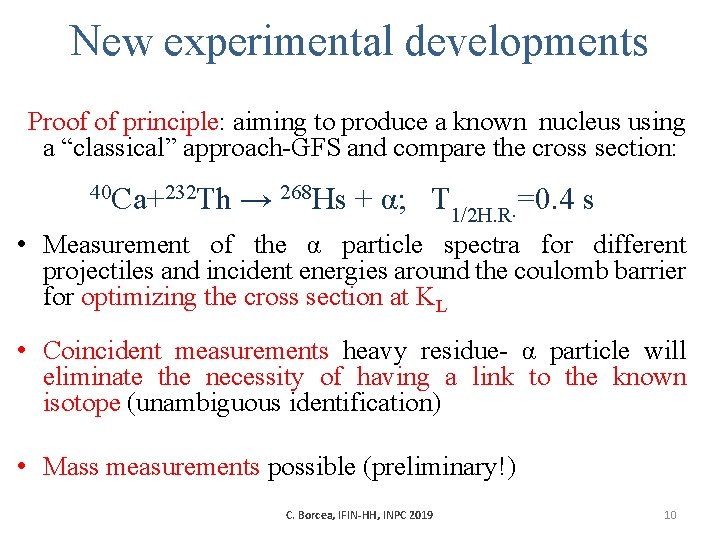
New experimental developments Proof of principle: aiming to produce a known nucleus using a “classical” approach-GFS and compare the cross section: 40 Ca+232 Th → 268 Hs + α; T 1/2 H. R. =0. 4 s • Measurement of the α particle spectra for different projectiles and incident energies around the coulomb barrier for optimizing the cross section at KL • Coincident measurements heavy residue- α particle will eliminate the necessity of having a link to the known isotope (unambiguous identification) • Mass measurements possible (preliminary!) C. Borcea, IFIN-HH, INPC 2019 10
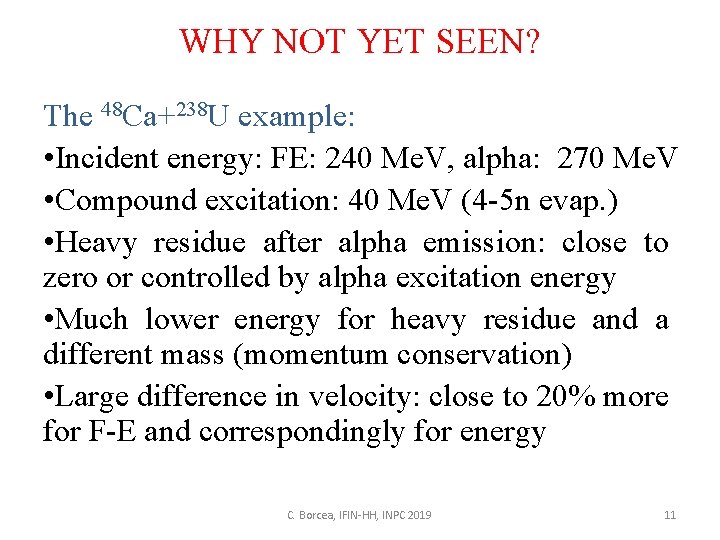
WHY NOT YET SEEN? The 48 Ca+238 U example: • Incident energy: FE: 240 Me. V, alpha: 270 Me. V • Compound excitation: 40 Me. V (4 -5 n evap. ) • Heavy residue after alpha emission: close to zero or controlled by alpha excitation energy • Much lower energy for heavy residue and a different mass (momentum conservation) • Large difference in velocity: close to 20% more for F-E and correspondingly for energy C. Borcea, IFIN-HH, INPC 2019 11
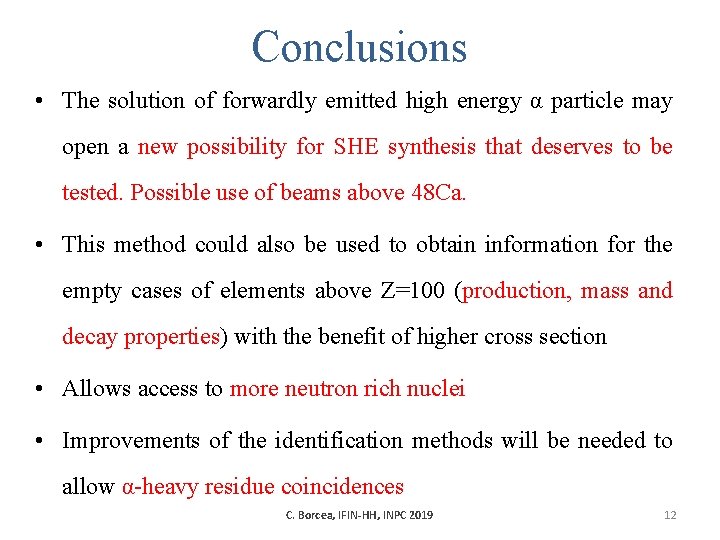
Conclusions • The solution of forwardly emitted high energy α particle may open a new possibility for SHE synthesis that deserves to be tested. Possible use of beams above 48 Ca. • This method could also be used to obtain information for the empty cases of elements above Z=100 (production, mass and decay properties) with the benefit of higher cross section • Allows access to more neutron rich nuclei • Improvements of the identification methods will be needed to allow α-heavy residue coincidences C. Borcea, IFIN-HH, INPC 2019 12
Thank you! C. Borcea, IFIN-HH, INPC 2019 13